
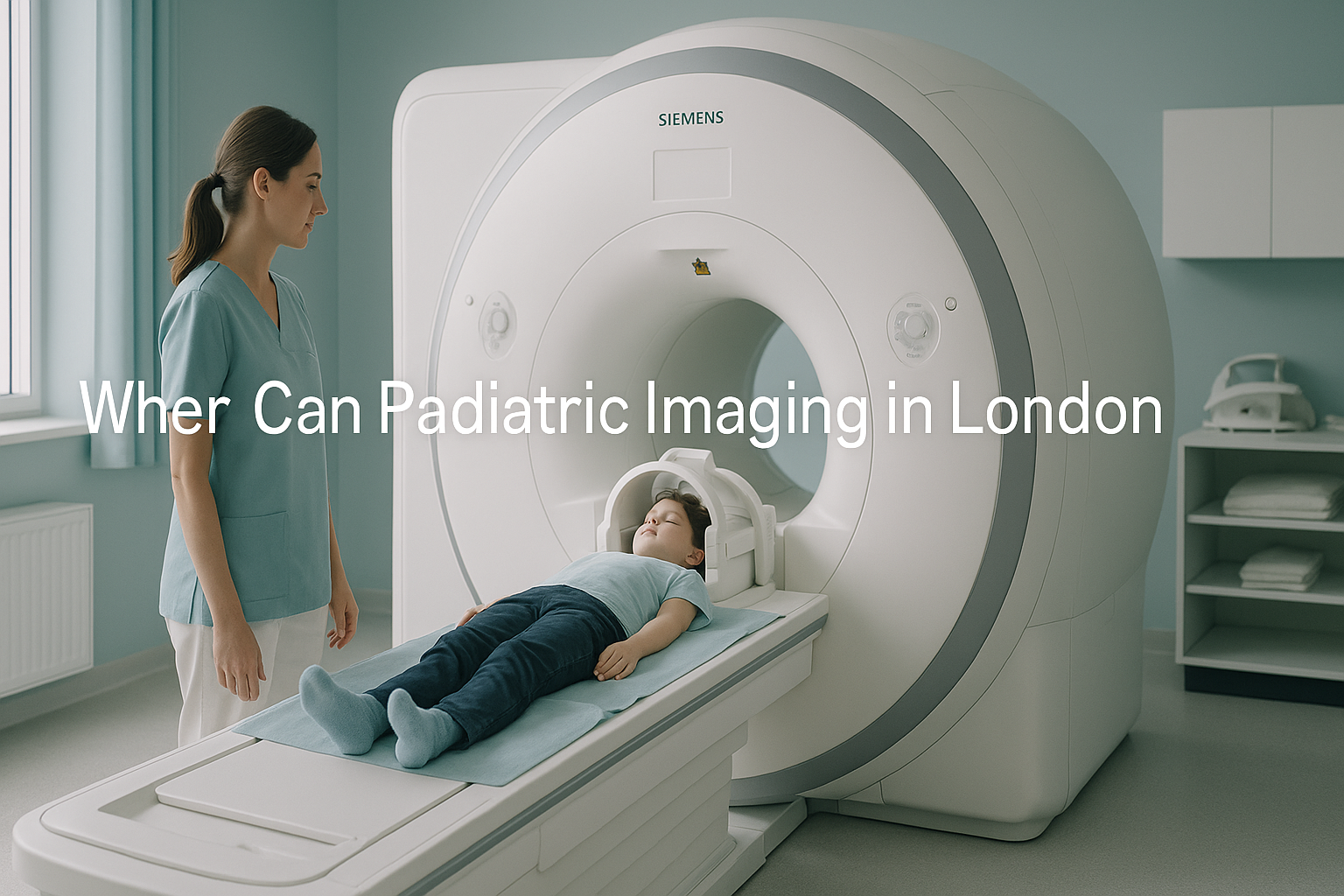
Where Can You Get Paediatric Imaging in London?
Several private clinics and NHS hospitals across London offer paediatric imaging. If you are looking for low dose, standing, whole-body imaging for a child or teenager, paediatric imaging at ScanAlign uses EOS technology at 19 Harley Street. EOS delivers about 90% less radiation than a standard X-ray, around ten times less, and scans the whole skeleton in one standing image.
Key takeaways
- Paediatric imaging in London is available through the NHS and several private clinics, including those with EOS technology.
- EOS captures the full skeleton standing up, using about 90% less radiation than a standard X-ray.
- Standing imaging shows alignment under real weight-bearing conditions, which lying-down scans can miss.
- A parent or guardian can stay in the room during the scan.
- No referral is needed for a private paediatric scan at ScanAlign.
Why does paediatric imaging need a different approach?
Children are more sensitive to radiation than adults because their cells are still dividing rapidly. A scan that is perfectly acceptable for a grown-up may deliver a dose that is unnecessarily high for a young person. That is why paediatric radiology uses low dose protocols designed specifically for smaller, growing bodies.
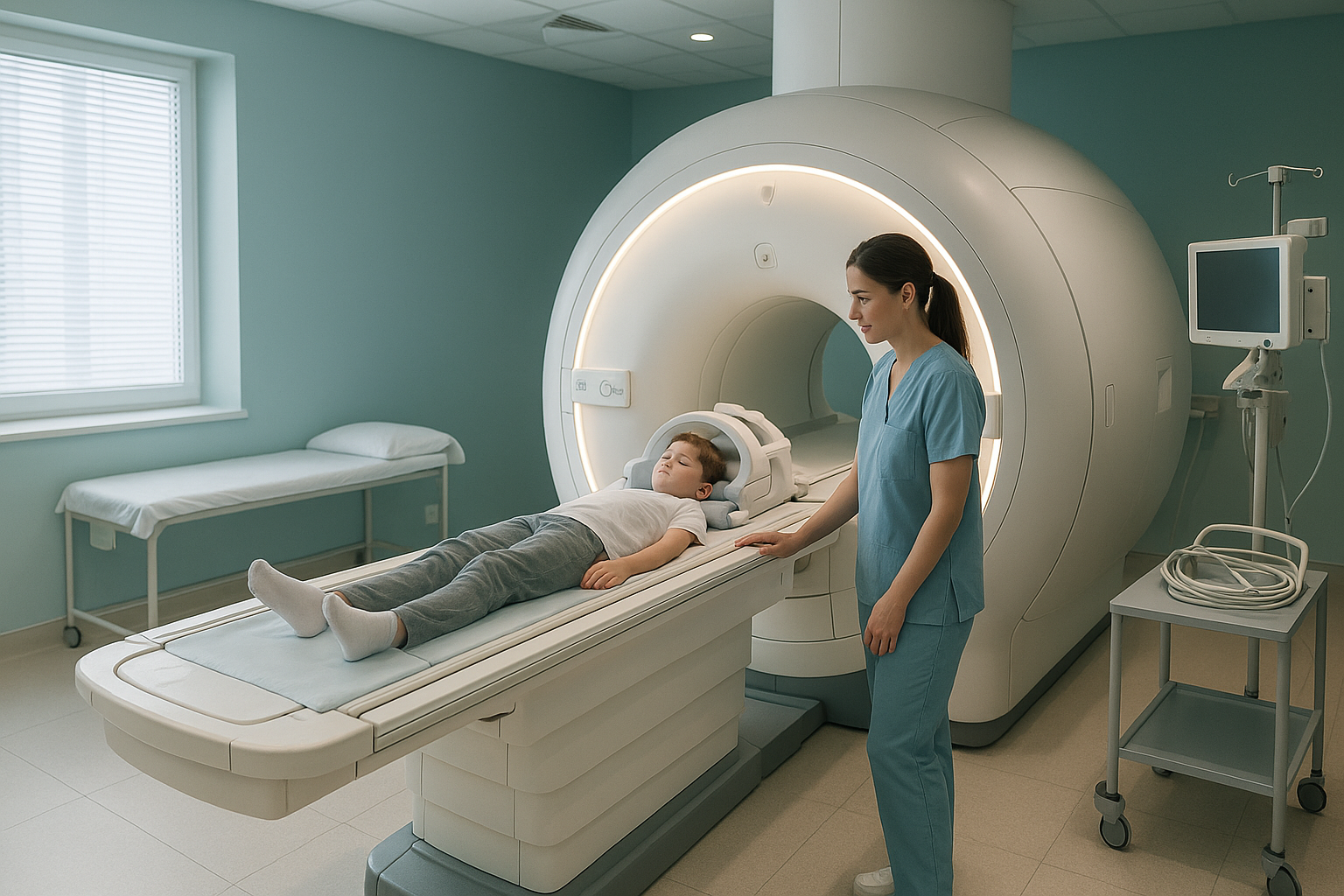
Beyond dose, children need a calm, quick experience. Long scan times, loud tunnel scanners, and being asked to lie still for many minutes can be stressful. The best paediatric imaging services keep the appointment short, explain every step in age-appropriate language, and let a parent stay in the room throughout.
What should you look for in a children's scan service?
The right paediatric imaging service combines clinical quality with a child-friendly environment. Here are the things that matter most.
Less time in the scanner means less stress and less chance of movement blur.
Equipment and settings specifically calibrated for children's smaller bodies.
A parent or guardian should be able to stay with the child during the scan.
Radiographers trained and experienced in scanning children and young people.
For more on how the EOS system keeps radiation to a minimum, read about EOS scan safety and radiation.
Why does standing imaging show more than lying down?
Most conventional X-rays, CT scans, and MRI scans are taken with the patient lying flat. When a child lies down, gravity is removed from the equation. Muscles relax, the spine straightens somewhat, and the pelvis, hips, and knees settle into positions they never adopt during daily life. This can hide alignment problems that only appear under the body's own weight.
Weight-bearing, real-world position. The skeleton is loaded exactly as it is when the child walks, stands, or sits at school. Curves in the spine, tilts in the pelvis, and differences in leg length all show as they truly are.
EOS captures the full body from head to foot in a single standing image, so every joint can be assessed in relation to every other joint. The body is a connected chain. A problem in the foot or ankle can create a compensatory shift further up, causing pain in the back or hip. A whole-body standing image reveals these connections.
Gravity removed. Lying-down imaging relaxes the muscles and lets the skeleton settle. A spinal curve may appear smaller than it really is. A pelvic tilt may vanish. Leg-length differences may not be visible at all.
Lying-down scans remain useful in many situations, but for alignment and posture questions, they can understate the problem.
Read more about EOS imaging for growing spines and why the standing position matters during growth.
What happens during a paediatric scan at ScanAlign?
The process is straightforward and designed to keep young patients comfortable.
You and your child speak with our team by video call. We check whether an EOS scan is the right next step and answer any questions. No referral is needed.
You arrive at the clinic in central London. The appointment is short, and a parent or guardian stays in the room throughout.
Your child stands still in the open EOS scanner. There is no tunnel and no loud noise. The system captures a full-body image in seconds, using about 90% less radiation than a standard X-ray, around ten times less.
A specialist radiologist reviews the images and produces a detailed alignment report. This report can be shared with your child's consultant, physiotherapist, or GP to guide treatment decisions.
Which children benefit most from a standing alignment scan?
A standing whole-body scan is particularly helpful for young people who have alignment or posture concerns that conventional imaging has not fully explained.
- Suspected scoliosis or spinal curvature being monitored over time
- Unexplained back, hip, or knee pain
- Leg-length difference or pelvic tilt
- Posture concerns during a growth spurt
- Pre-surgical or post-surgical alignment checks
- Soft-tissue injuries (muscle, tendon, ligament tears)
- Suspected disc problems or nerve compression
- Brain, organ, or abdominal concerns
- Very young children who cannot stand still independently
A note on MRI. EOS shows bones, joints, and alignment in a standing position. For soft tissue, discs, or nerves, MRI is usually the better tool. If your child's concern is soft-tissue based, we will tell you honestly during the video consultation.
Urgent symptoms. If your child is experiencing sudden severe back pain, numbness, weakness in the legs, or any loss of bladder or bowel control, please seek urgent medical attention. Contact your GP, call 111, or go to A&E rather than booking a scan.
Looking for a private paediatric scan in London with low dose, standing imaging? Start with a free video call to find out whether EOS is right for your child.
Book a free video consultationFrequently asked questions about paediatric imaging in London
Not for a private scan at ScanAlign. You can self-refer by booking a free video consultation. If your child is under an NHS pathway, a referral from your GP or consultant may still be useful for continuity of care.
EOS uses about 90% less radiation than a standard X-ray, around ten times less. This makes it particularly suitable for children and for conditions that need repeated imaging over time.
Yes. A parent or guardian is welcome to remain in the room throughout the scan. Appropriate shielding is provided.
We can scan children and teenagers who are able to stand still independently for a short time. Very young children who cannot stand unsupported may not be suitable. We assess suitability during the free video consultation.
The appointment is short. The scan itself takes only seconds. The total visit, including getting positioned and any questions, is kept brief to suit younger patients.
No. The EOS system is open, not enclosed. Your child simply stands upright between two panels. There is no tunnel, no loud noise, and no need to lie down.
Yes. EOS is widely used for scoliosis assessment because it shows the full spine in a weight-bearing position. This gives a true picture of curvature under gravity, which lying-down imaging may understate.
Pricing depends on the type of scan required. You can book a paediatric scan starting with a free video consultation, where we will discuss costs and options with you.
ScanAlign is at 19 Harley Street, central London. The nearest Underground stations are Oxford Circus, Regent's Park, and Great Portland Street. Learn more about ScanAlign, low dose standing imaging in Harley Street.
Yes, if you wish. The alignment report is produced by a specialist radiologist and can be shared directly with your child's treating clinician, whether that is a consultant, physiotherapist, or GP.
Ready to explore paediatric imaging for your child?
Start with a free video consultation. No referral needed, no obligation. We will help you decide whether an EOS scan is the right next step.
Book a free video consultationWritten by Abbas Dhami (Specialist Diagnostic Radiographer)
Sources
- The Royal College of Radiologists. Standards for the communication of radiological reports and fail-safe alert notification. RCR, 2016.
- NHS England. Ionising radiation: dose comparisons. Public Health England / UK Health Security Agency guidance.
- Deschênes S, et al. Diagnostic imaging of spinal deformities: reducing patients' radiation dose with a new slot-scanning X-ray imager. Spine, 2010; 35(9): 989-994.
This page is general information and not a diagnosis.
ScanAlign is the trading name of CoreMed Solutions Ltd and operates under The Harley Street Hospital's CQC licence.