

Why Does My Pain Get Worse Through the Day?
Pain that builds through the day and eases with rest is usually mechanical. Gravity, cumulative load and muscle fatigue compress your joints and spine over hours of standing or sitting. A scan taken lying down can miss this because it removes the very forces causing the problem. Weight-bearing imaging captures your body under real-world load.
Key takeaways
- Pain that worsens as the day goes on and improves with rest follows a mechanical pattern.
- Gravity compresses your discs and joints over hours, reducing cushioning and increasing load.
- Lying-down scans remove gravity, so they can look normal even when alignment is the problem.
- Standing, weight-bearing imaging shows your skeleton under the same forces that trigger pain.
- If you have sudden weakness, numbness or loss of bladder or bowel control, seek urgent medical help first.
What is a mechanical pain pattern?
A mechanical pain pattern means your pain is driven by physical load on your body rather than by inflammation or infection. It gets worse when you use the affected area, especially under gravity, and it eases when you rest or lie down. This is the most common type of back, hip and knee pain in adults.
Think of it this way. When you stand up in the morning, your spine is at its tallest and your discs are fully hydrated after a night's rest. Over the course of the day, gravity pushes fluid out of those discs, they lose height, and the joints above and below them take on more stress. The muscles that support your posture fatigue gradually. By evening, your body has less cushioning and less muscular support, so pain builds.
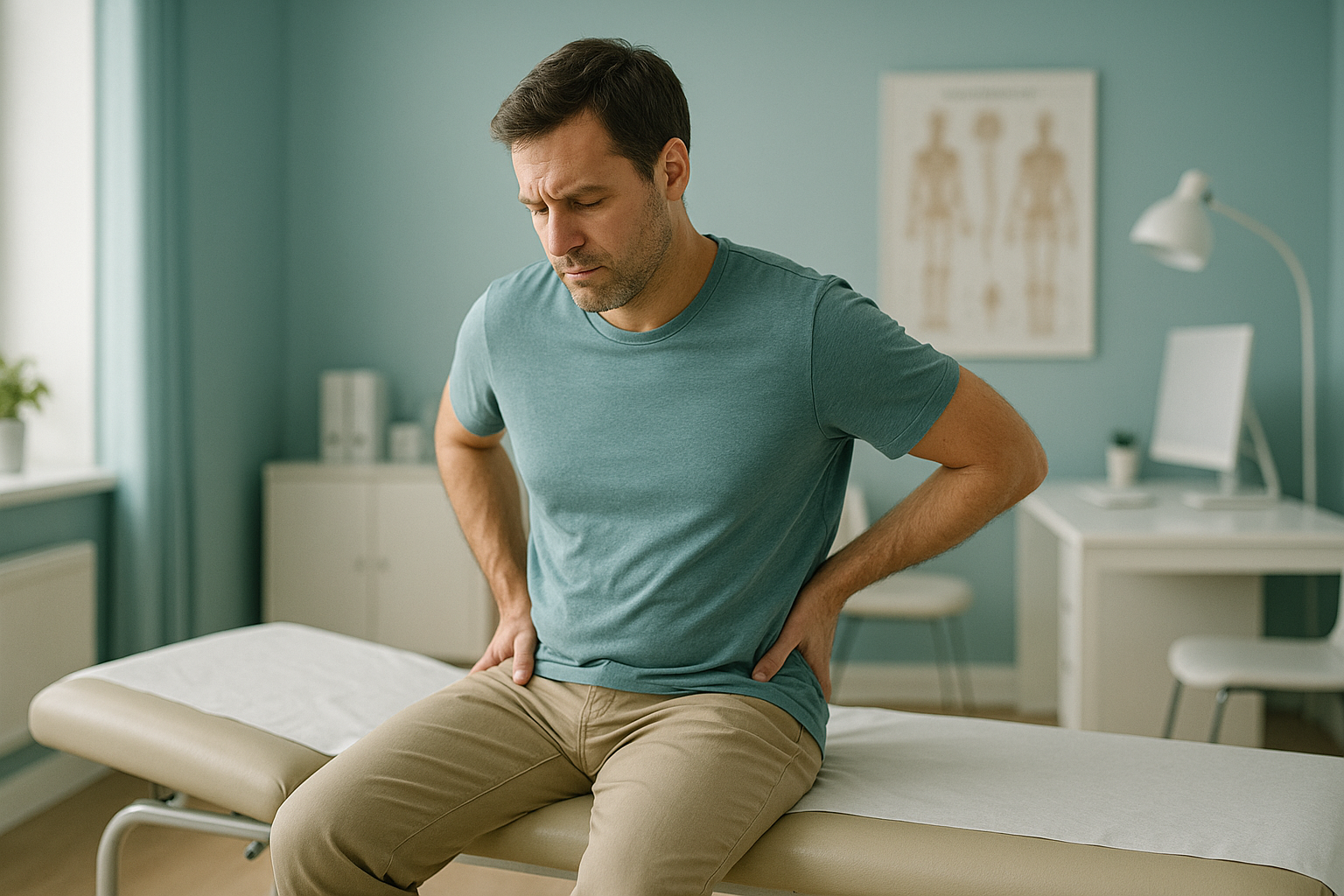
The same principle applies to your knees and hips. Every step you take loads the cartilage in those joints. Over hours, the cumulative load adds up, and by the end of the day the joint has less capacity to absorb shock comfortably.
How do I know if my pain follows a mechanical pattern?
Mechanical pain has a recognisable daily rhythm. You may notice several of these signs.
Pain is mild or absent in the morning and worsens steadily by afternoon or evening.
Sitting down, lying flat or taking weight off the joint brings noticeable relief.
Standing, walking or being upright for long periods makes the pain climb.
You can link the pain to a specific activity, posture or amount of time upright.
If your pain is worse first thing in the morning and loosens up with movement, that tends to point towards an inflammatory pattern rather than a mechanical one. The distinction matters because the underlying causes, and the investigations needed, are different.
What causes pain to build through the day?
Several overlapping factors contribute. They all share one thing in common: gravity and time under load.
Your spinal discs lose fluid under gravity, reducing the cushion between vertebrae by the evening.
The muscles that support your posture tire over hours, leaving joints less protected.
Every step and movement adds a small amount of stress. Over a full day, the total load on a joint is enormous.
A tilt or twist in your pelvis, spine or legs can worsen under gravity as supporting muscles tire.
Your body is a connected chain from your feet to your head. A subtle alignment issue in one area, such as a leg length difference or pelvic tilt, forces another area to compensate. That compensation works well enough when you are fresh, but by the end of the day the compensating structures are exhausted, and pain appears. This is why pain often shows up away from its true cause.
Conditions like spinal stenosis can also follow a mechanical pattern. The spinal canal narrows under load, pressing on nerves more as the day progresses.
How is mechanical pain different from inflammatory pain?
Mechanical pain and inflammatory pain have opposite daily rhythms, and telling them apart helps guide the right investigation.
Worst: end of the day, after prolonged activity or standing.
Better: with rest, lying down, taking weight off the joint.
Common causes: wear and tear of joints, disc degeneration, alignment issues, muscle fatigue.
Key feature: the pain is load-dependent. Remove the load and it settles.
Worst: first thing in the morning or after prolonged rest. Often comes with stiffness lasting more than 30 minutes.
Better: with movement and gentle activity through the day.
Common causes: rheumatoid arthritis, ankylosing spondylitis, other autoimmune conditions.
Key feature: the pain is driven by the immune system, not by mechanical load. Blood tests and MRI are often the priority.
If your pain clearly worsens through the day and improves with rest, a mechanical cause is more likely, and investigating alignment under load becomes especially relevant.
Why does a lying-down scan sometimes miss the problem?
When you lie flat for a conventional X-ray, CT or MRI, gravity is removed. Your muscles relax, your discs decompress slightly, and your joints settle into a neutral position. The scan may look reassuringly normal, even though your pain is clearly real.
This is one of the most frustrating experiences people describe. You feel significant pain by early evening, yet the images taken while lying down show nothing obviously wrong. The difference between weight-bearing versus lying imaging explains why.

A standing, weight-bearing scan captures your skeleton under real load, the same conditions that trigger your symptoms. It can reveal disc height loss, joint narrowing, pelvic tilts and subtle alignment shifts that disappear when you lie flat. At ScanAlign, weight-bearing standing imaging uses EOS technology, which delivers about 90% less radiation than a standard X-ray, around ten times less.
When MRI is the better choice: EOS shows bones, joints and alignment. If your clinician suspects a disc bulge pressing on a nerve, a soft-tissue tear or spinal cord compression, MRI is usually the better tool. The two investigations complement each other.
What can help if my pain gets worse through the day?
The first step is understanding what is causing the load-related pain. Without that, any approach is guesswork. Here are general strategies that many people find useful while they investigate the cause.
- Pacing. Alternating between standing, sitting and moving throughout the day spreads the load and delays fatigue.
- Short rest breaks. Even a few minutes off your feet can allow discs to rehydrate and muscles to recover partially.
- Supportive footwear. Shoes that cushion and support your feet reduce cumulative load on your knees, hips and spine.
- Activity diary. Tracking when pain starts and what you were doing helps you and your clinician spot patterns.
- Accurate diagnosis. Identifying the structural or alignment cause, through appropriate imaging, gives your physiotherapist, osteopath or surgeon the information they need to target treatment properly.
If your pain builds through the day and lying-down scans have not explained it, a standing scan may show what has been missed.
Book a free video consultationImportant: if you develop sudden numbness or weakness in your legs, or any loss of bladder or bowel control, seek urgent medical attention. Contact your GP, call 111 or go to A&E. These are red-flag symptoms that need immediate assessment, not a scan booking.
Frequently asked questions
Your spinal discs lose fluid throughout the day under gravity, reducing the cushion between your vertebrae. At the same time, the muscles supporting your spine fatigue. By evening, there is less cushioning and less muscular support, so pain increases. This is a classic mechanical pain pattern.
Pain that follows a predictable mechanical pattern is common and usually not an emergency. However, it often indicates a structural or alignment issue that deserves investigation, especially if it has persisted for weeks or months. If you develop sudden weakness, numbness or loss of bladder or bowel control, seek urgent medical help.
Hours of standing, walking or climbing stairs at work create cumulative load on your knee joints. Cartilage and surrounding structures absorb this load until they become fatigued by the end of the day. If your knee alignment is slightly off, the load is unevenly distributed, which accelerates the discomfort.
Mechanical pain worsens with activity and load, and eases with rest. Inflammatory pain is typically worst in the morning, often with prolonged stiffness, and improves as you move. Inflammatory conditions are usually investigated with blood tests and MRI, while mechanical problems benefit from weight-bearing imaging.
Yes. If your scan was taken while you were lying down, gravity was removed. Your muscles relaxed, your discs decompressed and your joints settled into a neutral position. The image may look normal even though significant alignment issues exist under load. A standing, weight-bearing scan captures your body in the position that triggers symptoms.
An EOS scan captures your full skeleton from head to foot while you stand. It uses about 90% less radiation than a standard X-ray, around ten times less. Because you are upright, it shows how gravity and your body weight affect your alignment, something a lying-down X-ray cannot show.
No. ScanAlign accepts self-referrals. You start with a free video consultation where a specialist radiographer reviews your history and confirms whether a standing scan is appropriate for you.
Pricing depends on the areas scanned. You can find current cost information on the ScanAlign FAQs page.
EOS uses about 90% less radiation than a standard X-ray, around ten times less. The dose is very low, making it one of the lowest-radiation skeletal imaging options available.
MRI is excellent for soft tissue, discs and nerves. A standing EOS scan adds a different piece of the puzzle: it shows how your bones and joints line up under gravity. If your MRI looked normal but your pain is clearly mechanical, a weight-bearing scan may reveal what the MRI could not.
Find out what is causing your pain
If your pain builds through the day and previous scans have not given you answers, a free video consultation is the next step. A specialist radiographer will review your history and advise whether a standing scan is right for you.
Book a free video consultationWritten by Abbas Dhami (Specialist Diagnostic Radiographer)
Sources
- Tyrrell AR, Reilly T, Troup JDG. Circadian variation in stature and the effects of spinal loading. Spine. 1985;10(2):161-164.
- NHS. Back pain: causes, treatment and prevention. nhs.uk/conditions/back-pain.
- Illés T, Somoskeöy S. The EOS imaging system and its uses in daily orthopaedic practice. International Orthopaedics. 2012;36(7):1405-1411.
This page is general information and not a diagnosis.
ScanAlign is the trading name of CoreMed Solutions Ltd and operates under The Harley Street Hospital's CQC licence.