
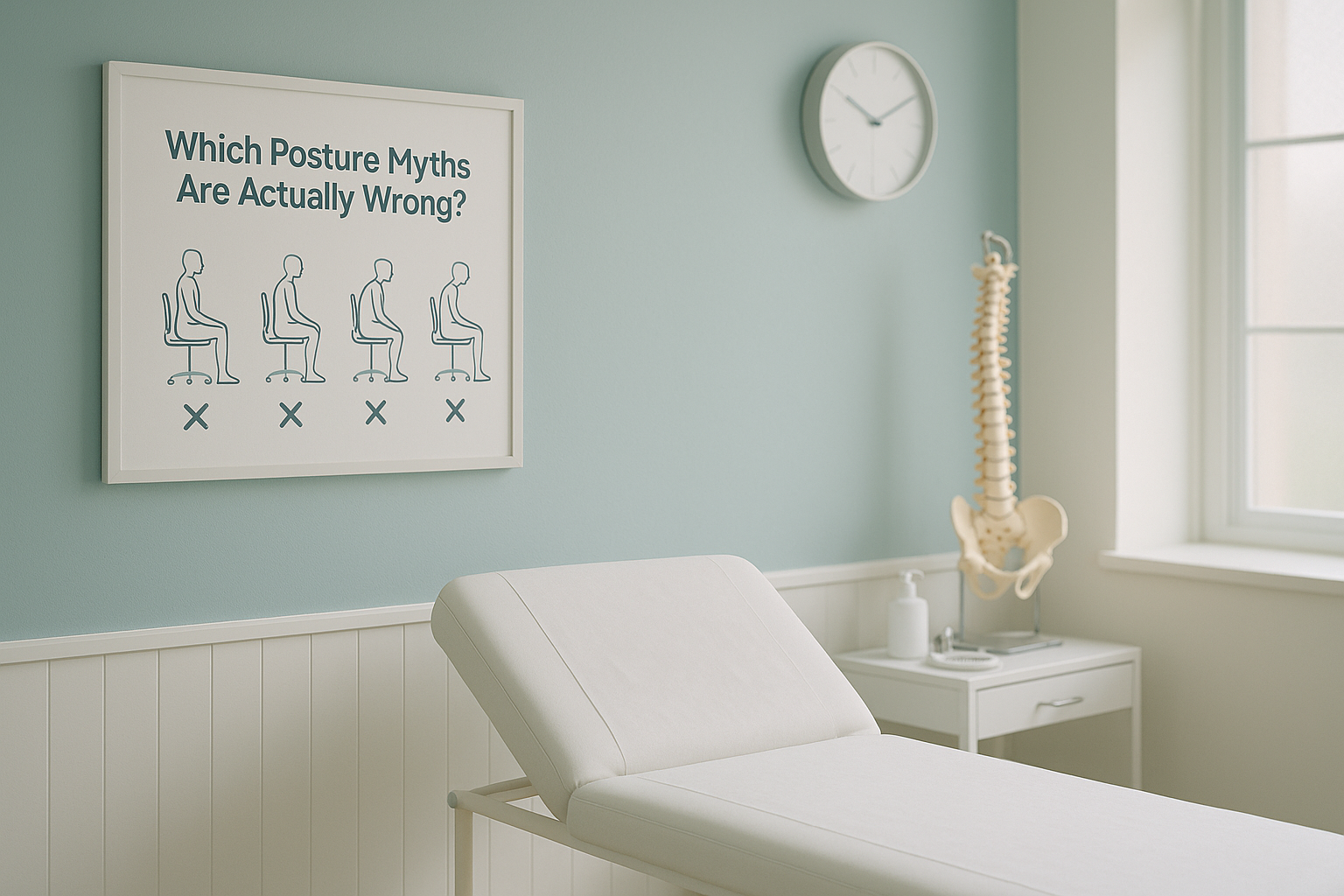
Which Posture Myths Are Actually Wrong?
Many common posture beliefs are not supported by good evidence. There is no single "correct" posture, sitting up straight does not prevent back pain on its own, and slouching is not as dangerous as people think. What matters more is how much you move, how strong you are, and whether a structural alignment issue is putting extra load on your joints.
Key takeaways
- There is no single perfect posture. Your best posture is your next posture.
- Slouching does not automatically damage your spine.
- Posture correctors, braces and "text neck" warnings are often overstated.
- Movement variety, strength and load management matter far more than sitting perfectly still.
- When pain persists, a standing whole-body image can show whether a real alignment issue is contributing.
If you have spent years worrying about your posture, you are not alone. The internet is full of confident claims about what causes back pain and how to fix it. Some of those claims are helpful. Many are not. Below, we separate the posture myths from the posture facts so you can stop worrying about the wrong things and focus on what actually helps.
What are the most common posture myths people believe?
Several posture beliefs have become so widely repeated that they feel like medical fact. Research tells a different story. Here are the ones worth questioning.
No strong evidence links a relaxed sitting position to spinal damage. Forcing a rigid upright posture can actually increase muscle tension and discomfort.
Large studies have found no consistent link between slouching posture and pain. Many people who slouch have no back problems at all.
Looking down at your phone is a normal neck movement. The neck is designed to flex. There is no evidence of an epidemic of structural harm from phone use.
Constantly bracing your abdominal muscles is not how your body was designed to work. Your core activates automatically during movement. Forced bracing can increase stiffness and anxiety.
Wearable braces may remind you to move, but there is little evidence they change your posture long term. They can weaken muscles if relied upon.
Does posture actually cause back pain?
The relationship between posture and pain is much weaker than most people assume. Several large systematic reviews have found that how you sit or stand does not reliably predict whether you will develop back pain. Stress, sleep, activity levels and general health are often stronger predictors.
That does not mean your body's alignment never matters. There is an important difference between everyday posture habits and a structural alignment problem. A significant leg-length difference, a rotated pelvis, or an unbalanced spinal curve can change how load travels through your joints. Over time, that extra load may contribute to wear, fatigue and pain. The distinction is this: the way you happen to sit at your desk is unlikely to be the cause. A measurable structural imbalance might be.
Fear of "bad posture" can itself make pain worse. Researchers call this fear avoidance. When you believe your body is fragile and that any wrong movement will cause damage, you move less. Moving less leads to deconditioning, which leads to more pain. For more detail on what healthy alignment actually looks like, see our body alignment guide.
What actually matters more than sitting up straight?
Movement variety matters more than any single position. Your body thrives on change. The best posture is the one you do not hold for too long.

Changing position often is better for your joints than any single "ideal" posture.
Strong, well-conditioned muscles support your skeleton far better than a brace or a rigid sitting position.
Gradually building up what your body can handle matters more than how perfectly you sit while doing it.
Poor sleep and high stress are stronger predictors of back pain than any postural habit.
For practical steps you can take today, read our posture correction guide.
When does posture actually matter enough to investigate?
Posture matters when there is a structural reason behind it. If your pelvis is tilted, one leg is functionally shorter, or your spine has an unbalanced curve, the rest of your body compensates. Over months and years, that compensation can lead to extra wear on specific joints. This is not about how you choose to sit. It is about how your skeleton is built and how it bears weight.
The problem with most imaging is that it is done lying down. When you lie on a table for an X-ray, CT or MRI, gravity is removed. Your muscles relax. A tilt, rotation or imbalance that only appears under your own body weight can disappear entirely. That is why many people with persistent pain are told their scans look normal.
A standing, weight-bearing image captures your skeleton the way it actually works. With ScanAlign standing EOS imaging, we image from your head to your feet in a single upright scan, using about 90% less radiation than a standard X-ray, around ten times less. This shows the full chain of alignment from ankles to spine, so your clinician can see whether a measurable structural issue is contributing to your symptoms, rather than guessing.
A note on MRI. EOS shows bones, joints and alignment under load. For soft-tissue problems such as disc bulges, nerve compression or ligament tears, MRI is usually the better tool. The two types of imaging answer different questions.
Want to know whether a structural alignment issue might explain your symptoms? A short video call with our radiographer can help you decide if imaging is the right next step.
Book a free video consultationWho should consider a standing alignment assessment?
A standing EOS scan is not for everyone. Here is an honest look at when it adds value and when it does not.
- Long-standing back, hip or knee pain with no clear diagnosis
- Pain that persists despite treatment targeting one area
- Planning for or recovering from joint replacement surgery
- Previous scans that came back "normal" but you still have symptoms
- Mild aches that come and go and do not limit you
- Suspected soft-tissue injury (MRI is more appropriate)
- Acute trauma or fracture (go to A&E)
- A desire to simply "check" your posture out of curiosity
When to seek urgent help
If you develop numbness, weakness in your legs, or loss of bladder or bowel control alongside back pain, this needs urgent medical attention. Contact your GP, call 111, or go to A&E. Do not wait to book a scan.
Frequently asked questions about posture myths
Not in the way most people think. Research shows no consistent link between everyday sitting or standing posture and long-term spinal damage. Lack of movement, poor sleep and stress are generally stronger predictors of pain. A measurable structural alignment issue is different from a casual slouch, though, and that is worth investigating if pain persists.
There is no strong evidence that forcing yourself into a rigid upright position prevents back pain. In fact, it can increase muscle tension. Changing positions regularly is more beneficial than holding any single posture.
Looking down is a normal neck movement. While spending very long periods in any one position can cause stiffness, there is no evidence of an epidemic of structural neck damage from phone use. The term "text neck" is more marketing than medicine.
There is little evidence that wearable posture braces create lasting postural change. They may serve as a short-term reminder to adjust your position, but long-term reliance can weaken the muscles that should be doing that job. Strength training is generally more effective.
No. Your core muscles activate automatically during movement. Constantly bracing can increase stiffness, raise intra-abdominal pressure, and contribute to anxiety around movement. Strengthening your core through exercise is helpful, but holding it tight all day is not necessary.
Posture becomes clinically relevant when there is a structural issue, such as a significant spinal curve, pelvic tilt, or leg-length difference, that changes how your body distributes load. This is different from everyday slouching and is best assessed with weight-bearing imaging.
When you lie down, gravity is removed and your muscles relax. A tilt or imbalance that only appears when you bear weight can disappear. A standing EOS scan captures your skeleton under real-world conditions, showing alignment as it actually functions day to day.
Yes. The EOS system uses about 90% less radiation than a standard X-ray, around ten times less. It captures the full body in one pass, so repeat exposures from multiple films are avoided.
No. ScanAlign is a private self-pay clinic. You can book a measured posture assessment directly, starting with a free video consultation with our radiographer.
Pricing details are on our FAQs and cost page. The free video consultation helps you decide whether a scan is appropriate before you commit to anything.
Wondering if alignment is part of your problem?
A free video consultation with our specialist radiographer can help you work out whether standing imaging would add something your previous scans have missed.
Book a free video consultationSources
- Slater D, Korakakis V, O'Sullivan P, et al. "Sit Up Straight": Time to Re-evaluate. Journal of Orthopaedic & Sports Physical Therapy. 2019;49(8):562-564.
- Christensen ST, Hartvigsen J. Spinal curves and health: a systematic critical review of the epidemiological literature. Journal of Manipulative and Physiological Therapeutics. 2008;31(5):355-367.
- NHS. Back pain: prevention. nhs.uk. Available at: https://www.nhs.uk/conditions/back-pain/prevention/
Written by Abbas Dhami (Specialist Diagnostic Radiographer)
This page is general information and not a diagnosis.
ScanAlign is the trading name of CoreMed Solutions Ltd and operates under The Harley Street Hospital's CQC licence.