
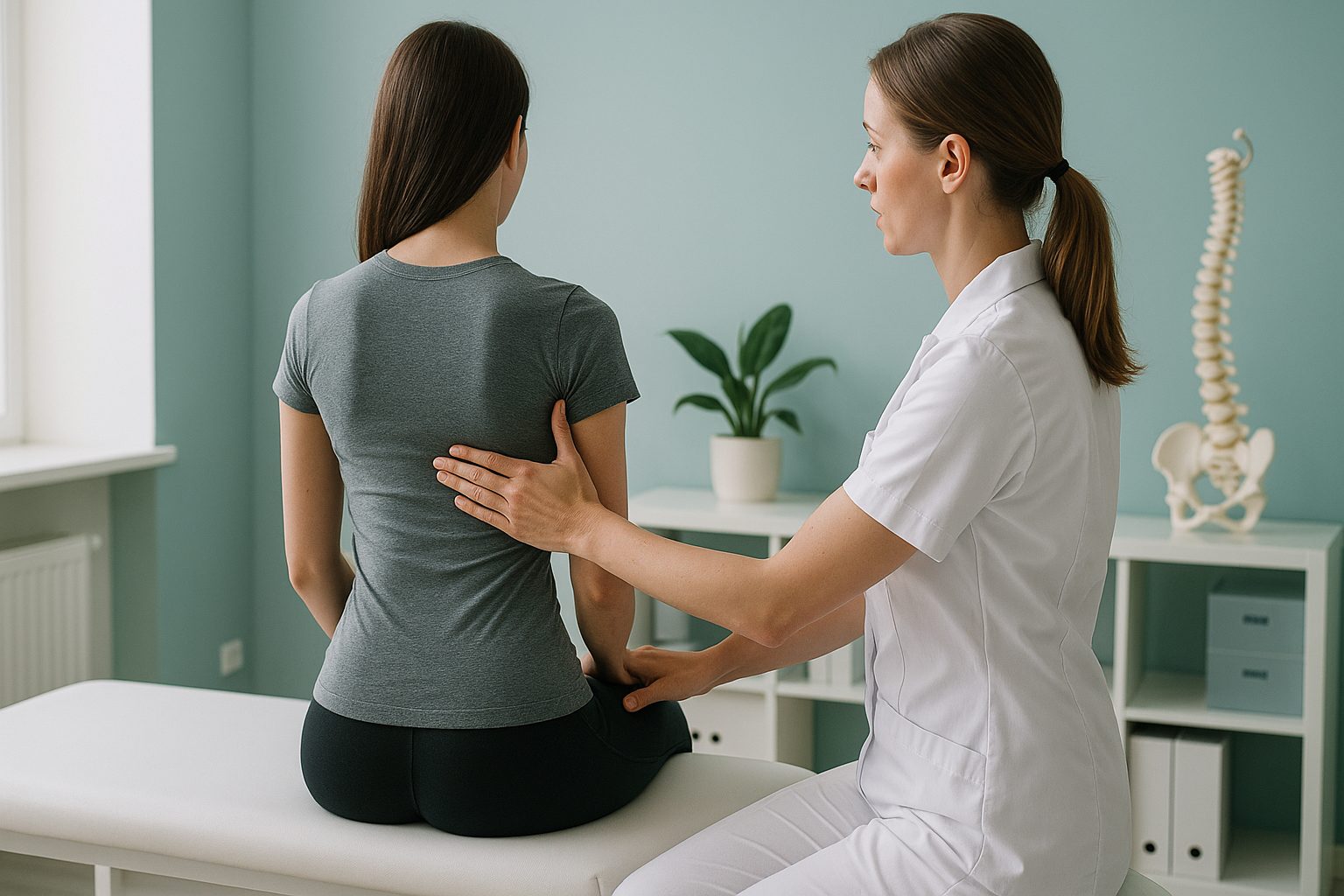
Posture Correction: How to Assess & Improve Your Posture
Improving your posture starts with understanding how your body actually lines up when you are standing, not lying on a scanner bed. Poor posture is rarely about laziness. It is usually the result of structural habits, compensations or alignment shifts that build up over years. A whole-body standing assessment can reveal the root cause so that exercises, treatment or referrals target the right area.
If you have tried stretching, strengthening and reminders to "stand up straight" without lasting results, the missing piece may be accurate measurement. Most scans image one small area while you lie flat. That position hides the very imbalances that cause poor posture in daily life.
This guide covers what good posture actually means, the signs and causes of postural problems, the main types of postural misalignment, and how a standing EOS whole-body scan can give you a clear, measurable starting point for posture correction.
What Is "Good Posture" and Why Does It Matter?
Posture is the way your body holds itself against gravity. Think of a plumb line dropped from the side of your head. In well-balanced posture, that line passes through your ear, the tip of your shoulder, the middle of your hip, just behind your kneecap and in front of your ankle bone.
When any of these landmarks drifts forward, backward or to one side, your muscles, joints and spine have to compensate. Over months and years, those compensations can lead to stiffness, pain, rounded shoulders, and wear on joints that were never designed to carry the extra load.
Good posture is not about standing to attention. It is about balance: your skeleton supporting your weight efficiently so your muscles do not have to overwork.
Signs of Poor Posture You Might Recognise
Many people have lived with poor posture for so long they barely notice it. These are common signs that your alignment may be off:
Shoulders roll forward, upper back curves more than it should. Shirts pull at the back.
Headaches, a stiff neck or jaw clenching that does not ease with rest.
Persistent dull ache across the lower back, worse after sitting or standing for long stretches.
One trouser leg shorter, one shoulder strap always slipping, or a pelvic tilt that a physio has mentioned.
Feeling drained by standing or walking, or wobbling more than you expect on uneven ground.
Pain that feels like it is in one joint but may actually stem from alignment higher up or lower down the leg.
What Causes Poor Posture?
Fixing bad posture permanently means understanding why it happened. The most common causes fall into a few categories:
Desk work, driving and screen time train the body into a flexed, forward position hour after hour.
Weak core, glutes or upper-back muscles leave the skeleton without proper support.
A healed fracture, hip replacement or ankle sprain can shift your centre of gravity permanently.
A leg-length difference, scoliosis or natural spinal curve that puts the chain out of balance.
Carrying a bag on one side, always crossing the same leg, or sleeping in the same curled position.
Often the cause is a combination of several of these. That is why a single-region scan or a quick visual check by a practitioner can miss the full picture.
Common Types of Postural Misalignment
Postural problems are not one-size-fits-all. Here are the patterns seen most often, each covered in more detail on its own page:
How to Improve Posture While Sitting and Standing
Good habits matter. Here are practical starting points you can use straight away, split by the two positions most people spend their day in.
How to improve posture while sitting
- Feet flat on the floor. If your chair is too high, use a footrest. Dangling feet tilt the pelvis.
- Hips slightly higher than knees. A small wedge cushion can help.
- Screen at eye level. If you look down for hours, your head drifts forward and your upper back rounds.
- Elbows roughly at right angles. Reaching for a keyboard pulls your shoulders forward.
- Stand every 30 minutes. Even a brief stretch resets muscle tension.
These tips reduce strain, but they cannot correct a structural tilt or leg-length difference. If discomfort persists despite good desk setup, an alignment assessment may reveal why.
How to improve posture while standing
- Weight even on both feet. Leaning on one leg shifts the pelvis and spine sideways.
- Knees soft, not locked. Locking the knees pushes the pelvis forward and increases lower-back curve.
- Chin gently tucked. Imagine a string pulling the crown of your head toward the ceiling.
- Shoulders back and down, not forced. Think of sliding your shoulder blades into your back pockets.
- Core lightly engaged. Not bracing, just a gentle lift of the lower belly.
If you find yourself slumping within minutes despite trying, the issue may be a compensation pattern in your skeleton rather than a lack of willpower.
Posture Correction Exercises That Help
Exercises to improve posture generally focus on strengthening weak areas and releasing tight ones. Common categories include:
- Upper-back and shoulder openers such as wall slides, band pull-aparts and thoracic spine extensions over a foam roller. These counter rounded shoulders.
- Core stability work including dead bugs, bird dogs and planks. A stable core supports the lower back and pelvis.
- Hip flexor stretches like the kneeling lunge stretch. Tight hip flexors pull the pelvis into a forward tilt.
- Glute activation through bridges and single-leg exercises. Weak glutes let the pelvis drop and rotate unevenly.
- Neck retraction exercises to counteract the forward head position that comes from screen use.
Generic programmes help many people. But if you have been doing posture correction exercises for months without progress, the programme may be targeting the wrong region. An accurate alignment picture lets a therapist prescribe exercises that match your specific imbalance, rather than guessing.
Not sure where your imbalance actually is? A free video consultation can help you understand whether a whole-body standing assessment is the right next step.
Book a free video consultationWhy a Standing Whole-Body Scan Changes the Approach
Most imaging happens while you lie down. That removes gravity from the equation. Your body flattens out, curves reduce, and the very misalignments causing your pain can disappear from the image.
An EOS standing scan captures your full skeleton from head to feet while you stand naturally. Because it images you upright, under your own body weight, it reveals:
- How far your head sits forward or to one side of your centre of gravity.
- The exact angle of every spinal curve and how each relates to the one above and below.
- Whether your pelvis is tilted, rotated or shifted sideways.
- Leg-length differences down to the millimetre.
- Knee and ankle angles and their effect on gait.
Think of EOS as a full-body truth-teller. It shows how your entire chain connects, from feet to skull, in the position you actually use all day.
EOS uses about 90% less radiation than a standard X-ray, around ten times less. The scan itself takes under a minute. It is still uncommon in the UK, though it is used routinely in European and North American orthopaedic centres. For more on how EOS compares with other imaging, see our EOS vs X-ray, CT and MRI page.
When MRI is the better tool: If your main concern is a disc bulge, nerve compression or soft-tissue damage, MRI is more appropriate. EOS shows bones, joints and alignment. If we think MRI is a better fit during your consultation, we will say so and can help with a referral.
Your Posture Assessment Journey at ScanAlign
We talk through your symptoms, history and goals. No charge, no obligation. If we feel a scan is not the right next step, we will tell you.
You stand in the scanner for under a minute. No injections, no contrast dye, no claustrophobic tube. See our what to expect page for full details.
Your report shows every relevant angle and measurement in plain language, with annotated images you and your practitioner can both understand.
Armed with accurate data, your physiotherapist, osteopath or consultant can focus treatment precisely. We provide referrals where needed.
For pricing details, visit our cost and FAQs page.
Is a Posture Assessment Right for You?
- Persistent back, hip or knee pain that has not responded to treatment
- Rounded shoulders or a forward head position that worsens over time
- Uneven hips or shoulders noticed by a therapist
- A previous injury or surgery and lingering compensation
- A desire to target exercises to improve posture with precise data
- Your main concern is a soft-tissue injury (disc, ligament, muscle tear)
- You need nerve-level detail (MRI is usually better)
- You are pregnant
- You are unable to stand unsupported for about one minute
Honest advice, always. During your free video consultation, if we believe an MRI or a different pathway would serve you better, we will recommend that instead. We would rather point you in the right direction than sell you a scan you do not need.
Frequently Asked Questions About Posture Correction
Many people see lasting improvement when they understand the specific cause of their poor posture and follow a targeted plan. Structural factors like a leg-length difference may need an ongoing solution such as a heel lift, but muscular imbalances often respond well to the right exercises over a few months.
Most people begin to notice changes in awareness and comfort within two to four weeks of consistent, targeted exercise. Visible changes in alignment may take two to three months. Progress is faster when the exercises are matched to your actual imbalance rather than a generic routine.
A brace can serve as a short-term reminder, but it does not strengthen the muscles that maintain posture. Over-reliance may actually weaken those muscles. Most clinicians recommend using a brace sparingly and focusing on strengthening and alignment work for a lasting result.
Lying down removes gravity. Your curves flatten, your joints decompress, and misalignments temporarily hide. Standing reintroduces the load, and any tilt, rotation or imbalance shows up again. This is exactly why a weight-bearing, standing scan is more revealing than imaging taken while lying flat.
No. ScanAlign is a private, self-pay service. You can book directly without a referral. If your report shows something that needs further investigation, we can refer you to an appropriate specialist.
Yes. EOS uses about 90% less radiation than a standard X-ray, around ten times less. You can read more on our EOS scan safety page.
Ready to See the Full Picture?
Most scans look where it hurts. This scan shows you why it hurts. Book a free video consultation to find out whether a standing whole-body assessment is the right next step for you.
Book a free video consultation View cost & FAQsThis page is general information and not a diagnosis. ScanAlign is the trading name of CoreMed Solutions Ltd and operates under The Harley Street Hospital's CQC licence.