
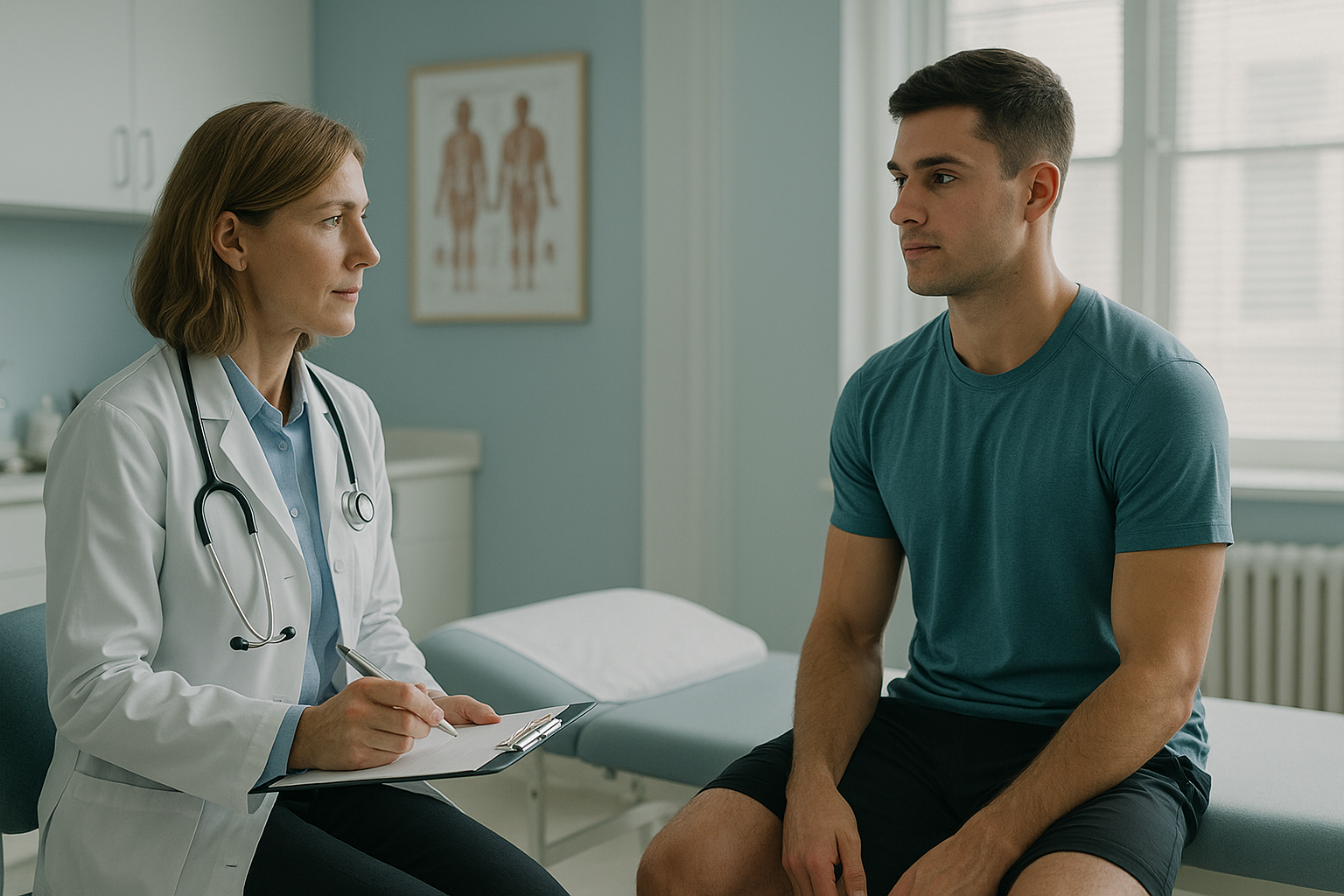
How Do Sports Clubs Run Pre-Season Screening?
Pre-season screening gives medical staff a structural baseline for every player before training ramps up. A standing whole-body EOS scan captures alignment from head to ankle in a single low-dose image, highlighting asymmetries and joint loading patterns that lying-down scans can miss. Clubs use this data to guide training loads and support sports injury prevention strategies.
Key takeaways
- Standing imaging shows how each player's skeleton bears load, something lying-down scans cannot replicate.
- One EOS scan captures the full body in about 20 seconds, with about 90% less radiation than a standard X-ray, around ten times less.
- Baseline data lets medical teams compare future scans after injury or across seasons.
- ScanAlign provides group bookings with secure, shareable reports for club medical staff.
What does a pre-season musculoskeletal screening include?
A pre-season musculoskeletal screening typically combines movement-based tests with structural imaging. The imaging component is where EOS adds something most protocols lack: a full weight-bearing picture of the entire skeleton, taken while the athlete is standing.
| Component | What it shows | Limitation |
|---|---|---|
| Movement screening (e.g. FMS) | Functional range, motor control | Subjective scoring, no bony detail |
| Lying-down X-ray / CT | Bone structure, fractures | Gravity removed, alignment hidden |
| MRI | Soft tissue, discs, ligaments | Lying down, no weight-bearing alignment |
| Standing EOS scan | Full skeletal alignment under load | Bones and joints only, not soft tissue |
The ideal protocol uses a combination of tools. EOS fills the structural gap that movement tests and lying-down imaging leave open.
Why does standing imaging matter for athlete screening?
Standing imaging matters because gravity changes everything. When an athlete lies down for a conventional scan, muscles relax, joints decompress, and alignment shifts. The image may look normal even when the player has meaningful asymmetry or tilt that only appears under load.
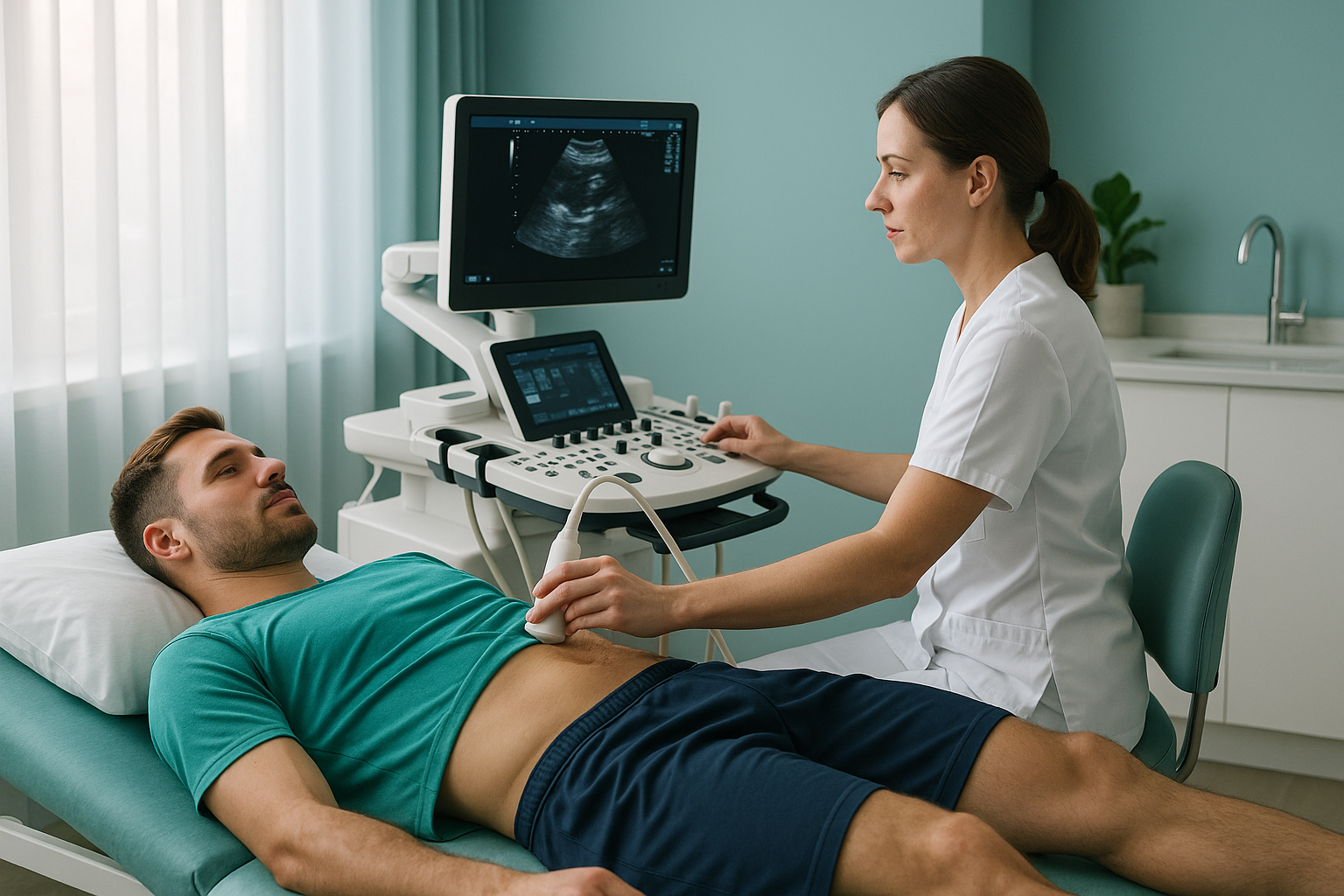
Your body is a connected chain from feet to head. A subtle leg-length difference or pelvic tilt alters how load travels up through the spine and down through the knees. In sport, these compensations amplify under speed and fatigue. A standing EOS scan reveals them so medical staff can plan around them rather than discover them after an injury.
For more detail on how the scan works and its safety profile, see EOS scan safety and radiation.
When MRI is the better choice: EOS shows bones, joints, and alignment under load. For soft tissue detail such as ligament tears, disc injuries, or nerve compression, MRI is usually the better tool. Many clubs use both as part of a complete screening programme.
How do clubs book squad screening with ScanAlign?
Clubs book squad screening through a straightforward four-step process. We work directly with your medical team to schedule a session at ScanAlign, standing EOS imaging in London, at 19 Harley Street.
Initial enquiry
Your head physio or team doctor gets in touch. We discuss squad size, scheduling, and what the screening should cover.
Consent and logistics
Each player provides individual consent. We arrange a dedicated session so the squad is scanned efficiently, usually within a single visit.
Scanning day
Each player stands in the EOS system for about 20 seconds. No special preparation is needed. The full body is captured in one exposure.
Reports and data sharing
Reports are shared securely with your medical staff. Baseline data is stored so future scans can be compared season to season or after injury.
Medical professionals can register as a referring practitioner for ongoing access.
Which sports clubs benefit most from pre-season screening?
Any club with a duty of care towards its athletes can benefit. Screening is most valuable where training loads are high, injury rates are significant, and there is a medical team in place to act on the findings.
- Professional and semi-professional squads
- Academy programmes with growing athletes
- Clubs with existing medical or physiotherapy staff
- Sports with high lower-limb or spinal demands (football, rugby, athletics, cricket)
- Suspected soft-tissue injuries (MRI is usually better)
- Acute injuries needing urgent assessment (go to A&E)
- Clubs without medical staff to interpret and act on results
Planning a squad screening? We can walk your medical team through what is involved, what the reports look like, and how to schedule a group session.
Enquire about club screeningFrequently asked questions about pre-season screening
Each scan takes about 20 seconds. With changeover time, most squads of 20 to 30 players can be scanned in a single dedicated session. We plan the schedule with your medical team in advance.
EOS uses about 90% less radiation than a standard X-ray, around ten times less. Dose justification for screening asymptomatic athletes is assessed on a case-by-case basis by our clinical team, in line with IRMER regulations and current guidance. This wording is subject to clinical review.
No. Clubs can refer through their own medical staff. Team doctors and physiotherapists can register as a referring practitioner directly.
The scan shows full skeletal alignment under gravity. That means spinal curves, pelvic position, hip and knee angles, and leg length, all in one standing image. It does not show soft tissue, so ligament or disc injuries need MRI.
Pricing depends on squad size and what is included. Please enquire about club screening for a tailored quote.
Yes. That is one of the main benefits. If a player is injured mid-season, a repeat scan can be compared directly to their pre-season baseline to see what has changed structurally.
Reports are shared securely with named, consented recipients on your medical staff. We agree the data-sharing process during the initial planning stage.
No. EOS imaging complements movement screening by adding a structural layer. Functional tests show how a player moves. EOS shows the skeletal framework underneath. The two together give a more complete picture.
ScanAlign is an adult-only service. Academy player screening is available for players aged 18 and over. Younger athletes should be assessed through appropriate paediatric pathways.
ScanAlign is at 19 Harley Street, London. We operate under The Harley Street Hospital's CQC licence. Clubs travel from across the UK for screening sessions.
Ready to plan your squad's screening?
Talk to us about group bookings, data sharing, and what your medical team can expect from the results.
Enquire about club screeningSources
- British Journal of Sports Medicine, "Consensus statement on injury prevention and health protection in sport," BJSM, 2016.
- EOS imaging clinical documentation, "Ultra-low dose full-body imaging for orthopaedic assessment," EOS imaging (now part of Alphatec), 2020.
- Ionising Radiation (Medical Exposure) Regulations 2017 (IR(ME)R), UK statutory guidance on dose justification for medical exposures.
Written by Abbas Dhami (Specialist Diagnostic Radiographer)
This page is general information and not a diagnosis.
ScanAlign is the trading name of CoreMed Solutions Ltd and operates under The Harley Street Hospital's CQC licence.