
What Causes Psoas and Deep Hip Flexor Pain?
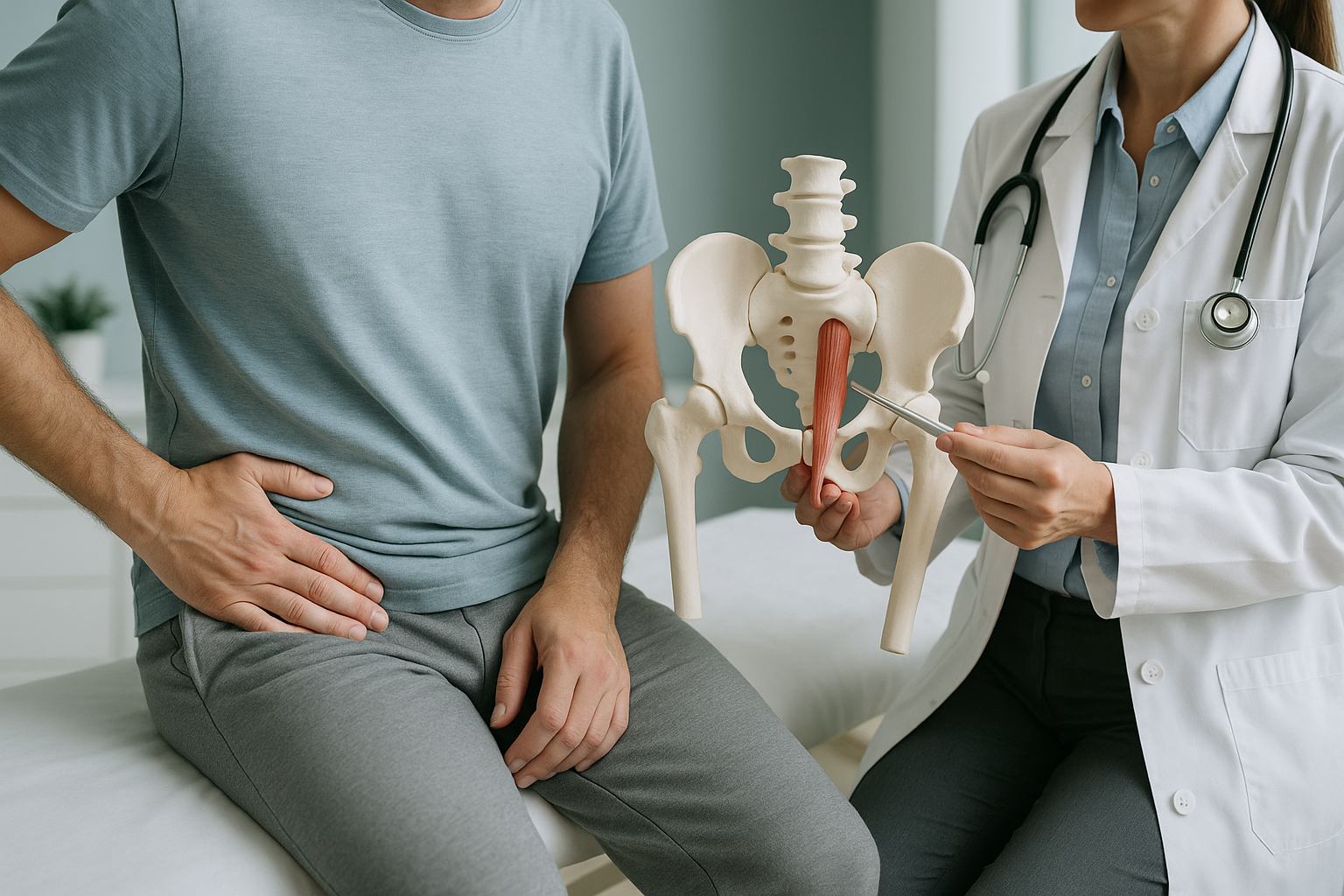
Psoas major muscle pain usually comes from overuse, prolonged sitting, or an alignment problem in the pelvis and lower spine. The psoas connects your lumbar vertebrae to your thigh bone, so tightness or irritation in this deep hip flexor can refer pain to the groin, front of the hip, or lower back. Standing whole-body imaging helps reveal the alignment issues that keep the muscle under strain.
Key takeaways
- The psoas major is the deepest hip flexor. It runs from the lumbar spine to the top of the thigh bone.
- Deep hip flexor pain is commonly felt in the groin, front of the hip, or lower back, and often worsens after sitting.
- Pelvic alignment and lumbar posture directly affect how hard the psoas has to work.
- Lying-down scans relax the muscle and may hide the alignment load that drives symptoms.
- A standing EOS scan images the full chain from spine to hips under real weight-bearing conditions.
What is the psoas muscle and why does it matter?
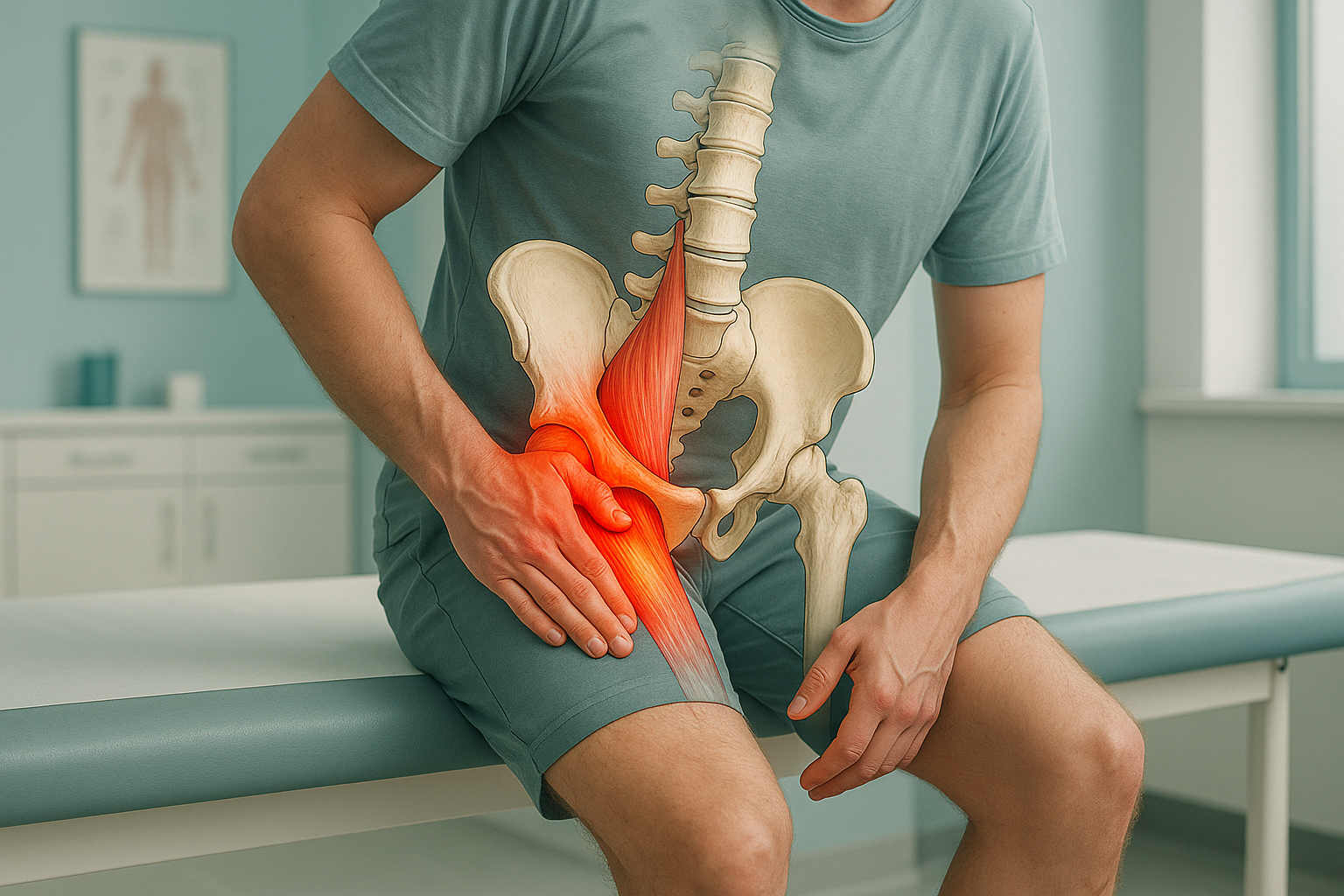
The psoas major is a thick, deep muscle that runs from the sides of your lumbar vertebrae, through the pelvis, and attaches to the lesser trochanter near the top of your thigh bone (femur). Together with the iliacus muscle that lines the inside of the pelvis, it forms the iliopsoas, the body's most powerful hip flexor.
Because it bridges the spine and the leg, the psoas is involved in almost every movement you make: walking, climbing stairs, standing up from a chair, and maintaining upright posture. When it is working well you barely notice it. When it is irritated, tight, or overloaded, the pain it produces can be surprisingly widespread.
What does psoas muscle pain feel like?
Psoas muscle pain symptoms often mimic other conditions, which is why they are frequently misdiagnosed. The discomfort tends to be deep rather than on the surface, and it can shift between several areas.
A note about nerve symptoms. If you develop sudden numbness, weakness in the leg, or loss of bladder or bowel control alongside hip or back pain, seek urgent medical attention. Contact your GP, call 111, or go to A&E. These symptoms need immediate assessment.
What causes psoas major muscle pain?
Several factors overload or irritate the psoas. Often more than one is at play at the same time.
An important point is that the body works as a connected chain. A problem in the lumbar spine, a leg-length difference, or a rotated pelvis can all change how the psoas is loaded. The pain you feel in the groin or hip may actually be driven by misalignment elsewhere. This is why looking at the whole picture matters.
How does a standing scan help with deep hip flexor pain?
A standing scan shows your skeleton under real weight-bearing load, exactly the conditions that stress the psoas. When you lie down for a conventional X-ray, CT or MRI, gravity is removed, muscles relax, and the pelvis settles into a neutral position that may not reflect how you actually stand and move.
You stand naturally inside the EOS scanner. The image captures your spine, pelvis, hips, and legs in one view, showing how each area relates to the others. Pelvic tilt, leg-length discrepancy, and compensatory curves all become visible. The scan uses about 90% less radiation than a standard X-ray, around ten times less.
Lying-down imaging relaxes the psoas and flattens the lumbar curve. A tilt or rotation of the pelvis that loads the muscle all day may look normal when gravity is removed. Individual area scans also miss how the spine, pelvis, and legs interact as a chain.
ScanAlign standing EOS imaging captures the full picture so your clinician can see exactly what is pulling on the psoas and why. If the irritation is linked to iliopsoas bursitis, a swollen fluid sac next to the tendon, the alignment data helps explain why the bursa is under pressure in the first place.
When MRI is the better choice. EOS shows bones, joints, and alignment brilliantly. For soft tissue detail, such as the psoas tendon itself, discs, or nerves, MRI is usually the better tool. Your consultant may recommend both to build a complete picture.
What helps manage psoas muscle pain?
Treatment depends on the underlying cause, and that is something your clinician will decide after a proper assessment. A few general approaches are worth knowing about.
- Graduated loading. Current evidence favours progressive strengthening of the hip flexors over passive stretching alone. A psoas stretch may ease short-term discomfort, but loading the muscle under guidance tends to produce longer-lasting change.
- Posture and movement habits. Breaking up long periods of sitting, adjusting workstation height, and varying your movement through the day all reduce sustained shortening of the psoas.
- Alignment assessment. Identifying the structural factors, such as a pelvic tilt or a lumbar curve issue, gives a clinician the information they need to plan targeted rehabilitation rather than guesswork.
Be wary of claims about deep massage or manual psoas release producing lasting fixes on their own. The psoas sits behind the abdominal organs and is difficult to reach directly. Meaningful improvement usually comes from understanding and correcting the alignment and movement patterns that overload it.
Wondering whether your psoas pain is related to how your pelvis and spine are aligned? A free video consultation can help you decide if a standing scan is the right next step.
Book a free video consultationFrequently asked questions about psoas pain
Most people feel it as a deep ache in the groin or at the front of the hip. It can also refer to the lower back or the front of the thigh, because the muscle spans all three areas.
Yes. The psoas attaches directly to the lumbar vertebrae. When the muscle shortens or tightens, it can pull the lower spine forward into an increased curve, which may produce back pain.
Not quite. Psoas pain is a general term for discomfort from the muscle itself. Iliopsoas tendinopathy refers specifically to irritation or degeneration of the tendon where the combined iliopsoas attaches to the thigh bone. The two often overlap.
A psoas stretch can provide temporary relief, but current thinking favours graduated loading and strengthening alongside stretching. If an alignment issue is driving the tightness, stretching alone may not address the root cause.
The Thomas test is a clinical examination where you lie on the edge of a couch and pull one knee to your chest. If the opposite thigh lifts off the couch, it suggests the hip flexor on that side is tight. It is a useful screening tool but does not explain why the muscle is tight.
Yes. In some cases the psoas tendon can catch against the edge of the acetabular cup (the socket component). This is sometimes called psoas impingement and typically causes deep groin pain with hip flexion activities.
An EOS scan captures your skeleton while you stand, using about 90% less radiation than a standard X-ray, around ten times less. It images the full body in one pass, so clinicians can see how the spine, pelvis, and legs align under real load.
No. You can self-refer. The process begins with a free video consultation where we discuss your symptoms and confirm whether a standing scan is appropriate for you.
You can find current pricing details on our book a hip and pelvis scan page or by speaking with us during your free consultation.
Yes. The EOS system uses about 90% less radiation than a standard X-ray, around ten times less. It is widely used in orthopaedic centres around the world and is considered very low dose.
Understand what is driving your psoas pain
A free video consultation with our specialist radiographer helps you decide whether standing whole-body imaging is the right next step.
Book a free video consultationWritten by Abbas Dhami (Specialist Diagnostic Radiographer)
Sources
- Andersson, E. et al. "The role of the psoas and iliacus muscles for stability and movement of the lumbar spine, pelvis and hip." Scandinavian Journal of Medicine & Science in Sports, 1995.
- Domb, B.G. et al. "Iliopsoas impingement: a newly identified cause of labral pathology in the hip." HSS Journal, 2011.
- NHS. "Hip pain in adults." nhs.uk. Accessed 2024.
This page is general information and not a diagnosis.
ScanAlign is the trading name of CoreMed Solutions Ltd and operates under The Harley Street Hospital's CQC licence.