
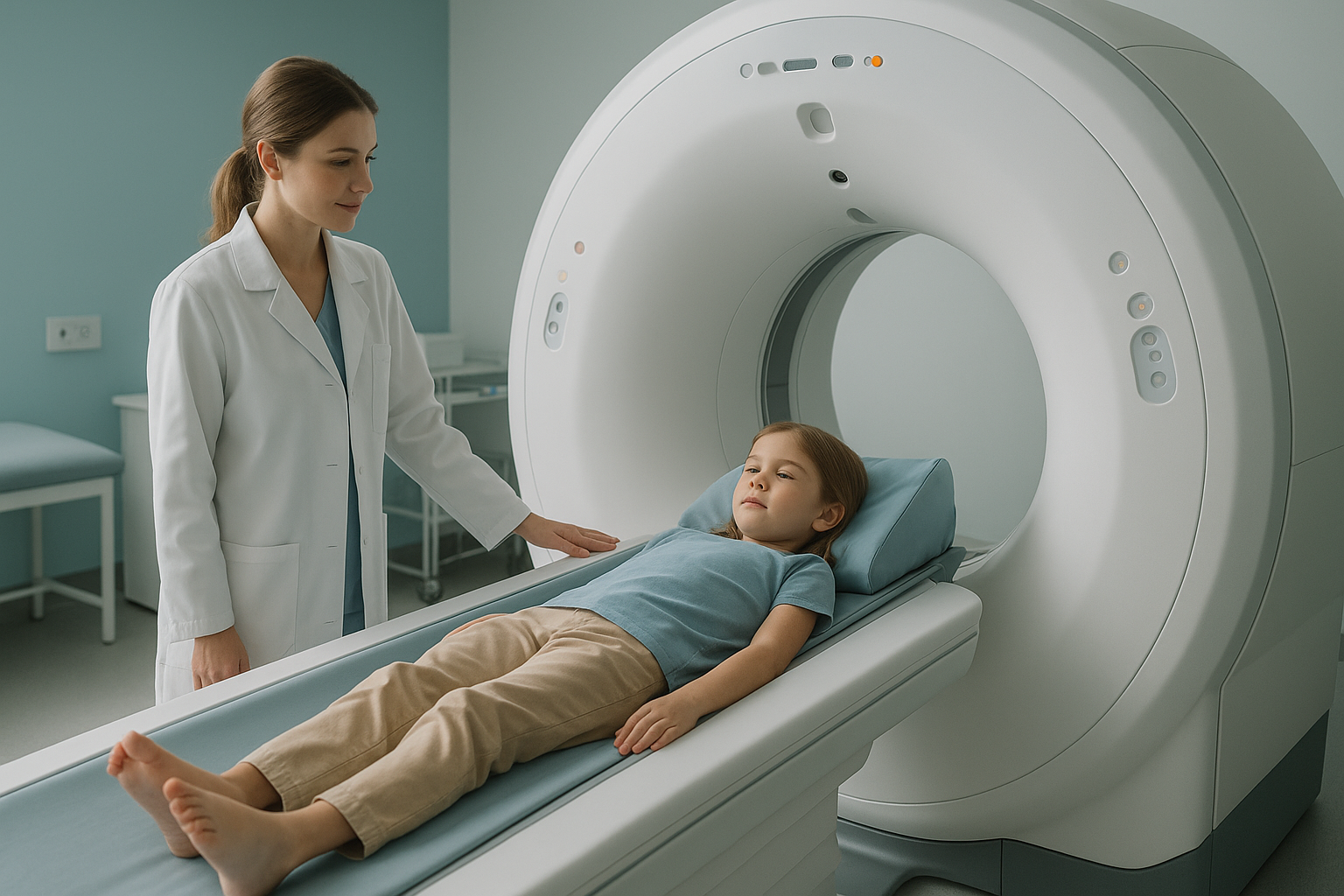
Is It Safe to Scan a Child, and How Much Radiation Do They Get?
Yes, imaging a child can be safe when the scan is clinically justified and the dose is kept as low as possible. Children are more sensitive to radiation than adults because their tissues are still growing. EOS imaging uses about 90% less radiation than a standard X-ray, around ten times less, making it one of the lowest-dose options for conditions such as scoliosis that need repeat monitoring.
Key takeaways
- Children's growing tissues are more sensitive to radiation, so every scan must be justified.
- The ALARA principle means using the lowest dose that still gives a clear, diagnostic image.
- EOS delivers about 90% less radiation than a standard X-ray, around ten times less.
- Standing EOS scans show the whole skeleton under gravity, reducing the need for extra images.
- A parent or carer can stay in the room during the scan.
Why are children more sensitive to radiation than adults?
Children's cells divide faster than adult cells because their bodies are still growing. Rapidly dividing cells are more vulnerable to damage from ionising radiation. A child also has more years ahead in which any theoretical effect could develop. That is why paediatric imaging safety centres on two principles: justification (is this scan genuinely needed?) and optimisation (can we get a clear image with a lower dose?).
Rapidly dividing cells are more sensitive to ionising radiation.
More years ahead means more time for any theoretical risk to develop.
Conditions like scoliosis may need repeated scans over years of growth.
This does not mean scans should be avoided altogether. It means every image should earn its place. When a child has a spinal curve, hip concern or leg-length question, imaging is often the only way to guide the right care. The goal is to get the clearest picture at the lowest possible dose.
How much radiation does a child get from an X-ray?
The dose depends on the type of scan, the body area, and the equipment used. A single chest X-ray delivers a very small amount of radiation, roughly equivalent to a few days of natural background radiation from the environment. Spine and pelvis X-rays use more because the area is larger and the tissues are denser.
For conditions that need repeat monitoring, cumulative exposure is the real concern. A child with scoliosis might need full-spine images every six to twelve months across several years of growth. Each scan adds to the total. That is why choosing the lowest-dose technology matters so much for young patients.
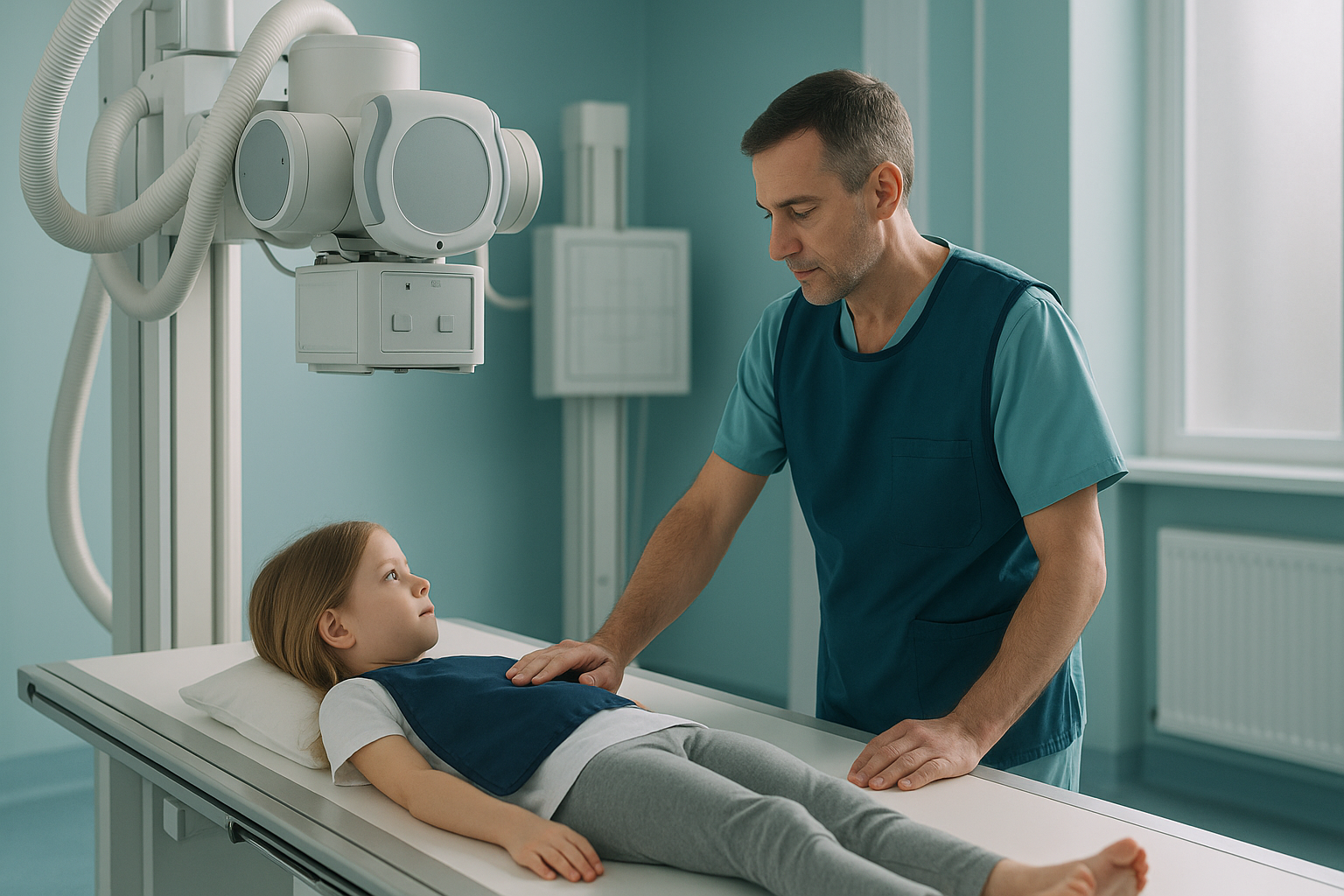
How does EOS reduce radiation for children?
EOS uses a slot-scanning technique with ultra-sensitive detectors, originally developed from Nobel Prize-winning physics research. Instead of a single broad flash of X-ray, the beam sweeps in a narrow line from head to toe while the child stands naturally. This method captures a full-length image with about 90% less radiation than a standard X-ray, around ten times less.
Because the child stands during the scan, the image shows real weight-bearing alignment. This is particularly important for scoliosis, hip conditions, and leg-length differences, where gravity changes the picture. A lying-down scan relaxes muscles and can mask the true position of bones and joints. One standing EOS image can often replace multiple conventional X-rays, further reducing the total dose over time.
Learn more about EOS scan safety and radiation or read about EOS imaging for growing spines.
When is MRI the better choice? EOS excels at showing bones, joints, and whole-body alignment. For soft tissue, discs, or nerves, MRI is usually the better tool, and it uses no ionising radiation at all. Your clinician can advise which scan suits your child's needs. In many cases, both types of imaging work together to give a complete picture.
What happens when you book a paediatric scan?
The process is straightforward and designed to put both parent and child at ease. No GP referral is needed for paediatric imaging at ScanAlign.
Free video consultation
A specialist radiographer reviews your child's history and confirms whether EOS is the right scan. There is no obligation.
Arrival at 19 Harley Street
Your child wears light, metal-free clothing. A parent or carer stays in the room throughout.
The scan itself
Your child stands still inside the EOS system for a short time. The scan captures full-length images from head to toe with very low radiation.
Report and next steps
A consultant radiologist reviews the images and produces a detailed report. This can be shared with your child's specialist or GP to guide care.
What safety principles apply to children's scans?
Every paediatric scan at ScanAlign, low dose standing imaging follows the ALARA principle. ALARA stands for "as low as reasonably achievable." It means using the smallest dose that still produces a diagnostic-quality image. For children, that also means using paediatric-specific protocols that adjust the scan settings for a smaller body.
- Paediatric protocols adjust dose for body size
- Slot-scanning limits radiation to the scanned area
- Full-length images in one pass, fewer repeat exposures
- Parent or carer present in the room
- Justification check before every scan
- Sudden severe back pain with numbness or weakness
- Loss of bladder or bowel control
- Unexplained fever with spinal pain
- These need urgent medical attention, not an imaging booking. Contact your GP, call 111, or go to A&E.
Have questions about whether EOS is right for your child? Our specialist radiographer can talk you through the process in a free, no-obligation video call.
Book a free video consultationFrequently asked questions
When a scan is clinically justified and the dose is kept as low as possible, imaging is considered safe for children. The risk from a single, well-optimised X-ray is very small. The concern grows with cumulative exposure over many scans, which is why choosing the lowest-dose technology matters.
There is no fixed "safe number." Each scan should be individually justified, meaning the clinical benefit must outweigh the small risk. Choosing lower-dose imaging, such as EOS, helps reduce cumulative exposure when repeat scans are needed.
EOS uses about 90% less radiation than a standard X-ray, around ten times less. This makes a meaningful difference for children who need repeated full-spine or full-leg imaging.
Standing shows how the skeleton actually behaves under the body's own weight. Lying down relaxes muscles and can hide alignment problems. For scoliosis, hip concerns and leg-length differences, the standing position gives a truer picture of what is happening.
Yes. A parent or carer can stay in the room throughout the scan. You will be given appropriate shielding. Being there helps keep your child calm and still.
No. You can self-refer. The process starts with a free video consultation where a specialist radiographer checks whether EOS is the right scan for your child's needs.
You can book a paediatric scan through our booking page, where current pricing information is available. The initial video consultation is free and carries no obligation.
They do different jobs. EOS shows bones, joints, and whole-body alignment with very low radiation. MRI shows soft tissue, discs, and nerves with no ionising radiation. For structural and alignment questions, EOS is often the better starting point. Your clinician can advise which scan, or combination, suits your child.
ALARA stands for "as low as reasonably achievable." It is the guiding principle in medical imaging that every scan should use the smallest dose of radiation that still produces a clear, diagnostic image. It is particularly important for children.
The scan itself is quick. Your child stands still inside the system for a short time while the image is captured. The whole appointment, including positioning and checks, is a straightforward visit at 19 Harley Street, London.
Concerned about your child's scan?
Talk to a specialist radiographer in a free video call. No referral needed, no obligation. Just clear, honest answers about your child's imaging options.
Book a free video consultationWritten by Abbas Dhami (Specialist Diagnostic Radiographer)
Sources
- Image Gently Alliance. "Pause and Pulse: Radiation Safety in Pediatric Imaging." imagegently.org
- NHS. "Radiation exposure: X-rays and scans." nhs.uk
- Deschênes S, et al. "Diagnostic imaging of spinal deformities: reducing patients radiation dose with a new slot-scanning X-ray imager." Spine, 2010;35(9):989-994. PubMed.
This page is general information and not a diagnosis.
ScanAlign is the trading name of CoreMed Solutions Ltd and operates under The Harley Street Hospital's CQC licence.