
How Do You Know You Are Ready to Return to Sport?
You are ready to return to sport when you can meet objective, criteria-based benchmarks, not simply when a calendar says so. That means sufficient strength symmetry between sides, pain-free movement under load, confidence in your body, and clearance from a qualified professional. Alignment problems picked up only when standing can also affect readiness.
Key takeaways
- Criteria-based progression is safer than counting weeks alone.
- Strength symmetry, load tolerance and psychological readiness all matter.
- Hidden muscle imbalance or alignment shifts can raise reinjury risk.
- Standing whole-body imaging can reveal compensations that lying-down scans miss.
- A structured, graded return reduces the chance of breaking down again.
Coming back too early is one of the most common mistakes in sport. Pain settles, you feel eager, and the temptation to jump straight back in is enormous. But feeling better and being ready are not the same thing. This page explains the objective measures that separate the two, and why whole-body alignment deserves a place in that conversation.
What are the signs you are ready to play again?
The clearest signs are a combination of physical benchmarks and mental confidence, not just the absence of pain. Your body should tolerate sport-specific loads without swelling, guarding or compensating on one side.
You can perform your sport's key movements at full effort without pain during or after.
The injured side has regained at least comparable strength to the uninjured side, tested in relevant patterns.
You trust your body in explosive, reactive and unpredictable situations, not just controlled exercises.
You have built up through progressive training stages without setback before returning to full competition.
What are the return to play criteria that actually matter?
Return to play criteria are the objective measures a clinician or physiotherapist uses to decide whether your body is genuinely ready. They matter because they look at function, not just healing time.
The most widely recognised criteria include:
- Strength testing. Comparing the injured and uninjured limb in sport-relevant movements such as single-leg press, hamstring curl or calf raise.
- Hop tests. Single-leg hop for distance, triple hop, crossover hop and timed hop. These test power, control and confidence together.
- Load tolerance. Completing full training sessions at match intensity without increased pain or swelling in the 24 hours afterwards.
- Movement quality. Observing how you land, change direction and decelerate. Compensations here point to residual weakness or fear of loading.
- Psychological screening. Questionnaires such as the ACL-RSI scale measure your mental readiness, which research shows is a strong predictor of reinjury.
Is a time-based or criteria-based return to sport safer?
A criteria-based return is safer. Time alone does not tell you how well the tissues have adapted, whether strength has been restored, or whether your movement patterns have changed during recovery.
Criteria-based progression uses measurable tests at each stage. You advance only when you pass specific benchmarks for strength, control and confidence. This approach adapts to your individual recovery rate and reduces the risk of returning before your body is truly prepared.
Time-based progression follows a fixed calendar. For example, "return at 9 months." While time frames provide a rough guide, they do not account for individual variation. Two people with the same injury can recover at very different speeds depending on age, fitness, rehabilitation quality and alignment.
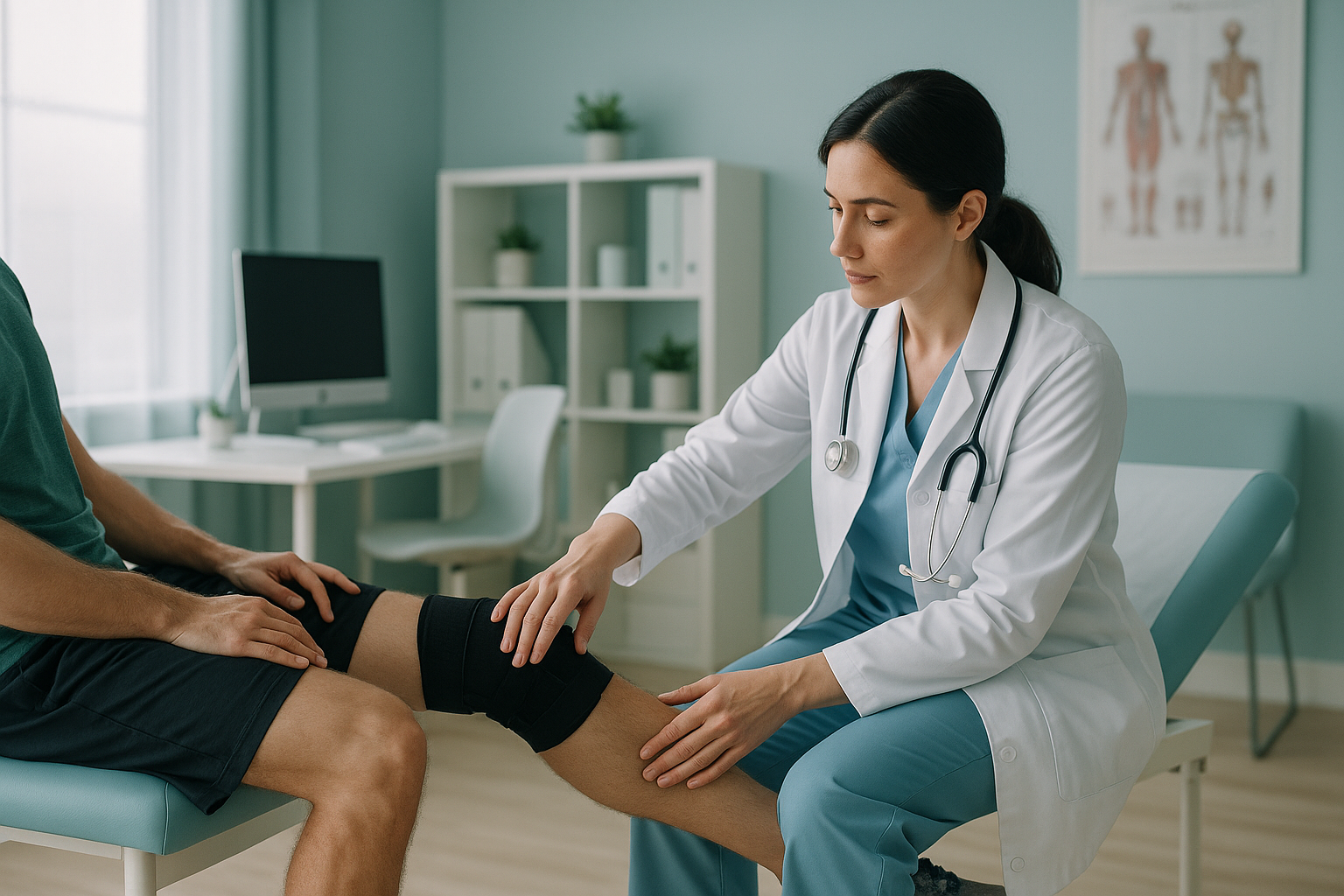
Each stage requires you to pass specific tests before advancing. If something flags up, you stay at that stage until the benchmark is met. This is how elite sport manages return to play, and it works just as well for recreational athletes.
How does whole-body alignment affect your return to sport?
Your alignment affects how force travels through your body when you run, jump and change direction. If one area is out of line, another area compensates. Over time, that compensation can overload a joint or tendon and lead to reinjury.
Standard imaging usually looks at one body part at a time while you are lying down. That relaxes your muscles and removes gravity from the picture. It can miss shifts in alignment that only appear when you are standing and bearing weight. A slight pelvic tilt, for example, might change the loading on a recently repaired knee, yet it would not show on a lying-down scan.
ScanAlign standing EOS imaging captures your skeleton from head to toe in a single upright image, using about 90% less radiation than a standard X-ray, around ten times less. This gives your clinician a clear view of how your joints line up under real-world conditions, information that is especially useful when you are trying to understand why an injury keeps coming back or whether your body is truly balanced enough to handle sport again.
Identifying and addressing muscle imbalance or a hidden alignment shift before you return is a practical step towards sports injury prevention.
When is MRI the better choice? EOS shows bones, joints and overall alignment. For soft-tissue injuries like ligament tears, disc problems or nerve involvement, MRI is usually the more appropriate tool. Your clinician can advise which scan, or combination, best fits your situation.
What increases your reinjury risk after returning to sport?
Reinjury risk is highest in the first weeks after returning to competition. Research consistently shows that athletes who return before meeting criteria-based benchmarks are significantly more likely to get hurt again.
The injured limb has not regained enough strength relative to the other side.
Returning based on a calendar date rather than passing functional tests.
A shift in posture or alignment that overloads other structures under sporting demands.
Unresolved anxiety leads to guarded movement patterns that increase injury risk.
Good communication with your coach, physiotherapist and medical team is essential. They need to know not just that you have been cleared to play, but what benchmarks you passed, and what ongoing monitoring looks like.
Wondering whether alignment could be playing a role in a recurring injury? A standing whole-body scan can provide objective information your treatment team can use.
Book a free video consultationWhen should you seek urgent medical attention instead?
If you experience sudden severe pain, numbness, weakness in a limb, or any loss of bladder or bowel control during or after sport, do not wait for a routine appointment. Contact your GP, call 111, or go to A&E immediately. These symptoms need urgent assessment.
Frequently asked questions about returning to sport
That depends on the injury and your individual recovery. Running involves high repetitive load, so you need pain-free walking, adequate single-leg strength and good landing control before progressing to a graded running programme. A physiotherapist can guide the timing.
Return to training means you can handle structured, controlled sessions. Return to competition adds unpredictability, fatigue and pressure. You should meet additional criteria, including psychological readiness, before competing.
Hop tests measure power, control and confidence on one leg. Comparing results between your injured and uninjured sides gives a practical snapshot of functional symmetry, which is one of the most reliable indicators of readiness.
Yes. Athletes who report fear of reinjury or low confidence are more likely to get hurt again. Guarded, tentative movement changes your biomechanics in ways that increase strain on vulnerable tissues.
Your body is a connected chain. If your pelvis sits slightly tilted or one leg bears more load, the forces through your knee, hip or ankle change. That extra stress can push a recently healed structure past its tolerance, especially at match intensity.
An EOS scan captures your entire skeleton in one standing image with about 90% less radiation than a standard X-ray, around ten times less. Because you are upright, it shows how your joints actually line up under gravity, something a lying-down X-ray cannot reveal.
No. ScanAlign is a private, self-pay clinic. You can self-refer. The first step is a free video consultation to discuss whether a scan is appropriate for your situation.
Yes. EOS uses about 90% less radiation than a standard X-ray, around ten times less. It is one of the lowest-dose skeletal imaging systems available.
Pricing details are available on the ScanAlign FAQs and cost page. You can also ask during your free video consultation.
An EOS scan does not measure strength or fitness. What it can do is reveal alignment issues or compensations that might affect your readiness. That information can be shared with your physiotherapist or surgeon to help build a more complete picture.
Concerned about alignment before returning to sport?
A free video consultation lets you discuss your situation with a specialist radiographer. No pressure, no obligation.
Book a free video consultationSources
- Grindem H, Snyder-Mackler L, Moksnes H, Engebretsen L, Risberg MA. Simple decision rules can reduce reinjury risk by 84% after ACL reconstruction. British Journal of Sports Medicine. 2016;50(13):804-808.
- Ardern CL, Taylor NF, Feller JA, Webster KE. Fifty-five per cent return to competitive sport following anterior cruciate ligament reconstruction surgery: an updated systematic review and meta-analysis. British Journal of Sports Medicine. 2014;48(21):1543-1552.
- NHS. Sprains and strains: Returning to sport. nhs.uk. Available at: https://www.nhs.uk/conditions/sprains-and-strains/
Written by Abbas Dhami (Specialist Diagnostic Radiographer)
This page is general information and not a diagnosis.
ScanAlign is the trading name of CoreMed Solutions Ltd and operates under The Harley Street Hospital's CQC licence.