

What Is the Schroth Method, and Does It Help Scoliosis?
The Schroth method is a physiotherapy approach that uses scoliosis specific exercises, rotational breathing and postural correction to reduce the visible and functional effects of a spinal curve. It does not cure scoliosis, but research shows it can slow curve progression, improve posture and reduce pain when practised consistently under a certified therapist.
Key takeaways
- Schroth exercises work in three dimensions, targeting the rotation, side-shift and flattening that define a scoliosis curve.
- Evidence supports Schroth therapy as an effective non-surgical approach, especially when combined with regular monitoring.
- Results depend on correct curve pattern classification, a certified therapist and consistent daily practice.
- Standing imaging shows your curve under real weight-bearing load, giving your therapist a more accurate baseline and follow-up comparison.
What is the Schroth method for scoliosis?
The Schroth method is a system of scoliosis specific exercises developed in Germany in the 1920s by Katharina Schroth. It treats the spine as a three-dimensional structure, not just a side-to-side curve on an X-ray. A certified Schroth therapist assesses your individual curve pattern and then teaches you targeted exercises that aim to elongate, de-rotate and stabilise the spine.
Unlike general fitness or stretching, every Schroth exercise is tailored to your specific curve type. Two people with scoliosis may have very different curve patterns, so they would be given different exercises. This personalisation is central to how the method works.

How do Schroth exercises work?
Schroth exercises work by targeting the three planes of a scoliosis curve at the same time. Your therapist will classify your curve pattern and then guide you through a programme built on four core principles.
Your therapist identifies whether your curve is thoracic, lumbar, or a combination, and assigns a specific exercise block.
You learn to breathe directionally into the collapsed side of your ribcage, helping to expand areas that have been compressed by the curve.
Each exercise elongates, de-rotates and deflects the trunk at the same time, working across all three planes.
You practise corrected postures in everyday activities, sitting, standing and walking, to reinforce the new muscle patterns.
The goal is not to force the spine straight. It is to train the muscles around the curve so they hold a more balanced position during everyday life. Adherence matters. Research consistently shows that people who practise daily get better outcomes than those who only exercise during clinic sessions.
Does the Schroth method actually work?
Yes, there is a growing body of evidence supporting the Schroth method for managing scoliosis. A number of controlled studies and systematic reviews have shown that scoliosis specific exercises can slow curve progression, improve trunk symmetry and reduce self-reported pain.
The 2016 SOSORT (Society on Scoliosis Orthopaedic and Rehabilitation Treatment) guidelines recommend scoliosis specific exercises as a first-line conservative approach for mild to moderate curves, and as a complement to bracing for larger curves. More recent reviews have confirmed these findings.
It is important to be honest about the limitations, too. Schroth therapy does not reverse established structural curves. The evidence is stronger for slowing progression and improving function than for producing large, lasting reductions in curve size. Outcomes also depend heavily on the skill of the therapist and your commitment to daily practice.
Multiple randomised controlled trials show that scoliosis specific exercises reduce curve progression compared to observation alone. Improvements in pain, quality of life and self-image are also well documented. SOSORT recognises the Schroth method as one of the main evidence-based exercise approaches worldwide.
Most studies have relatively small sample sizes and vary in how they measure outcomes. Long-term follow-up data beyond a few years is limited. Results depend on therapist expertise and patient adherence, which are hard to standardise in research. The method does not replace surgical consultation for severe or rapidly progressing curves.
Who is Schroth therapy best suited for?
Schroth therapy is best suited for adults with mild to moderate scoliosis who want to manage their curve conservatively, reduce discomfort and improve their posture. It is also used alongside bracing when both approaches are appropriate.
- Mild to moderate scoliosis curves
- Back pain or stiffness linked to a curve
- Postural imbalance you want to improve
- Post-surgical maintenance of alignment
- Alongside bracing for added stability
- Severe or rapidly progressing curves needing surgical assessment
- Sudden numbness, weakness or loss of bladder or bowel control (seek urgent medical attention via your GP, 111 or A&E)
- Cases where the underlying diagnosis is still unclear
When MRI is the better tool: EOS imaging shows bones, joints and alignment under weight-bearing load. For soft tissue detail, such as discs, nerves or spinal cord compression, MRI is usually the better tool. Your clinician can advise which you need.
How does standing imaging help track Schroth therapy progress?
Standing imaging gives your Schroth therapist a true picture of your curve under gravity and load. When you lie down for a conventional X-ray, your muscles relax, and the curve can look different from how it behaves in real life. A standing, weight-bearing image captures what your spine actually does when you are upright.
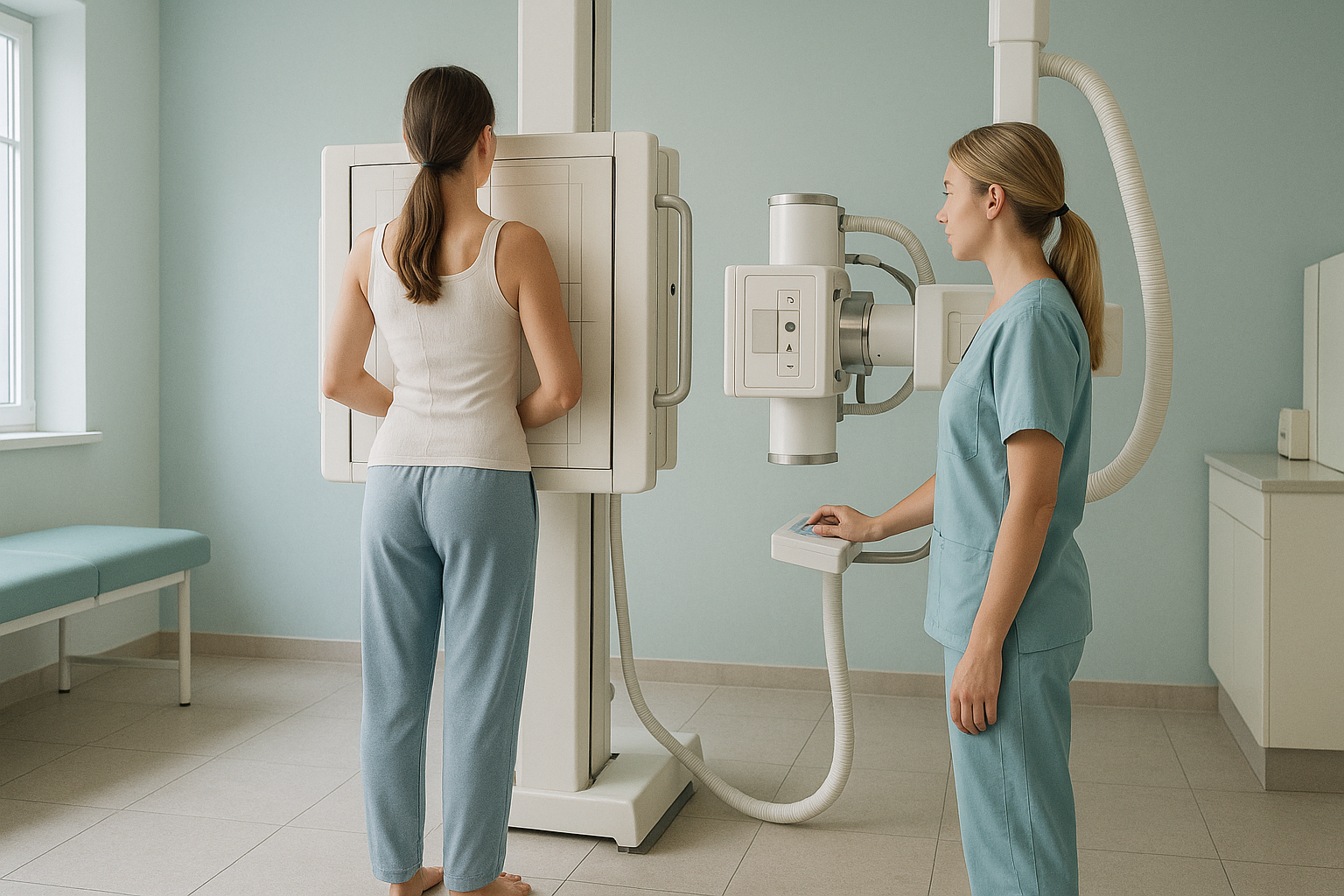
This matters for Schroth therapy because the whole point of the exercises is to change how you hold yourself when standing and moving. If your progress images are taken lying down, they may not reflect the real-world improvements your exercises are producing.
A consistent Cobb angle measurement taken in the same standing position each time gives you and your therapist a reliable comparison. EOS imaging at ScanAlign, low dose standing imaging uses about 90% less radiation than a standard X-ray, around ten times less. That lower dose makes regular monitoring more practical, so you and your therapist can see how your curve responds over time.
Working with a Schroth therapist and want a standing baseline or follow-up image of your scoliosis curve?
Book a free video consultationWhat happens in a Schroth therapy session?
A typical course of Schroth therapy follows a structured process. Here is what most people experience.
Your therapist examines your posture and reviews any imaging. They classify your curve pattern using the Schroth system, which determines which exercises you will be given.
You learn how to elongate and de-rotate your trunk using specific body positions. Your therapist guides you with hands-on cues and a mirror so you can see the correction.
You practise breathing into the concave side of your ribcage while holding the corrective position. This helps expand areas that have been compressed by the curve.
You take away a personalised daily exercise programme. Your therapist reviews and adjusts it at follow-up sessions. Consistency is the biggest factor in results.
Frequently asked questions about the Schroth method
The Schroth method is a physiotherapy approach that uses scoliosis specific exercises, rotational breathing and postural training to manage the effects of a spinal curve. It treats the curve in three dimensions rather than just addressing the side-to-side bend.
No. Schroth therapy does not cure scoliosis. It can slow curve progression, improve posture and reduce pain, but it does not eliminate a structural curve. It is a management tool, not a cure.
Most people notice improvements in posture and comfort within a few weeks of daily practice. Measurable changes on imaging may take several months. Results depend on the severity of the curve, your consistency and the quality of guidance from your therapist.
Yes. Schroth exercises are often used alongside bracing. The exercises help maintain muscle strength and flexibility while the brace provides external support. Many clinicians recommend this combined approach.
Look for a physiotherapist with specific Schroth certification, such as training through the Barcelona Scoliosis Physical Therapy School (BSPTS) or the Schroth Best Practice programme. Some UK hospitals and private clinics list certified therapists on their websites. Ask for their qualification details before starting.
Yes. Although much early research focused on younger patients, Schroth therapy is widely used by adults with scoliosis. Adults often find it helpful for managing pain, improving posture and maintaining function.
Standing imaging captures your curve under gravity and load, which is how your spine behaves in real life. Lying down relaxes the muscles and can make the curve look different. Standing images give your therapist a more accurate and consistent measurement for tracking change over time.
An EOS scan uses about 90% less radiation than a standard X-ray, around ten times less. This lower dose makes it more practical for repeat imaging when you and your therapist want to track progress over time.
No. ScanAlign accepts self-referrals. You can book a monitoring scan directly without a GP letter. Many people are referred by their Schroth therapist or physiotherapist, but it is not required.
There is no single rule. Your therapist or consultant will advise based on your curve, your age and how your treatment is going. Because EOS imaging uses a very low radiation dose, repeat scans are more practical than with standard X-rays. A common approach is a baseline scan before starting therapy and a follow-up at an agreed interval.
Track your scoliosis curve with standing imaging
A low-dose standing image gives you and your Schroth therapist a clear, weight-bearing baseline to measure progress against.
Book a free video consultationSources
- Negrini S, Donzelli S, Aulisa AG, et al. 2016 SOSORT guidelines: orthopaedic and rehabilitation treatment of idiopathic scoliosis during growth. Scoliosis and Spinal Disorders. 2018;13:3.
- Schreiber S, Parent EC, Moez EK, et al. Schroth physiotherapeutic scoliosis-specific exercises added to the standard of care lead to better Cobb angle outcomes in adolescents with idiopathic scoliosis. PLoS ONE. 2016;11(12):e0168746.
- NHS England. Scoliosis: overview, treatment and management. nhs.uk. Accessed 2024.
Written by Abbas Dhami (Specialist Diagnostic Radiographer)
This page is general information and not a diagnosis.
ScanAlign is the trading name of CoreMed Solutions Ltd and operates under The Harley Street Hospital's CQC licence.