

Cobb Angle Measurement: How Are Spinal Curves Assessed?
A cobb angle measurement is the standard way doctors and radiographers assess how much the spine curves sideways or front to back. It is calculated from an X-ray or standing scan by drawing lines along the most tilted vertebrae at the top and bottom of a curve. The resulting angle tells your clinician whether a curve is mild, moderate or significant.
Key Takeaways
- The cobb angle is the universal standard for measuring spinal curvature on imaging.
- It applies to both sideways curves (scoliosis) and front-to-back curves (kyphosis and lordosis).
- Measurements taken while you are standing under load are more representative of real life than those taken lying down.
- EOS whole-body standing imaging uses about 90% less radiation than a standard X-ray, around ten times less.
- A cobb measurement alone does not explain the cause of pain. Whole-body alignment gives the bigger picture.
What is a cobb angle?
A cobb angle is a number that describes how much your spine curves in a particular direction. It was developed by the orthopaedic surgeon John Robert Cobb in 1948 and has been the standard measurement method ever since. Whether a clinician is looking at a sideways curve (scoliosis) or an excessive forward or backward curve (kyphosis or lordosis), they will almost always report it using a cobb angle.
In plain terms, a larger number means a bigger curve. Your specialist uses this number to decide whether a curve needs monitoring, further investigation, or input from a spinal team. It is not a diagnosis on its own, but it is a vital piece of the puzzle.

How is a cobb angle measured?
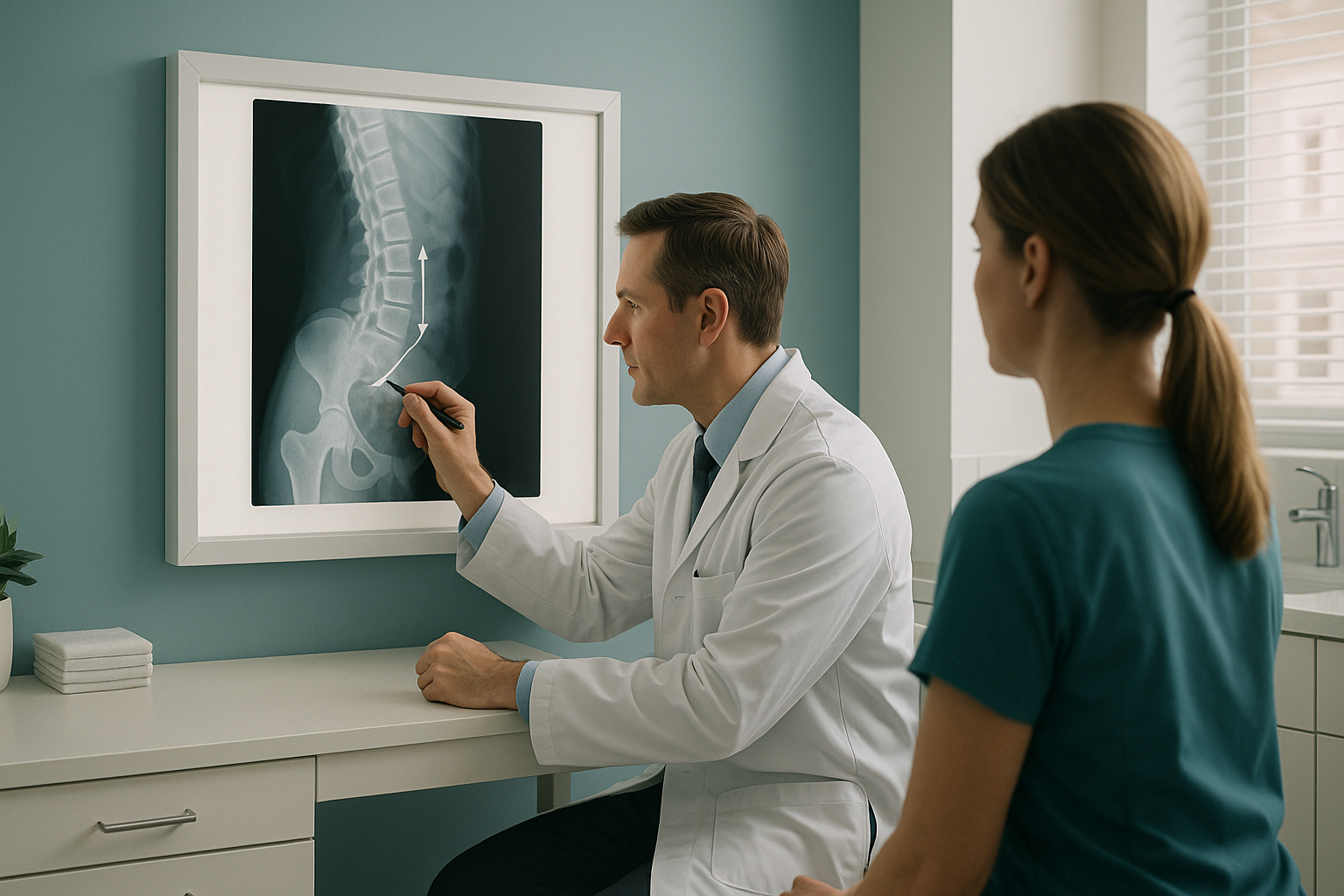
A radiographer or specialist identifies the vertebrae at the very top and very bottom of the curve on an X-ray or standing scan. A line is drawn along the upper surface (endplate) of the top vertebra and another along the lower surface of the bottom vertebra. The angle where those two lines meet is the cobb angle.
This sounds technical, but the outcome is simple. Your report will describe the curve as mild, moderate or significant. Your clinician then uses that alongside your symptoms, posture and medical history to guide next steps.
Often monitored without intervention. Your clinician may recommend periodic imaging to check for any change over time.
May warrant physiotherapy, specialist review or more detailed imaging to understand the cause and impact of the curve.
Usually needs specialist spinal assessment. The curve may be affecting breathing, balance or causing persistent pain.
What signs suggest you might have a spinal curve?
Many spinal curves develop gradually, so you may not notice one until someone else points it out, or until you start feeling the effects. Common signs include one shoulder sitting higher than the other, uneven hips, clothes hanging unevenly, back pain or stiffness that does not respond to usual treatment, and visible asymmetry when you bend forward.
Pain from a spinal curve does not always appear at the curve itself. Because your body is a connected chain from feet to head, a curve in the mid-back can cause the pelvis to tilt, which in turn puts extra load on one hip or knee. This is why whole-body assessment is so valuable. It reveals the compensations your body has made.
Wondering whether your symptoms relate to spinal alignment? A standing whole-body scan can give you a clear answer.
Book a free video consultationWhy does it matter whether a cobb angle is measured standing or lying down?
It matters because gravity changes your spine. When you lie down for a conventional X-ray, CT or MRI, your muscles relax and your spinal curves can flatten or shift. The measurement you get may not reflect how your spine actually behaves during the day, when you are upright and bearing weight.
A standing scan captures your spine under load, exactly as it works in real life. Research consistently shows that cobb angles measured in a standing position can differ meaningfully from those measured lying down. For your clinician, that difference can change the recommended course of action.
How does EOS imaging help with cobb angle measurement?
EOS is a standing, whole-body X-ray system that captures your full skeleton in one pass, from head to feet, while you are upright. This means the cobb angle it measures reflects your true spinal alignment under gravity. It also shows the rest of your skeletal chain at the same time, so your clinician can see how a spinal curve affects your pelvis, hips, knees and overall balance.
EOS uses about 90% less radiation than a standard X-ray, around ten times less. This makes it particularly suitable if you need follow-up scans to monitor a curve over time.
Because EOS images the whole body in one scan, it reveals the compensations your body has made in response to a curve. A tilted pelvis, an uneven leg load, a shifted centre of gravity. These details are invisible on single-area scans but can be the key to understanding why you have pain.
When MRI is the better choice: EOS shows bones, joints and alignment clearly. For soft-tissue problems such as disc herniations, nerve compression or ligament damage, MRI is usually the better tool. Your clinician can advise which type of imaging you need.
Want to understand your spinal curve in the context of your whole body alignment? Speak to our team first, at no cost.
Book a free video consultationLearn more about how EOS whole-body standing imaging works and what a scan involves.
Frequently asked questions about cobb angle measurement
It is the standard way to measure how much the spine curves. A specialist draws lines on an X-ray or standing scan along the most tilted vertebrae at each end of the curve. The angle between those lines is the cobb angle. A bigger number means a bigger curve.
No. It is also used to measure kyphosis (an excessive forward curve in the upper back) and lordosis (an excessive inward curve in the lower back). Any curvature of the spine can be described using a cobb angle.
Yes. When you lie down, gravity no longer compresses your spine, and muscles relax. This can make a curve appear smaller than it really is. A standing measurement is generally more representative of your day-to-day alignment.
The radiographer identifies the vertebra at the top of the curve that tilts most into the curve, and the vertebra at the bottom. A line is drawn along the upper endplate of the top vertebra and the lower endplate of the bottom one. The angle where perpendicular lines from each intersect is the cobb angle.
No. You can self-refer. We offer a free video consultation first so our specialist radiographer can confirm the scan is appropriate for you and answer any questions. No GP referral is needed.
EOS uses about 90% less radiation than a standard X-ray, around ten times less. This makes it one of the lowest-dose imaging options available. You can find more detail on our FAQs and safety page.
ScanAlign is a private, self-pay clinic. For current pricing, please visit our FAQs page.
On its own, no. A cobb measurement tells you the size of a curve, not the cause of your pain. That is why whole-body alignment imaging is so useful. It shows how a spinal curve is affecting the rest of your body, revealing compensations in the pelvis, hips and knees that may be driving your symptoms.
A larger curve usually means a specialist review is advisable. ScanAlign provides the diagnostic imaging and a detailed report. Your clinician, whether an orthopaedic surgeon, physiotherapist or GP, then uses that information to guide any treatment decisions.
Yes, and the low radiation dose makes EOS particularly suitable for follow-up imaging. Repeated scans taken in a consistent standing position give reliable, comparable measurements so your clinician can track whether a curve is stable, improving or progressing.
Understand your spinal alignment, from head to feet
A free video consultation with our specialist radiographer. No referral needed. No obligation.
Book a free video consultationRelated pages
Read more about spinal alignment and the conditions EOS imaging can assess.
Sources
Written by Abbas Dhami (Specialist Diagnostic Radiographer)
This page is general information and not a diagnosis.
ScanAlign is the trading name of CoreMed Solutions Ltd and operates under The Harley Street Hospital's CQC licence.