
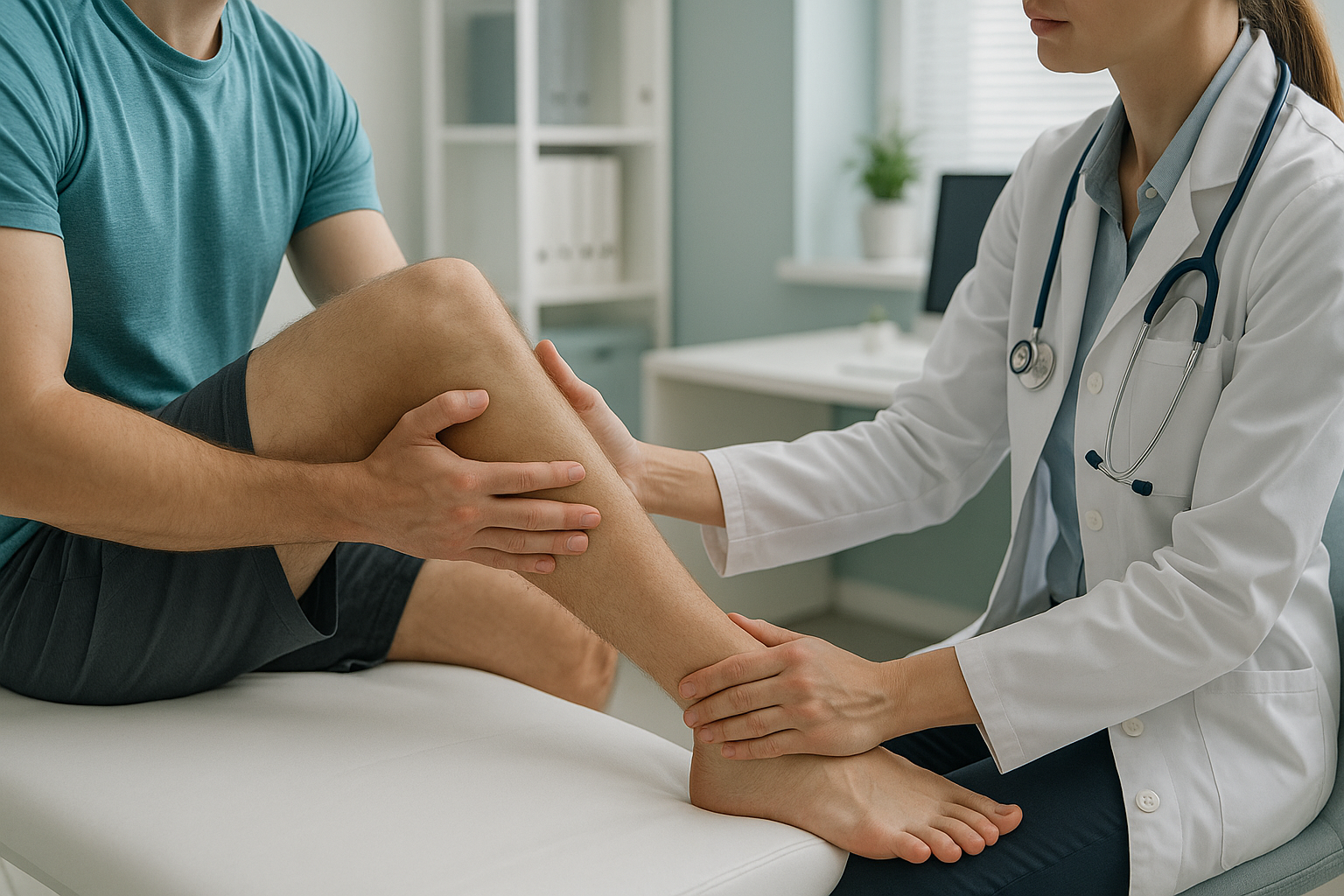
What Causes Shin Splints, and How Do You Stop Them Returning?
Shin splints are caused by repeated stress on the tibia and the tissues that attach to it. They often return because the underlying cause, such as poor leg alignment, overpronation or an abrupt jump in training load, is never identified. A standing, weight-bearing assessment of whole-body alignment can reveal the structural factors that keep the cycle going.
Key takeaways
- Shin splints (medial tibial stress syndrome) affect the inner edge of the shinbone.
- Training errors, footwear, running surface and biomechanical alignment all play a role.
- Lying-down scans can miss alignment issues that only appear when you are standing.
- An EOS standing scan images your legs, ankles and feet under real weight-bearing load.
- Identifying the structural cause is the key to stopping shin splints from returning.
What are shin splints exactly?
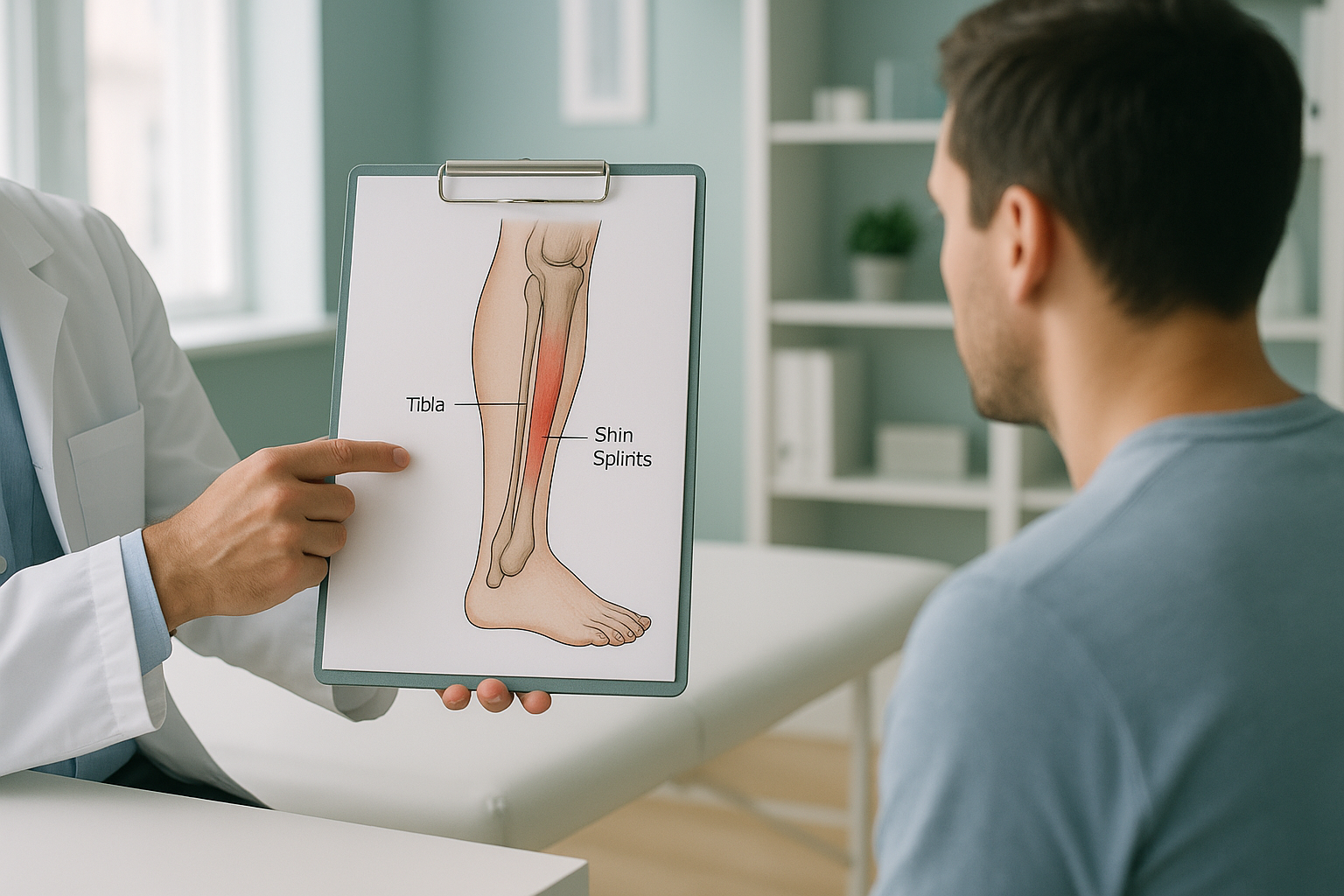
Shin splints, known in clinical practice as medial tibial stress syndrome, are a bone-stress injury. The pain sits along the inner border of the tibia, the larger bone in your lower leg. It develops when the periosteum (the thin tissue wrapping the bone) and the muscles attached to it become irritated by repetitive loading.
This is not a single event injury. It builds gradually. If the loading continues without enough recovery, or if the root biomechanical cause goes unaddressed, the irritation can worsen toward a stress fracture.
How do you know if you have shin splints?
The hallmark is a dull, aching pain along the inner edge of your shin. It usually appears during or after running and eases with rest, at least at first. As the condition progresses, pain can become constant.
When to seek urgent help. If your shin pain is severe at rest, the area is hot or very swollen, or you also have numbness, weakness, or loss of sensation in your foot, see your GP, call 111, or attend A&E. These may suggest a stress fracture or another condition that needs immediate assessment.
What causes shin splints to keep coming back?
Shin splints return when you treat the symptoms but not the cause. Most people rest until the pain fades, then resume the same training pattern, with the same biomechanics, in the same shoes. The overload starts again.
How does alignment affect shin pain when running?
Your body is a connected chain. When one link is out of position, the links above and below compensate. A subtle twist at the hip or a small difference in leg length changes the angle at which your foot strikes the ground. That altered loading pattern concentrates stress on the inner border of the tibia, exactly where shin splints develop.
These alignment issues are often invisible to the naked eye. Standard lying-down imaging relaxes the muscles and joints, so the skeleton settles into a neutral position that may not reflect what happens when you are standing and moving. That is why many runners have normal-looking scans yet still get recurring shin pain.

How do you prevent shin splints from returning?
Prevention starts with understanding what went wrong in the first place. Some factors you can control yourself. Others need investigation.
What you can do now
- Manage your training load. Increase weekly distance by no more than about 10% at a time. Build in rest days.
- Rotate your footwear. Use more than one pair of running shoes and replace them before the cushioning breaks down.
- Strengthen your calves. Calf raises (both straight-knee and bent-knee) build the capacity of the muscles that support the tibia.
- Increase your running cadence slightly. Shorter, quicker steps can reduce impact force on each stride.
- Vary your surfaces. Mix softer ground with road running when possible.
What may need professional assessment
If you have tried the above and your shin splints keep returning, the missing piece is usually structural. Issues like tibial rotation, a subtle leg-length difference, or foot mechanics that cannot be seen from the outside may be driving the overload. Read more about preventing sports injury with 3D skeletal scans.
Recurring shin splints often have a biomechanical cause that standard imaging misses. A standing alignment scan can show exactly what is happening under load.
Book a free video consultationHow does a standing EOS scan help with shin splints?
An EOS scan captures your full skeleton while you stand naturally, bearing your own weight. Unlike a standard X-ray taken lying down, it shows how your bones and joints actually line up under load, the same conditions that trigger shin pain.
For runners with recurring medial tibial stress syndrome, this can reveal tibial rotation, ankle alignment, arch position, and leg-length differences, all in a single image. The scan uses about 90% less radiation than a standard X-ray, around ten times less.
Standing EOS. You stand in the scanner. Gravity loads your joints exactly as it does when you run. Alignment issues, rotations, and leg-length differences appear as they truly are. A specialist radiographer captures a full image from head to toe in one pass.
Lying-down imaging. When you lie flat for a conventional X-ray, CT or MRI, your muscles relax and your joints settle. Rotational issues straighten out, leg-length differences compress, and arch changes disappear. The image may look normal even though your alignment under load is not.
A note on MRI. EOS shows bones, joints and alignment. If your clinician suspects a soft-tissue problem, a stress fracture that needs detailed characterisation, or nerve involvement, MRI is usually the better tool. The two scans answer different questions and often complement each other.
At ScanAlign, your images are reviewed by a specialist radiographer who maps your alignment from the ground up. The report gives you and your clinician clear, actionable information to guide treatment decisions.
Frequently asked questions about shin splints
Running through the pain usually makes things worse and can lead to a stress fracture. Reduce your mileage or switch to low-impact exercise until the pain settles, then address the underlying cause before building back up.
Most people see improvement within a few weeks of reduced activity. Full recovery depends on the severity and on whether the structural or training cause is addressed. Without that, they tend to return.
Shin splints produce a diffuse ache along a stretch of the inner shin. A stress fracture typically causes a sharper, more pinpointed pain, often noticeable even at rest. If you suspect a stress fracture, seek medical attention promptly.
They can, particularly if overpronation is contributing to the problem. The key is knowing whether your foot mechanics are actually part of the cause. A standing alignment assessment can confirm this before you invest in orthotics.
Calf raises (both with a straight knee and a bent knee) strengthen the soleus and gastrocnemius muscles. Toe walks, heel walks and single-leg balance exercises also help. These build tissue tolerance around the tibia.
No. You simply stand still for a few seconds while the scanner captures your image. There is no injection, no enclosed tunnel and no discomfort.
An EOS scan uses about 90% less radiation than a standard X-ray, around ten times less. It is one of the lowest-dose skeletal imaging methods available.
No. ScanAlign is a private self-pay clinic. You can refer yourself. The process starts with a free video consultation to check that the scan is appropriate for you.
Pricing details are on our frequently asked questions page.
Yes. Research links lower-limb biomechanics, including tibial rotation, hip alignment and foot pronation, to medial tibial stress syndrome. When the skeleton is not aligned well under load, some tissues absorb more force than they can manage.
Ready to find out why your shin splints keep returning?
Start with a free video consultation. We will discuss your symptoms, review your history and let you know whether a standing alignment scan could help.
Book a free video consultationRelated reading
Written by Abbas Dhami (Specialist Diagnostic Radiographer)
Sources
- Yates B, White S. The incidence and risk factors in the development of medial tibial stress syndrome among naval recruits. American Journal of Sports Medicine. 2004;32(3):772-780.
- Winters M et al. Medial tibial stress syndrome can be diagnosed reliably using history and physical examination. British Journal of Sports Medicine. 2018;52(19):1267-1272.
- NHS. Shin splints. nhs.uk. Available at: https://www.nhs.uk/conditions/shin-splints/
This page is general information and not a diagnosis.
ScanAlign is the trading name of CoreMed Solutions Ltd and operates under The Harley Street Hospital's CQC licence.