
Bow Legs, Knock Knees or Straight: How Do You Know If Your Leg Alignment Is Normal?
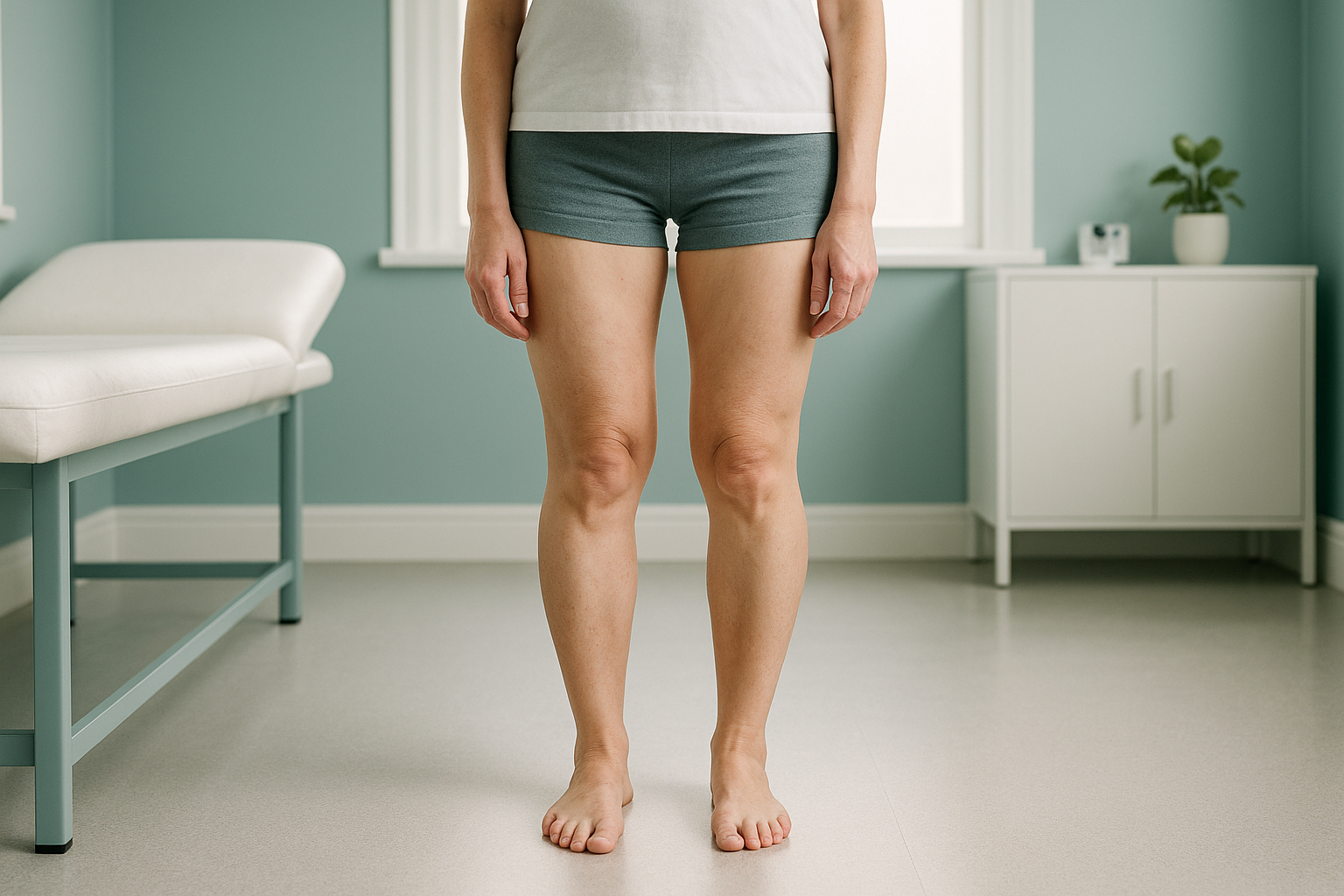
Bow legs curve outward so the knees stay apart when the ankles touch. Knock knees angle inward so the knees press together. In adults, both patterns shift how weight passes through the hip, knee and ankle, often causing pain far from the actual misalignment. A standing, weight-bearing image is the clearest way to see which pattern you have and how much it matters.
Key takeaways
- Bow legs (genu varum) and knock knees (genu valgum) are the two most common leg alignment patterns in adults.
- Misalignment changes how load travels through your joints, which can speed up wear on one side of the knee.
- Your body compensates by adjusting the hip, pelvis and ankle, so pain often appears away from the root cause.
- Lying-down scans relax the muscles and can hide alignment problems that only show when you are standing.
- EOS whole-body standing imaging captures your legs, hips and spine in one low-radiation image under real weight.
What is normal leg alignment?
Normal leg alignment means the centre of your hip, the centre of your knee and the centre of your ankle all line up roughly along one straight line when you stand. Doctors call this the mechanical axis. When the line falls through the middle of the knee, your weight is shared evenly between the inner and outer sides of the joint.
If the line shifts inward, the inner compartment of the knee takes more load. That is a bow-legged pattern, called genu varum. If the line shifts outward, the outer compartment is overloaded. That is a knock-knee pattern, called genu valgum. A small amount of variation is normal. Problems tend to start when the shift is large enough to overload cartilage on one side.
How do you know if you have bow legs or knock knees?
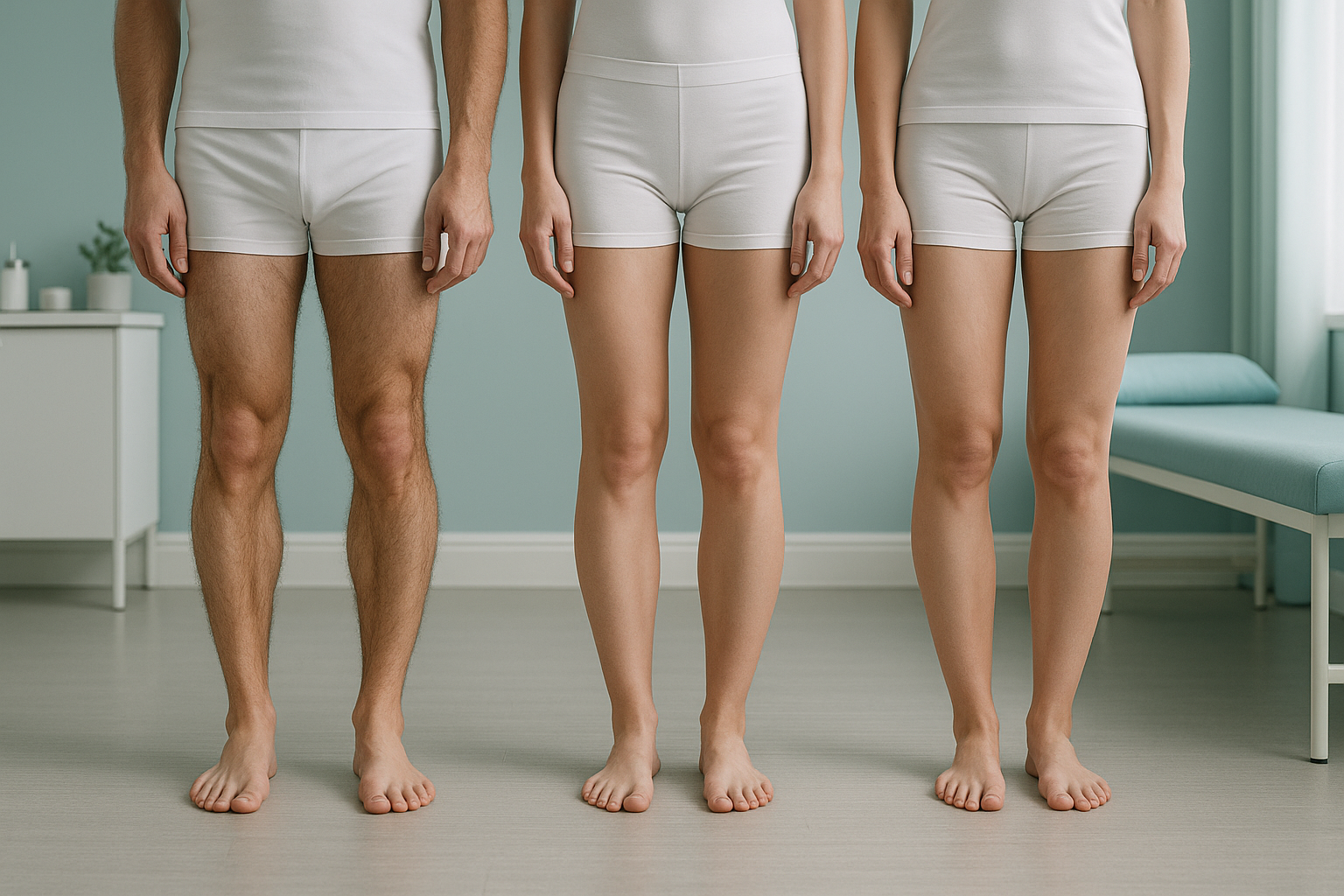
Many people notice the shape of their legs when they look in a mirror. But misalignment also causes symptoms you might not link to your leg shape.
A clear space between the knees (bow legs) or difficulty keeping the ankles together (knock knees) when you stand with feet flat.
Pain on the inner edge of the knee often points to bow legs. Pain on the outer edge may suggest a knock-knee pattern.
Soles wearing down more on one side suggest your foot is rolling to compensate for how the leg sits above it.
Your pelvis and spine may tilt or twist to compensate for the leg angle, creating pain higher up the chain.
What causes bow legs in adults?
Bow legs in adults are rarely left over from childhood. In most cases, the alignment changes over time because of how the joint wears, how the bones have developed, or a past injury. Knock knees share many of the same causes, just on the opposite side of the joint.
Cartilage wearing down on one side of the knee gradually tilts the bone angle.
A bone that healed at a slight angle can shift the mechanical axis over time.
Conditions that soften or reshape bone, such as Paget's disease, can alter leg alignment in adults.
Damaged ligaments can let the knee drift outward or inward under load, creating a functional malalignment.
Because these changes happen slowly, many people adapt without realising it. The body compensates by adjusting the ankle, the opposite hip, or the lower back. That is why pain often turns up in a different area from the structural problem.
Why does leg alignment need to be assessed standing up?
When you lie on a table for a standard X-ray or MRI, gravity is no longer pushing through your joints. Your muscles relax, the joint spaces open up, and any tilt or twist caused by misalignment can disappear. That image may look normal even when your leg alignment under real load is not.
An EOS scan takes a full-length image of both legs, both hips and the spine while you stand on your feet. The machine captures everything from head to ankle in a single exposure, using about 90% less radiation than a standard X-ray, around ten times less. Because you are weight-bearing, the image shows the true mechanical axis of each leg and how the rest of the body is compensating.
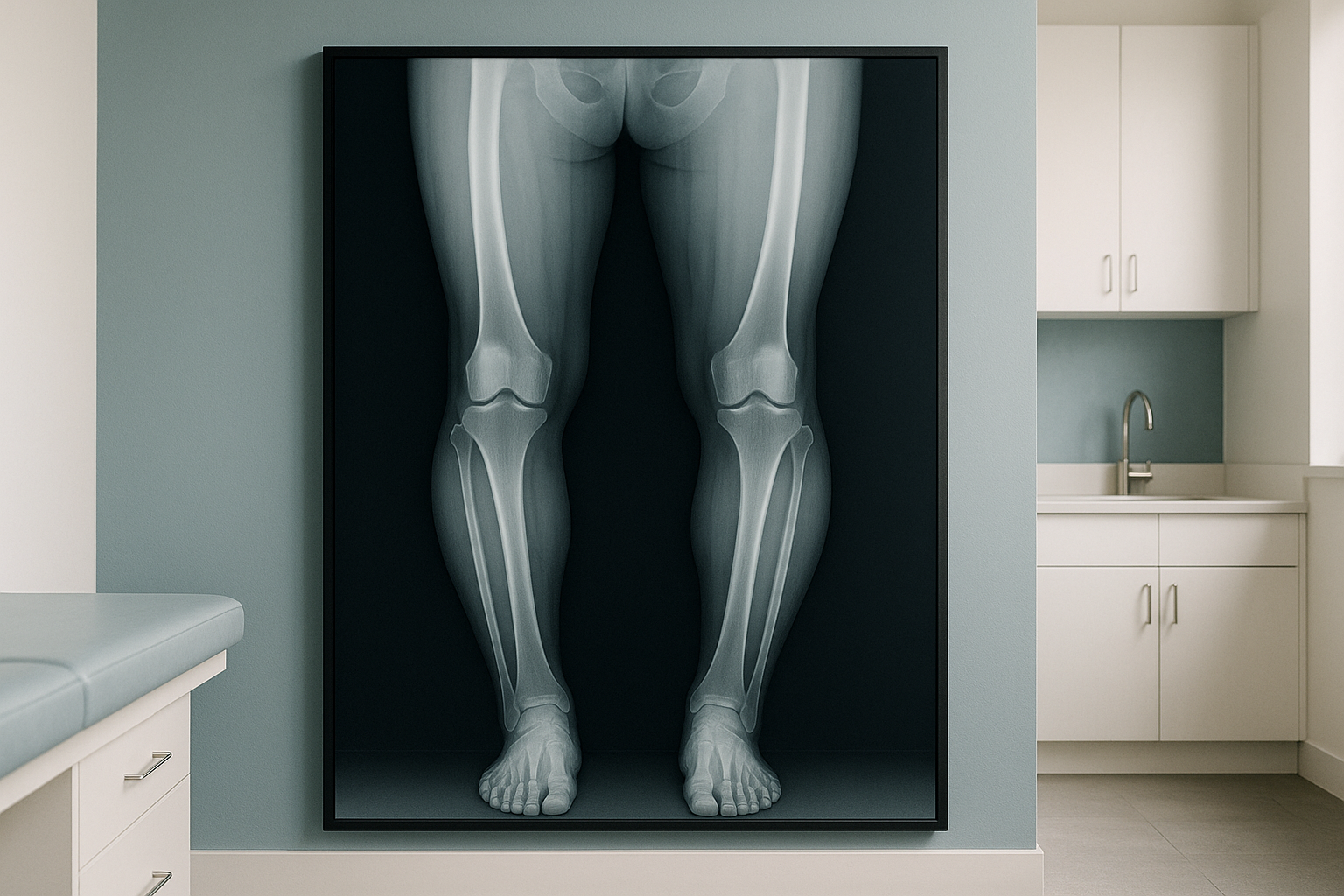
This matters because a surgeon planning a knee replacement or osteotomy needs to know the exact axis under load. A physiotherapist building a rehab programme benefits from seeing how the whole chain adapts. Without a standing image, both are working with incomplete information.
When is MRI the better choice? EOS shows bones, joints and alignment clearly. For soft-tissue problems like cartilage tears, meniscus injuries or nerve issues, MRI is usually the better tool. Your clinician can advise which you need, and sometimes you need both.
What helps with bow legs or knock knees in adults?
The right approach depends on how much misalignment you have, what is causing it, and how much it affects your daily life. ScanAlign is a diagnostic imaging clinic, not a treatment provider, so the role of the scan is to give you and your clinician the detailed picture needed to decide on next steps.
Options your specialist may consider include targeted physiotherapy to strengthen the muscles around the joint, orthotics to adjust load through the foot and ankle, or in more significant cases, surgical correction such as osteotomy or joint replacement. The key point is that all of these decisions work better when the full alignment picture is known in advance.
Not sure whether your leg alignment needs investigating? Talk to us first, at no cost.
Book a free video consultationFrequently asked questions about bow legs and leg alignment
Yes. If the cause is joint wear or a bone condition, the angle can gradually increase over time. The rate depends on activity level, body weight and the underlying cause. Monitoring with periodic imaging helps track any change.
Bow legs (genu varum) curve outward, leaving a gap at the knees. Knock knees (genu valgum) angle inward so the knees touch but the ankles do not. Both shift the weight-bearing line away from the centre of the knee and can overload cartilage on one side.
Mild cases are often managed with physiotherapy and orthotics, which can reduce symptoms by strengthening surrounding muscles and improving load distribution. Whether these approaches are enough depends on the cause and severity, which a standing alignment image helps to clarify.
No. ScanAlign accepts self-referrals. You can book directly with a free video consultation, and a specialist radiographer will help determine whether the scan is appropriate for you.
An EOS scan uses about 90% less radiation than a standard X-ray, around ten times less. This makes it suitable for full-length imaging of both legs, hips and spine in a single exposure.
When you lie flat, gravity no longer pushes through your joints. Muscles relax and joint spaces open up, which can mask the tilt or drift that only becomes apparent under your full body weight. A standing image captures the true mechanical axis.
Yes. Your body is a connected chain from feet to head. When leg alignment is off, the pelvis and lower spine often tilt or twist to compensate. This can produce pain in the hip, the lower back, or both, even though the root cause is at the knee or below.
Details on pricing are available on our FAQs and cost page. The free video consultation will also confirm which scan package suits your needs.
Yes. EOS imaging is commonly used to assess alignment around existing implants. It shows how the prosthesis sits relative to the mechanical axis and whether the overall alignment of the leg and pelvis is balanced.
You stand still inside the EOS machine for a few seconds while it captures a full-length image. There is no enclosed tunnel and no need to hold an uncomfortable position. Full details on what to expect are on the FAQs page.
See how your legs really line up
A free video consultation with our specialist radiographer can help you decide whether standing alignment imaging is right for you.
Book a free video consultationLearn more about whole-body alignment
Written by Abbas Dhami (Specialist Diagnostic Radiographer)
Sources
- Paley, D. (2002). Principles of Deformity Correction. Springer. A widely referenced orthopaedic text on limb alignment and mechanical axis planning.
- NHS. "Knock knees." NHS Website. General guidance on genu valgum, causes and when to seek medical advice.
- Illés, T. & Somoskeöy, S. (2012). "The EOS imaging system and its uses in daily orthopaedic practice." International Orthopaedics, 36(7), 1405-1411. Overview of EOS technology and low-dose standing imaging.
This page is general information and not a diagnosis.
ScanAlign is the trading name of CoreMed Solutions Ltd and operates under The Harley Street Hospital's CQC licence.