
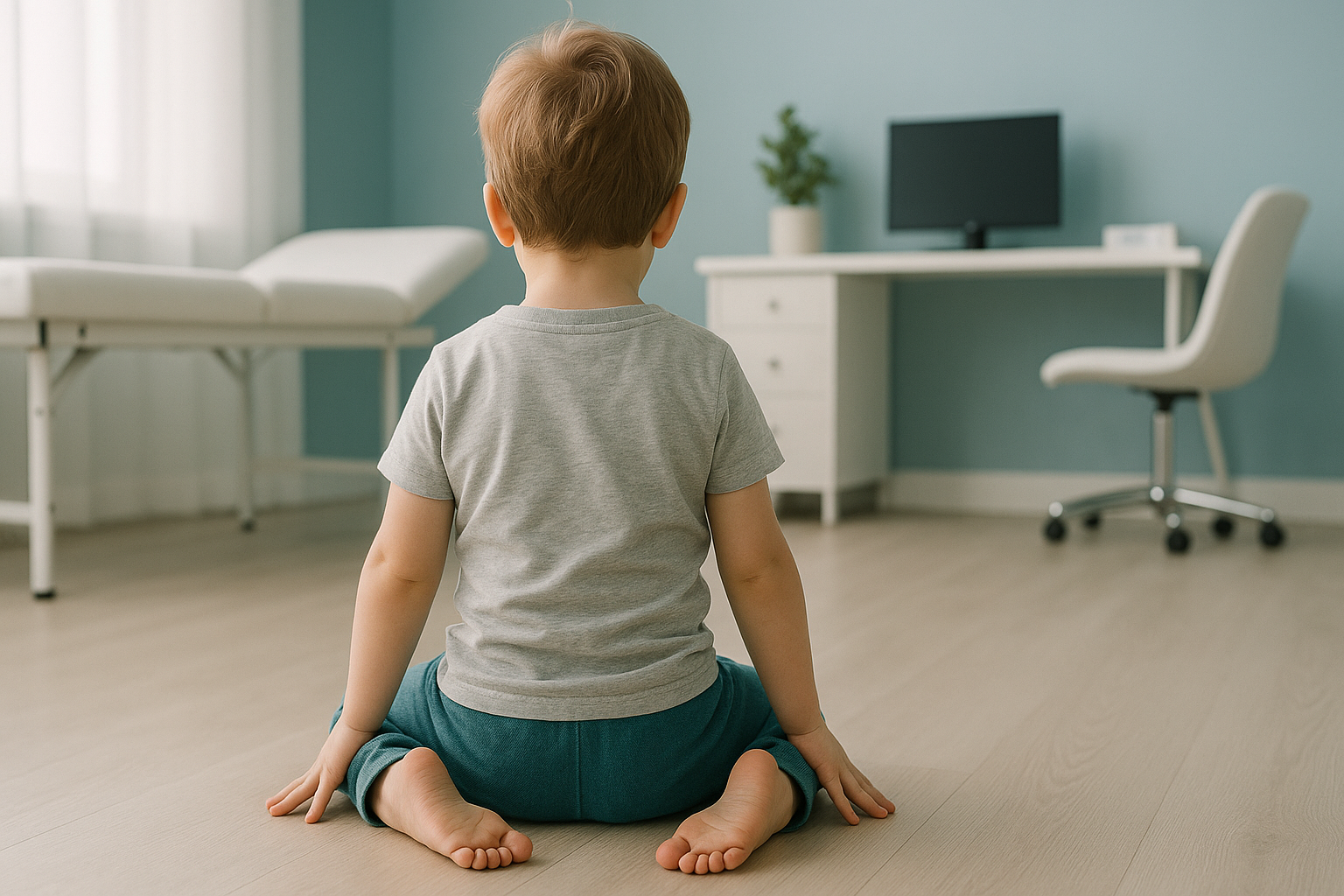
Does W-Sitting Actually Harm a Child's Hips?
For most typically developing children, w sitting is a comfortable habit, not a cause of hip damage. There is no strong evidence that it leads to hip dysplasia or long-term orthopaedic problems. However, if a child sits this way often and also has stiffness, pain, or an unusual gait, it can be worth investigating further.
Key takeaways
- W sitting on its own is not proven to harm healthy hips.
- It is common in toddlers and usually fades as they grow.
- Persistent w sitting combined with other signs may point to an underlying condition such as femoral anteversion.
- If you are concerned, a standing hip assessment can check alignment under real weight-bearing load.
- Constantly correcting a child who is otherwise well is unlikely to be helpful and may cause distress.
What is w sitting and what does the position look like?
W sitting is when a child sits on the floor with their bottom between their feet and both knees bent, so the legs form a W shape when seen from above. The hips are turned inward and the knees point forward.

It is extremely common. Many toddlers and young children move in and out of this position throughout the day. The wide base gives them extra stability while they use their hands for play.
Is w sitting actually bad for a child's hips?
The short answer is that the evidence is weak. Despite widespread concern online, no high-quality study has shown that w sitting in a typically developing child causes hip dysplasia, bone deformity, or lasting joint damage.
The worry originally came from clinical observations in children who already had neuromuscular conditions. Over time, the advice was applied more broadly, but the research has not kept up. A 2021 review in the journal Pediatric Physical Therapy found no strong evidence linking w sitting to orthopaedic problems in otherwise healthy children.
- Child moves freely in and out of the position
- No pain or stiffness
- Walking and running look normal
- No other developmental concerns
- Only comfortable sitting in the W position
- Hip stiffness or reduced range of movement
- In-toeing gait that worsens or causes tripping
- Pain in the hips, knees, or legs
- Known history of developmental dysplasia of the hip
Why does my child sit in the w position?
Children choose the w position because it gives them a wider, more stable base than cross-legged or side sitting. It lets them keep their trunk steady while they reach, build, or draw. In most cases it is a matter of comfort and habit, nothing more.
Young children's hips naturally allow more internal rotation. This makes w sitting easy and comfortable.
The wide base reduces the need for trunk control, freeing up the hands for play.
Some children have a naturally increased twist in the thigh bone, making internal rotation feel easier than external rotation.
In a smaller number of cases, persistent w sitting can be a sign of low muscle tone or joint hypermobility. It is also sometimes seen more often in children with autism or other developmental conditions, though the sitting position itself is not the concern in those situations.
Should I stop my child from w sitting?
If your child is developing normally and can sit in other positions too, most paediatric specialists would say there is no need to keep correcting them. Repeatedly telling a child to change position can create anxiety without solving a problem that probably does not exist.
However, you should speak to your GP or a paediatric physiotherapist if you notice any of the following alongside the w sitting habit:
Falls or seems very uncomfortable in any other floor position.
Complains of pain during or after sitting, walking, or running.
Feet point inward when walking, worsening over time or causing frequent trips.
Most children grow out of it. If it persists well into primary school, a check may be useful.
How can standing imaging help if you are concerned about hip alignment?
If a clinician suspects that w sitting is related to an underlying alignment issue, imaging can help clarify the picture. Standard X-rays or MRI scans are taken lying down, which relaxes the muscles and removes the effect of gravity. That means they can miss subtle alignment differences that only show up when the body is bearing its own weight.
An EOS scan takes a low-dose, full-length image while the child stands. It uses about 90% less radiation than a standard X-ray, around ten times less. The image captures the hips, knees, and lower limbs in one view, so the clinician can see how the whole chain lines up under real conditions.
This kind of assessment is most relevant when a child has symptoms alongside the w sitting habit, not for a child who simply likes sitting this way. Paediatric imaging at ScanAlign is carried out at 19 Harley Street, London, by an experienced specialist radiographer.
When is MRI the better choice? EOS shows bones, joints, and alignment clearly. For soft tissue, cartilage, or nerve-related concerns, MRI is usually the better tool. Your clinician can advise which type of scan is right for your child.
Not sure whether your child needs a scan? We offer a free video consultation to talk it through with no obligation.
Book a free video consultationFrequently asked questions about w sitting
In a typically developing child, there is no strong evidence that w sitting damages the hips. It becomes more relevant if the child also has pain, stiffness, or difficulty moving in other positions.
Current research has not established a causal link between w sitting and hip dysplasia. Children who already have hip dysplasia may prefer the w position because of how their hip joint is shaped, but the sitting position itself is not considered a cause.
If your child is otherwise well and can sit in other positions, repeatedly correcting them is unlikely to be necessary. Gentle encouragement to try other positions is fine, but constant correction can cause unnecessary stress.
W sitting is sometimes observed more often in children with autism or other developmental conditions. However, it is also very common in typically developing children, so the sitting position alone does not indicate autism.
Most children naturally move away from w sitting by around age 6 to 8 as their hips mature and they develop more core strength. If it continues well beyond this age, it may be worth discussing with a clinician.
Femoral anteversion is a natural inward twist of the thigh bone. Children with more anteversion find it easier to rotate their hips inward, which makes the w position feel comfortable. It usually corrects as they grow. You can read more about femoral anteversion and how it is assessed.
Cross-legged sitting, side sitting (legs to one side), long sitting (legs straight out in front), and kneeling are all good alternatives. Offering a small chair or stool can also help.
No. At ScanAlign, low dose standing imaging, you can self-refer. We recommend starting with a free video consultation so we can make sure imaging is appropriate for your child's situation.
Yes. EOS uses about 90% less radiation than a standard X-ray, around ten times less. The scan takes only a few seconds and is taken standing up, which most children find straightforward.
You can book a paediatric assessment or start with a free video consultation to discuss your child's needs. We will explain pricing during that conversation.
Concerned about your child's hip alignment?
A short video call with our specialist radiographer can help you decide whether imaging is the right next step. No referral needed, no obligation.
Book a free video consultationWritten by Abbas Dhami (Specialist Diagnostic Radiographer)
Sources
- Catan H, et al. "W-Sitting in Typically Developing Children: Is There Cause for Concern?" Pediatric Physical Therapy, 2021.
- NHS. "In-toeing and out-toeing." NHS Inform guidance on childhood gait patterns.
- Fabry G, et al. "Torsion of the femur: A follow-up study in normal and abnormal conditions." Journal of Bone and Joint Surgery, 1973.
This page is general information and not a diagnosis.
ScanAlign is the trading name of CoreMed Solutions Ltd and operates under The Harley Street Hospital's CQC licence.