
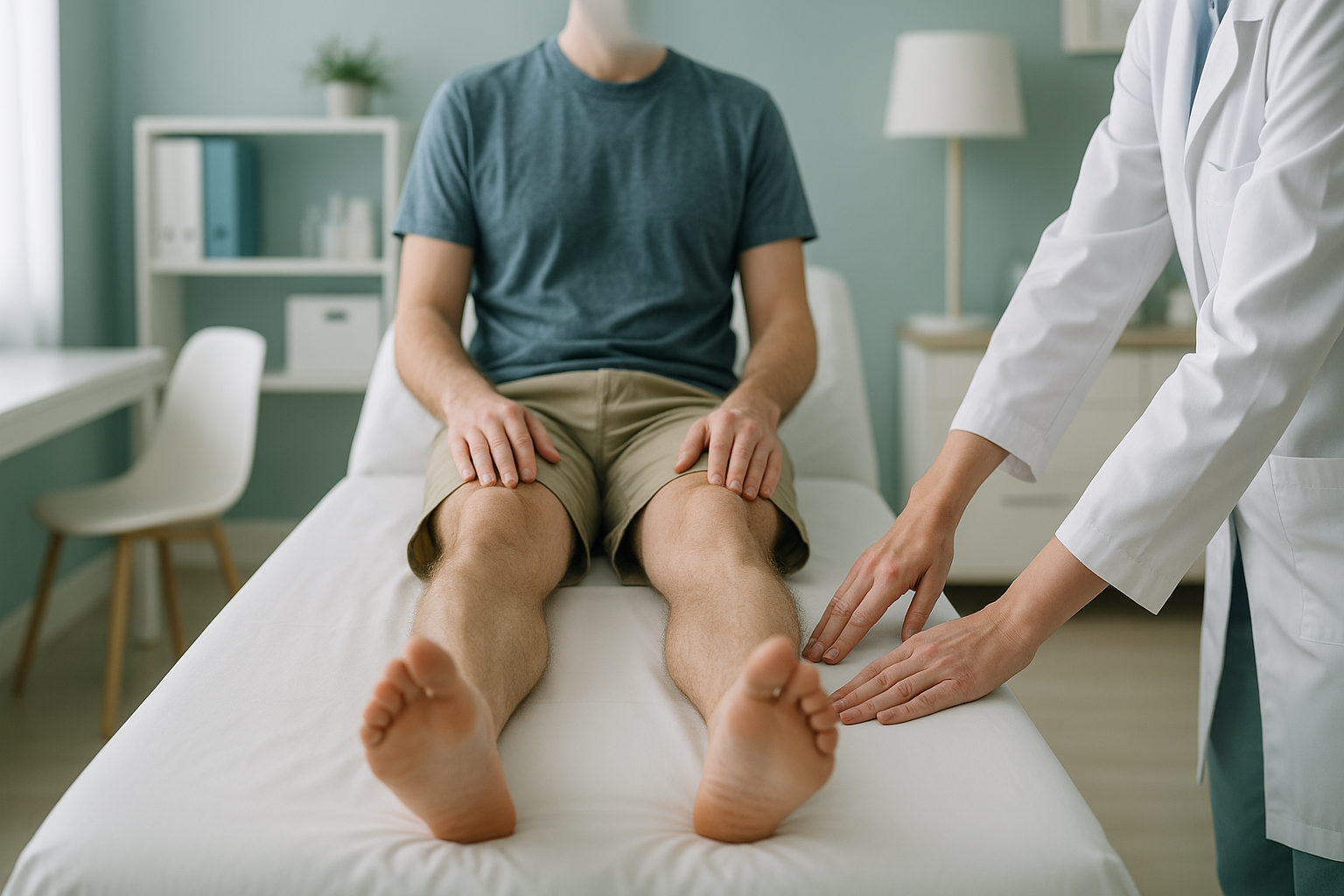
Why Does One Leg Feel Longer Than the Other?
One leg can feel longer because the bones genuinely differ in length or because a tilt in the pelvis or spine makes the legs appear uneven. A true difference means one bone is actually shorter. An apparent difference means the bones are the same length, but something higher up in the body shifts them out of line. Standing imaging is the most reliable way to tell which type you have.
Key takeaways
- A leg length discrepancy can be a true bone difference or an apparent one caused by pelvic or spinal position.
- Pain often appears in the back, hip or knee on the opposite side to the shorter leg because the body compensates.
- Lying-down scans can miss alignment shifts that only appear when you stand and bear weight.
- An EOS standing scan measures both legs from hip to ankle in a single image, under weight, with about 90% less radiation than a standard X-ray.
- Knowing the type and size of the difference helps your clinician decide on the right next step.
Most people have a small difference between their legs. It is surprisingly common and often causes no trouble at all. But when the difference is large enough, or when your body cannot compensate for it smoothly, you may start to notice pain, fatigue or an uneven gait that gets worse over time.
The tricky part is working out what is actually going on. Is one bone genuinely shorter? Or is a tilted pelvis making it seem that way? The answer changes what you do about it.
What is the difference between a true and an apparent leg length discrepancy?
A true discrepancy means the thigh bone or shin bone on one side is physically shorter than on the other. An apparent discrepancy means the bones are the same length, but something else, usually a pelvic tilt, a curved spine, or muscle tightness around the hip, makes one leg sit higher or lower than the other.
A true difference is structural. One bone grew shorter, or was shortened by a fracture, surgery or a childhood growth-plate issue. The bones themselves are unequal. This is confirmed by measuring the full leg on imaging taken while you stand.
An apparent difference is positional. The bones are the same length, but a tilted pelvis or uneven hips make one leg function as though it is shorter. Muscle imbalance, scoliosis, or a stiff joint can all produce this effect. Standing imaging reveals the tilt that a tape-measure test in clinic may miss.
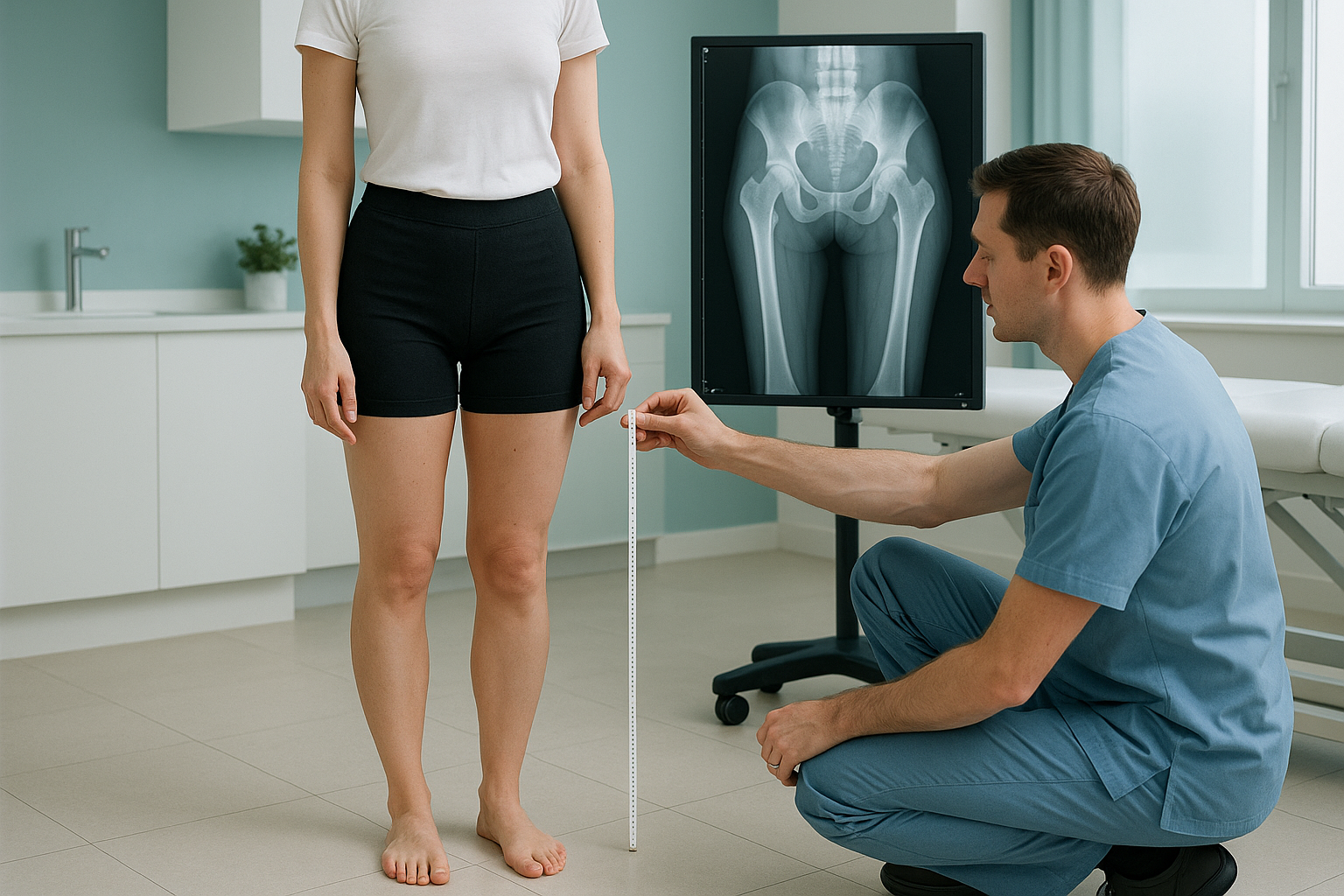
Many people have a combination of both. A small true difference can cause the pelvis to tilt, which then adds an apparent component on top. This is why measuring the whole chain, from the ground up, matters so much.
How do I know if one leg is longer than the other?
You may notice everyday clues before a clinician ever measures you. Here are the most common signs.
One trouser leg drags or needs hemming more than the other, even on straight-cut trousers.
The sole on one shoe wears down faster, particularly on the outside edge.
Your pelvis dips noticeably to one side with every step, making your gait look uneven.
Aching on one side of the lower back or hip, often worse after long walks or standing.
The longer leg often takes more load, leading to knee fatigue or pain that seems unexplained.
None of these signs on their own prove a leg length difference. But if you recognise two or three together, it is worth investigating.
What causes uneven legs?
Several things can make one leg sit higher or shorter than the other. Some are present from birth, others develop over time.
One leg may simply grow slightly more than the other during childhood.
A broken thigh or shin bone can heal slightly shorter if the fragments overlap.
Joint replacement surgery can slightly alter the effective length of the leg.
A tilted pelvis or a curve in the spine shifts the hip sockets, creating an apparent difference.
Tight hip flexors or adductors on one side can pull the pelvis down, mimicking a shorter leg.
Your body is a connected chain from your feet to your head. When one link changes, other links compensate. That is why the pain from a leg length difference can turn up in your back, your opposite hip, or even your neck, far from the actual problem.
Why does standing imaging matter for a leg length difference?
Standing imaging captures the way your body actually works under gravity. When you lie down for a standard X-ray, CT or MRI, your muscles relax, your pelvis flattens, and the alignment shift that causes your symptoms can disappear from the picture entirely.
An EOS scan takes a single, full-length image of your skeleton from your ankles to your hips (or higher) while you stand naturally. This lets the radiographer see the true position of every bone under real load. At ScanAlign, full-body standing imaging, we use EOS technology that delivers about 90% less radiation than a standard X-ray, around ten times less.
For a detailed look at how EOS captures the whole leg in one calibrated image, read more about EOS scanning for leg length discrepancy.
Want to find out whether a standing scan could explain your symptoms?
Book a free video consultationWhen MRI is the better choice. EOS excels at showing bones, joints and overall alignment. If your clinician suspects a soft-tissue problem such as a disc issue, nerve compression or a muscle tear, MRI is usually the more appropriate tool. The two scans answer different questions and sometimes complement each other.
What can be done about a leg length difference?
The right next step depends entirely on the type and size of the difference, and on whether it is causing symptoms. ScanAlign is a diagnostic imaging clinic, not a treatment provider. Our role is to give you and your clinician an accurate picture of what is happening.
Once the measurements are clear, your treating clinician may consider options such as a heel lift, physiotherapy to address pelvic tilt, or, in more significant cases, a referral to an orthopaedic specialist. The key point is that the imaging comes first. Without it, any approach is guesswork.
If you would like to book a leg length measurement, you can start with a free video consultation to discuss whether a standing scan is right for you.
Important. If you experience sudden numbness, weakness in one or both legs, or any loss of bladder or bowel control, seek urgent medical attention. Contact your GP, call 111, or go to A&E. These symptoms need immediate assessment, not a routine scan.
Frequently asked questions
Very common. Studies suggest that the majority of adults have some measurable difference between their legs. In most cases the difference is small and causes no problems at all.
Yes. A tilted pelvis shifts one hip socket higher than the other, making the leg on that side function as though it is shorter. This is called an apparent leg length discrepancy. Standing imaging can reveal the tilt clearly.
A clinical tape-measure test gives a rough guide, but it relies on finding exact bony landmarks through skin and muscle. It can also be affected by pelvic position. Imaging while standing is more precise because it measures the bones directly under load.
No. ScanAlign is a private, self-pay clinic. You can refer yourself. We recommend starting with a free video consultation so we can check that a standing scan is the right investigation for you.
An EOS scan uses about 90% less radiation than a standard X-ray, around ten times less. This makes it one of the lowest-dose options available for full-length skeletal imaging.
It can. When one leg is effectively shorter, the pelvis tilts and the spine curves to compensate. Over time, this places extra strain on the lower back muscles, joints and discs, which can contribute to pain.
When you lie down, gravity no longer acts on your skeleton the same way. Your muscles relax, your pelvis can flatten out, and any tilt or compensation your body uses while upright disappears from the image. A standing scan captures your real, weight-bearing alignment.
We do not list prices on individual pages. You can find current pricing and payment details on our FAQs and cost page.
Absolutely. Uneven hips and a leg length difference often go hand in hand. One can cause the other, or both can stem from the same underlying alignment issue. A full standing image helps untangle the relationship.
You speak with a member of the team who will ask about your symptoms and history. They will let you know whether a standing EOS scan is likely to be useful, and explain what the appointment involves. There is no obligation to book.
Find out what is really going on
A standing EOS scan can measure both legs precisely, under your own body weight, and show whether your pelvis or spine is compensating. Start with a free, no-obligation video consultation.
Book a free video consultationSources
- Knutson, G.A. (2005). Anatomic and functional leg-length inequality: a review and recommendation for clinical decision-making. Chiropractic & Osteopathy, 13, 11.
- Sabharwal, S. & Kumar, A. (2008). Methods for assessing leg length discrepancy. Clinical Orthopaedics and Related Research, 466(12), 2910–2922.
- NHS. Lower limb length discrepancy overview. NHS Conditions. Available at: nhs.uk.
Written by Abbas Dhami (Specialist Diagnostic Radiographer)
This page is general information and not a diagnosis.
ScanAlign is the trading name of CoreMed Solutions Ltd and operates under The Harley Street Hospital's CQC licence.