

Abbas Dhami
Specialist Diagnostic Radiographer
A lot of people walk around with one leg slightly shorter than the other and have no idea. Not because it is hard to detect, but because the way it gets tested often misses it entirely. A standard leg length X-ray done while lying flat on a table does not show how your body behaves when you are actually standing, walking, or going about your day.
An EOS scan works differently. It captures your full skeleton from head to foot while you stand in your natural position. The result is a more accurate leg length measurement than lying-down scans can usually provide. If you have ongoing hip pain, lower back pain, or an uneven walk with no clear answer, EOS imaging for leg length discrepancy may help show what other scans miss.
What Is Leg Length Discrepancy?
Leg length discrepancy, often shortened to LLD, means one leg is shorter than the other. It sounds simple, but it can happen in two different ways, and the difference matters when planning treatment.
Structural Leg Length Discrepancy
Structural LLD means the bone itself is physically shorter on one side. This may involve the femur, tibia, or both. It is a true anatomical difference in the skeleton.
Functional Leg Length Discrepancy
Functional LLD happens when the bones are the same length, but the body makes one leg appear shorter. This can be caused by pelvic tilt, muscle tightness, poor posture, or joint imbalance.
Both types can create real problems. Even a small difference can affect the pelvis, change the way you walk, and place uneven pressure on the hips, knees, and lower back over time.
Why Accurate Leg Length Measurement Matters
Accurate leg length measurement is not just about getting a number. It helps decide the right treatment. If a structural difference is mistaken for a functional one, or the other way around, the treatment plan may not work.
Shoe lifts, orthotics, physiotherapy, and surgical correction all depend on knowing the exact type and size of the discrepancy. A standing lower limb alignment assessment gives doctors more useful information because it shows how the body behaves under normal weight-bearing conditions.
Important Note: A leg length difference of just a few millimetres can affect pelvic alignment and may contribute to long-term back or hip pain if it is not measured properly.
Traditional Methods of Leg Length Measurement — And Their Limits
Before EOS imaging, doctors commonly used several methods to measure leg length. Each method can be useful, but each also has limitations.
| Method | How It Works | Key Limitation |
|---|---|---|
| Clinical tape measure | Measures from hip bone to ankle | Prone to human error and less precise |
| Standard leg length X-ray | Flat X-ray taken while lying down | No weight-bearing view and possible magnification errors |
| CT scanogram | CT scan of the legs while lying flat | Higher radiation and still not weight-bearing |
| Full leg length X-ray | Long X-ray image of the whole leg | Can have magnification error and limited posture detail |
The main issue is that many traditional scans are done while the patient is lying down. When you lie down, the pelvis relaxes, muscles change tension, and the body is no longer carrying weight. That is not the position your body is in when pain or walking imbalance usually happens.
What Is an EOS Scan and How Does It Work?
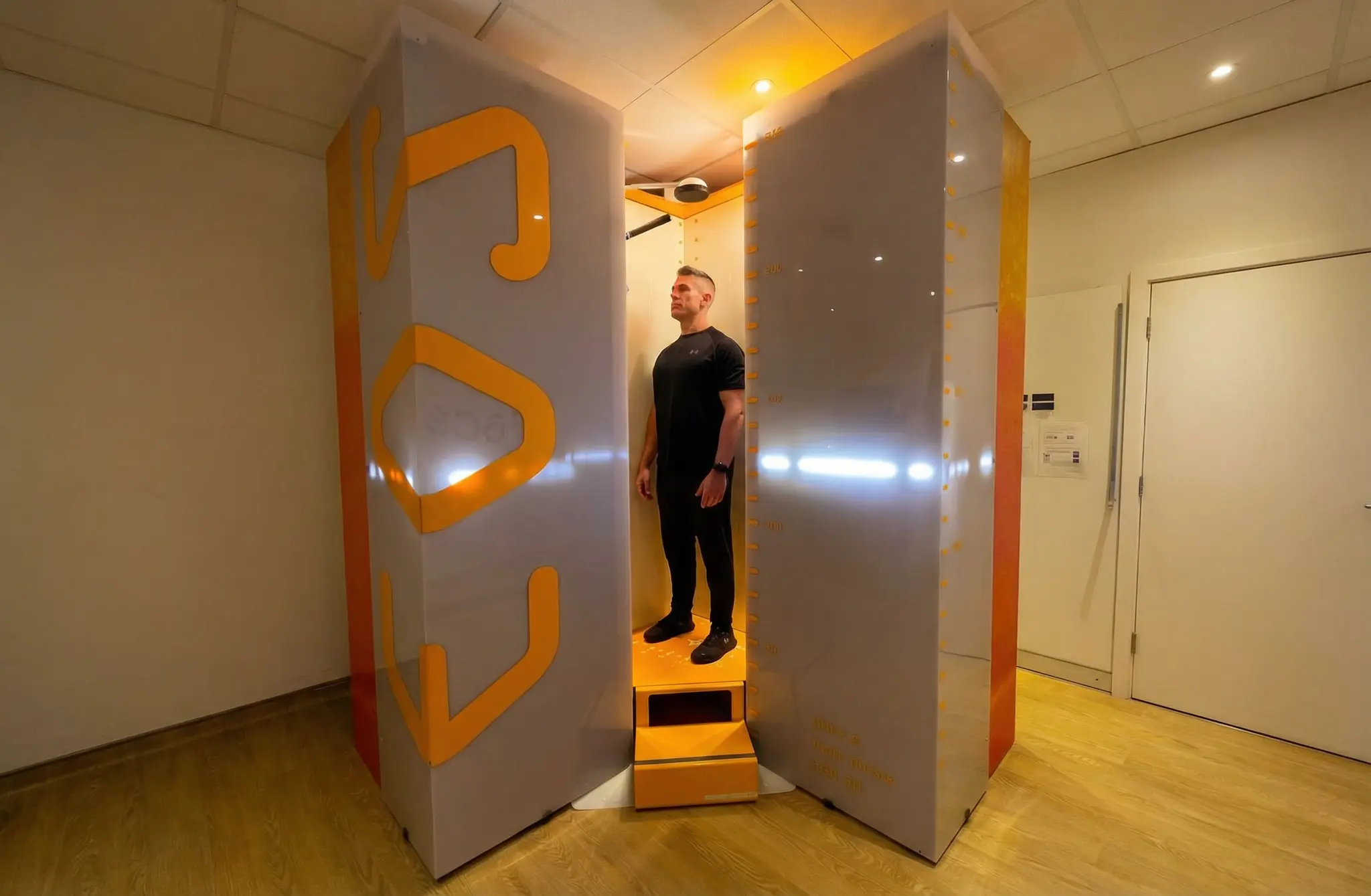
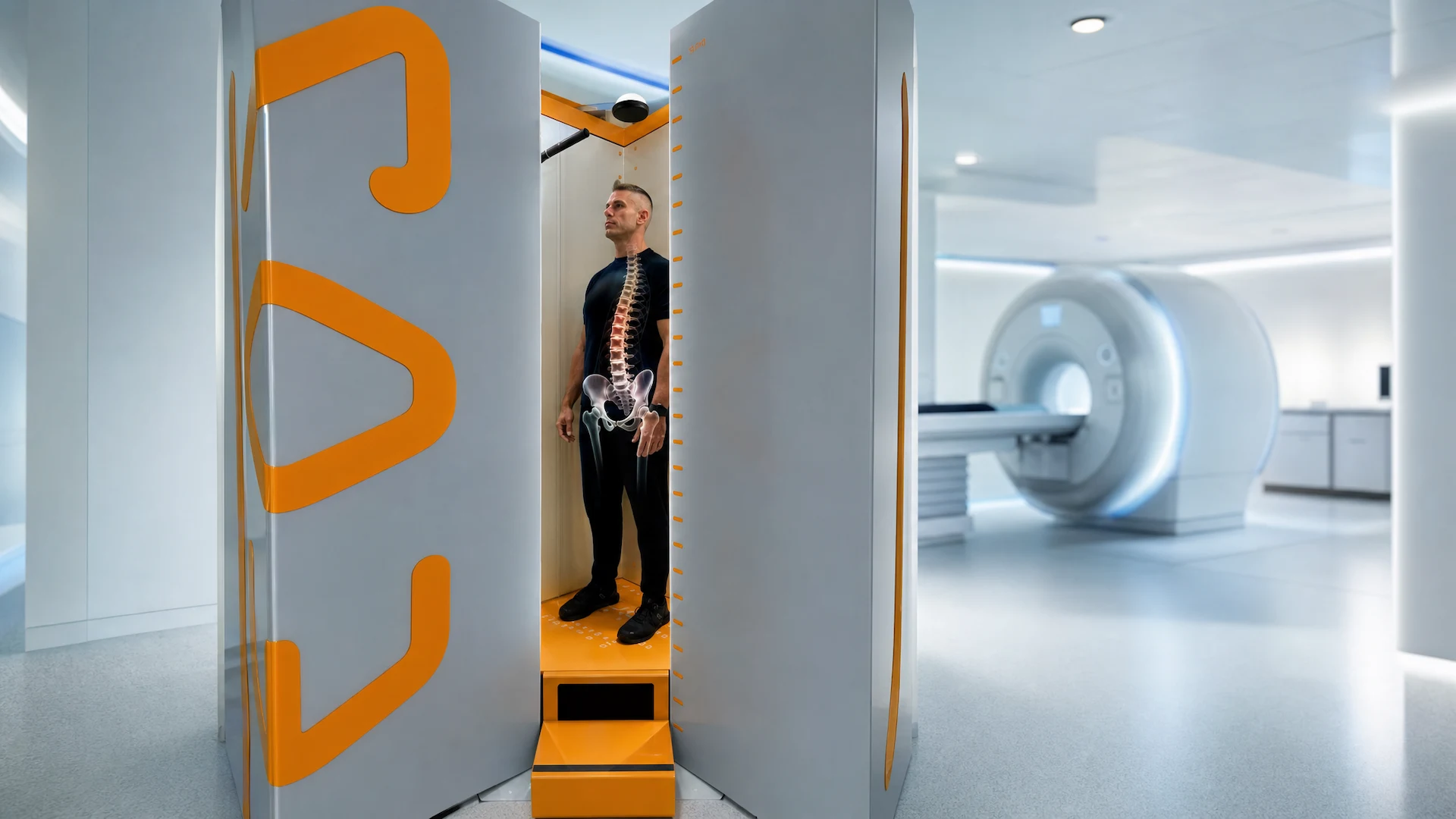
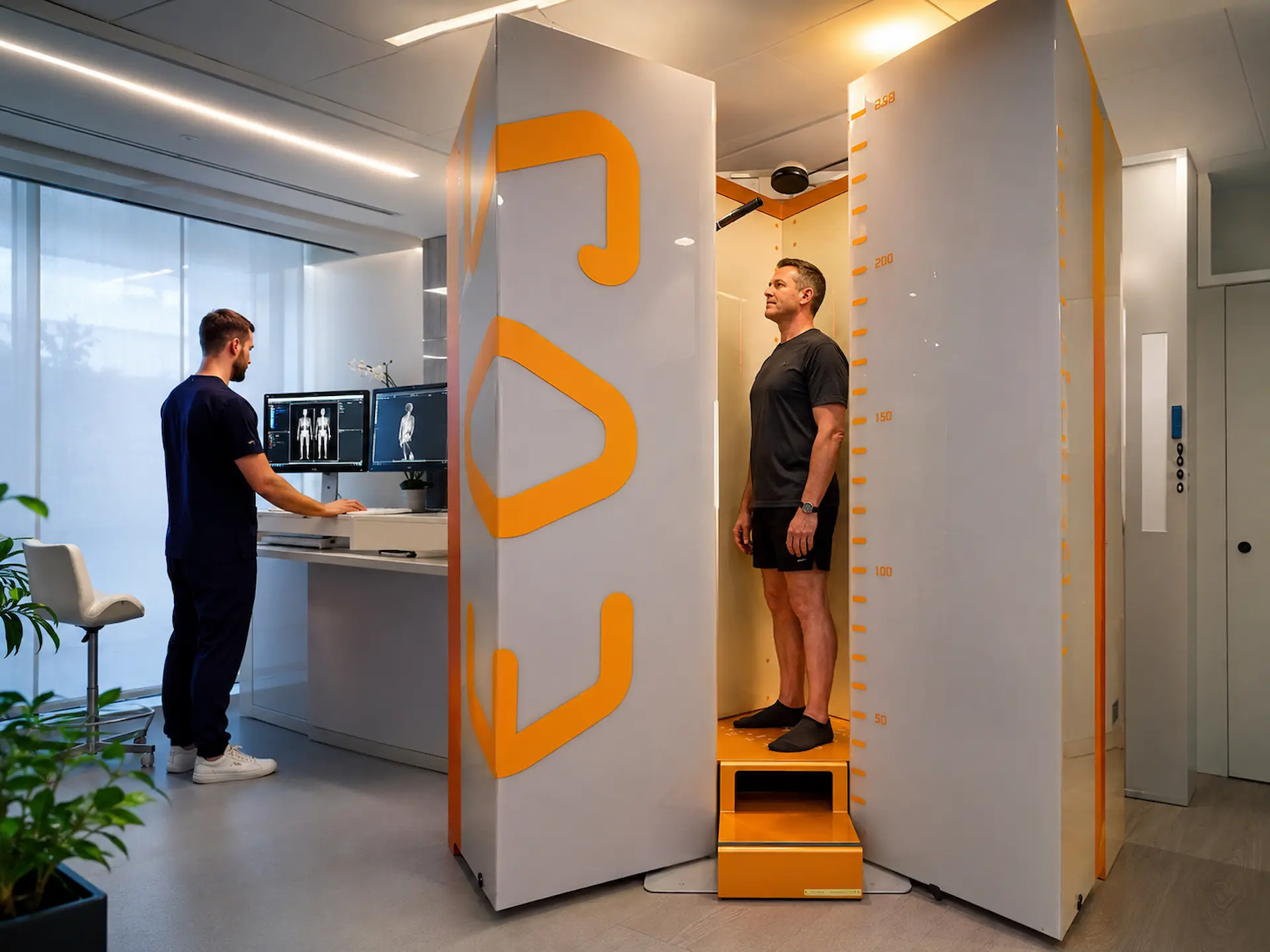
An EOS scan uses two low-dose X-ray beams to capture the body from the front and side at the same time while you stand naturally. The scan is quick, non-invasive, and does not require injections, dye, or a tunnel.
EOS imaging is different because it combines three important things:
- Standing position: Your skeleton is captured upright, under natural body weight.
- Full-body view: The scan can show alignment from head to foot in one image.
- 3D reconstruction: The system can create detailed measurements of bones, joints, and alignment.
This makes EOS especially useful for posture, skeletal alignment, and leg length discrepancy assessment. You can also read more about the EOS scan process before booking your appointment.
How EOS Measures Leg Length Discrepancy
EOS measures leg length while the patient is standing, which gives doctors a more realistic view of how the body carries weight. The scan can capture the lower limbs from the top of the femoral head down to the ankle and foot area.
Using 3D reconstruction, clinicians can measure:
- Exact femur and tibia length on each side
- True structural leg length difference in millimetres
- Pelvic tilt and its effect on apparent leg length
- Hip-knee-ankle angle
- Full lower limb alignment
This helps separate structural leg length discrepancy from functional leg length discrepancy. That distinction matters because both types can require different treatment plans.
EOS vs. Traditional Leg Length Scans: A Clear Comparison
| Feature | EOS Scan | Standard X-Ray | CT Scanogram | Tape Measure |
|---|---|---|---|---|
| Weight-bearing standing view | Yes | No | No | No |
| Full body alignment view | Yes | Limited | No | No |
| 3D measurement | Yes | No | Yes | No |
| Magnification errors | Very low | Possible | Moderate | High |
| Radiation level | Low-dose imaging | Moderate | Higher | None |
| Helps separate structural and functional LLD | Yes | Limited | Partial | No |
For low-dose imaging for leg length, EOS gives doctors both measurement accuracy and standing alignment information. This makes it especially helpful for patients whose symptoms appear during walking, standing, sport, or daily activity.
Who Should Get an EOS Scan for Leg Length Discrepancy?
You do not need to be in severe pain to benefit from an EOS leg length scan. Some people use it because symptoms are already affecting daily life. Others use it for monitoring, surgical planning, or to understand long-term alignment issues more clearly.
An EOS scan may be useful if you:
- Have persistent one-sided hip pain
- Walk with a visible lean or uneven gait
- Have recurring lower back pain
- Have scoliosis and want to understand if leg length is contributing
- Are a child or teenager being monitored during growth
- Have had hip replacement surgery and need leg length checked
- Are an athlete with repeated one-sided strain
Children are an important group because a leg length difference can change as they grow. EOS can support repeated monitoring while keeping radiation exposure lower than many traditional imaging options.
Important Note: If symptoms are ongoing or getting worse, always speak with a qualified specialist. A scan can provide useful information, but diagnosis and treatment should be guided by a medical professional.
What Happens During an EOS Leg Length Scan at ScanAlign?
The process at ScanAlign is designed to be simple and clear from start to finish.
Free Video Consultation
Before the scan, you can speak with an EOS specialist by video consultation. They review your symptoms, history, and reason for the scan to confirm whether EOS is suitable for you.
Arriving at Harley Street
ScanAlign operates from Harley Street Hospital in central London. You may be asked to remove metal items such as belts or jewellery and wear comfortable clothing.
The Scan
You stand inside the EOS scanning cabin while the system captures your body alignment. The scan is quick and does not involve a tunnel, injection, or dye.
Your Report
A consultant radiologist reviews the images and prepares a detailed report. This may include leg length measurements, alignment findings, and 3D skeletal information.
Follow-Up Guidance
A doctor can explain what the findings mean and how they relate to your symptoms, posture, walking pattern, or treatment plan.
What the Results Show — And How They Guide Treatment
An EOS leg length report gives your clinician a detailed view of both measurement and alignment. Instead of relying only on a lying-down image, doctors can see how your body stands, balances, and carries weight.
Based on the findings, treatment options may include:
- Shoe lifts or orthotics for smaller structural differences
- Physiotherapy when pelvic tilt or muscle imbalance is involved
- Surgical planning for larger structural differences
- Monitoring for children and teenagers during growth
- Post-surgery alignment checks when needed
If you also have back pain and poor posture, the scan may help show whether a leg length difference is contributing to spinal imbalance or uneven pressure through the body.
Can Leg Length Discrepancy Cause Back Pain or Hip Pain?
Yes, it can. When one leg is shorter, the pelvis may tilt to compensate. Over time, this can affect the lower back, hips, knees, and walking pattern.
Some people feel pain on one side only. Others notice that pain improves for a short time after treatment but keeps returning. In these cases, an unequal leg length scan may help identify a deeper alignment issue.
This does not mean every case of back or hip pain is caused by leg length discrepancy. But when symptoms are unexplained, EOS imaging can help doctors check whether body alignment is part of the problem.
Conclusion
Leg length discrepancy is often missed because many standard scans are not designed to show how the body behaves while standing. A measurement taken lying down may not fully explain hip pain, lower back pain, uneven walking, or posture imbalance.
An EOS scan for leg length discrepancy gives doctors a clearer view by combining standing posture, full-body alignment, and 3D measurement in one low-dose scan. Whether you are managing pain, monitoring growth, or planning treatment, accurate measurement is the first step toward better decisions.
Ready to Find Out If You Have a Leg Length Discrepancy?
At ScanAlign, Harley Street Hospital, our specialist team uses EOS 3D imaging to provide accurate standing leg length measurements and full-body alignment insights. One scan can help give you clearer answers about posture, pain, and movement.
FAQs
- 1. What is the most accurate way to measure leg length discrepancy? An EOS scan taken while standing is one of the most accurate options because it shows the body under natural weight-bearing conditions and supports detailed 3D measurements.
- 2. Can an EOS scan pick up a difference of just a few millimetres? Yes. EOS imaging can help detect small differences in leg length, which is important before recommending orthotics, shoe lifts, monitoring, or surgical planning.
- 3. Is EOS better than a CT scanogram for leg length? For many patients, EOS is preferred because it provides standing alignment information with low-dose imaging. A CT scanogram can measure bone length, but it is usually performed lying down.
- 4. What is the difference between structural and functional leg length discrepancy? Structural LLD means one bone is physically shorter. Functional LLD means the bones may be the same length, but pelvic tilt, posture, or muscle imbalance makes one leg appear shorter.
- 5. Is an EOS scan safe for children being monitored for leg length discrepancy? EOS is commonly used for children because it provides useful alignment information with lower radiation exposure than many traditional imaging methods. Your specialist will advise based on the child’s condition.
- 6. Can a leg length difference cause back pain or hip pain? Yes. Even a small difference can affect pelvic position and walking pattern, which may place extra stress on the hips, knees, and lower back over time.
Continue reading
More articles
What Is an EOS Scan?
Learn what an EOS full body scan is, how it works, its benefits, safety, and how it helps detect spine, joint, and posture problems with low radiation imaging.
MRI Shows Nothing But Back Pain Remains: Could Alignment Be the Cause?
Your MRI showed nothing but back pain never left. Alignment problems rarely show on standard scans. See how EOS imaging finds real cause while standing.
Posture Assessment in London: When Should You Consider an EOS Scan?
Got back pain or posture problems in London? Find out when a posture assessment and EOS scan can help you uncover the real cause of your pain.