

Why Is My Posture Getting Worse as I Get Older?
Your posture gets worse with age because of a combination of disc height loss in the spine, declining muscle mass (sarcopenia), reduced bone density, and years of habitual positioning. These changes are gradual, often painless at first, and many are partly reversible with the right guidance, once you know exactly what has changed.
Key takeaways
- Disc thinning, muscle loss and bone density changes all shift your alignment over time.
- Some postural changes are structural and fixed. Others are muscular and can be improved.
- Standard lying-down imaging does not show how your posture behaves under gravity.
- A standing whole-body scan creates a measurable baseline so changes can be tracked year on year.
- Early awareness is the single most useful step you can take.
You may have noticed it in a shop window reflection, a photograph, or the way your clothes hang differently. Perhaps someone has commented that you seem shorter, or you find yourself leaning further forward than you used to. These are not things you are imagining. Posture really does change with age, and there are clear biological reasons why.
What are the signs your posture is getting worse?
The most common sign is a gradual forward shift of the head and upper back. You might also notice height loss, stiffness first thing in the morning, or aching across the shoulders by the end of the day.
Increased postural sway is another subtle change. You may feel less steady on your feet, particularly when standing still for a period of time.
What causes posture to get worse with age?
Age-related postural decline is driven by several overlapping processes. None of them happens overnight, which is precisely why the change creeps up on you.
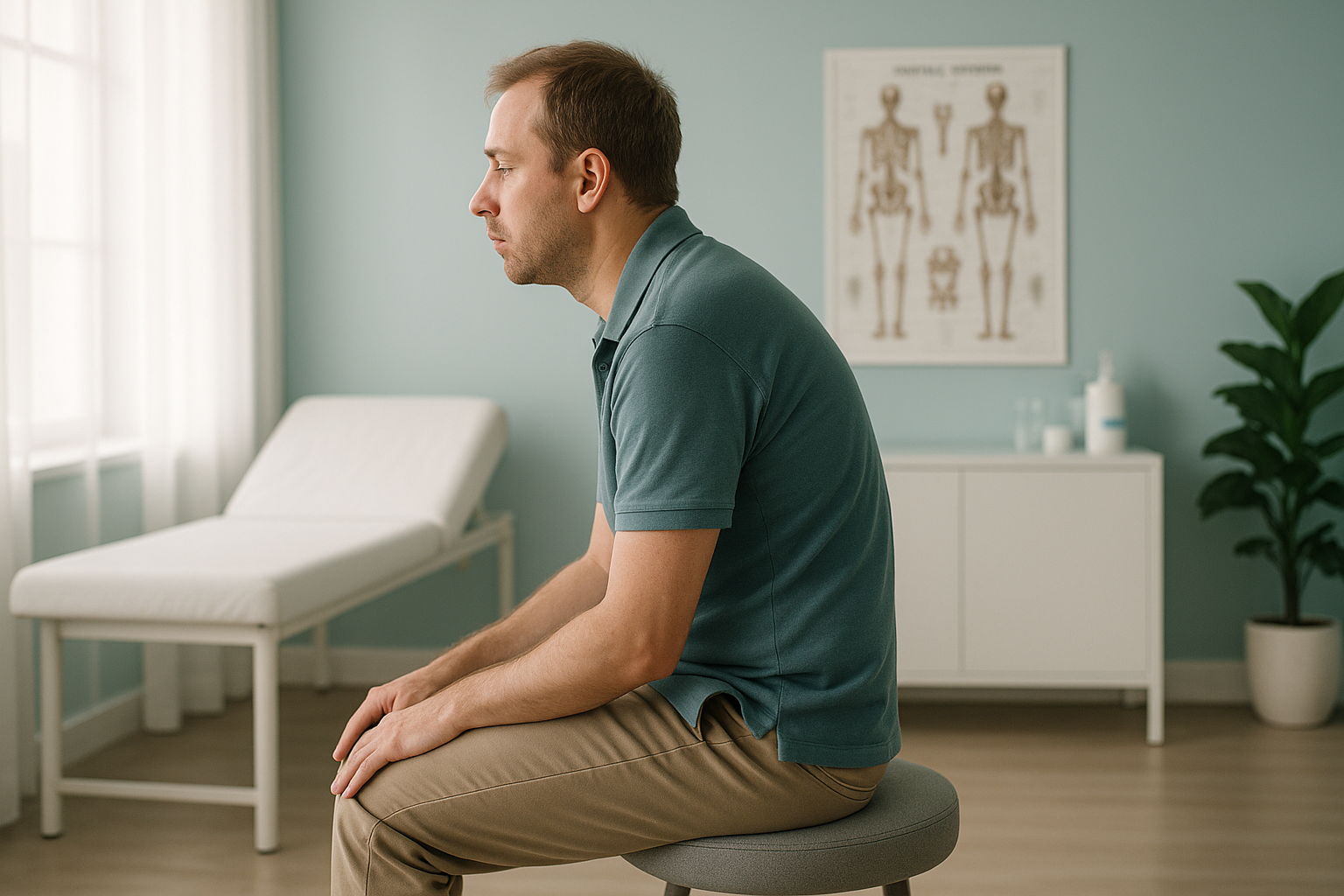
These four factors rarely act alone. Your body is a connected chain from your feet to your head. When the upper back rounds forward, the lower back, pelvis and knees all adjust to keep you balanced. This is why you may feel pain or stiffness in areas far from the original change. Forward leaning posture is one of the most common patterns we see.
Is age-related posture change reversible?
Some of it is, and some of it is not. The answer depends on whether the change is structural or muscular. That distinction matters enormously, and it is exactly what imaging can clarify.
- Muscle weakness and imbalance (sarcopenia)
- Tight hip flexors and chest muscles from prolonged sitting
- Reduced activity levels and deconditioning
- Poor movement habits and habitual positioning
- Disc height loss that has already occurred
- Vertebral wedging from reduced bone density
- Fused or significantly degenerated joints
- Long-standing fixed spinal curves
The encouraging part is that muscular factors often make up a meaningful share of the problem, especially in the early stages. Resistance training, targeted exercise and simply being more active can slow the decline and sometimes partly reverse it. But you need to know what you are working with before you start. Trying to stretch a structural curve, or strengthen muscles against a problem that needs medical review, wastes time and money.
A standing whole-body scan shows you exactly what is structural and what is muscular, giving you a clear starting point.
Book a free video consultationWhy does posture need to be assessed standing up?
Because posture only exists under gravity. When you lie down for a standard X-ray, CT or MRI, your muscles relax and the spine settles into a shape that may look quite different from how you actually stand. Curves can flatten, tilts can disappear, and the compensations your body makes every day simply switch off.
A standing EOS scan captures your entire skeleton from head to foot in one image, under your full body weight. It shows exactly how your spine, pelvis, hips, knees and ankles relate to one another in the position you actually live in. This is essential for posture, because posture is, by definition, your body's response to gravity.
The scan uses about 90% less radiation than a standard X-ray, around ten times less.
Conventional imaging takes pictures while you are lying flat. Gravity is removed, muscles are relaxed, and joints settle into positions they do not hold during the day. It is excellent for many things, but it cannot tell you how your alignment behaves when you are upright and weight-bearing.
ScanAlign standing EOS imaging captures your whole alignment in a single scan. That means the relationship between your upper back curve, lower back, pelvis and legs is visible in one view, not stitched together from separate images taken at different times.
When MRI is the better choice: EOS shows bones, joints and alignment. For soft-tissue problems such as disc bulges, nerve compression or ligament damage, MRI is usually the better tool. If your symptoms include numbness, weakness, or loss of bladder or bowel control, please seek urgent medical attention from your GP, 111, or A&E rather than booking a scan.
How can a baseline scan track posture changes over time?
A single scan gives you a snapshot of where you are today. A follow-up scan, taken after a period of exercise, treatment or simply the passage of time, gives you a measurable comparison. You can see precisely what has changed, what has stayed stable, and where to focus next.
Discuss your concerns with a specialist radiographer. No referral needed.
A quick, low-dose whole-body image captured while you stand naturally at 19 Harley Street.
Your alignment is analysed and explained in plain language, with measurements your clinician or physio can use.
Return for a repeat scan to track progress, monitor changes, or check that a programme is working.
This is particularly valuable if you have started a new exercise routine, physiotherapy programme, or are simply aware that your posture is changing and want to keep an eye on it. You can book a baseline posture scan without a GP referral.
Frequently asked questions
Most people begin to notice subtle changes from their 40s onwards. Disc thinning and muscle mass decline both accelerate after this point, although lifestyle, activity level and genetics all play a part in the speed of change.
Yes, height loss with age is real. It is mainly caused by the spinal discs losing water content and becoming thinner, along with increased curvature of the upper back. A standing scan can measure the extent of these changes precisely.
Exercise, particularly resistance training and targeted strengthening, can improve the muscular component of poor posture. It cannot reverse structural changes like disc height loss or vertebral wedging, but it can slow their impact and improve how you hold yourself day to day.
A posture problem may be entirely muscular and habitual. A spinal condition, such as significant degeneration or vertebral compression, is structural. Imaging helps distinguish between the two, which determines what kind of help you need.
Posture only exists under gravity. A lying-down X-ray removes the effect of body weight, so curves and tilts that are present when you stand may not appear. A standing EOS scan captures your real-world alignment from head to foot in a single image.
Yes. The EOS system uses about 90% less radiation than a standard X-ray, around ten times less. This low dose makes it suitable for baseline scans and follow-up comparisons over time.
No. ScanAlign accepts self-referrals. You can book a free video consultation directly to discuss your concerns before deciding whether a scan is right for you.
Pricing details are available on our FAQs and pricing page. The initial video consultation is free.
That depends on your situation. If you are actively working on posture improvement through exercise or physiotherapy, a follow-up after several months can show measurable progress. For general monitoring, an annual or biennial scan is a common choice. Your radiographer can advise during the consultation.
No. EOS excels at showing bony alignment, joint spacing and whole-body posture. For soft-tissue detail such as disc bulges, nerve compression or ligament injuries, MRI is usually the better tool.
See where your posture stands today
A standing whole-body scan gives you a measurable baseline. Track changes over time. No referral needed.
Book a free video consultationWritten by Abbas Dhami (Specialist Diagnostic Radiographer)
Sources
- Cruz-Jentoft AJ, Bahat G, Bauer J, et al. Sarcopenia: revised European consensus on definition and diagnosis. Age and Ageing. 2019;48(1):16-31.
- Katzman WB, Wanek L, Shepherd JA, Sellmeyer DE. Age-related hyperkyphosis: its causes, consequences, and management. Journal of Orthopaedic & Sports Physical Therapy. 2010;40(6):352-360.
- NHS. Posture tips for older adults. nhs.uk. Available at: https://www.nhs.uk/live-well/exercise/common-posture-mistakes-and-fixes/
This page is general information and not a diagnosis.
ScanAlign is the trading name of CoreMed Solutions Ltd and operates under The Harley Street Hospital's CQC licence.