
Forward Leaning Posture: What Causes It and How Do You Find Out Why?
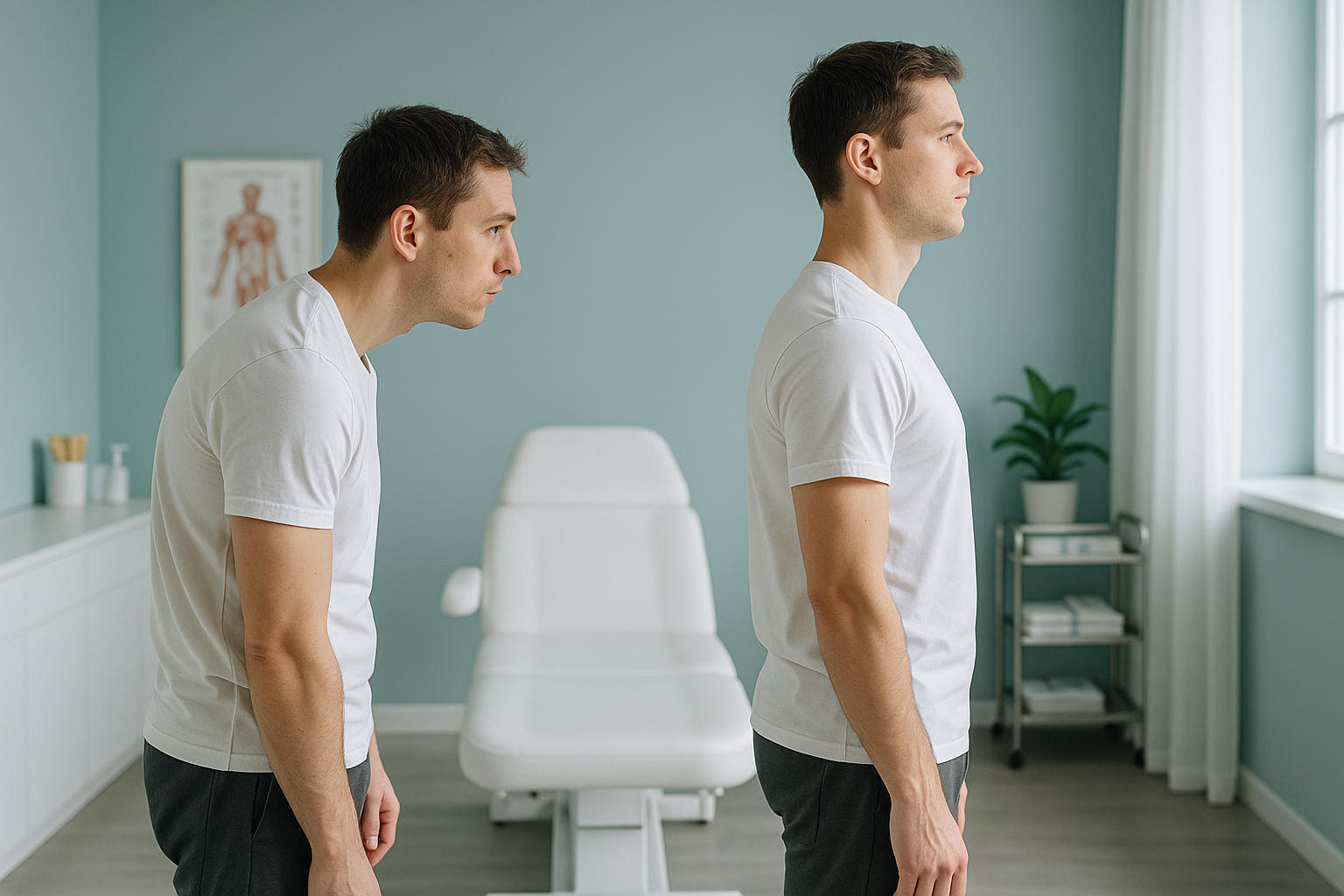
Forward posture happens when your head, shoulders or trunk shift ahead of your centre of gravity. Your muscles and joints then work harder to keep you upright, often causing pain in areas far from the real problem. A standing, whole-body image is the clearest way to see where the imbalance begins.
Key takeaways
- Forward posture is a whole-body alignment issue, not just a neck or shoulder problem.
- Pain often shows up away from the actual structural cause.
- Lying-down scans can miss alignment shifts that only appear when you are standing and weight-bearing.
- EOS imaging captures your full skeleton in a standing position with about 90% less radiation than a standard X-ray.
- ScanAlign is a diagnostic imaging clinic. It does not provide treatment, but its findings can guide the clinician who does.
What is forward leaning posture?
Forward leaning posture is a shift in your body's alignment where parts of your skeleton sit further forward than they should relative to your centre of gravity. In a well-aligned posture, your ear, shoulder, hip, knee and ankle should roughly line up when viewed from the side. When that line breaks, your muscles have to compensate to stop you falling forward.
This is sometimes called a stooped posture or forward trunk lean. It can involve the head alone (often called a forward head position), the upper back rounding forward, the pelvis tilting, or a combination of all three. It is very common and becomes more noticeable with age, prolonged sitting, or after certain spinal conditions.
How do you know if you have forward posture?
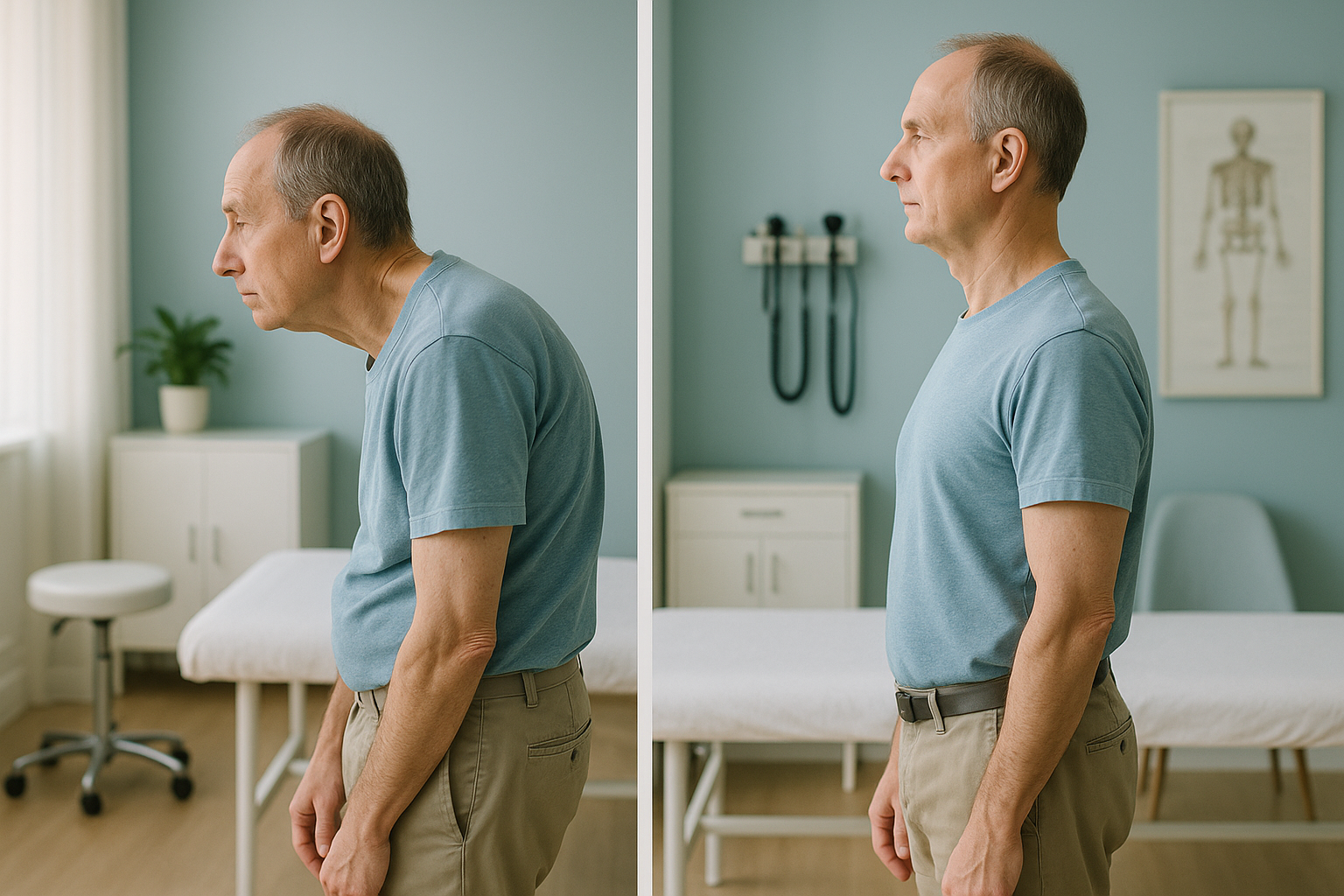
You might notice it yourself, or someone else may point it out. Many people live with it for years before the discomfort builds up enough to investigate. Here are common signs.
When you stand naturally, your ears are clearly ahead of your shoulders rather than above them.
Your upper back curves more than it should, making your shoulders roll forward.
Persistent aching across the back of the neck, between the shoulder blades, or into the lower back.
Standing for more than a few minutes feels tiring because your muscles are constantly working to keep you upright.
A note on red-flag symptoms. If your forward posture is accompanied by sudden weakness in your legs, numbness spreading into both arms or legs, or loss of bladder or bowel control, seek urgent medical attention. Contact your GP, call 111, or go to A&E.
What causes forward leaning posture?
Forward posture is rarely caused by one thing alone. It usually develops from a combination of habits, structural changes, and the body's attempt to stay balanced despite them.
Desk work, driving, or sofa time trains your body into a forward-rounded position over months and years.
Wear in the discs or vertebrae can reduce the natural curves of your spine, tipping you forward.
If your hips or knees cannot fully extend, your trunk shifts forward to keep your balance.
Weak core and back extensor muscles cannot hold the spine in its natural upright position.
Spinal fusion, hip replacement, or an old fracture can alter the way your skeleton balances.
Why does forward posture cause pain in unexpected places?
Your skeleton works as a connected chain from your feet to your head. When one link shifts, the links above and below adjust to compensate. This is why forward posture correction needs to start with understanding the whole chain, not just the area that hurts.
For example, stiff hips that will not fully straighten can push your pelvis into a forward tilt. Your lower back then increases its curve to keep you looking ahead, and your upper back rounds further to balance. The result is neck pain and shoulder tension, but the root cause is in the hips.
A scan that only looks at the neck will see the strain but miss the reason. That is why single-area imaging often gives an incomplete picture.
Want to understand how your whole alignment connects? A free video consultation is a good place to start.
Book a free video consultationHow is forward posture assessed when you are standing up?
The most accurate way to see forward posture is to image the body while it is upright, weight-bearing, and working against gravity. This is exactly what an EOS scan does.
Most standard imaging, whether X-ray, CT, or MRI, asks you to lie down. When you lie flat, gravity is removed. Your muscles relax, your joints decompress, and the alignment shifts that cause your symptoms can partially or completely disappear. The images look more "normal" than your body actually is during daily life.
An EOS scan captures your full skeleton from head to feet in one standing image. It uses about 90% less radiation than a standard X-ray, around ten times less. Because you are standing, the image shows your posture and alignment exactly as it is when you are on your feet, walking, or going about your day.
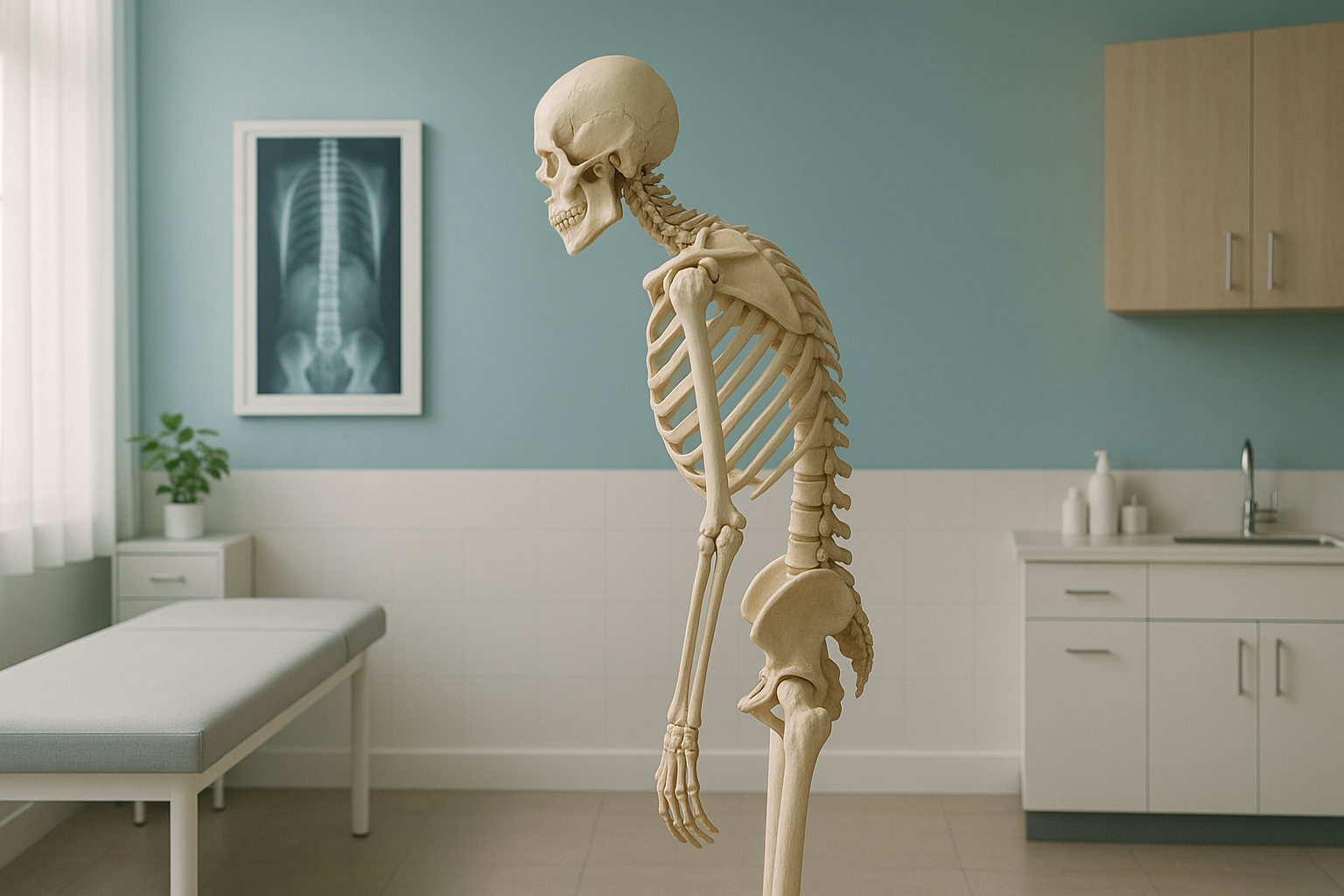
At ScanAlign, the EOS image is reviewed and a detailed alignment report is produced. This report gives your treating clinician, whether a physiotherapist, osteopath, or surgeon, the information they need to target the actual source of your forward posture rather than just the symptoms. Learn more about how EOS whole-body imaging works.
What helps with leaning forward posture correction?
Correction starts with knowing exactly where the imbalance is. Without that, any approach is guesswork. Here is the general landscape of what clinicians may consider, depending on the findings.
- Targeted exercises. Strengthening the right muscles and stretching the tight ones, guided by what the imaging actually shows.
- Manual therapy. Physiotherapy, osteopathy, or chiropractic work can address joint stiffness contributing to the lean.
- Ergonomic changes. Adjusting your desk, screen height, or driving position to reduce the time spent in a forward-loaded posture.
- Surgical planning. In more severe or structural cases, a surgeon may use the alignment data to plan a procedure. This is especially relevant after a previous spinal procedure or when considering one.
ScanAlign does not provide treatment. It provides the diagnostic imaging that helps the people who treat you make better decisions.
When MRI is the better choice. EOS shows bones, joints, and whole-body alignment clearly. If your clinician suspects a disc bulge, nerve compression, or soft-tissue damage as part of your forward posture, MRI is usually the better tool for those structures. The two types of imaging complement each other well.
Frequently asked questions about forward posture
In many cases, yes, it can be improved. The degree of improvement depends on what is causing it. Postural habits and muscle imbalances often respond well to targeted exercise. Structural changes in the spine may limit full correction but can still be managed. The key is accurate imaging to understand what is driving the lean before starting any programme.
Not exactly. Kyphosis refers specifically to an increased curve in the upper back (the thoracic spine). Forward posture is a broader term that can involve the head, upper back, pelvis, hips, or all of them. Kyphosis is one of several things that can contribute to an overall forward lean.
If your alignment is shifted forward, your back muscles have to work constantly to stop you tipping further. Over time this causes fatigue and pain. When you sit or lie down, the load is taken off and the pain eases, which is another clue that the problem is alignment-related.
No. ScanAlign is a private, self-pay clinic. You can refer yourself. The process begins with a free video consultation to make sure the scan is right for your situation.
An EOS scan uses about 90% less radiation than a standard X-ray, around ten times less. This makes it one of the lowest-dose skeletal imaging options available.
A standard X-ray can show part of the picture, but it usually only images one region at a time and often with you lying down. It cannot show how your whole skeleton balances from head to foot in a standing position. An EOS scan captures that full, weight-bearing view in a single image.
The scan itself takes less than a minute. You stand still inside the EOS system while it captures the image. The whole appointment, including positioning, is much quicker than most hospital imaging visits.
Pricing details are available on the ScanAlign FAQs and cost page. The free video consultation is a good first step to understand whether the scan is appropriate for you.
The scan provides a detailed alignment report, not an exercise programme. Your treating clinician, whether a physiotherapist, osteopath, or surgeon, uses the report to design the right plan for you. It gives them the objective data they need rather than relying on observation alone.
Yes, it can. When your trunk leans forward, the load on your hips and knees changes. They may bear more weight on the front or on one side, leading to pain and wear over time. A whole-body standing image helps reveal these connections. You can read more about knee alignment assessment or hip alignment assessment.
See your posture as it really is
A free video consultation helps you understand whether a standing whole-body scan is the right next step for your forward posture.
Book a free video consultationWritten by Abbas Dhami (Specialist Diagnostic Radiographer)
Sources
- Glassman SD, Bridwell K, Dimar JR, Horton W, Berven S, Schwab F. The impact of positive sagittal balance in adult spinal deformity. Spine. 2005;30(18):2024-2029.
- NHS. Back pain: causes. nhs.uk. Available at: https://www.nhs.uk/conditions/back-pain/
- Illés T, Somoskeöy S. The EOS imaging system and its uses in daily orthopaedic practice. International Orthopaedics. 2012;36(7):1405-1411.
This page is general information and not a diagnosis.
ScanAlign is the trading name of CoreMed Solutions Ltd and operates under The Harley Street Hospital's CQC licence.