

Abbas Dhami
Specialist Diagnostic Radiographer
Back pain is one of the most common health problems in the UK, yet millions of people are still told “everything looks normal” after their scans. The truth is, traditional imaging methods have real limits — they scan you lying down, which means your spine is relaxed and not in the position it actually holds during daily life. This disconnect between how you are scanned and how you actually live is one of the main reasons so many people cycle through treatments without ever finding real relief. The problem was never that nothing was wrong — it was that the scan was never designed to find it.
EOS imaging for back pain solves this problem. It scans your full skeleton while you stand upright, revealing the true state of your spinal alignment, posture, and the hidden causes of your pain — all in around 15 seconds, with ultra-low radiation. Unlike traditional methods that capture a single region of the body in a resting position, EOS produces a complete 2D and 3D picture of your entire skeleton under real load.
That means your care team can finally see not just where your pain is — but exactly why it is there.
Why Back Pain and Poor Posture Are So Commonly Misdiagnosed
Many people spend years cycling through treatments without ever finding lasting relief — and often, the reason comes down to incomplete imaging that never captured the full picture.
The Problem With Standard Scans
Standard MRI and CT scans are done while you lie flat on your back. In this position, gravity is no longer pressing down on your spine. Muscles relax, discs decompress, and any imbalances that only appear under the weight of your body simply disappear from the image. This is why so many patients walk away with a “normal” result, even when something is clearly wrong.
How Poor Posture Builds Up Over Time
Postural imbalance develops slowly. Years of sitting at a desk, carrying weight on one side, or simply not standing straight gradually shift the natural curves of the spine. By the time pain appears, the underlying skeletal problem may have been there for years — invisible to standard scans and therefore left untreated.
What Is EOS Imaging? A Closer Look at the Technology
If you have never heard of EOS imaging before, you are not alone — it remains rare in the UK, despite being widely used across Europe, the USA, Japan, and Australia.
How EOS Works
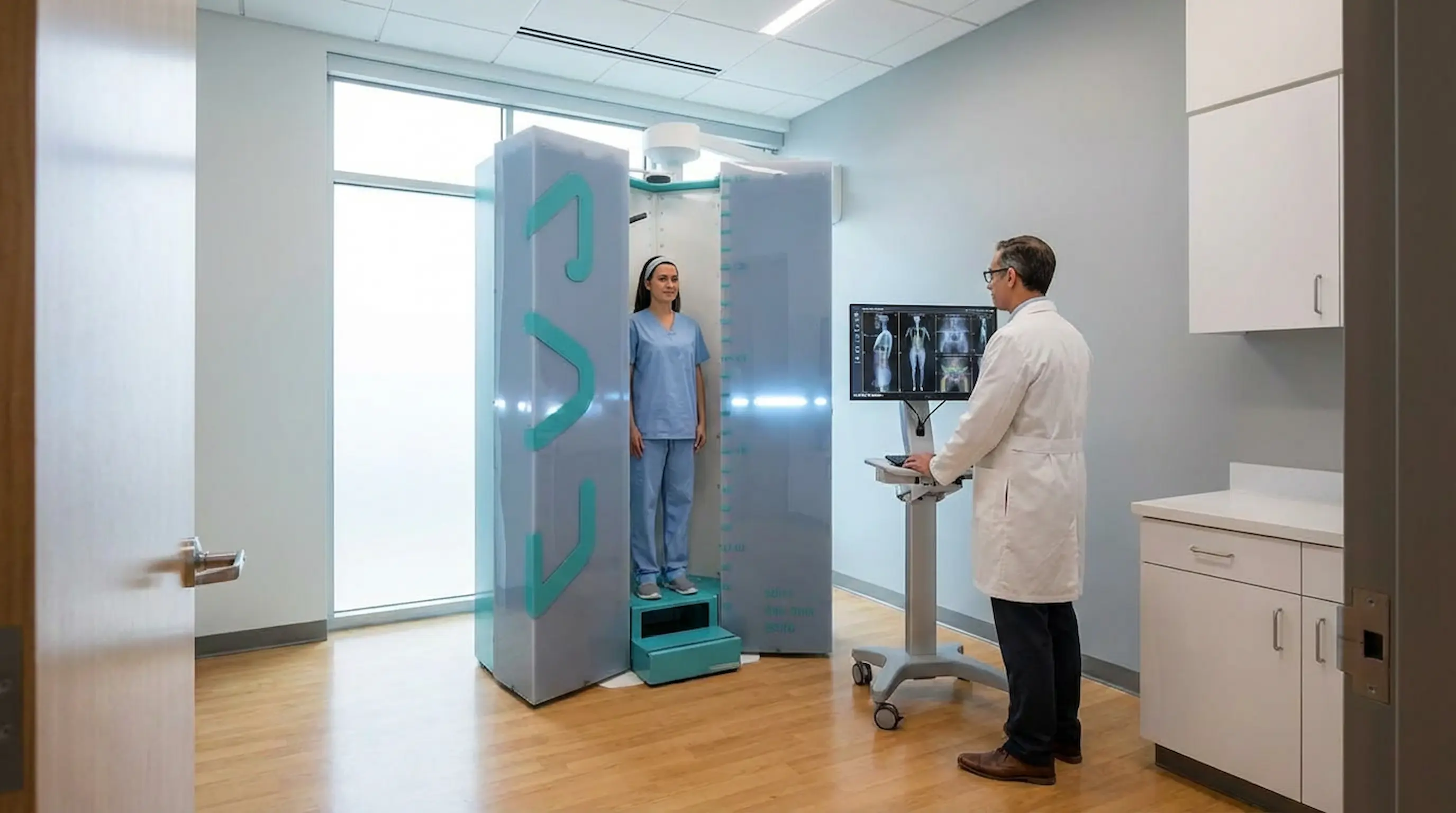
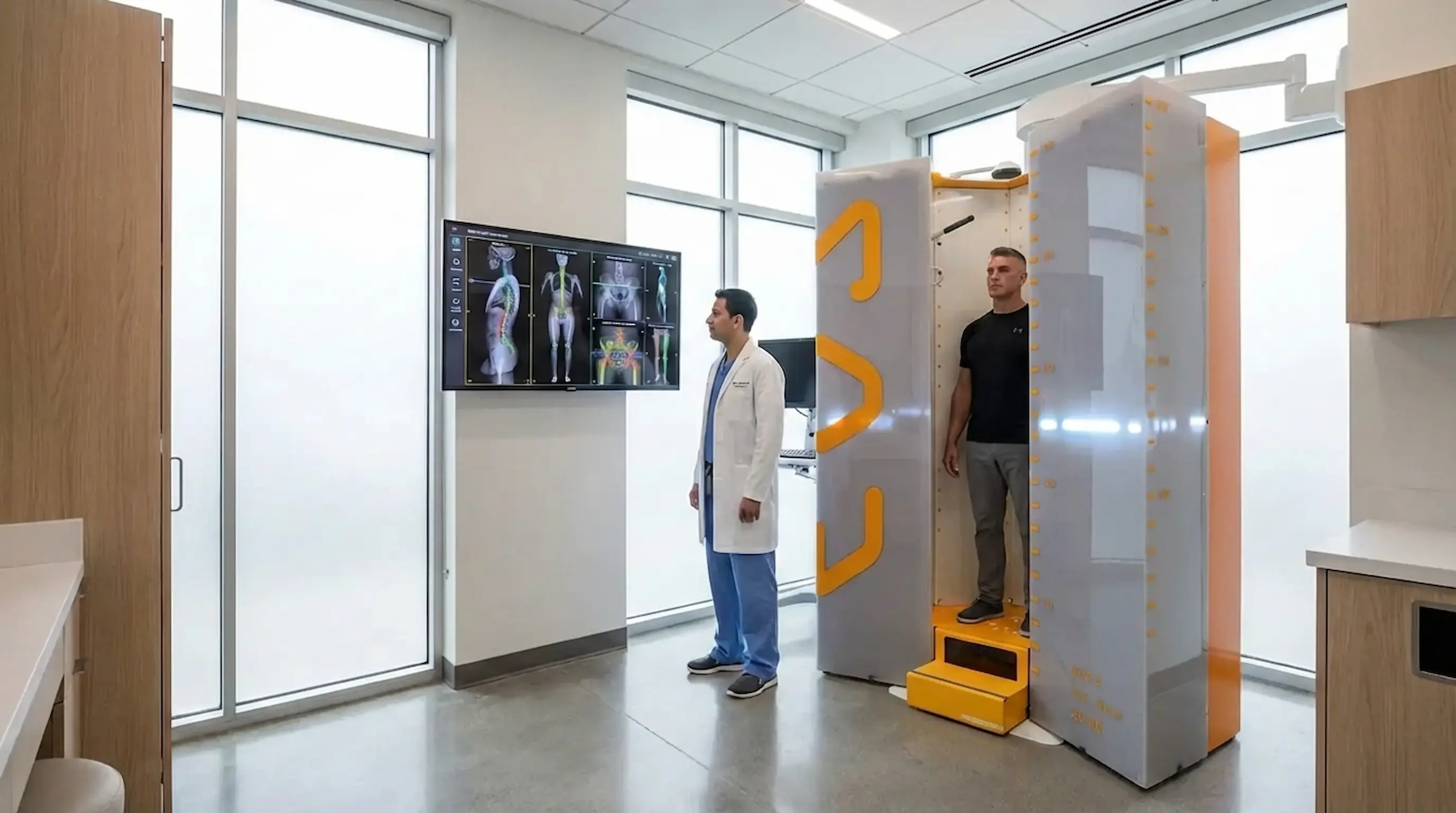
EOS imaging is a full-body scanning system that captures your entire skeleton — spine, pelvis, hips, and legs — while you stand in a natural, upright position. It takes two images at the same time: one from the front and one from the side. These are then combined to create both 2D and 3D views of your skeletal structure, giving specialists a level of detail that simply was not available before.
The technology is based on Nobel Prize-winning particle detector science, originally developed at CERN. Its detectors are so sensitive that they need very little radiation to produce a sharp, detailed image — up to 90% less radiation than a standard X-ray.
Why EOS Is Still Rare in the UK
EOS imaging is widely used in the USA, Germany, Japan, and Australia. In the UK, it remains rare due to high equipment costs and the fact that NICE has not yet recommended it for widespread NHS use. ScanAlign, based at the world-renowned Harley Street in London, is among the very few private clinics in the UK where patients can access this technology directly and quickly.
The Problem With Traditional Scans: Why Lying Down Does Not Tell the Whole Story
Most patients are not told that the position of their scan can affect what is — and is not — visible. This is one of the most important things to understand before choosing your imaging method.
Weight-Bearing Imaging vs. Lying-Down Scans
When you lie down for a scan, your spine is in a completely different state than when you stand. A weight-bearing X-ray or standing spine scan shows the spine under real-world conditions — with gravity acting on the body exactly as it does throughout your waking hours. A curve, tilt, or misalignment that is barely noticeable on a lying-down scan can look completely different, and far more significant, when captured while standing.
What EOS Does Differently
EOS imaging is built around this principle. Patients stand inside the open scanning unit, and the machine captures both front and side images at the same moment. There is no lying down, no repositioning, and no awkward poses. The result is an image that reflects how your body actually functions, not just how it looks at rest.
What Does EOS Imaging Reveal About Your Spine?
A single EOS scan produces more diagnostic information than most patients receive from months of appointments — covering everything from individual vertebrae to whole-body balance.
Spinal Alignment
EOS measures the exact angles and curves of every section of your spine — from the neck all the way down to the tailbone. Any deviation from healthy spinal alignment is clearly identified and precisely measured, giving your care team a reliable baseline to work from.
Kyphosis Posture
Kyphosis is an excessive forward rounding of the upper back. It is common in people who sit for long hours, older adults with bone density changes, and teenagers during growth spurts. EOS imaging provides precise 3D measurements of the degree of kyphosis, which is critical for choosing the right treatment path and monitoring progress over time.
Postural Imbalance
An uneven pelvis, one shoulder sitting higher than the other, or a spine that tilts to one side are all signs of postural imbalance. EOS makes these visible and measurable in a single scan — something no lying-down scan can replicate.
Pelvic Tilt and Leg Length Discrepancy
A tilted pelvis is one of the most overlooked causes of lower back pain. Even a small difference in leg length forces the spine to compensate over years, creating pain that builds gradually. EOS measures both legs and the full pelvic structure at the same time, making these issues easy to spot and measure accurately.
EOS Imaging for Back Pain: How It Finds the Root Cause
Persistent back pain rarely has a single, simple cause — and that is exactly why standard imaging so often falls short of finding it.
Seeing the Full Picture
Chronic back pain is usually the result of several imbalances working together — a tilted pelvis here, a slight leg length difference there, and a rotated vertebra all adding pressure to the same area. Traditional scans focus on one region of the body at a time and miss the chain reactions happening across the whole skeleton.
How EOS Connects the Dots
EOS imaging for back pain captures the entire skeleton in one standing scan, revealing how different parts of your body are compensating for each other. If one leg is shorter, the pelvis tilts. That tilt curves the lower spine. That curve strains the muscles further up the back. None of these connections are visible unless the whole body is scanned together, in a standing position.
By mapping these chain reactions, EOS gives your doctor or physiotherapist a complete picture of your alignment — so treatment targets the actual cause, not just where you feel the pain.
Kyphosis, Lordosis, and Postural Imbalance: What EOS Can Detect
EOS imaging does not just confirm whether a spinal condition is present — it measures exactly how significant it is, which makes a real difference to how effectively it can be treated.
Kyphosis
Kyphosis posture means the upper back curves too far forward. Even a mild kyphosis that is not clearly visible can affect how the rest of the spine compensates, leading to muscle strain and pain further down the back.
Lordosis
Lordosis is an excessive inward curve of the lower back. It often develops alongside a forward-tilting pelvis and is frequently linked to extended periods of sitting, which tightens the hip flexor muscles and gradually alters the lower spine’s natural position.
Postural Imbalance
Postural imbalance is any situation where the body is not symmetrically balanced — front to back or side to side. It causes uneven wear on joints, muscle fatigue on one side, and chronic pain that seems to shift location. EOS imaging for posture problems measures all of these conditions in their true weight-bearing state — identifying not just what is wrong, but exactly how much, which is essential for building an effective treatment plan.
EOS Imaging vs. MRI and Standard X-Ray: Which Scan Is Right for Back Pain?
Most people with back pain have already had at least one scan before they discover EOS — and a common question is how it compares to what they have already tried. The honest answer is that each method sees something different, and for assessing the structural causes of back pain and poor posture, EOS provides information that neither MRI nor a standard X-ray can offer.
| Feature | EOS Imaging | Standard X-Ray | MRI |
|---|---|---|---|
| Patient position | Standing (weight-bearing) | Usually lying or partial load | Lying flat |
| View coverage | Full spine and body in one scan | One region at a time | One region at a time |
| Spinal alignment measurement | Precise, under real load | Limited, no full context | Not assessed |
| Kyphosis and lordosis grading | Accurate 3D measurement | Basic only | Not primary function |
| Postural imbalance detection | Full body under load | Not assessed | Not assessed |
| Pelvic tilt and leg length | Both measured simultaneously | Not measured | Not measured |
| Soft tissue and disc assessment | Bone and alignment only | Bone only | Discs, nerves, soft tissue |
| Radiation dose | Very low (up to 90% less than X-ray) | Low | None |
| Surgical and treatment planning | Full 3D skeletal model | Limited | Soft tissue only |
MRI excels for detailed soft tissue views, X-rays spot basic bone issues, but EOS uniquely captures full-body alignment under natural load — highlighting what lying-down scans miss.
EOS Imaging for Posture Problems: Who Should Consider It?
EOS is not exclusively for people with severe spinal conditions — it is a genuinely useful diagnostic tool for a much wider range of patients.
Are You the Right Candidate?
Check the full eligibility criteria at ScanAlign to find out if an EOS scan is right for you. In general, you may benefit from a scan if you:
- Have had chronic back, hip, or leg pain for more than three months
- Have been told your scans are normal but the pain continues
- Have been diagnosed with scoliosis, kyphosis, or another spinal curve condition
- Notice one shoulder, hip, or leg appears higher than the other
- Are preparing for or recovering from spinal surgery
- Are an athlete with recurring lower back or hip injuries
- Have a child whose spinal condition needs regular monitoring
Why It Is Safe for Regular Use
Because low-dose spine imaging with EOS uses up to 90% less radiation than a conventional X-ray, it is one of the safest options for patients requiring repeat scans — including children. ScanAlign has a dedicated paediatric EOS imaging service for younger patients with developing spinal conditions that need to be monitored safely over time. If you want to understand more about radiation exposure, read is an EOS scan safe on the ScanAlign blog.
How EOS Results Help Your Doctor or Physiotherapist Treat You Better
Accurate imaging does not just identify a problem — it transforms the quality of care that follows, making every treatment decision sharper and more targeted.
From Diagnosis to Targeted Treatment
Because EOS provides a complete 3D map of your skeletal structure in a weight-bearing position, your doctor or physiotherapist can see exactly what is causing your pain — not just where it is. A physiotherapist treating lower back pain can see whether it is linked to a pelvic tilt, a leg length difference, or a spinal curve. Instead of generic exercises, they can design a plan that targets the specific imbalance driving your symptoms.
Better Imaging, Better Outcomes
For surgeons, EOS provides the full anatomical picture needed for accurate pre-operative planning. For those using orthotics or insoles, it delivers the precise measurements needed to create a truly personalised device. A spine posture assessment with EOS transforms the way your care team understands your body — and that understanding leads directly to better, longer-lasting results.
Conclusion
Back pain and poor posture affect millions of people in the UK, and for many, finding the real cause has been a long and frustrating journey. Traditional scans miss what EOS imaging consistently finds — the hidden skeletal imbalances driving chronic pain.
By scanning the full body in a natural standing position with minimal radiation, EOS gives specialists the clearest possible picture of your spine, posture, and alignment. When your care team can see exactly how your skeleton is aligned under real load, every treatment decision becomes sharper and more targeted.
Whether you are at the start of your diagnostic journey or have been searching for answers for years, an EOS scan can help turn uncertainty into clarity.
Ready to Find the Real Cause of Your Back Pain?
Stop guessing and start knowing. Book your free consultation and take the first step toward clearer answers and better treatment planning.
Book Your Free EOS Consultation Today →FAQs
- What is EOS imaging used for? EOS imaging is used to assess spinal alignment, posture, scoliosis, kyphosis, pelvic tilt, leg length differences, and other musculoskeletal conditions — especially the root cause of chronic back pain and poor posture.
- How is EOS imaging different from an MRI or CT scan? Unlike MRI and CT scans performed lying down, EOS images you while standing upright. This captures your spine under real weight-bearing conditions, revealing imbalances that lying-down scans can miss.
- Is EOS imaging safe for repeated use? Yes. EOS uses up to 90% less radiation than a conventional X-ray, making it one of the safest options for patients — including children — who need regular monitoring scans.
- Can EOS imaging detect kyphosis and poor posture? Yes. EOS is highly effective for assessing kyphosis and postural imbalance, providing precise 3D measurements of spinal curves and overall alignment in a single standing scan.
- How do I book an EOS spine posture assessment in the UK? You can start by booking a consultation through the ScanAlign website, where the team can assess your needs and guide you through the next steps.
- Does ScanAlign accept GP referrals? Yes. Healthcare professionals including GPs, physiotherapists, and consultants can refer patients through the ScanAlign website.
Continue reading
More articles
Is EOS Scan Safe? Radiation Levels, Risks, and FAQs
Discover if EOS imaging is safe, its radiation levels, risks, and benefits. Learn why it’s preferred for accurate, low-dose skeletal scans.

EOS Scan for Scoliosis: Why Standing Imaging Matters
Discover how EOS for scoliosis provides low-radiation imaging for accurate spinal alignment and better scoliosis diagnosis and monitoring.
Hip Pain & Alignment: EOS Imaging for Better Diagnosis
EOS imaging for hip pain reveals pelvic tilt, leg length discrepancy & spinopelvic alignment that routine scans miss. Book Appointment now.