

Why Does My Back Hurt When I Lie Down?
Back pain while lying down often happens because your spine changes shape when you go from standing to flat. Lying down removes gravity's load, but it also changes how your joints, muscles and discs sit. Conditions like facet joint wear, tight hip flexors, or an overly curved lower back can feel worse in bed because certain positions compress already irritated structures.
Key takeaways
- Lying flat changes spinal loading and can increase pressure on worn joints or tight muscles.
- Back pain in bed is not always about your mattress. It may point to a structural or alignment issue.
- Unrelenting night pain that wakes you and does not ease in any position is a red flag. Seek medical review urgently.
- Standard scans are done lying down and can miss alignment problems that only show when you are upright and weight-bearing.
- A standing whole-body scan captures your spine under real-world load, helping clinicians see what flat imaging hides.
You spend all day on your feet without trouble, yet the moment you climb into bed, your lower back starts to ache. Or you wake at 3 a.m. with stiffness that takes half an hour to ease. If that sounds familiar, you are not alone, and you are right to want an explanation.
What causes back pain while lying down?
Several common conditions cause or worsen back pain in bed. When you lie flat, your spine moves into a different curve compared to standing. That change in position can compress joints, stretch tight muscles, or shift pressure onto already inflamed structures.
Lying on your back can push the small joints at the rear of each vertebra together. If those joints are worn or inflamed, this creates a dull, central ache. Learn more about facet joint arthropathy.
Sitting all day shortens the hip flexor muscles at the front of your pelvis. When you lie flat, those tight muscles pull your lower back into an exaggerated arch, increasing strain.
Discs absorb fluid overnight and swell slightly. If a disc is already bulging or damaged, this extra volume can press on nearby nerves, making morning stiffness worse.
When the spinal canal narrows, certain lying positions can reduce the available space for nerves. This may cause aching, tingling, or heaviness in the legs at night. Read more about spinal stenosis.
Your mattress and pillow play a role too, but they are rarely the whole story. If you have tried a new mattress and still wake in pain, it is worth looking at the structural side.
How do I know if my back pain in bed is structural?
Structural or mechanical back pain tends to follow recognisable patterns. If one or more of the signs below match your experience, your spine's alignment or joint health may be involved.
Pain that flares lying on your back but eases on your side, or vice versa, often points to facet joints or disc involvement.
If you feel locked up on waking but loosen within 20 to 30 minutes, inflammatory or degenerative changes may be at play.
Pain that creeps in after an hour or two in bed suggests that prolonged loading in one position is aggravating a specific structure.
If getting up and moving eases the pain quickly, the problem may relate to how your spine sits when unloaded rather than when upright.
When is back pain worse at night a red flag?
Most back pain in bed is mechanical and not dangerous. However, certain patterns need urgent medical attention. If any of the following apply to you, contact your GP, call 111, or go to A&E rather than booking a scan.
- Unrelenting pain that does not change with any position, including pain that wakes you from deep sleep and never settles.
- Numbness or weakness in one or both legs, especially if it is getting worse.
- Loss of bladder or bowel control, or numbness around your groin or saddle area.
- Unexplained weight loss, fever, or a history of cancer alongside new night pain.
These can signal conditions that require same-day medical review. Do not wait.
Why do lying-down scans sometimes miss the cause?
Standard X-rays, CT scans and MRI are usually performed with you lying flat. That position relaxes your muscles and removes gravity's load from your spine. The result is an image of your spine at rest, not under the forces it deals with all day.
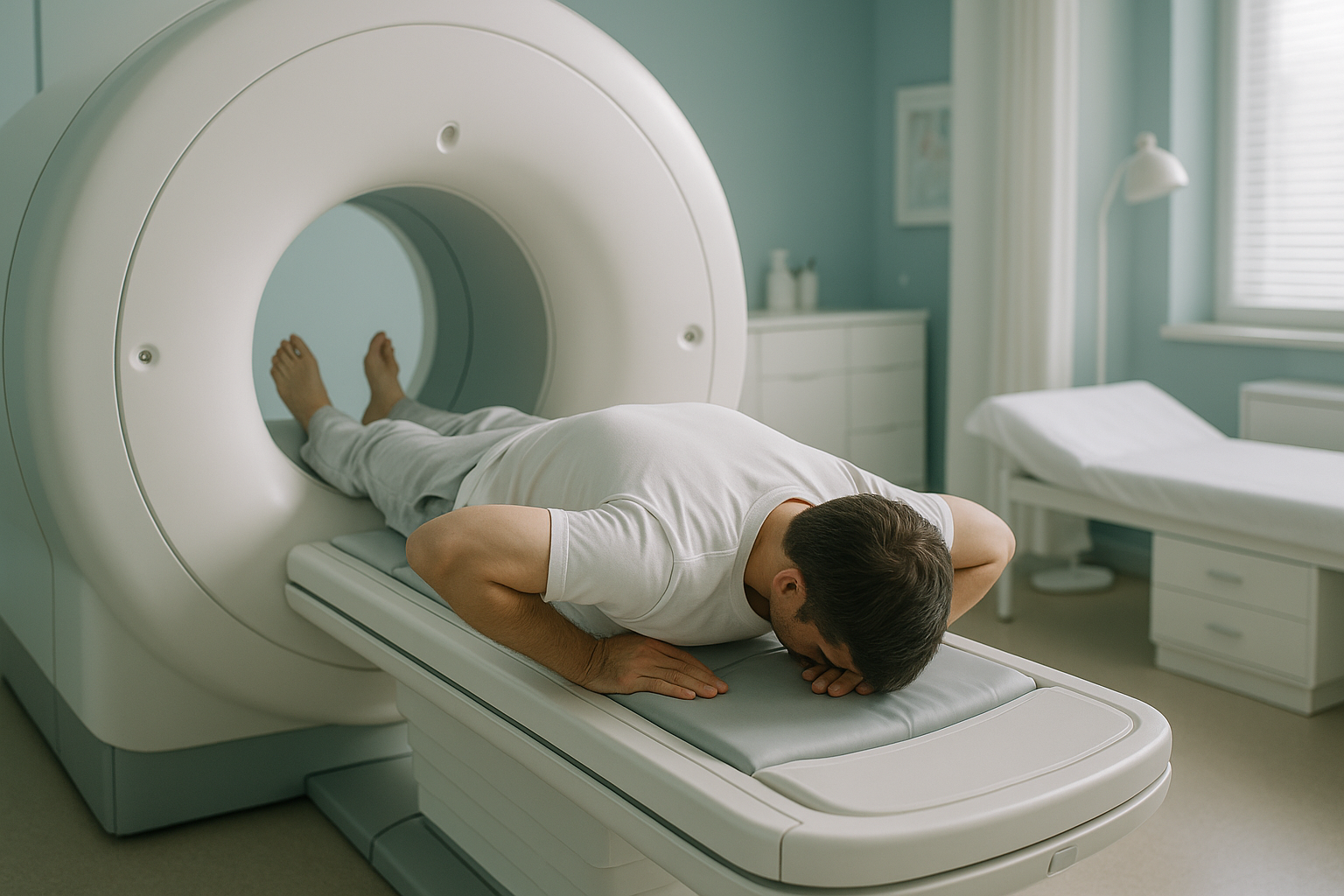
This matters because alignment problems, joint compression, and compensatory curves are gravity-dependent. They appear when you are upright and may vanish the moment you lie down on the scanner table. That is why a scan can come back as "normal" even though you are clearly in pain.
An EOS scan is taken while you stand. It captures your entire skeleton from head to feet in a single image, using about 90% less radiation than a standard X-ray, around ten times less. Because you are weight-bearing, your clinician sees your spine exactly as it behaves in daily life. Read more about weight-bearing versus lying imaging and how ScanAlign standing EOS imaging works.
A note on MRI. EOS shows bones, joints and alignment in excellent detail. For soft-tissue problems such as discs, nerves, or ligaments, MRI is usually the better tool. The two scans answer different questions. Your clinician can advise which one you need, or whether you may benefit from both.
What can help with back pain when lying down?
The right approach depends entirely on the cause. That is why getting an accurate picture of your spine's structure and alignment matters before committing to any treatment plan. Some general strategies people find helpful include:
- Sleeping position adjustments. Placing a pillow under your knees when lying on your back, or between your knees on your side, can reduce strain on the lower spine.
- Gentle movement before bed. A short walk or light stretching may help muscles relax and reduce the contrast between being active and suddenly lying still.
- Addressing hip flexor tightness. If you sit for long periods, your hip flexors may pull your pelvis forward when you lie flat. A physiotherapist can assess this.
- Understanding your alignment. If your pain keeps returning despite trying different mattresses, pillows and exercises, the next step is often imaging that shows how your whole skeleton lines up under load.
If you have been dealing with back pain in bed for more than a few weeks and standard scans have not given you a clear answer, a standing whole-body scan may reveal what has been missed.
Book a free video consultationFrequently asked questions
Lying flat increases the natural curve of your lower back. If your facet joints are worn or your hip flexor muscles are tight, this position compresses or stretches structures that are comfortable when you are upright. Placing a pillow under your knees can reduce this curve and ease the load.
Most night back pain is mechanical and not dangerous. However, pain that is constant, wakes you from sleep, does not change with position, or comes with numbness, weakness, or bladder or bowel changes needs urgent medical review. Contact your GP, call 111, or go to A&E.
A very old or unsupportive mattress can contribute, but it is rarely the sole cause of persistent back pain. If you have tried a new mattress and the pain continues, the issue is more likely structural. Imaging can help identify what is going on inside your spine.
Overnight, your spinal discs absorb fluid and swell slightly. This increased disc volume can press on nearby structures, causing stiffness until you move around and the discs compress back to their daytime size. Inflammatory conditions can also cause prolonged morning stiffness.
Many people find lying on their side with a pillow between the knees most comfortable. If you prefer lying on your back, a pillow under your knees can reduce the arch in your lower spine. The ideal position depends on the specific cause of your pain.
MRI is performed lying down, which relaxes your muscles and removes gravity from the equation. Alignment issues, joint compression and compensatory curves that appear when you are upright may simply not show on a flat scan. A standing EOS scan captures your skeleton under real-world loading conditions.
An EOS scan is taken while you stand and captures your full body in one image. It uses about 90% less radiation than a standard X-ray, around ten times less. This gives your clinician a complete picture of how your spine, pelvis, hips and legs align under gravity.
No. ScanAlign is a private, self-pay clinic and you can refer yourself. You start with a free video consultation to make sure the scan is appropriate for your situation.
Yes. The EOS system uses about 90% less radiation than a standard X-ray, around ten times less. It is one of the lowest-dose skeletal imaging methods available.
For current pricing, please visit the book a spine assessment page or start with a free video consultation. ScanAlign is a private, self-pay service.
Still waking up in pain?
A free video consultation lets you talk through your symptoms and find out whether a standing whole-body scan could give you the answers lying-down imaging has missed.
Book a free video consultationSources
- NHS. Back pain: causes and when to get help. nhs.uk. Available at: nhs.uk/conditions/back-pain
- Dubousset J, Charpak G, Dorion I, et al. A new 2D and 3D imaging approach to musculoskeletal physiology and pathology with low-dose radiation in standing position: the EOS system. Bulletin de l'Académie Nationale de Médecine. 2005;189(2):287-297.
- National Institute for Health and Care Excellence (NICE). Low back pain and sciatica in over 16s: assessment and management (NG59). 2016, updated 2020.
Written by Abbas Dhami (Specialist Diagnostic Radiographer)
This page is general information and not a diagnosis.
ScanAlign is the trading name of CoreMed Solutions Ltd and operates under The Harley Street Hospital's CQC licence.