
What Are Bone Spurs (Osteophytes), and Do They Need Treating?
Osteophytes, commonly called bone spurs, are small bony growths that develop along joint edges. They are usually a sign of normal, age-related wear rather than a disease. Most osteophytes cause no symptoms at all and do not need treatment. When they do cause problems, it is usually because they press on a nerve or limit movement in the spine.
Key takeaways
- Osteophytes are extremely common and often found by accident on imaging reports.
- Most bone spurs are painless and need no treatment whatsoever.
- They form because the body is trying to stabilise a joint that has experienced wear over time.
- Symptoms only arise when a spur presses on a nerve or restricts joint movement.
- A standing, weight-bearing scan can show whether bone spurs are affecting your alignment under real-life loading conditions.
What exactly are osteophytes?
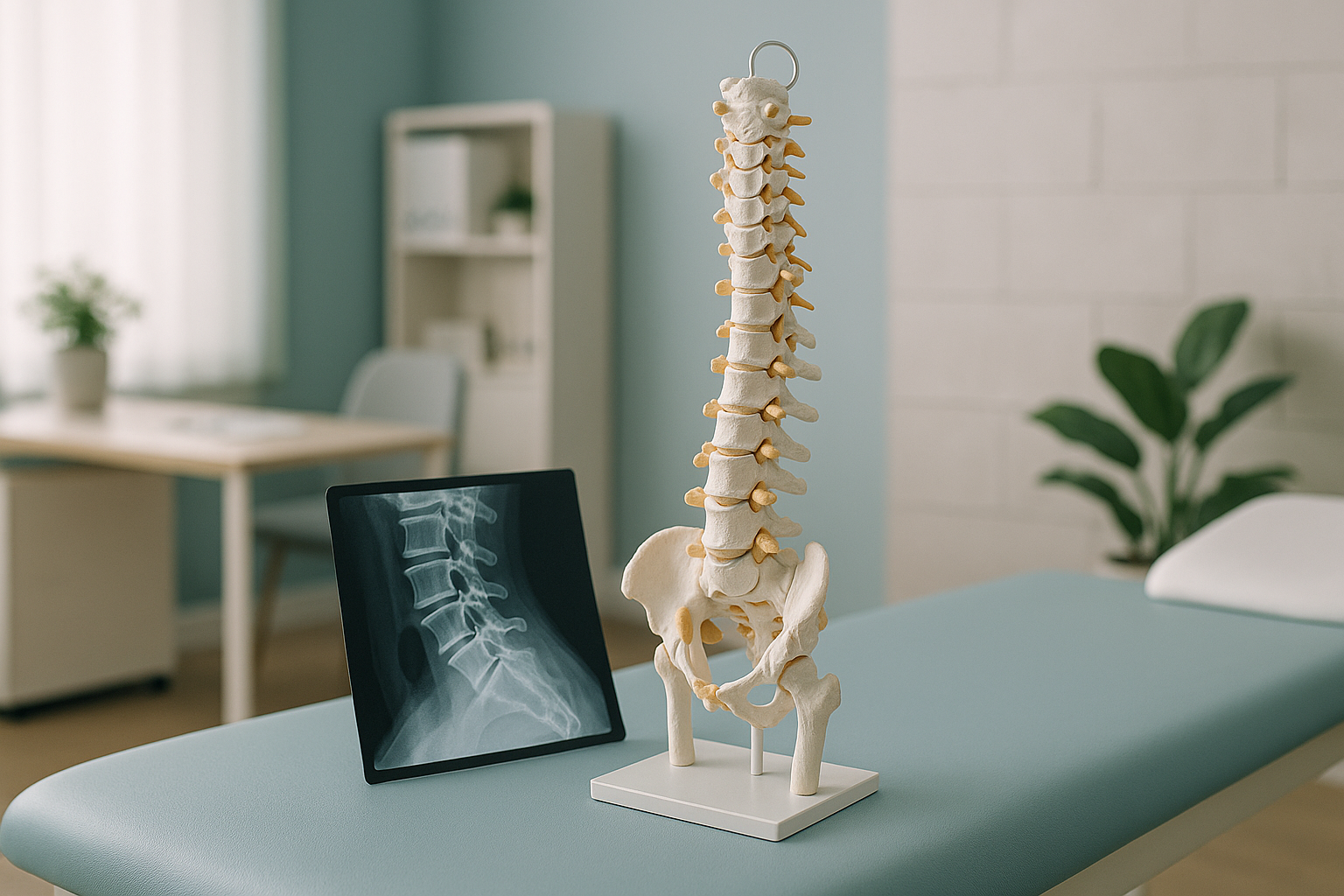
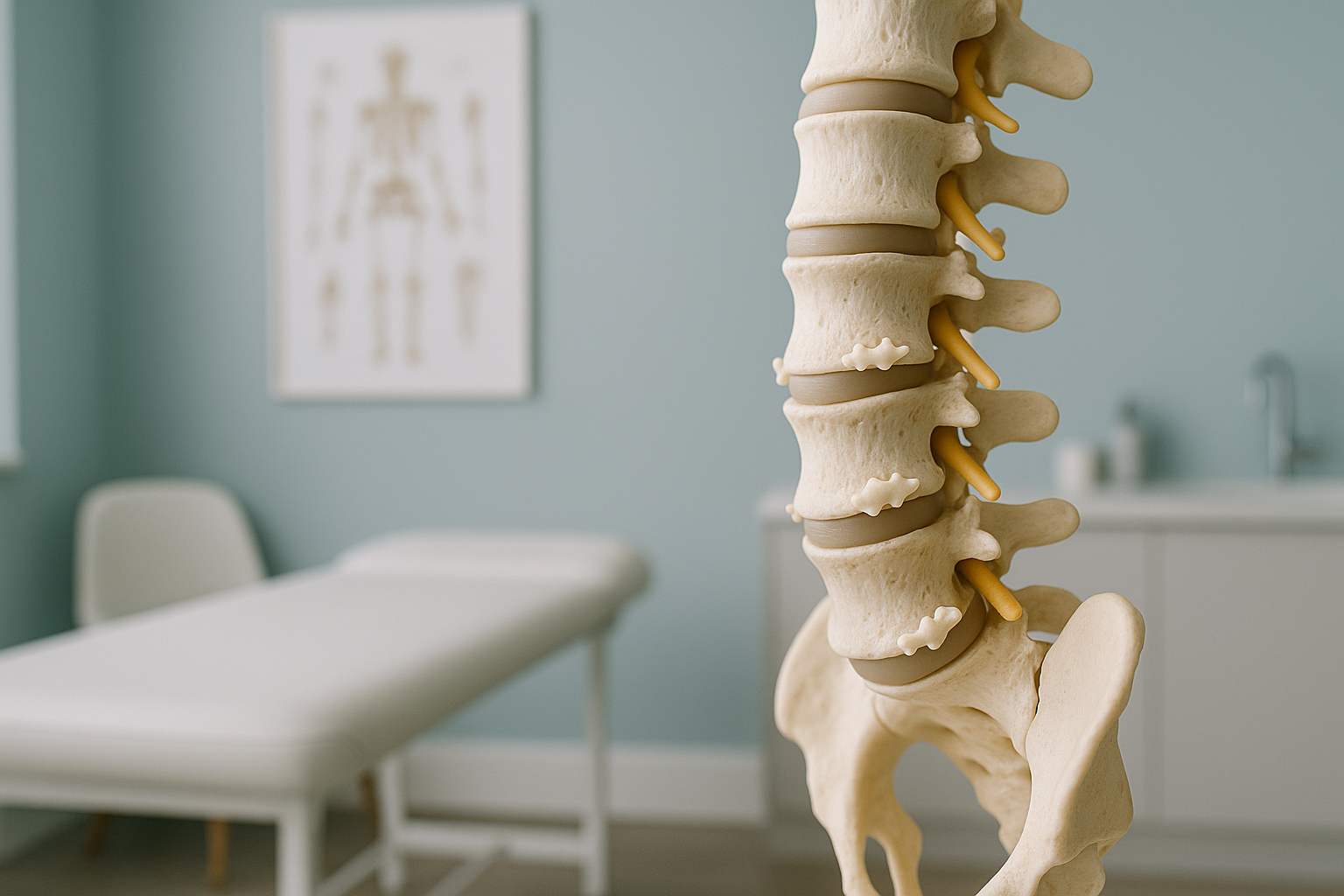
Osteophytes are small projections of extra bone that grow along the margins of a joint. Your body produces them as a natural repair response when cartilage wears down. Think of them as the skeleton's attempt to spread the load across a wider surface and add stability to a joint that has been under long-term stress.
They appear most often in the spine, particularly around the facet joints at the back of each vertebra and along the edges of the vertebral bodies. You may also see them around the hips, knees, shoulders and feet. In the spine they are closely linked to spondylosis, the general term for age-related degenerative changes.
Why do bone spurs form in the spine?
Bone spurs form because the body is responding to prolonged mechanical stress on a joint. When cartilage gradually thins, the underlying bone remodels itself, laying down extra material at the joint edges. This is not a sign that something has gone wrong. It is a sign that the body is adapting.
Age-related wear
Decades of normal use gradually thin the cartilage, triggering new bone growth at joint margins.
Repetitive loading
Physical occupations or heavy sport place extra stress on specific spinal segments.
Alignment imbalance
Poor posture or uneven loading accelerates wear in some joints while sparing others.
Because osteophyte formation is so closely tied to everyday ageing, studies consistently find them in the majority of adults over 60, most of whom have no pain at all. They are one of the most common incidental findings on spinal imaging reports. That is why reading "osteophytes noted" in your report does not mean you have a problem that needs fixing.
When do bone spurs actually cause symptoms?
Most osteophytes are completely silent. Symptoms only develop when a spur is large enough, or positioned in just the right spot, to interfere with surrounding structures. In the spine, the two main scenarios are nerve compression and joint restriction.
Localised stiffness
Reduced range of motion in the neck or lower back, especially first thing in the morning or after sitting for a long time.
Radiating discomfort
A spur pressing on a nerve root can send pain, tingling or numbness into an arm or leg. This overlaps with spinal stenosis.
Facet joint pain
Osteophytes on the facet joints can contribute to facet joint arthropathy, causing a dull ache that worsens when you lean backward.
Seek urgent medical help if you experience sudden weakness in your arms or legs, loss of bladder or bowel control, or rapidly worsening numbness. Contact your GP, call 111 or attend A&E. These symptoms need immediate assessment, not a routine scan.
How does a standing scan show what lying-down imaging misses?
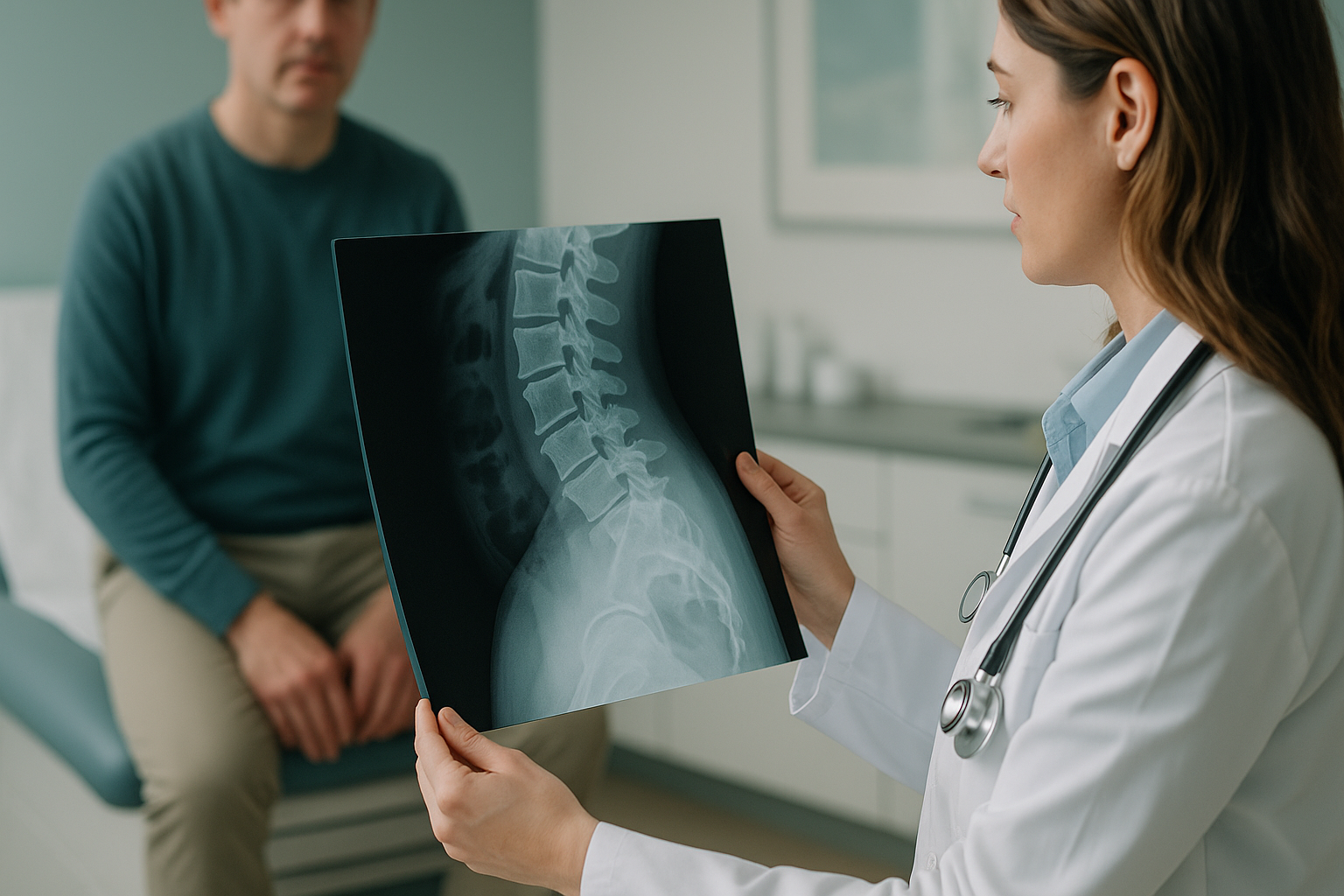
A standard X-ray, CT or MRI is taken while you lie flat. That position relaxes the muscles and removes the force of gravity from your spine. Any alignment issue, compensatory curve or narrowing that only appears under your own body weight can be hidden.
A standing, weight-bearing EOS scan captures your skeleton from head to foot while you are upright, in a natural, loaded position. This matters for osteophytes because it reveals two things a lying-down image cannot:
- How the spur interacts with real loading. A bone spur near a nerve exit may only cause narrowing when your spine is compressed by gravity.
- The bigger alignment picture. Your body is a connected chain from feet to skull. If one area of the spine is stiffened by osteophytes, other areas may over-compensate, creating problems elsewhere. A whole-body standing image shows these knock-on effects at a glance.
ScanAlign standing EOS imaging uses about 90% less radiation than a standard X-ray, around ten times less. This makes it a practical option for anyone who wants a clear, weight-bearing view of their spine without unnecessary radiation exposure.
Want to see how your spine looks under load? A standing whole-body EOS scan captures your alignment from head to foot in one low-dose image.
Book a free video consultationDo bone spurs need removing?
In most cases, no. The vast majority of osteophytes are incidental findings that do not require any intervention. If your report mentions "mild osteophyte formation" or "degenerative change", it usually means your spine is showing normal signs of ageing. That is reassuring, not alarming.
Usually enough
- Staying active and mobile
- Gentle stretching and strengthening
- Good postural habits throughout the day
- Weight management to reduce spinal loading
- Over-the-counter pain relief for occasional flare-ups
Rarely needed
- Surgery is only considered when a spur causes significant nerve compression that does not respond to conservative measures
- This is uncommon, and any surgical decision is made by a specialist, not an imaging clinic
Because ScanAlign is a diagnostic imaging clinic, we do not provide treatment. What we can do is give you and your clinician a clear, weight-bearing picture of your spine so that any decisions about management are based on how your body actually looks when upright and loaded.
When MRI is the better choice: EOS imaging excels at showing bones, joints and overall alignment. If your clinician suspects a disc problem, nerve compression from soft tissue, or inflammation, MRI is usually the more appropriate tool. The two types of imaging complement each other well.
Frequently asked questions about osteophytes
Yes. "Osteophyte" is the medical term and "bone spur" is the everyday name. They mean exactly the same thing: a small outgrowth of bone at the edge of a joint.
No. Once formed, osteophytes do not shrink or disappear. However, this is not usually a concern because most bone spurs are painless and harmless.
In most cases, no. This is one of the most common incidental findings on spinal imaging. It means the radiologist has seen normal, age-related bony change. If you have no significant symptoms, it often requires no further action.
They can, but they usually do not. Many people with bone spurs have no pain, and many people with back pain have no bone spurs. Pain is more commonly linked to muscle tension, disc issues or inflammation than to the spurs themselves.
Osteophytes are the bony growths. Spinal stenosis is the narrowing of the spinal canal or nerve exit tunnels. Large osteophytes can contribute to stenosis, but stenosis can also be caused by thickened ligaments, bulging discs or other changes.
A lying-down X-ray removes the effect of gravity from your spine. A standing EOS scan shows how your spine behaves under your own body weight, which can reveal narrowing or alignment issues that a standard image misses. It also uses about 90% less radiation than a standard X-ray, around ten times less.
No. ScanAlign accepts self-referrals. You can book a free video consultation directly without needing a letter from your GP.
Pricing details are available on the ScanAlign FAQs and cost page.
Yes. The EOS system uses about 90% less radiation than a standard X-ray, around ten times less. It is one of the lowest-dose skeletal imaging options available.
They can grow slowly over many years as part of the ongoing degenerative process. Staying active, maintaining a healthy weight and keeping good posture can help manage the load on your joints and slow further change.
See your spine the way it works. Standing up.
If your report mentions osteophytes and you want to understand what they mean for your alignment, a standing whole-body EOS scan can provide the full picture.
Book a free video consultationWritten by Abbas Dhami (Specialist Diagnostic Radiographer)
Sources
- NHS. Osteoarthritis overview. nhs.uk. Available at: https://www.nhs.uk/conditions/osteoarthritis/
- Van der Kraan PM, van den Berg WB. Osteophytes: relevance and biology. Osteoarthritis and Cartilage. 2007;15(3):237-244.
- Illés T, Somoskeöy S. The EOS imaging system and its uses in daily orthopaedic practice. International Orthopaedics. 2012;36(7):1405-1411.
This page is general information and not a diagnosis.
ScanAlign is the trading name of CoreMed Solutions Ltd and operates under The Harley Street Hospital's CQC licence.