
Spondylosis: What Are Spondylotic Changes and Should You Worry?
Spondylosis is the medical term for age-related wear and tear of the spine. Spondylotic changes, such as bone spurs and disc thinning, are extremely common and often painless. When symptoms do appear, standing whole-body imaging can reveal how these changes affect your alignment under real weight-bearing conditions.
Key takeaways
- Spondylotic changes happen in almost everyone over 60 and are often found by chance on scans.
- Symptoms range from stiffness and aching to nerve-related pain in the arms or legs.
- Lying-down scans can miss alignment problems that only show when you stand.
- EOS imaging captures your full spine standing up, with about 90% less radiation than a standard X-ray.
- ScanAlign provides diagnostic imaging, not treatment. Your results help guide the right next step.
What is spondylosis exactly?
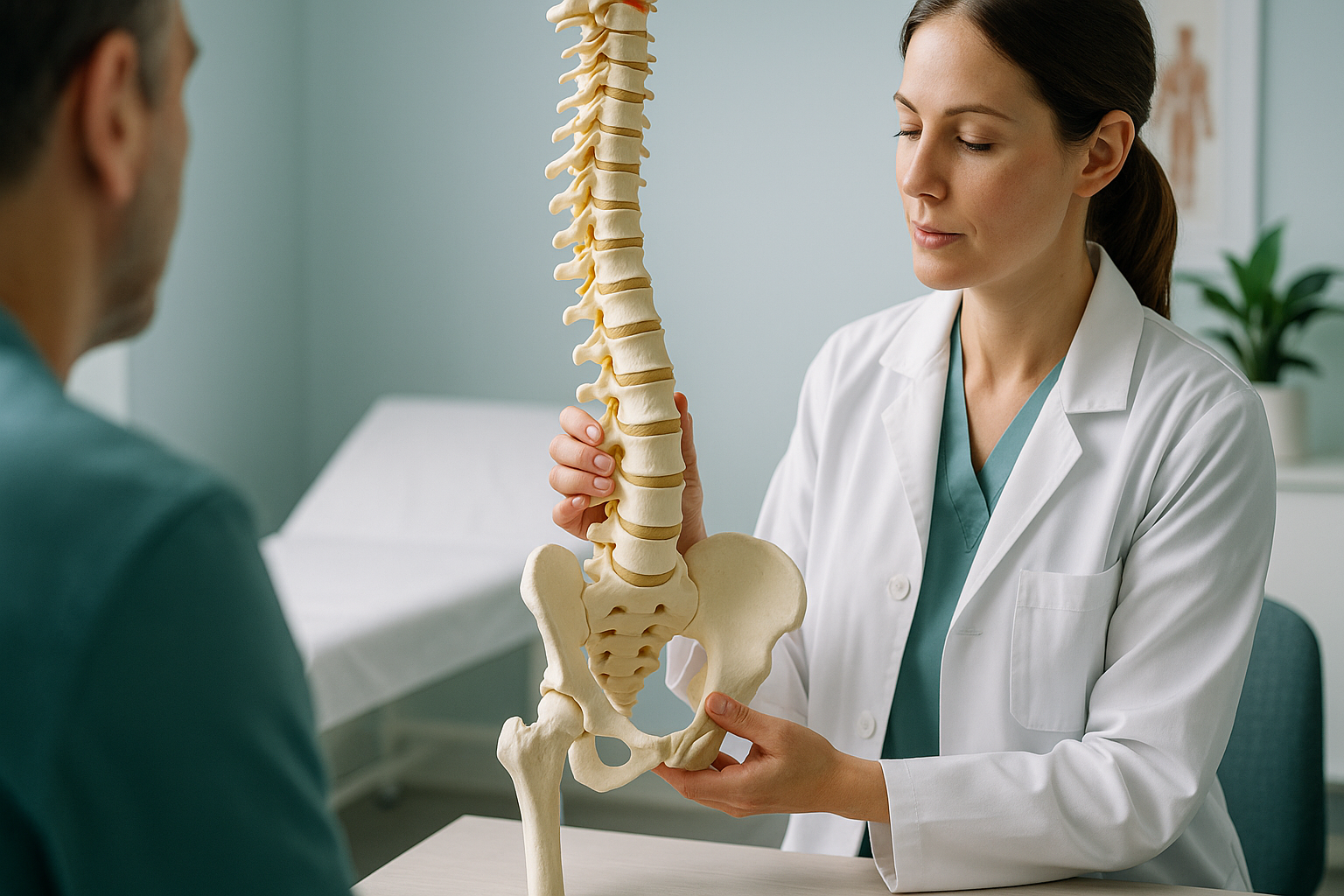
Spondylosis is the gradual breakdown of the discs, joints and bones in your spine that comes with normal ageing. Think of it as your spine showing its mileage. The discs between your vertebrae lose water content and become thinner. The small facet joints at the back of each vertebra develop roughened surfaces. Your body often responds by growing small bony spurs (called osteophytes) to try to stabilise things.
Doctors sometimes describe these findings as "spondylotic changes" on a scan report. The term can sound alarming, but it usually describes a process that has been happening slowly for years. Spondylosis can affect any part of the spine. When it affects the neck, it is called cervical spondylosis. In the lower back, it is called lumbar spondylosis. The mid-back (thoracic region) is less commonly affected because those vertebrae move less.

What are the symptoms of spondylosis?
Many people with spondylotic changes have no symptoms at all. When symptoms do develop, they tend to come on gradually rather than suddenly. What you feel depends on where in your spine the changes are and whether any nerves are being affected.
Your back or neck feels stiff first thing in the morning or after sitting for a long time.
A dull ache in the neck or lower back that worsens with activity and eases with rest.
Difficulty turning your head fully or bending comfortably through your lower back.
Tingling, numbness or pain that travels into your arm (cervical) or leg (lumbar).
Important. If you develop sudden weakness in your arms or legs, difficulty walking, or loss of bladder or bowel control, seek urgent medical attention straight away. Contact your GP, call 111, or go to A&E. These symptoms need immediate assessment and are not suitable for a routine scan booking.
What causes spondylosis?
Spondylosis is primarily caused by the cumulative effect of everyday use over decades. Your spine absorbs thousands of loads each day, and over time the structures naturally change.
The single biggest factor. Disc dehydration and joint roughening are part of ageing.
Heavy manual work or sports that stress the spine can speed up wear.
An old fracture or disc injury can accelerate changes at that level.
Family history and long-term postural habits both play a role.
What is the difference between spondylosis, spondylolysis and spondylolisthesis?
These three terms sound almost identical, which causes a lot of confusion. They describe different problems.
- Spondylosis means general wear-and-tear changes, such as disc thinning, bone spurs and joint roughening. It is a degenerative process.
- Spondylolysis is a stress fracture in a small piece of bone (the pars interarticularis) at the back of a vertebra. It is often linked to sports that involve repeated arching of the back.
- Spondylolisthesis happens when one vertebra slips forward over the one below it. This can result from spondylolysis, degeneration, or other causes.
All three can affect how your spine aligns and bears weight, which is why seeing the whole spine standing up matters.
How is spondylosis assessed with standing imaging?
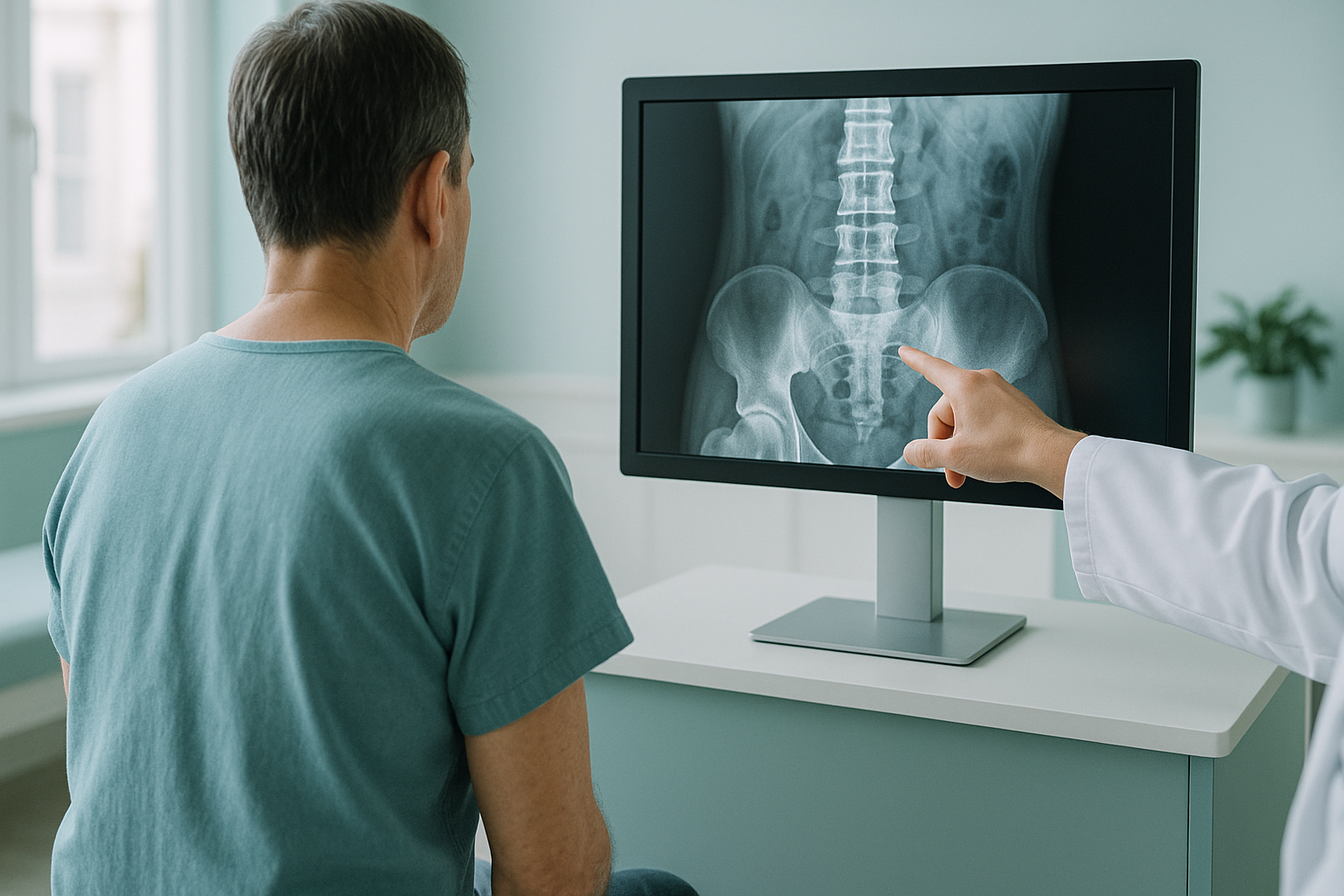
Standing whole-body EOS imaging captures your skeleton from head to feet while you are upright and weight-bearing. This is important because spondylotic changes do not exist in isolation. Your body is a connected chain. When one spinal segment stiffens or loses height, the areas above and below compensate. Your pelvis may tilt, your curves may shift, and the place where you feel pain may not be the place causing the problem.
Standard X-rays, CT scans and MRI are usually taken lying down. In that position your muscles relax, gravity is removed, and alignment problems can be hidden. An EOS scan shows your spine working as it does in real life, standing under load. It uses about 90% less radiation than a standard X-ray, around ten times less.
When MRI is the better choice. EOS imaging shows bones, joints and alignment brilliantly. If your clinician needs to look at soft tissues, such as discs, nerves or the spinal cord, MRI is usually the better tool. The two are complementary rather than competing.
Not sure whether your spondylosis symptoms need standing imaging? Talk it through with a specialist radiographer at no cost.
Book a free video consultationIs spondylosis serious and what can help?
For most people, spondylosis is a normal part of ageing and not a reason to panic. Many spondylotic spines cause no symptoms at all. When problems do arise, they are usually manageable. Your GP, physiotherapist or consultant will advise on what suits you. Options commonly discussed include staying active, physiotherapy, pain management and, in some cases, surgical review.
What matters most is understanding the full picture. If your lower back is stiff due to spondylotic changes, your hips and knees may be picking up the slack. That compensatory strain can show up as hip pain, knee pain, or changes to the way you walk. A whole-body standing scan helps identify these knock-on effects so that any treatment plan addresses the root cause, not just the symptom.
ScanAlign is a diagnostic imaging clinic. We do not provide treatment. The detailed alignment information from an EOS scan gives your treating clinician a clearer map to work with.
Frequently asked questions about spondylosis
It means the radiologist has seen signs of normal spinal wear and tear, such as disc thinning, roughened joints, or small bone spurs. These findings are very common, especially from middle age onwards, and do not always mean you will have symptoms.
It is closely related. Spondylosis is sometimes called spinal osteoarthritis because it involves the same kind of joint and cartilage degeneration that osteoarthritis causes in other joints. It is not the same as inflammatory arthritis, such as rheumatoid arthritis.
The structural changes tend to progress slowly because they are part of the ageing process. However, that does not mean symptoms will necessarily get worse. Staying active, maintaining a healthy weight and working with a physiotherapist can all help manage things over the long term.
The underlying process is the same. Lumbar spondylosis affects the lower back and may cause leg symptoms if nerves are involved. Cervical spondylosis affects the neck and may cause arm symptoms. Both can be assessed with a full-spine standing EOS scan.
Standard scans are taken lying down, which removes the effect of gravity. Spondylotic segments can stiffen your spine and shift how you balance when upright. A standing EOS scan shows these compensatory changes in real time so your clinician can see the full picture.
An EOS scan uses about 90% less radiation than a standard X-ray, around ten times less. It captures your full body in a single low-dose sweep.
No. ScanAlign is a private self-pay clinic, so you can self-refer. You start with a free video consultation with a specialist radiographer to check that the scan is appropriate for you.
Pricing details are on the FAQs and cost page. The free video consultation is a good opportunity to discuss what is included.
EOS excels at showing bone alignment, joint spacing and overall posture. For detailed views of soft tissue, discs and nerves, MRI is usually the better choice. Your radiographer can advise which scan suits your situation.
ScanAlign is based at 19 Harley Street, London. You can book a free video consultation through the website to discuss your symptoms and see whether standing imaging is right for you.
See your spine the way it really works
A free video consultation with a specialist radiographer to discuss your spondylosis and whether standing imaging can help.
Book a free video consultationLearn more
Find out how whole-body standing imaging works on the EOS scan overview page, or read about specific areas such as spinal alignment assessment, hip alignment and knee assessment.
Sources
- NHS. Cervical spondylosis. nhs.uk. Available at: https://www.nhs.uk/conditions/cervical-spondylosis/
- Middleton K, Fish DE. Lumbar spondylosis: clinical presentation and treatment approaches. Current Reviews in Musculoskeletal Medicine. 2009;2(2):94-104.
- Illés T, Somoskeöy S. The EOS imaging system and its uses in daily orthopaedic practice. International Orthopaedics. 2012;36(7):1405-1411.
Written by Abbas Dhami (Specialist Diagnostic Radiographer)
This page is general information and not a diagnosis.
ScanAlign is the trading name of CoreMed Solutions Ltd and operates under The Harley Street Hospital's CQC licence.