
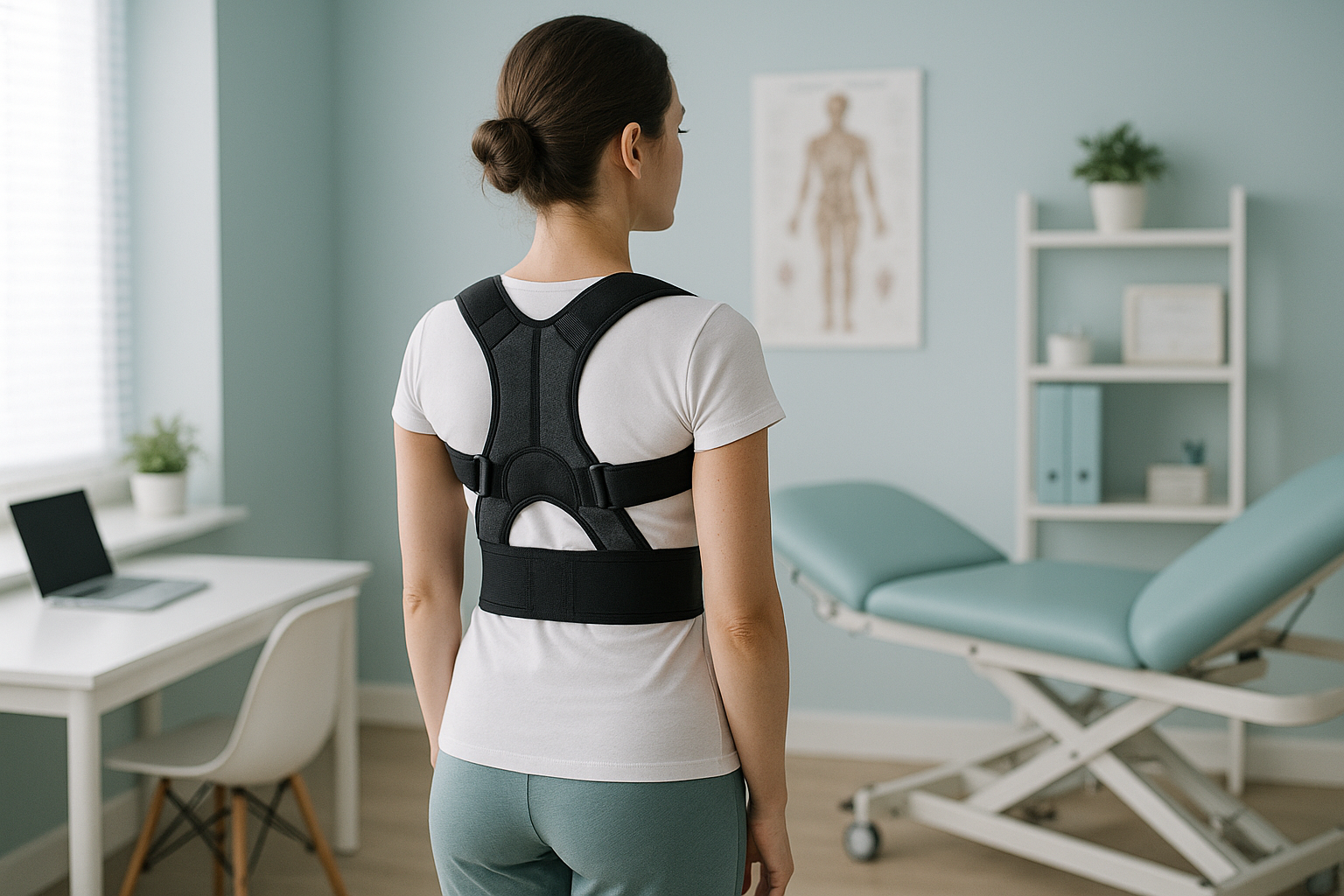
Do Posture Correctors Actually Work?
A posture corrector can remind you to sit or stand straighter in the short term. But the evidence shows that wearing a brace alone does not build the muscle strength or habit change needed for lasting improvement. Without understanding why your posture is the way it is, a corrector treats the symptom rather than the cause.
Key takeaways
- Posture braces act as a short-term physical cue, not a long-term fix.
- Over-reliance on a corrector can weaken the very muscles you need to strengthen.
- Lasting posture change comes from understanding your alignment, targeted exercise and habit change.
- A standing whole-body assessment can reveal the structural reasons behind your posture, which a brace cannot address.
What does a posture corrector actually do?
A posture corrector is a wearable brace, strap or support belt that pulls your shoulders back and encourages your spine into a more upright position. Most designs use elastic tension across the upper back to promote shoulder retraction. Some wrap around the lower back as well.
The idea is simple. By holding you in a better position, the brace trains your body to stay there on its own. In practice, the evidence is more complicated.
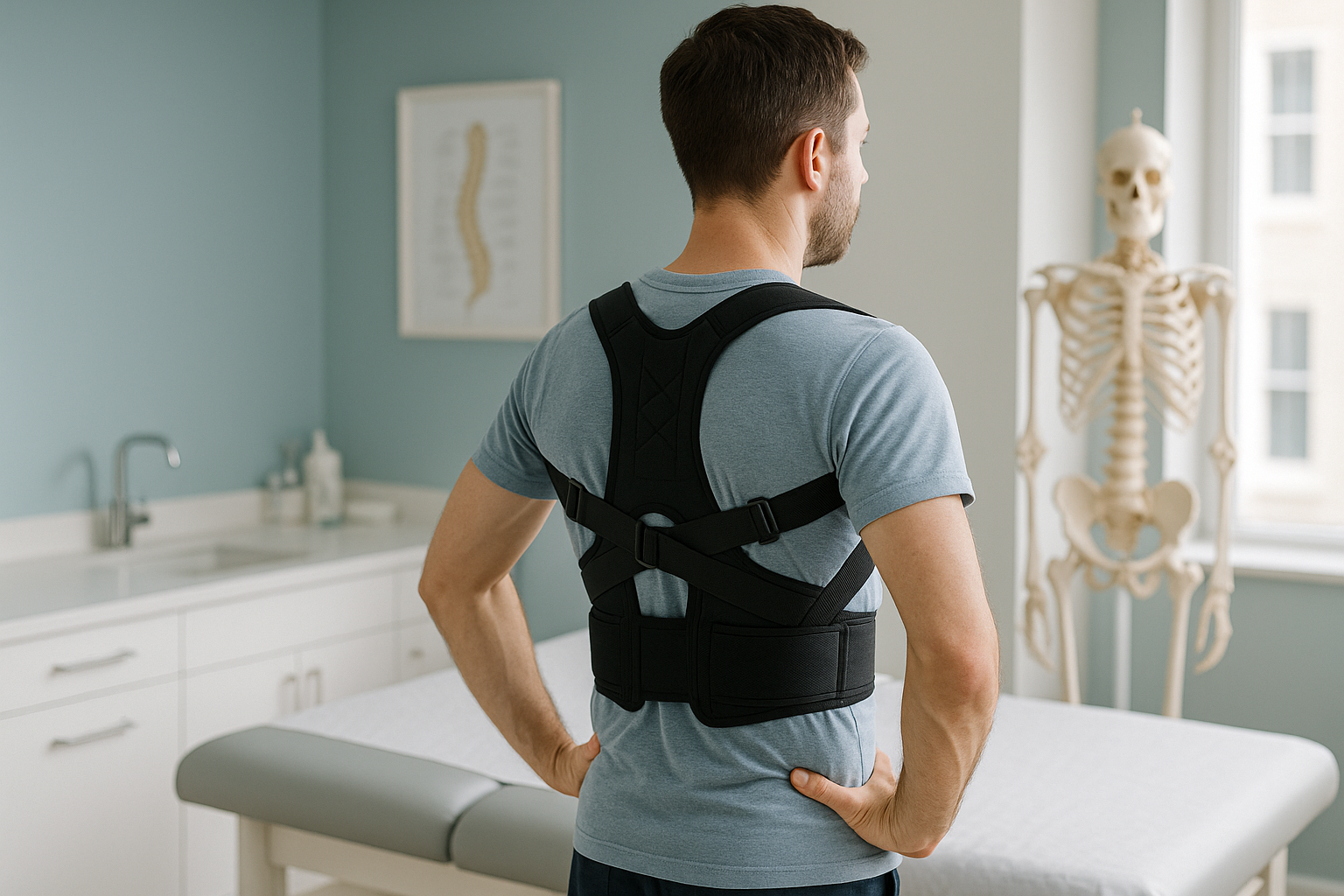
Whether you are looking at a simple shoulder strap, a cross-back posture brace, or a full posture support belt, they all share the same basic principle: passive support. They hold you in position rather than teaching your body to hold itself.
What are the signs you might need posture help?
Most people start looking for a posture corrector because something feels wrong. These are common patterns that suggest your posture needs attention.
Shoulders that roll forward when you stand or sit, often linked to desk work.
Tension or dull pain between the shoulder blades that worsens as the day goes on.
Your head sits in front of your shoulders rather than directly above them. See our guide to forward leaning posture.
A sense of postural sway or unsteadiness, especially when standing still.
Why is a posture brace not enough on its own?
A posture brace is not enough on its own because it provides passive support without building the muscle strength or postural awareness needed for lasting change. Research consistently shows that active approaches, such as strength training and movement re-education, produce better long-term outcomes than bracing alone.
- Act as a short-term physical cue
- Temporarily reduce slouching
- Remind you to check your position
- Offer comfort during a recovery period (on clinical advice)
- Strengthen weak postural muscles
- Fix a structural alignment issue
- Identify the root cause of your posture
- Prevent muscle deconditioning from long-term wear
The muscle deconditioning risk
When you wear a posture corrector for extended periods, the muscles it supports get less work. Over time, those muscles can weaken further, making you more dependent on the brace. This is the opposite of what most people want.
Think of it like a crutch. A crutch is helpful while a broken leg heals. But using it indefinitely would leave the leg weaker. The same logic applies to your postural muscles.
What actually helps improve posture long term?
Lasting posture improvement comes from understanding what your alignment looks like, then building the strength and habits to maintain it. A brace might play a small role as a reminder early on, but it is not the main solution.
A measured assessment of your posture while standing shows exactly where your alignment is off.
Strength training for the specific muscles that are weak, not a generic routine.
Adjusting your workspace, standing breaks and movement patterns throughout the day.
Comparing before and after imaging shows whether your posture has genuinely changed.
For a deeper look at how alignment connects from head to feet, read our body alignment guide.
Not sure where your posture problems come from? A free video consultation can help you decide whether a standing alignment assessment is the right next step.
Book a free video consultationHow is posture properly assessed when you are standing up?
Posture is properly assessed standing up because that is the only position where gravity, muscle effort, and joint loading all work together as they do in real life. When you lie down for a standard scan, your muscles relax, your curves flatten, and alignment problems can disappear from the image.
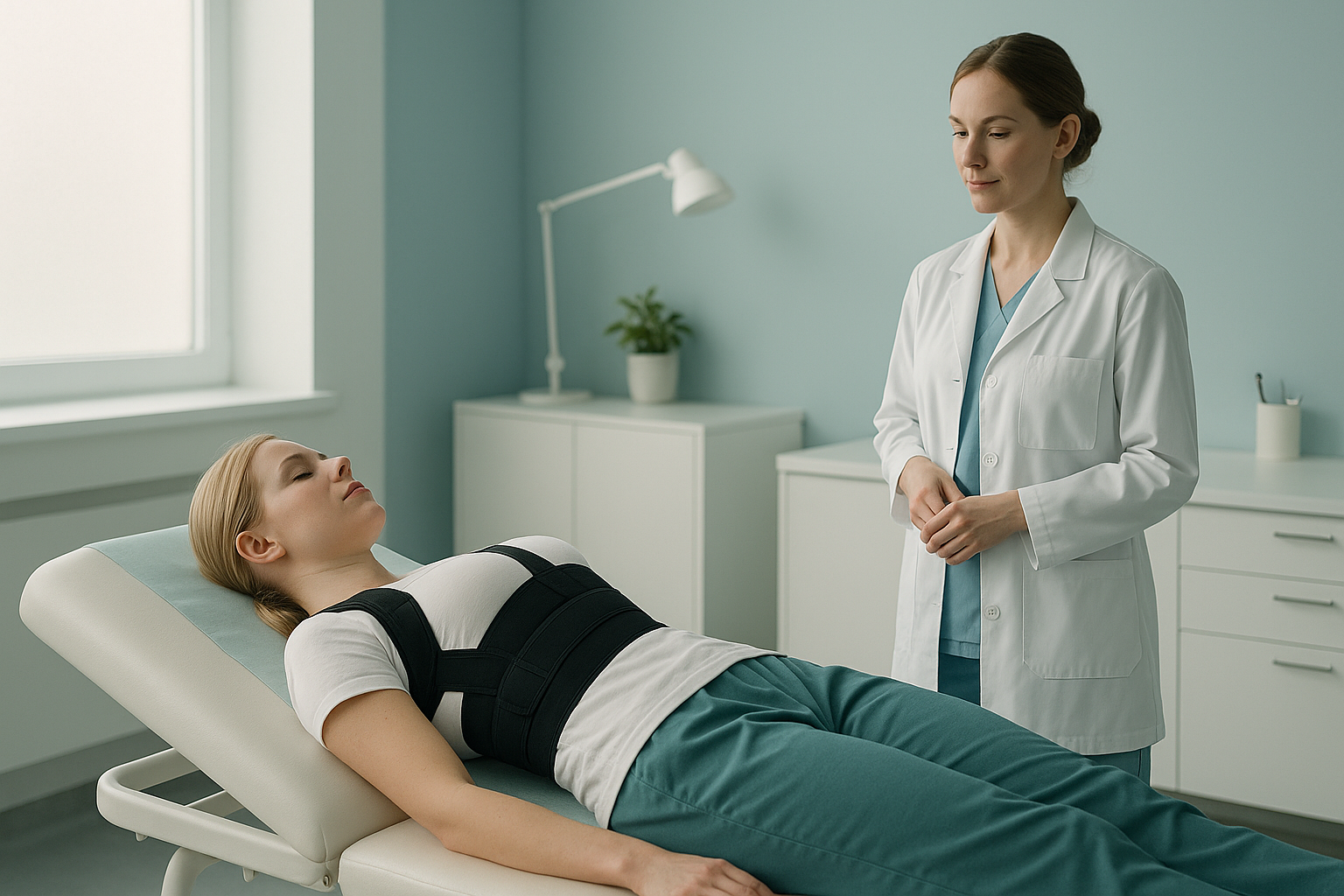
Your body is a connected chain. A tilt in the pelvis, a twist in the hip, or an imbalance in leg length can force your upper back and shoulders to compensate. This is often why you feel pain in one area while the actual cause sits somewhere else entirely. A posture corrector for rounded shoulders, for instance, cannot address a pelvic tilt that is driving those shoulders forward in the first place.
ScanAlign uses EOS imaging, which captures your full skeleton from head to feet in a single standing scan with about 90% less radiation than a standard X-ray, around ten times less. This gives your clinician or physiotherapist a clear map of your alignment under real weight-bearing conditions.
When MRI is the better choice: EOS shows bones, joints and alignment. For soft tissue problems such as disc injuries, nerve compression or ligament damage, MRI is usually the better tool. If you are unsure which you need, we can discuss this in your free consultation.
Frequently asked questions
They can serve as a short-term reminder to sit or stand straighter. But they do not fix posture on their own. Lasting change needs muscle strengthening, habit adjustment and an understanding of why your alignment is off.
If you choose to use one, most guidance suggests short periods of around 15 to 30 minutes at a time, a few times a day. Extended wear can lead to muscle deconditioning, where the muscles the brace supports become weaker because they are not doing the work.
It can, if worn too long. Over-reliance on passive support means your muscles get less practice holding you upright. Some people also experience skin irritation or discomfort from poorly fitting braces.
A brace may temporarily pull your shoulders back. However, rounded shoulders are often part of a larger alignment pattern, sometimes involving the mid-back or pelvis. Addressing only the shoulders without understanding the full chain may not produce lasting results.
Start with a proper assessment of your alignment. Then work with a physiotherapist or exercise professional on targeted strengthening and movement habits. Knowing exactly where your alignment is off makes the exercise far more effective.
When you lie down, gravity is no longer compressing your spine and joints. Your muscles relax, and your natural curves change. This means alignment issues that appear when standing and weight-bearing can look normal on a lying-down scan.
Yes. EOS uses about 90% less radiation than a standard X-ray, around ten times less. It captures a full standing image of your skeleton in one scan.
No. ScanAlign accepts self-referrals. You can book a measured posture assessment directly through a free video consultation, without needing a letter from your GP.
Pricing details are available on our FAQs page. We are happy to discuss costs during your free video consultation.
You can. Some people find a brace useful as a short-term cue while they work on strengthening. A standing assessment gives you the baseline measurements so you and your clinician know exactly what to target, and whether the brace is helping or not.
Find out what is really behind your posture
A posture corrector treats the surface. A standing whole-body assessment shows you what is underneath. Start with a free, no-obligation video consultation.
Book a free video consultationWritten by Abbas Dhami (Specialist Diagnostic Radiographer)
Sources
- Hsu DJ, et al. "Effect of posture corrector devices on spinal alignment: a systematic review." Journal of Physical Therapy Science, 2019.
- NHS. "Back pain: how to prevent it." NHS.uk. Accessed 2025.
- Illés T, Somoskeöy S. "The EOS imaging system and its uses in daily orthopaedic practice." International Orthopaedics, 2012; 36(7): 1405-1411.
This page is general information and not a diagnosis.
ScanAlign is the trading name of CoreMed Solutions Ltd and operates under The Harley Street Hospital's CQC licence.