
How Should You Sit When Driving to Avoid Back Pain?
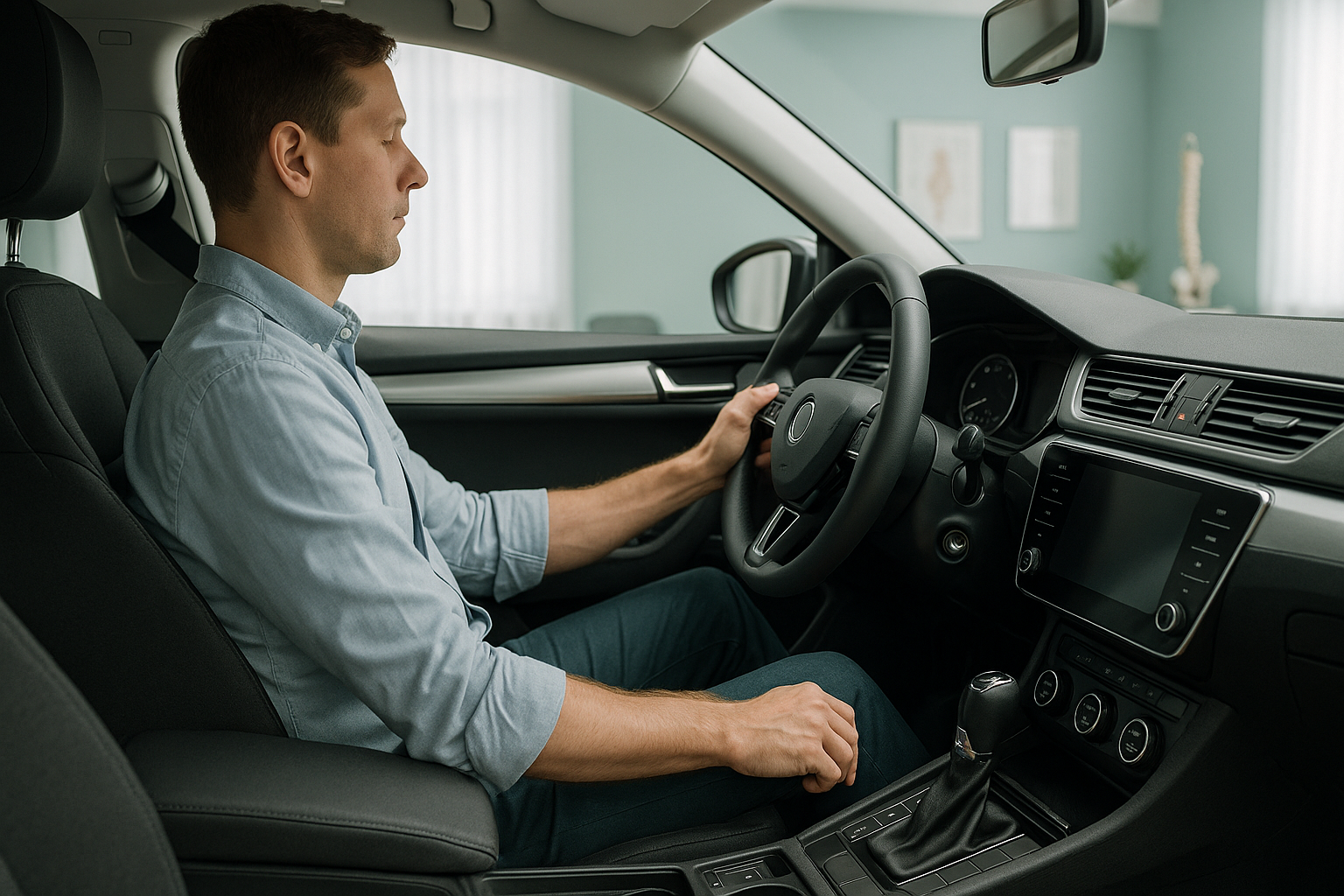
Sit with your back firmly against the seat, a slight recline of about 100 to 110 degrees, and your knees slightly higher than or level with your hips. Use the car's lumbar support, or a small cushion, to fill the gap in your lower back. Keep both hands on the wheel without reaching, and take breaks on long journeys. If pain persists, the cause may be a structural alignment issue that only shows up when you are weight-bearing.
Key takeaways
- Poor driving posture compresses the spine more than standing or walking.
- Lumbar support, correct seat angle and regular breaks reduce strain on your back.
- Persistent back pain when driving may point to an underlying alignment problem.
- A standing whole-body scan can reveal postural imbalances that lying-down scans miss.
- ScanAlign provides diagnostic imaging, not treatment, to help guide the right next step.
Why does driving cause back pain?
Driving causes back pain because it combines prolonged sitting with vibration and a semi-reclined hip angle. When you sit behind a wheel, your pelvis often tilts backward into a posterior pelvic tilt. This flattens the natural curve of your lower back, increasing pressure on the discs and ligaments of the lumbar spine.
Unlike sitting at a desk, driving adds constant low-frequency vibration from the road. Research shows this vibration travels up through the seat and into your spine, accelerating fatigue in the muscles that stabilise your trunk. Add a cramped foot position on the pedals, a wallet in your back pocket, or a long motorway stint without breaks, and the load on your spine rises further.
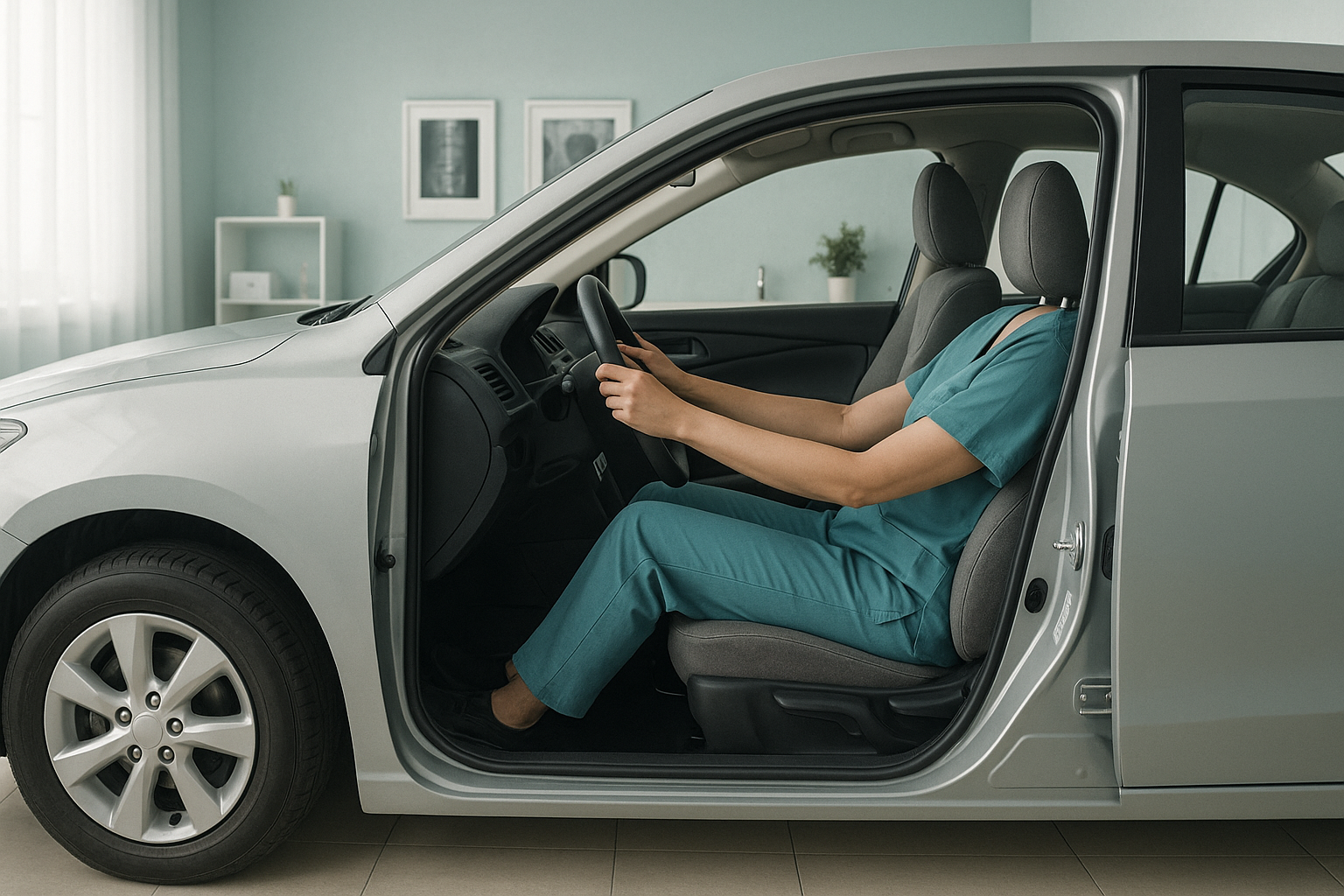
Your body works as a connected chain from your feet to your head. If your pelvis tilts, your lower back compensates. If your lower back flattens, your upper back rounds forward and your neck pushes ahead to keep your eyes on the road. Over time, pain can appear anywhere along that chain, often far from the original cause.
What is the correct driving position for your back?
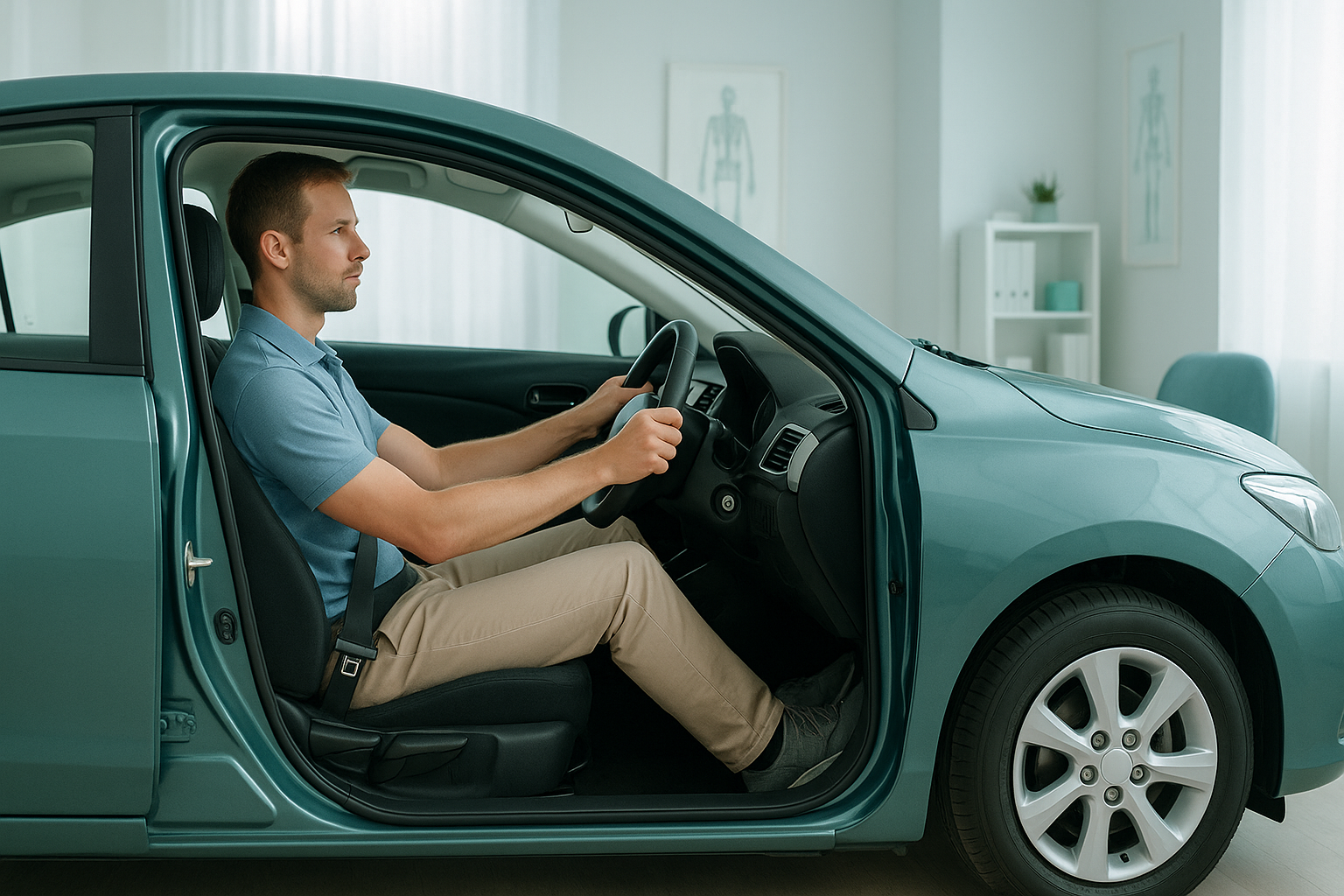
The correct driving position keeps your spine in a gentle, natural S-curve, the same shape it holds when you stand with good posture. Here is how to set it up.
Recline the backrest just past upright, roughly 100 to 110 degrees. Sitting bolt upright is tiring; reclining too far makes you crane your neck forward.
Adjust the car's built-in lumbar support, or place a small rolled towel or cushion, so it fills the hollow of your lower back without pushing you forward.
Raise the seat so your hips are level with or slightly above your knees. This helps keep a slight forward pelvic tilt, protecting the lumbar curve.
Slide the seat forward until you can press the pedals fully with a slight bend in your knees. Stretching locks your hips and strains the lower back.
Hold the wheel with a slight bend at the elbows. Set the headrest so the centre sits behind the middle of your head, not your neck.
When should you worry about back pain when driving?
Most driving-related back pain eases with better seat setup and regular breaks. But if your pain keeps returning, spreads into one or both legs, or gets worse over weeks, it may be a sign of something structural rather than simple muscle fatigue. Persistent lower back pain or sciatica when driving deserves proper investigation.
A note on urgent symptoms. If you develop sudden numbness, weakness in your legs, or loss of bladder or bowel control, do not wait for an imaging appointment. Contact your GP, call 111, or go to A&E. These symptoms need urgent medical attention.
When is MRI more useful? EOS imaging shows bones, joints and whole-body alignment. For soft tissue problems such as disc bulges, nerve compression or ligament damage, MRI is usually the better tool. Your clinician can advise which scan you need.
How can a standing scan help with driving-related back pain?
A standing whole-body scan captures your skeleton under the same gravitational load you experience sitting upright in a car. Standard imaging, such as a lying-down X-ray or MRI, relaxes the muscles and lets the joints settle into unloaded positions. Alignment problems that only appear when you are weight-bearing, like a subtle pelvic tilt or a leg-length difference, can be missed entirely.
EOS imaging uses about 90% less radiation than a standard X-ray, around ten times less. It captures your full skeleton in one standing image, from head to feet, so your specialist can see how every joint relates to every other joint. A pelvic tilt, a curved spine, a rotated hip, these can all contribute to pain that only flares when you sit and load your spine in a car seat.
ScanAlign standing EOS imaging provides the diagnostic picture that helps your clinician understand the structural cause, not just the symptom.
If your driving pain keeps coming back despite adjusting your seat, a standing alignment assessment may reveal why.
Book a free video consultationWhat practical habits reduce back pain on long drives?
Good seat setup is the foundation, but habits matter just as much. These small changes can make long journeys more comfortable.
- Take breaks every 60 to 90 minutes. Get out, walk around, and gently stretch your hips and lower back.
- Remove your wallet from your back pocket. Sitting on a wallet tilts your pelvis to one side, loading one half of your spine more than the other.
- Use cruise control on motorways. It lets you place both feet flat, reducing asymmetric hip strain from holding one foot on the accelerator.
- Warm up before getting in. A short walk or gentle hip circles loosen the muscles before you lock them into a seated position.
- Get in and out carefully. Swivel your whole body towards the door rather than twisting your spine to step out one leg at a time.
If these changes help but never fully resolve the pain, the problem may sit deeper in your skeletal alignment. A posture assessment can identify what is going on beneath the surface.
Frequently asked questions
Driving holds your spine in a fixed, semi-reclined position for a long time. Walking lets your muscles share the load and keeps your joints moving. The static compression and vibration of driving stress structures that cope well with movement.
A slight recline of about 100 to 110 degrees from horizontal is widely recommended. This distributes pressure more evenly across the lumbar discs than sitting bolt upright or reclining too far back.
Yes. Lumbar support fills the gap between the seat and the natural inward curve of your lower back. Without it, the pelvis tends to roll backward, flattening the lumbar spine and increasing disc pressure.
It can contribute. A wallet under one side of your pelvis creates an uneven base, tilting the spine and potentially irritating the sciatic nerve or piriformis muscle on that side. Removing it is one of the simplest fixes.
Aim for a short break every 60 to 90 minutes. Get out, walk for a few minutes, and stretch your hips and lower back. Even two minutes of movement helps reset the muscles.
An EOS scan captures your full skeleton while you stand, using about 90% less radiation than a standard X-ray, around ten times less. It shows how your bones and joints align under your own body weight, which a lying-down X-ray cannot do.
No. ScanAlign accepts self-referrals. You can book a free video consultation directly to discuss whether a scan is appropriate for you.
Details on pricing and what is included are available on the ScanAlign FAQs page.
Yes. The EOS system uses about 90% less radiation than a standard X-ray, around ten times less. The scan takes only a few seconds while you stand still.
A standing alignment scan shows the structural picture, how your bones and joints line up under load. It can reveal issues such as a pelvic tilt, spinal curvature or leg-length difference that contribute to pain. Your clinician then uses this information to guide any treatment decisions.
Still uncomfortable behind the wheel?
If adjusting your seat hasn't solved the problem, a standing alignment assessment could reveal the structural cause.
Book a free video consultationSources
- Lis AM, Black KM, Korn H, Nordin M. Association between sitting and occupational LBP. European Spine Journal. 2007;16(2):283-298.
- NHS. Back pain: prevention. nhs.uk. Accessed 2025.
- Illien-Jünger S, et al. Whole body vibration and intervertebral disc degeneration. Journal of Biomechanics. 2012;45(Suppl 1):S444.
Written by Abbas Dhami (Specialist Diagnostic Radiographer)
This page is general information and not a diagnosis.
ScanAlign is the trading name of CoreMed Solutions Ltd and operates under The Harley Street Hospital's CQC licence.