
Sciatica Yoga Poses: Which Ones Actually Help and Which Make Things Worse?
Gentle yoga can ease sciatic nerve discomfort by stretching the piriformis, hamstrings and hip flexors. But the wrong poses can make sciatica worse. The best approach depends on why the nerve is irritated in the first place, which is why understanding the cause matters more than copying a pose from a video.
Key takeaways
- Sciatica yoga poses work best when they target the actual cause of nerve irritation, not just the symptom.
- Some common poses, like deep forward folds, can aggravate a disc-related problem.
- If your sciatica has not improved after a few weeks, imaging can reveal what is going on structurally.
- A standing whole-body assessment shows how pelvic tilt or spinal alignment contributes to nerve compression.
- Yoga is not a replacement for diagnosis. It is a tool that works better once you know the root cause.
What causes sciatica in the first place?
Sciatica happens when the sciatic nerve, the longest nerve in your body, becomes compressed or irritated. The pain typically runs from the lower back through the buttock and down one leg. It can feel like a burning ache, a sharp jolt, or pins and needles.
Several things can cause it. The most common are a bulging or herniated disc pressing on the nerve root, tightness in the piriformis muscle deep in the buttock, or narrowing of the spinal canal. Pelvic misalignment, where one side of the pelvis sits higher or tilts forward, can also put uneven pressure on the nerve.
This matters for yoga because different causes respond to different movements. A piriformis stretch yoga sequence may help if the muscle is the problem. But the same stretch could do nothing, or make things worse, if a disc is involved.
A note on soft tissue. EOS imaging shows bones, joints and alignment clearly. For soft tissue, discs or nerves, MRI is usually the better tool. In many cases, both types of imaging together give the fullest picture of what is happening.
Important. If you have numbness, weakness in your leg or foot, or any loss of bladder or bowel control alongside sciatica, seek urgent medical attention. Contact your GP, call 111, or go to A&E. These can be signs of a serious condition that needs immediate care, not yoga.
What are the best yoga poses for sciatica pain relief?
The best yoga poses for sciatica are gentle stretches that release tension around the nerve without compressing the lower spine. These are suitable for most people as a starting point, but stop any pose that increases your pain.
Lying on your back, cross one ankle over the opposite knee and gently pull the thigh towards you. This stretches the piriformis without loading the spine.
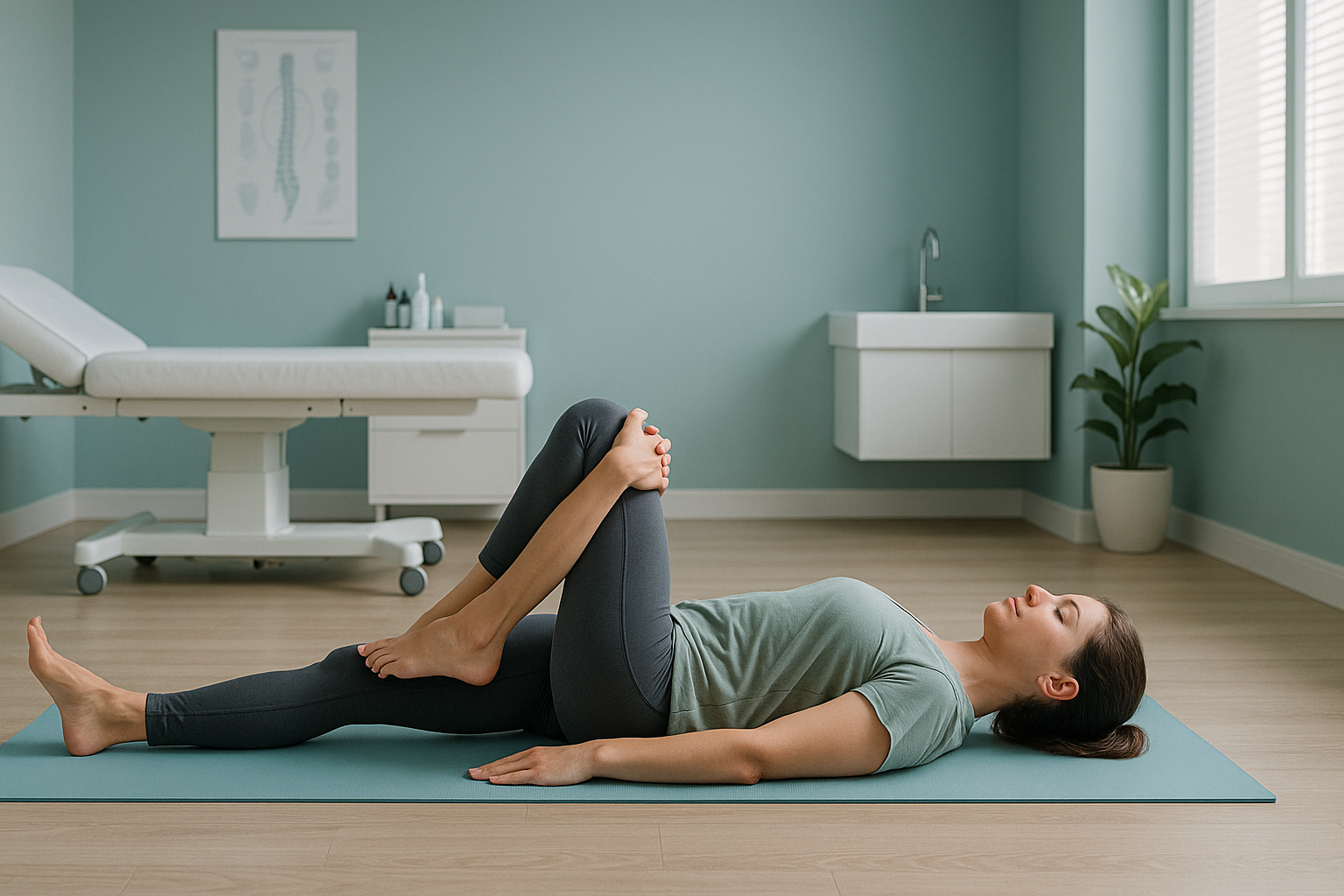
Draw both knees gently towards your chest while lying flat. This releases the lower back and can reduce pressure on the nerve roots.
On hands and knees, gently arch and round the spine. This mobilises the lower back and encourages healthy movement through the pelvis.
Lying down, drop both knees to one side while keeping shoulders flat. Use only a comfortable range. This can ease tension through the lower back and hips.
A restful position that gently lengthens the lower back. Keep knees wide if needed for comfort. This is a good resting position between other stretches.
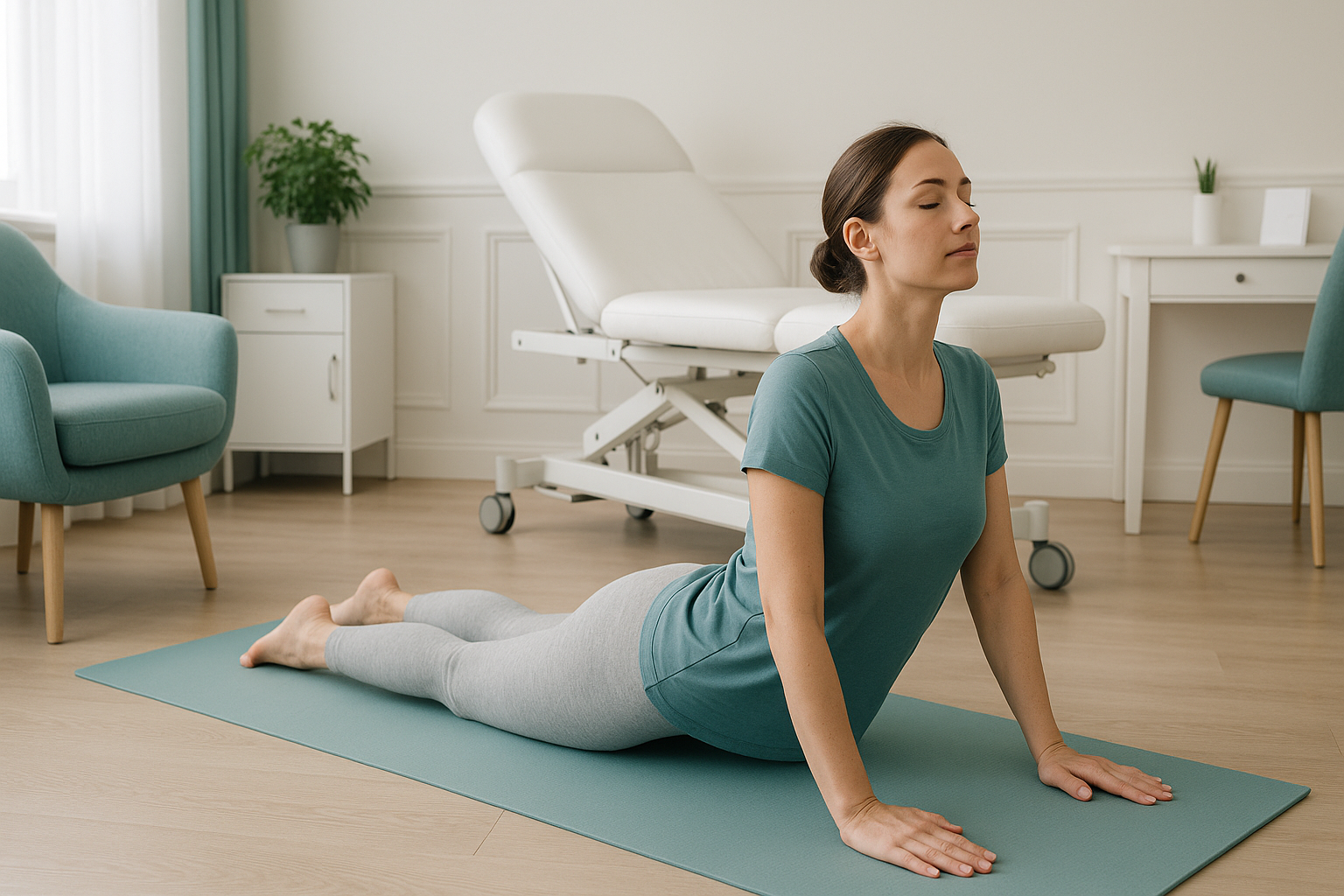
A small backbend from the floor can help with disc-related sciatica by encouraging the disc material away from the nerve. Keep it gentle and pain-free.
How long should you hold yoga poses for sciatica?
Hold each stretch for 20 to 30 seconds, breathing steadily. If a stretch feels comfortable, you can hold it for up to 60 seconds. Never push into pain. Repeat two to three times on each side, once or twice a day. Consistency matters more than intensity. Beginner yoga for sciatic nerve pain should feel like a gentle release, never a sharp pull.
Which yoga poses should you avoid with sciatica?
Some popular yoga poses can make sciatica worse, especially if a disc problem is the cause. Avoid these until you know what is driving your symptoms.
- Deep forward folds (standing or seated)
- Full wheel or deep backbends
- Straight-leg deadlift style stretches
- Any pose that rounds the lower back heavily under load
- Reclined stretches (on your back)
- Gentle hip openers
- Cat-cow and similar mobility work
- Supported child's pose
Forward folds increase pressure on the front of the spinal discs. If a disc is already bulging backwards into the nerve, folding forward can push it further. This is why the same pose that helps one person can make another person's sciatica significantly worse.
Why does whole-body alignment matter for sciatica?
Your body is a connected chain from your feet to your head. A problem in one area often causes another area to compensate, so pain can show up far from its true cause. With sciatica, a tilted pelvis or an uneven leg length can change how the lower spine sits, putting extra pressure on one side and irritating the nerve.
Standard imaging is often done lying down. When you lie on an MRI or CT table, gravity is removed and your muscles relax. A tilt or imbalance that shows up clearly when you stand may disappear completely when you are flat. This is why some people get scan results that look normal, even though they are in real pain.
A standing whole-body assessment, like the EOS imaging system, captures your skeleton from head to toe while you are upright and weight-bearing. It shows how your spine, pelvis, hips and legs actually line up under gravity. This can reveal the structural reason behind your sciatica, helping you and your clinician choose the right approach, including which yoga poses will genuinely help.
When should you get imaging instead of stretching?
Yoga is a reasonable starting point for mild sciatica. But if your symptoms have lasted more than a few weeks, or keep coming back, stretching alone is unlikely to resolve the underlying cause. Signs that imaging could help include:
- Sciatica that does not improve with gentle stretching or physiotherapy
- Pain that switches sides or changes pattern
- A feeling that one hip is higher than the other
- Previous scans that came back "normal" despite ongoing pain
- A clinician has suggested your pelvis or spine may be misaligned
Not sure whether imaging is the right step? You can talk it through with a specialist radiographer first, at no cost.
Book a free video consultationAn EOS scan uses about 90% less radiation than a standard X-ray, around ten times less. It takes a few seconds and captures a full standing image from head to toe. You can learn more about what to expect, safety and costs on the FAQs page.
Frequently asked questions about sciatica and yoga
Yoga cannot cure sciatica. It can help manage symptoms by stretching tight muscles and improving mobility. But if the cause is structural, such as a disc problem or pelvic misalignment, stretching alone will not resolve it. You need to understand the cause first.
The reclined version of pigeon pose, done lying on your back, is generally safer than the full upright version. The full pigeon can put a lot of pressure on the lower back and hip. If it increases your pain, stop and try the reclined version instead.
Once or twice a day for 10 to 15 minutes is a sensible starting point. Keep the stretches gentle and hold each for 20 to 30 seconds. Consistency is more helpful than long, intense sessions.
You may be doing poses that aggravate the specific cause of your sciatica. Forward folds, for example, can worsen disc-related irritation. If yoga makes your symptoms worse, stop and consider getting assessed so you know what is actually causing the problem.
If the piriformis muscle is compressing the sciatic nerve (sometimes called piriformis syndrome), targeted piriformis stretches can help. But if the issue is a disc or spinal problem, piriformis stretches will not address the cause. Knowing the difference matters.
An EOS scan captures your full skeleton in one standing image, from head to toe. A standard X-ray usually covers just one area and is often taken lying down. Standing imaging shows how your spine, pelvis and legs align under your own body weight, which can reveal problems that lying-down scans miss.
Yes. An EOS scan uses about 90% less radiation than a standard X-ray, around ten times less. The scan takes only a few seconds while you stand still.
No. ScanAlign is a private, self-pay clinic. You can refer yourself without needing a letter from your GP. You start with a free video consultation to discuss your situation first.
Pricing details are on the ScanAlign FAQs page. The free video consultation will also help you understand which assessment is right for your situation.
Yes. A pelvic tilt changes how weight is distributed through the lower spine. One side can end up under more pressure, compressing the nerve root on that side. This is one of the alignment issues that a standing whole-body scan is designed to identify. You can learn more on the spine and posture page.
Still stretching without knowing the cause?
A free video consultation with a specialist radiographer can help you decide whether standing imaging would add clarity to your situation.
Book a free video consultationWritten by Abbas Dhami (Specialist Diagnostic Radiographer)
Sources
- NHS. Sciatica. nhs.uk/conditions/sciatica. Accessed 2024.
- Valat JP, Genevay S, Marty M, Rozenberg S, Koes B. Sciatica. Best Practice & Research Clinical Rheumatology. 2010;24(2):241-252.
- Dubois G, Khoshhal KI, Bhatt S, et al. Advantages of the EOS system for the evaluation of the surgical correction of spinal deformities. Journal of Children's Orthopaedics. 2014;8(Suppl 1):S9.
This page is general information and not a diagnosis.
ScanAlign is the trading name of CoreMed Solutions Ltd and operates under The Harley Street Hospital's CQC licence.