
EOS Scan or MRI: Which One Do You Actually Need?
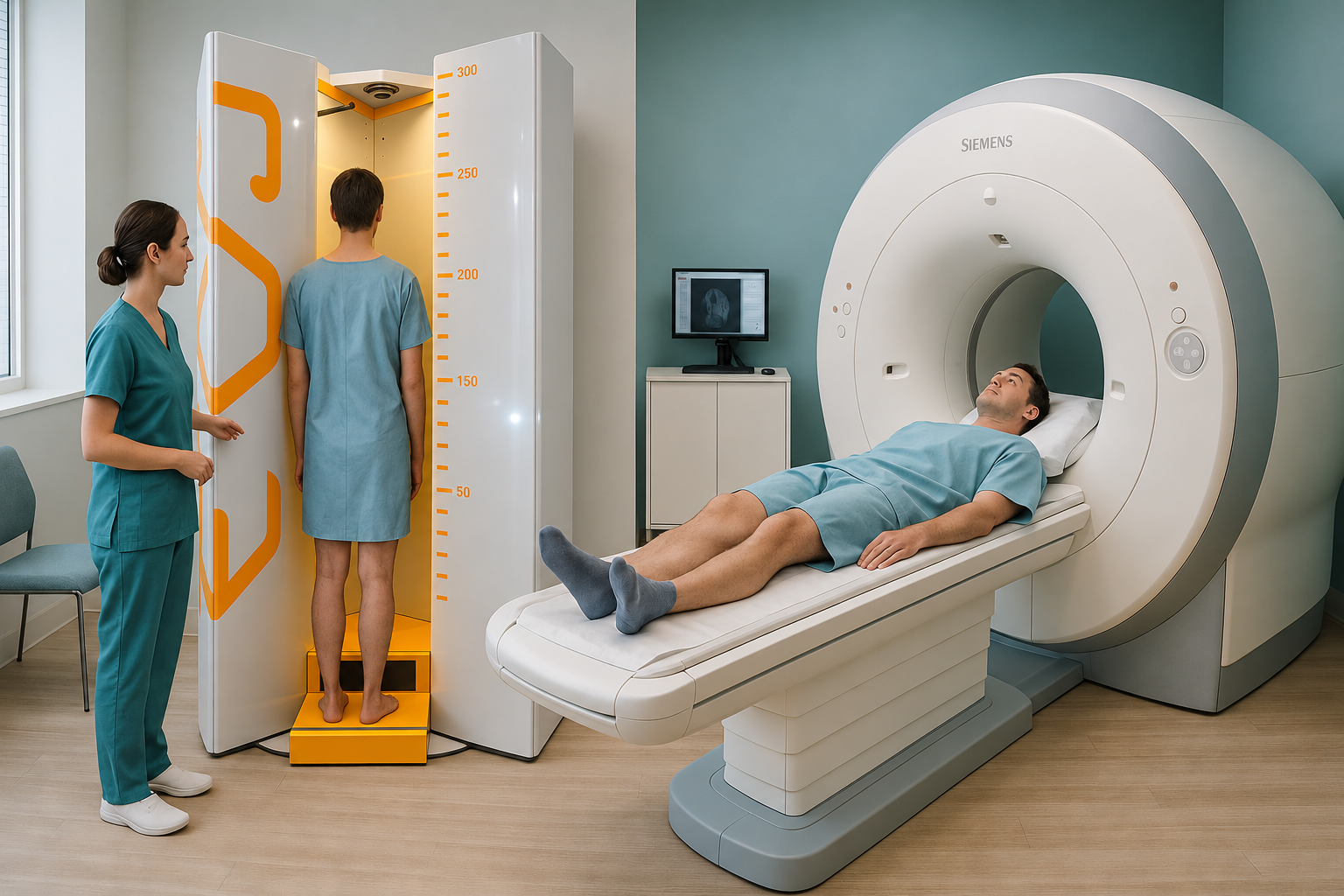
EOS and MRI are not rivals. They answer different questions. An EOS scan images your bones and joints while you stand, showing real alignment under your own body weight. MRI images soft tissue, such as discs, nerves and ligaments, while you lie down. Many people benefit from one or both, depending on the clinical question.
Key takeaways
- EOS shows bone alignment in a standing, weight-bearing position.
- MRI shows soft tissue detail (discs, nerves, cartilage) lying down.
- Neither scan replaces the other. They are complementary.
- EOS uses about 90% less radiation than a standard X-ray, around ten times less.
- If your problem involves both alignment and soft tissue, you may need both scans.
What does an EOS scan show that MRI does not?
An EOS scan captures your entire skeleton from head to feet in a single standing image. Because you are upright and weight-bearing, the picture reflects how your body actually works when you walk, stand and sit. It reveals the true relationship between your spine, pelvis, hips, knees and ankles under gravity. A lying-down scan cannot show this because your muscles relax and your joints shift position. Learn more about weight-bearing versus lying imaging and why the difference matters.
What does MRI show that EOS does not?
MRI uses strong magnets instead of radiation. It excels at showing soft tissue, including spinal discs, nerve roots, ligaments, cartilage and muscle. If your specialist suspects a disc bulge pressing on a nerve, or wants to assess cartilage damage inside a joint, MRI is usually the better tool. EOS does not image soft tissue in the same detail.
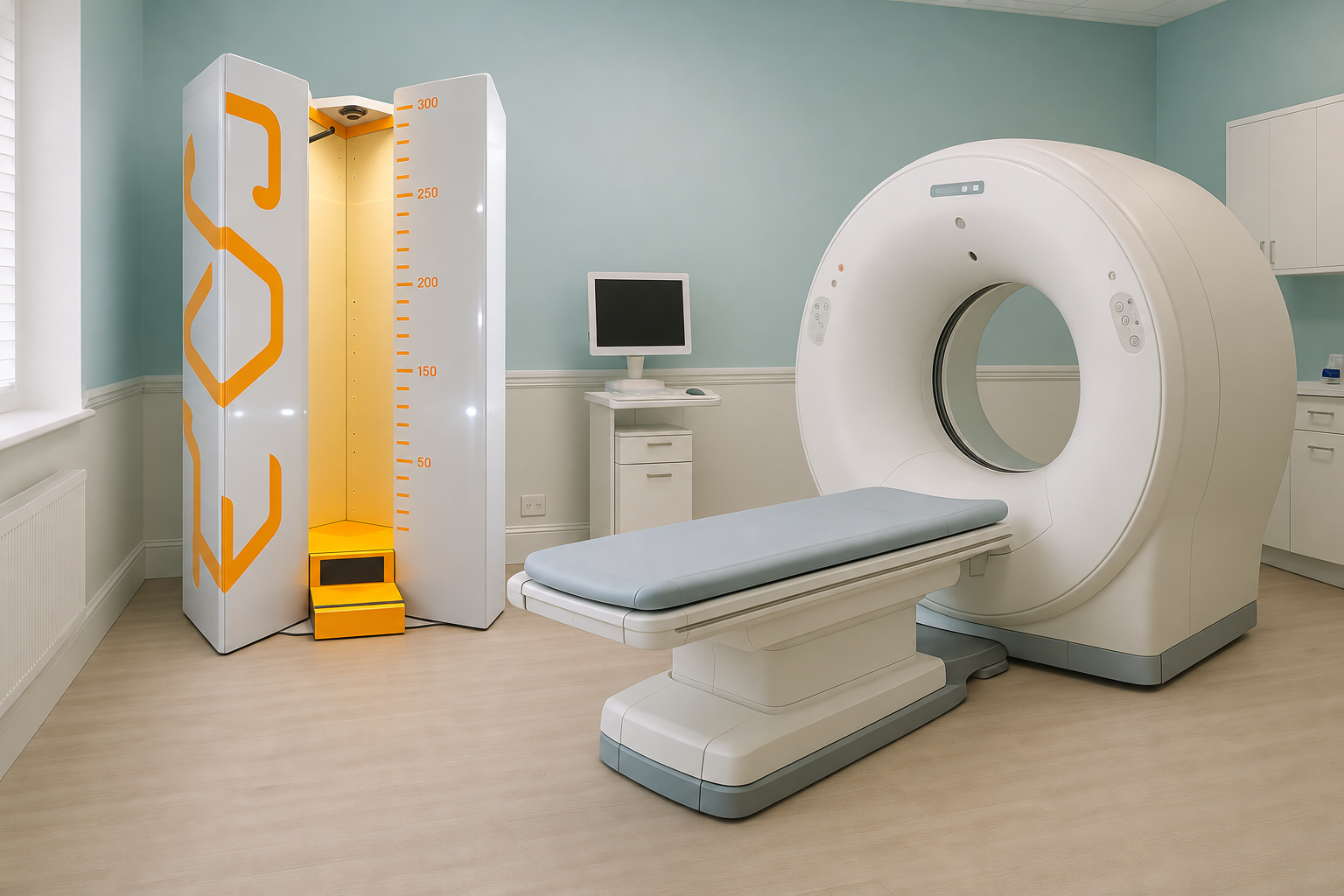
How does EOS compare with MRI side by side?
The table below highlights the practical differences. For a broader look at how EOS stacks up against conventional X-ray and CT as well, see our guide to EOS compared with x-ray, CT and MRI.
| Feature | EOS scan | MRI |
|---|---|---|
| Position during scan | Standing (weight-bearing) | Lying down |
| Best for | Bone alignment, posture, joint angles | Soft tissue: discs, nerves, ligaments |
| Radiation | About 90% less than a standard X-ray | None (uses magnets) |
| Full-body view | Yes, head to feet in one image | Usually one region at a time |
| Scan time | Under a minute for most scans | Typically 20 to 45 minutes |
| Claustrophobia risk | Open cabin, no tunnel | Enclosed tunnel (open MRI exists but is less common) |
| Metal implants | Generally safe | Some implants are not MRI-compatible |
When MRI is the better choice: EOS shows bones, joints and alignment clearly. For soft tissue, discs or nerves, MRI is usually the better tool. If your consultant suspects a disc herniation, ligament tear or nerve compression, they will typically recommend MRI. The two scans work well together, not against each other.
Why does scanning position matter for back pain?
When you lie down for an MRI or conventional X-ray, gravity is no longer pressing down through your spine, hips and knees. Your muscles relax. Joints settle differently. A tilt in your pelvis or an imbalance in your leg length may not show at all in a lying-down image.
Your body works as a connected chain from your feet up to your head. If one area is out of line, another area has to compensate. That compensation is often where you feel pain, not where the problem starts. An EOS scan captures the whole chain while you stand, so your specialist can trace the real source of the problem rather than treating only the painful spot.
This is why the question is rarely "MRI or EOS." It is more often "which scan answers the question my specialist needs answered right now?" Sometimes the answer is both.
Not sure which scan suits your situation? Talk it through first.
Book a free video consultationHow do you book an EOS scan at ScanAlign?
You do not need a GP referral. At ScanAlign, standing EOS imaging in Harley Street, you can self-refer as a private patient. Here is how it works.
Free video consultation
A short call with our team to understand your symptoms, history and what you hope to learn from imaging.
Your EOS scan
You stand in the open EOS cabin at 19 Harley Street. The scan itself takes under a minute and uses about 90% less radiation than a standard X-ray, around ten times less.
Your report
A specialist radiologist reviews your images and produces a detailed report. You and your treating clinician can use it to plan next steps.
Next steps
If further imaging such as MRI would help, we will tell you. Your report may also be shared with your GP, surgeon or physiotherapist.
For details on pricing, see the EOS scan cost page. Ready to book an EOS scan?
Frequently asked questions
No. EOS and MRI answer different questions. EOS shows bone alignment in a standing position. MRI shows soft tissue such as discs and nerves. They complement each other rather than compete.
It depends on the suspected cause. If your specialist thinks alignment, posture or a structural imbalance is the issue, EOS is ideal because it images you standing. If a disc bulge or nerve problem is suspected, MRI is usually recommended. Many people benefit from both.
Yes, but a very small amount. EOS uses about 90% less radiation than a standard X-ray, around ten times less. MRI uses no radiation at all, relying on magnetic fields instead.
EOS uses low-dose X-ray technology, so metal implants are generally not a problem. MRI uses powerful magnets, which means some types of metal implant are not safe inside an MRI scanner. If you have implants and are unsure, mention them during your free video consultation.
No. ScanAlign accepts self-referrals. You can book directly as a private patient without waiting for a GP letter.
The scan itself usually takes under a minute. You stand in an open cabin, so there is no enclosed tunnel and no need to lie still for a long time.
Yes. Because EOS captures your full spine while you stand, it shows spinal curves under real weight-bearing conditions. This gives your specialist a more accurate view of the curve than a lying-down scan would.
Most people do not. The EOS system is an open cabin, not a tunnel. You simply stand upright while the scanner moves around you. It is a very different experience from an MRI.
Pricing depends on the type of scan you need. Visit the EOS scan cost page for full details.
Absolutely. Many orthopaedic and spinal consultants find it helpful to see standing alignment from EOS alongside soft-tissue detail from MRI. Together the two scans give a fuller picture than either one alone.
Not sure which scan you need?
Our team can talk you through the options in a short, no-obligation video call.
Book a free video consultationWritten by Abbas Dhami (Specialist Diagnostic Radiographer)
Sources
- Deschênes S, Charron G, Beaudoin G, et al. "Diagnostic imaging of spinal deformities: reducing patients radiation dose with a new slot-scanning X-ray imager." Spine, 2010;35(9):989-994.
- NHS. "MRI scan: Overview." nhs.uk (accessed 2024).
- American Academy of Orthopaedic Surgeons (AAOS). "X-rays, CT Scans and MRIs." orthoinfo.aaos.org (accessed 2024).
This page is general information and not a diagnosis.
ScanAlign is the trading name of CoreMed Solutions Ltd and operates under The Harley Street Hospital's CQC licence.