
EOS Scan vs X-ray, CT & MRI: How Do They Compare?
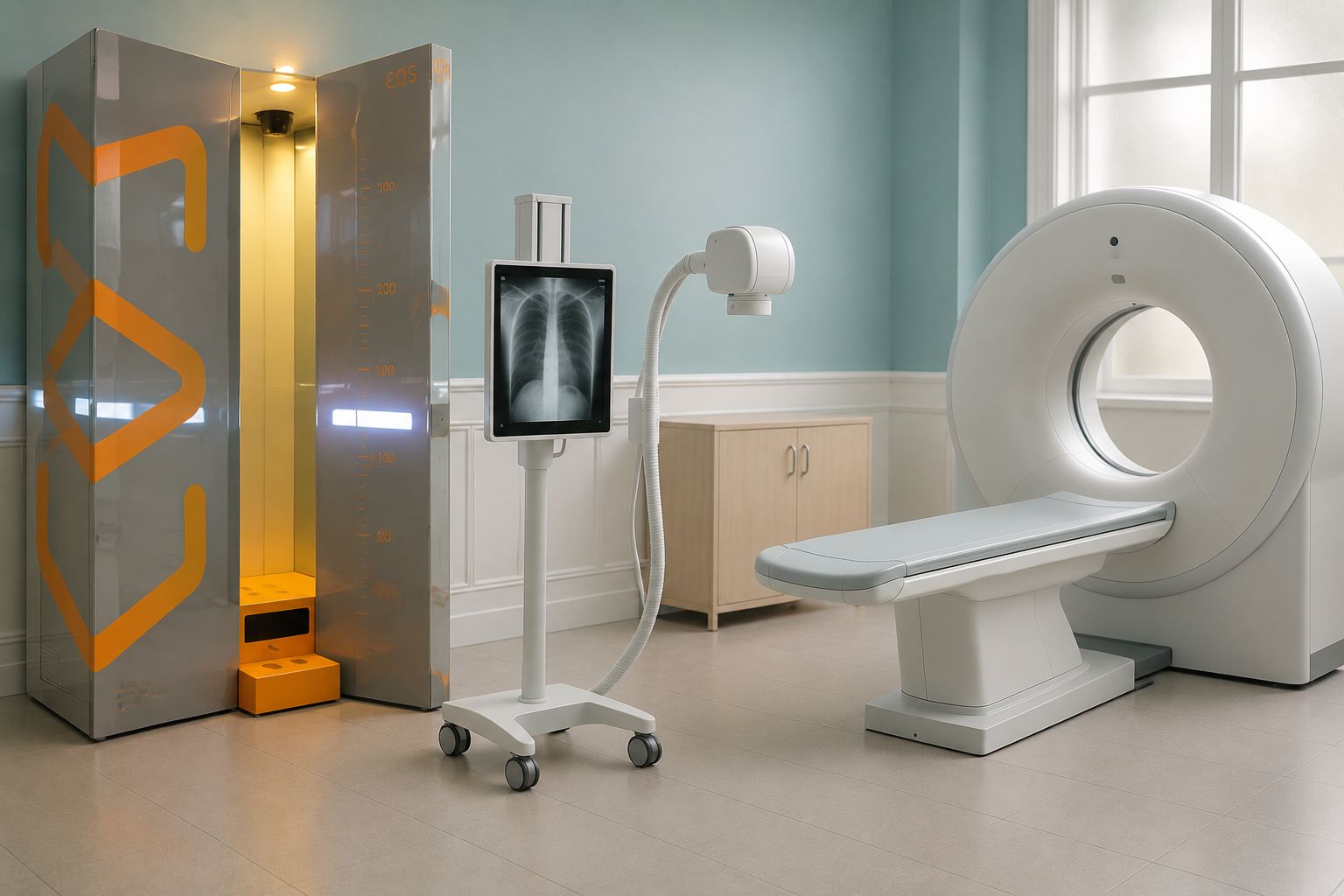
Each scan type has a specific strength. Standard X-rays show bones but miss weight-bearing alignment. CT gives fine bone detail with higher radiation. MRI excels at soft tissue. An EOS scan captures your entire skeleton while you stand, using about 90% less radiation than a standard X-ray, around ten times less, so it reveals how your body truly loads under gravity.
Key takeaways
- EOS images you standing up, showing real alignment under your own body weight.
- It uses about 90% less radiation than a standard X-ray, around ten times less.
- MRI is usually the better tool for soft tissue, discs and nerves.
- CT gives very fine bone detail but at a much higher radiation dose.
- No single scan does everything. The right choice depends on the clinical question.
If you have been told you need imaging, you have probably wondered which type of scan you actually need. X-ray, CT, MRI and EOS all look at different things, in different ways. Understanding those differences helps you and your clinician make the right decision.
What is the difference between an EOS scan, X-ray, CT and MRI?
The main difference is what each scan is designed to show and how it images your body. Here is a side-by-side summary.
| EOS | Standard X-ray | CT | MRI | |
|---|---|---|---|---|
| Position | Standing (weight-bearing) | Standing or lying | Lying down | Lying down |
| Coverage | Full body, head to feet, in one pass | One area at a time | One area at a time | One area at a time |
| Radiation | Very low (about 90% less than standard X-ray) | Low | Higher | None (uses magnets) |
| Best for | Whole-body skeletal alignment, joint angles, posture | Fractures, single-joint checks | Fine bone detail, complex fractures | Soft tissue, discs, ligaments, nerves |
| Shows alignment under load | Yes | Partially (limited area) | No (gravity removed) | No (gravity removed) |
| Scan time | Under a minute | A few seconds per view | A few minutes | 20 to 45 minutes |
Why does it matter whether you are standing or lying down for a scan?
It matters because gravity changes everything. When you lie down, your muscles relax, your spine decompresses, and your joints settle into an unloaded position. Alignment problems that cause pain when you walk, stand or sit can disappear entirely on a lying-down scan.
An EOS scan captures your skeleton while you stand naturally. That means the image shows how your body actually bears weight, where joints are tilting, and which areas are compensating for a problem elsewhere.
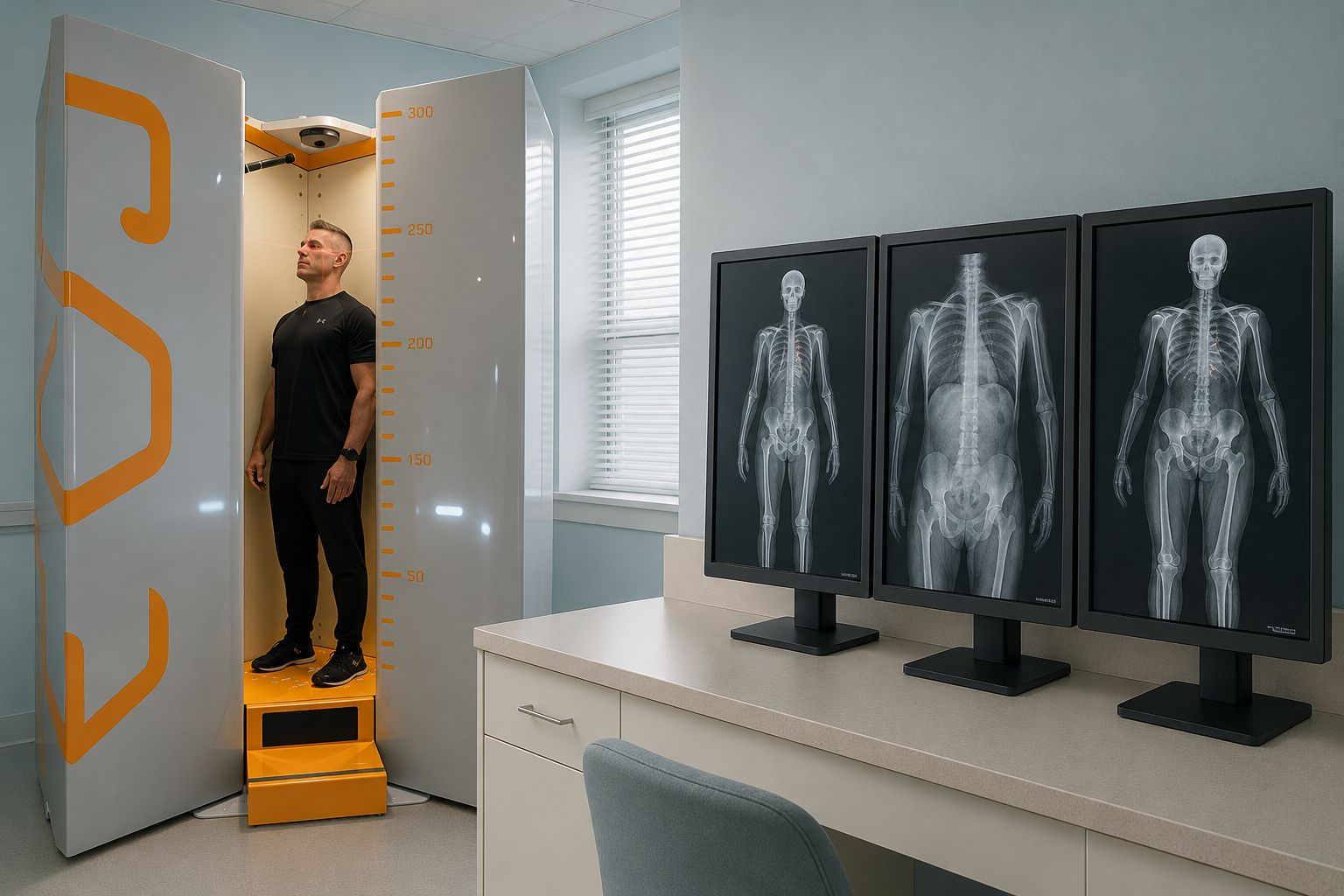
Your body is a connected chain from your feet to your head. If your pelvis tilts, your spine adapts. If your knee angles inward, your hip compensates. Because EOS captures the entire chain in one standing image, your clinician can see these compensations clearly. A standard X-ray of just one knee or a lying-down MRI of your lower back may miss the bigger picture entirely.
When is an EOS scan the right choice?
An EOS scan is most useful when the clinical question is about alignment, posture or how your skeleton loads under gravity. Here are some common situations.
When single-area scans have not explained your symptoms, whole-body alignment imaging can reveal the underlying cause.
Surgeons preparing for joint replacement or spinal surgery often need standing alignment data that CT and MRI cannot provide.
A full standing image shows true spinal curves and pelvic balance in the position they actually affect you.
Weight-bearing imaging accurately shows leg length differences and knee angles that change when you stand.
When MRI is the better choice: EOS shows bones, joints and alignment. If your clinician suspects a disc bulge, torn ligament, nerve compression or another soft-tissue problem, MRI is usually the more appropriate tool. The two scans answer different questions, and sometimes you need both.
How does an EOS standing assessment work at ScanAlign?
At ScanAlign, the process is straightforward. You stand naturally inside the EOS system while it takes a low-dose image of your full body in under a minute. There is no tunnel, no loud noise, and no need to hold uncomfortable positions.
The scan produces detailed front and side images of your skeleton from head to feet. A specialist diagnostic radiographer then analyses how your joints, spine and pelvis align under load. The findings are compiled into a clear report that you and your treating clinician can use to guide next steps, whether that is physiotherapy, orthopaedic review or monitoring.
Not sure whether EOS or another scan is right for your situation? We are happy to talk it through.
Book a free video consultationYou do not need a GP referral to book. ScanAlign is a private, self-pay clinic at 19 Harley Street, London. For details on cost, preparation and what to expect, visit the frequently asked questions page.
Frequently asked questions
It depends on the question being asked. For checking a single fracture, a standard X-ray is quick and effective. But if you need to see how your entire skeleton aligns while you stand, EOS is more informative, and it uses about 90% less radiation than a standard X-ray, around ten times less.
They do different jobs. EOS is excellent for bones, joints and whole-body alignment under gravity. MRI is the better tool for soft tissue such as discs, ligaments and nerves. Neither replaces the other, and in some cases both are needed.
An EOS scan uses about 90% less radiation than a standard X-ray, around ten times less. This makes it one of the lowest-dose skeletal imaging options available.
No. ScanAlign accepts self-referrals. You can book directly without a letter from your GP or consultant.
The scan itself takes under a minute. Your total appointment is a little longer to allow for positioning and a brief discussion with the radiographer.
Not always. CT gives very fine cross-sectional bone detail, which is useful for complex fractures or planning certain surgeries. EOS gives a different advantage: whole-body alignment in a standing position with far less radiation. Your clinician will recommend whichever best answers the clinical question.
No. You stand in an open cabin, not inside a tunnel. Most people find it quick and comfortable compared to an MRI.
Pricing details are on the FAQs and cost page. ScanAlign is a private, self-pay service.
ScanAlign is at 19 Harley Street, London. You can learn more about the clinic on the homepage.
Not sure which scan you need?
Speak with a specialist diagnostic radiographer for free. We will help you understand whether an EOS standing scan is the right next step for your situation.
Book a free video consultationSources
- Deschênes S, Charron G, Beaudoin G, et al. "Diagnostic imaging of spinal deformities: reducing patients' radiation dose with a new slot-scanning X-ray imager." Spine, 2010;35(9):989-994.
- NHS. "X-ray overview." nhs.uk/conditions/x-ray.
- The Royal College of Radiologists. "iRefer: Making the best use of clinical radiology." rcr.ac.uk.
Written by Abbas Dhami (Specialist Diagnostic Radiographer)
This page is general information and not a diagnosis.
ScanAlign is the trading name of CoreMed Solutions Ltd and operates under The Harley Street Hospital's CQC licence.