
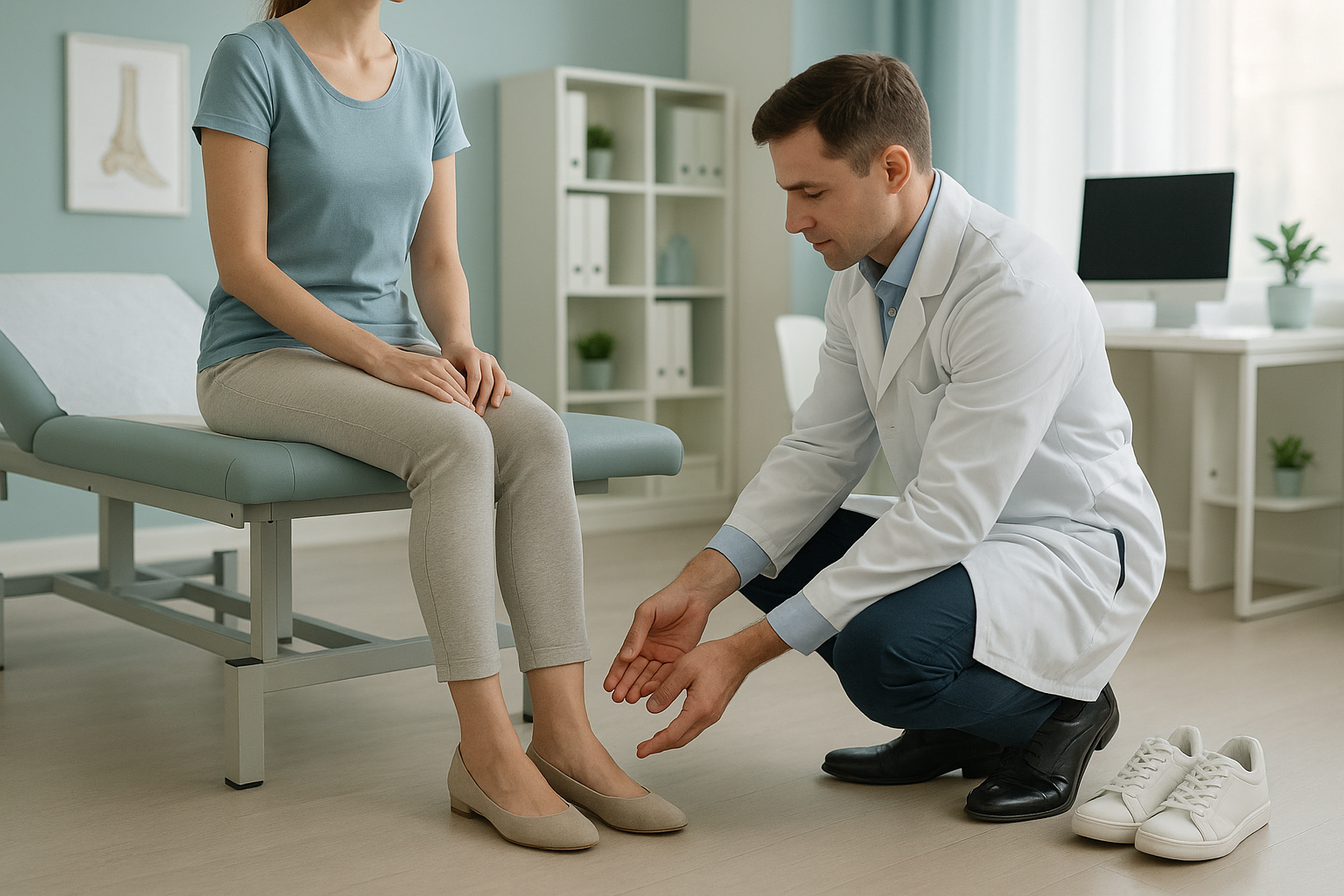
How Do Your Shoes Affect Your Posture and Alignment?
Your shoes change where your body weight falls over your feet. A raised heel, a stiff sole or a narrow toe box shifts your centre of mass and forces your spine, pelvis and knees to compensate. Over time, those compensations can cause pain far from your feet. A standing, whole-body assessment is the clearest way to see the effect.
Key takeaways
- Heel height tips your centre of mass forward, increasing the curve in your lower back.
- Completely flat, unsupportive shoes can overload the arch and alter knee tracking.
- The body is a connected chain. A problem at your feet can show up as hip, back or neck pain.
- Lying-down scans relax the muscles and can hide alignment shifts that only appear when you stand.
- A standing EOS image captures the full chain from feet to head in one low-dose exposure.
How do shoes change your posture?
Shoes alter the angle between your foot and the ground. Even a small change in heel height shifts your centre of mass forward. Your body responds automatically by adjusting curves in the spine, tilting the pelvis and changing how your knees track. These adjustments are not a choice. They are your body's way of keeping you upright.
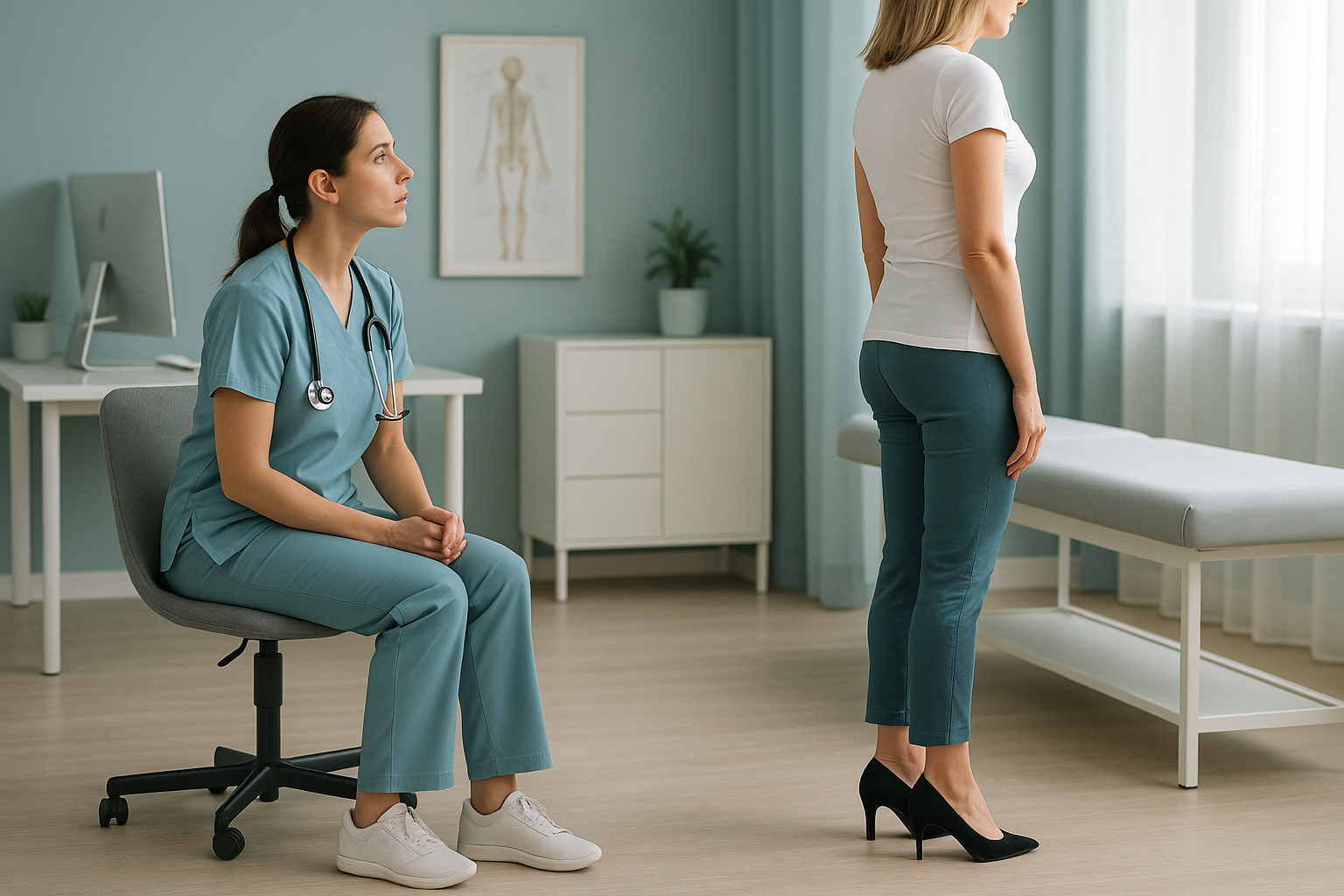
Think of your skeleton as a stack of blocks balanced on top of each other. When the base tilts, every block above it has to shift to stop the tower from falling. That is exactly what happens inside your body when your footwear changes the angle of your foot. The spine deepens or flattens its natural curves, the pelvis may develop an anterior pelvic tilt, and your muscles have to work harder to hold you steady, which can increase postural sway.
Do high heels cause back pain?
Yes, they can. High heels push the forefoot down, tipping your weight forward and increasing the curve of the lower back (lumbar lordosis). Over time this can compress the joints at the back of the spine and strain the muscles that try to keep you balanced. The higher the heel, the greater the shift.
Are barefoot shoes better for posture?
Barefoot or minimal shoes have a thin, flexible sole and zero heel drop. They let the foot move more naturally and may strengthen the small muscles of the foot over time. However, switching suddenly from a cushioned, raised-heel shoe to a minimal shoe can overload tissues that have adapted to years of support. A gradual transition period is important.
What is heel drop in running shoes and why does it matter?
Heel drop (or heel-to-toe drop) is the difference in thickness between the heel and the forefoot of a shoe. A traditional running shoe might have a drop of around 10 to 12 millimetres, while a minimal shoe may be close to zero. A higher drop encourages a heel-strike pattern and shifts more load to the knees, while a lower drop places more demand on the Achilles tendon and calf. Neither is inherently better. The right drop depends on your individual alignment and running style.
What are the signs your shoes are affecting your alignment?
Your body often gives you clues. You might not connect them to your footwear at first, because the pain frequently shows up away from the real cause.
Because the body compensates as a connected chain, a foot-level problem can produce symptoms at the knee, hip or spine. This is why looking at only one area, or scanning while lying down, can miss the full picture.
How is footwear-related alignment assessed standing up?
A standing, weight-bearing scan shows your skeleton under real load, exactly as it is when your shoes are influencing it. Lying-down imaging relaxes the muscles and lets gravity flatten out the very compensations you need to see. That is why traditional X-rays or MRI may show "nothing wrong" even when you are in pain.
ScanAlign standing EOS imaging captures your full skeleton, from your feet to your head, in a single low-dose exposure using about 90% less radiation than a standard X-ray, around ten times less. The image is taken while you stand naturally so your alignment, pelvic tilt and spinal curves appear exactly as they do in daily life.
If you wear orthotics and overpronation insoles, you can be scanned with and without them to compare the effect on your whole-body alignment.
When MRI is the better tool: EOS shows bones, joints and alignment. If your clinician suspects soft-tissue damage, disc problems or nerve compression, MRI is usually the more appropriate investigation. The two scans answer different questions and can complement each other.
What can help if your shoes are affecting your posture?
Changing your footwear alone may not be enough if your alignment has already adapted. Understanding the full picture is the first step. Here are some general principles that clinicians commonly recommend.
- Vary your shoes. Alternating between different heel heights and sole types during the week reduces repetitive loading patterns.
- Transition gradually. If you want to move to a lower-drop or minimal shoe, reduce the heel height in stages over weeks or months to give your calves and Achilles tendon time to adapt.
- Check your toe box. A wider toe box lets your toes spread, improving your base of support and balance.
- Consider a standing alignment assessment. Knowing exactly where your compensation pattern starts, and how far up the chain it reaches, helps you and your clinician decide on the right approach.
ScanAlign does not provide treatment. It provides the diagnostic imaging that informs the treatment decisions made by your clinician, physiotherapist or podiatrist.
Wondering whether your footwear is part of the problem? You can book a standing posture scan or start with a free video consultation to discuss your symptoms.
Book a free video consultationFrequently asked questions
Yes. High heels push your weight forward and increase the curve in your lower back. Over time this can strain muscles and compress joints in the lumbar spine, leading to persistent lower back pain.
Very flat shoes with no arch support can overload the arch in some people, changing how the foot rolls inward. This can affect knee and hip alignment. Whether flat shoes suit you depends on your individual foot structure.
Barefoot shoes allow the foot to move more naturally, which may strengthen the small muscles of the foot and improve sensory feedback from the ground. They are not right for everyone, and switching too quickly can cause problems.
There is no single best heel drop. A higher drop (around 10 to 12 mm) encourages a heel strike and shifts load to the knees. A lower drop places more demand on the calf and Achilles. The right choice depends on your alignment and running style.
Clues include pain that worsens in certain shoes, uneven sole wear, or discomfort that eases when you change footwear. A standing whole-body image can show whether the alignment of your foot, knee and hip is contributing to the problem.
Yes. You can be scanned with and without your orthotics so your clinician can compare the effect on your full alignment from feet to head.
An EOS scan takes a full-body, standing image in a single pass, using about 90% less radiation than a standard X-ray, around ten times less. Because you are upright and weight-bearing, your alignment is captured as it actually is in daily life.
No. ScanAlign accepts self-referrals. You can book a free video consultation to discuss your symptoms first, and a referral is not required.
Pricing details are available on the ScanAlign FAQs and cost page.
Yes. The EOS system uses about 90% less radiation than a standard X-ray, around ten times less. It is a very low-dose imaging method. More safety details are on the FAQs page.
See how your footwear affects your whole-body alignment
A free video consultation lets you discuss your symptoms with a specialist radiographer before you decide on a scan.
Book a free video consultationAuthor: Abbas Dhami (Specialist Diagnostic Radiographer)
Sources
- Cronin NJ. The effects of high heeled shoes on female gait: a review. Journal of Electromyography and Kinesiology. 2014;24(2):258-263.
- Franklin S, Grey MJ, Heneghan N, Bowen L, Li FX. Barefoot vs common footwear: a systematic review of the kinematic, kinetic and muscle activity differences during walking. Gait & Posture. 2015;42(3):230-239.
- NHS. Back pain: causes, treatment and prevention. nhs.uk/conditions/back-pain.
This page is general information and not a diagnosis.
ScanAlign is the trading name of CoreMed Solutions Ltd and operates under The Harley Street Hospital's CQC licence.