

Why Do I Get Headaches at the Back of My Head?
A headache at the back of your head is often linked to the upper neck. Tight muscles, stiff joints or poor alignment in the top three cervical vertebrae can refer pain upward into the skull. This is called a cervicogenic headache, and it is one of the most common reasons for persistent occipital pain in adults.
Key takeaways
- Most headaches at the base of the skull start in the upper cervical spine, not the head itself.
- Forward head posture and screen habits are major contributing factors.
- Lying-down scans can miss alignment problems that only appear when you are upright and weight-bearing.
- A standing whole-body scan shows how your neck, spine and pelvis work together under gravity.
- If you have sudden severe headache, visual changes, or numbness, seek urgent medical attention first.
What does a headache at the back of your head feel like?
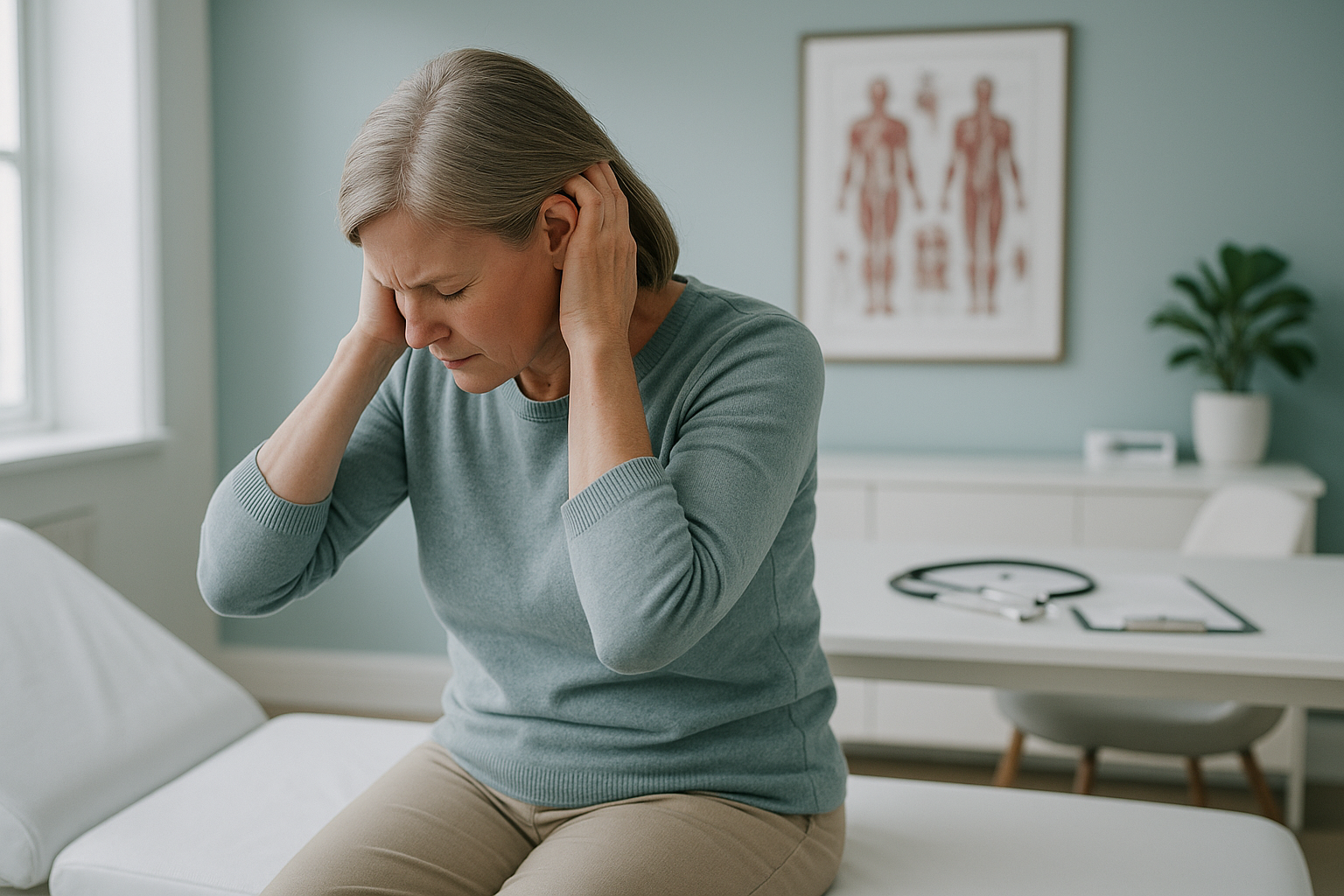
It usually feels like a deep, steady ache at the base of the skull, sometimes wrapping around one side toward the temple or behind the eye. The pain can be dull and constant, or it can come in waves. Many people describe it as a heavy, pressing sensation rather than a sharp stab.
These symptoms overlap with tension headache back of head patterns. The difference often comes down to whether the pain is driven by muscle tension alone or by a structural issue in the cervical spine.
What causes headaches at the base of the skull?
The most common cause is irritation of the joints, nerves or muscles in the upper cervical spine, around the C1, C2 and C3 vertebrae. The occipital nerves run from this area up and over the back of the skull, so any tension or misalignment here can send pain upward.
Less commonly, an occipital headache can be linked to a loss of the normal neck curve, known as cervical lordosis. When the neck straightens or reverses its natural curve, the load on the upper joints increases significantly.
How does neck alignment cause a headache at the back of your head?
Your neck is not an isolated structure. It sits on top of the thoracic spine, which sits on the pelvis. If your pelvis tilts or your mid-back curves too far forward, your neck has to compensate to keep your eyes level. This compensation overworks the small muscles and joints at the very top of the spine, right where the occipital nerves sit.
This is the compensation narrative in action. Your pain is at the top, but the cause may be much further down. That is why a scan of the head alone, or even just the neck, often misses the bigger picture. If there is a cervical tilt or a pelvic imbalance underneath, treating only the headache symptoms will not solve the problem.
People who also experience headache with lower back pain are a good example of this connected pattern.
How is a cervicogenic headache assessed with standing imaging?
A cervicogenic headache is assessed most accurately when you are upright and weight-bearing, because that is when gravity acts on your spine and reveals how your body truly aligns. Lying down for a standard scan relaxes the muscles and lets the joints settle into an artificial position, which can hide the very misalignment causing your pain.
Weight-bearing EOS imaging captures your entire skeleton from head to feet in a single standing exposure. It shows your cervical curve, head position, thoracic kyphosis and pelvic alignment all at once, so the clinician can trace the compensation chain from bottom to top.
The EOS system uses about 90% less radiation than a standard X-ray, around ten times less. You stand still for a few seconds. No enclosed tube, no lying flat.
Lying-down imaging (conventional X-ray, CT or MRI) removes the effect of gravity. Your muscles relax, joints decompress, and subtle tilts or shifts disappear. For soft-tissue questions an MRI is often better, but for alignment questions, a lying-down image does not show the real picture.
ScanAlign standing EOS imaging at 19 Harley Street gives your clinician a full picture of how your skeleton behaves under its own weight. No GP referral is needed.
Persistent headaches at the back of your head deserve a closer look at your neck alignment.
Book a free video consultationWhen is MRI better? EOS shows bones, joints and alignment beautifully. For soft tissue, discs, nerves or suspected nerve compression, MRI is usually the better tool. If your headache comes with arm numbness or tingling, your clinician may recommend MRI alongside or instead of a standing scan.
When should you see a doctor urgently for a headache at the back of your head?
Most occipital headaches are not dangerous, but some patterns need urgent attention. Contact your GP, call 111, or go to A&E if you experience any of the following:
- A sudden, severe "thunderclap" headache that peaks within seconds.
- Headache with numbness, weakness in your arms or legs, or difficulty speaking.
- Loss of bladder or bowel control alongside head or neck pain.
- High fever, a stiff neck you cannot flex forward, or a rash that does not fade under pressure.
- Headache after a head injury, even a mild one.
- Visual changes, double vision, or sudden loss of vision.
These are red flags that need medical assessment before any imaging is considered.
What helps manage headaches that start in the neck?
The first step is finding out exactly where the problem comes from. Once you know whether the issue is joint stiffness, muscle tension, a curve change, or a compensation pattern further down the spine, a physiotherapist, osteopath or specialist can work with you more effectively.
General approaches that clinicians often recommend include improving screen posture, targeted neck exercises, and addressing jaw clenching habits. For those whose headaches are linked to broader postural patterns, exploring the relationship between posture related headache triggers can be helpful.
ScanAlign does not provide treatment. It provides the detailed standing alignment assessment that helps your treatment provider target the actual cause rather than just chasing the symptom.
If you would like to book a standing spine scan, you can start with a free video consultation to discuss whether it is the right step for you.
Frequently asked questions
Recurring headaches at the back of the head are most often caused by tension or stiffness in the upper cervical spine. The joints and muscles around C1, C2 and C3 can irritate the occipital nerves, sending referred pain up and over the skull. Forward head posture and prolonged screen use are very common triggers.
A cervicogenic headache is a headache that originates in the neck rather than the brain. It is caused by referred pain from the cervical spine's joints, discs or muscles. The pain typically starts at the base of the skull and can spread to the forehead, temple or behind the eye.
Yes. Forward head posture increases the load on the upper neck by a significant amount. This extra strain on the suboccipital muscles and cervical joints is one of the most common contributors to tension headache back of head patterns.
Most of the time, no. Cervicogenic and tension headaches are uncomfortable but not dangerous. However, a sudden, very severe headache, or one accompanied by numbness, weakness, visual changes or fever, needs urgent medical attention.
A standing EOS scan shows your entire skeleton under the force of gravity. It reveals neck alignment, head position, spinal curves and pelvic tilt all in one image. Lying-down scans can miss subtle alignment shifts because gravity is removed and muscles relax.
No. ScanAlign is a private, self-pay clinic. You can self-refer directly. You start with a free video consultation to discuss your symptoms and confirm the scan is appropriate for you.
Yes. The EOS system uses about 90% less radiation than a standard X-ray, around ten times less. You stand still for a few seconds while the system captures a full-body image.
It depends on what your clinician is looking for. EOS is ideal for bone alignment, spinal curves and posture under gravity. MRI is better for soft tissue, discs and nerves. In some cases, both types of imaging are useful.
Yes. Cervicogenic headaches can mimic migraines, with one-sided pain, sensitivity to light, and nausea. The key difference is that cervicogenic headaches are triggered by neck movement or sustained postures, while migraines have neurological triggers. They can also co-exist.
Pricing details are available on the ScanAlign FAQs page. A free video consultation is the first step, and there is no obligation to book a scan afterward.
Find out what is behind your headaches
A free video consultation is the first step. No referral needed, no obligation.
Book a free video consultationSources
- Bogduk, N. & Govind, J. "Cervicogenic headache: an assessment of the evidence on clinical diagnosis, invasive tests, and treatment." The Lancet Neurology, 2009; 8(10): 959-968.
- International Headache Society. "The International Classification of Headache Disorders, 3rd edition." Cephalalgia, 2018; 38(1): 1-211.
- NHS. "Headaches." nhs.uk/conditions/headaches (accessed 2024).
Written by Abbas Dhami (Specialist Diagnostic Radiographer)
This page is general information and not a diagnosis.
ScanAlign is the trading name of CoreMed Solutions Ltd and operates under The Harley Street Hospital's CQC licence.