
Cervical Lordosis: What Happens When Your Neck Loses Its Natural Curve?
Cervical lordosis is the gentle inward curve of your neck. When that curve flattens or reverses, the head sits too far forward, overloading muscles, joints and discs. This is sometimes called "military neck." A standing, weight-bearing scan shows the true position of the neck under gravity, something a lying-down scan can miss.
Key takeaways
- Your neck should have a gentle inward curve. Loss of that curve is called straightening of cervical lordosis.
- It can cause neck pain, headaches, shoulder tension and even mid-back or lower-back problems.
- Lying-down imaging relaxes muscles and can hide how far forward your head really sits.
- EOS whole-body standing imaging captures your neck alignment as it actually is when you are upright.
- ScanAlign provides the diagnostic picture. Treatment decisions are made by your clinician.
Your cervical spine is made up of seven vertebrae at the top of your spinal column. In a healthy neck, these vertebrae form a smooth, backward C-shaped curve called lordosis. This curve acts as a natural shock absorber, distributing the weight of your head evenly across the discs and joints.
When that curve flattens, straightens or even reverses, the balance changes. Your head, which weighs roughly the same as a bowling ball, shifts forward. The muscles at the back of your neck have to work much harder to hold it up. Over time, this can lead to pain, stiffness and wear on structures that were never designed to carry load in that way.
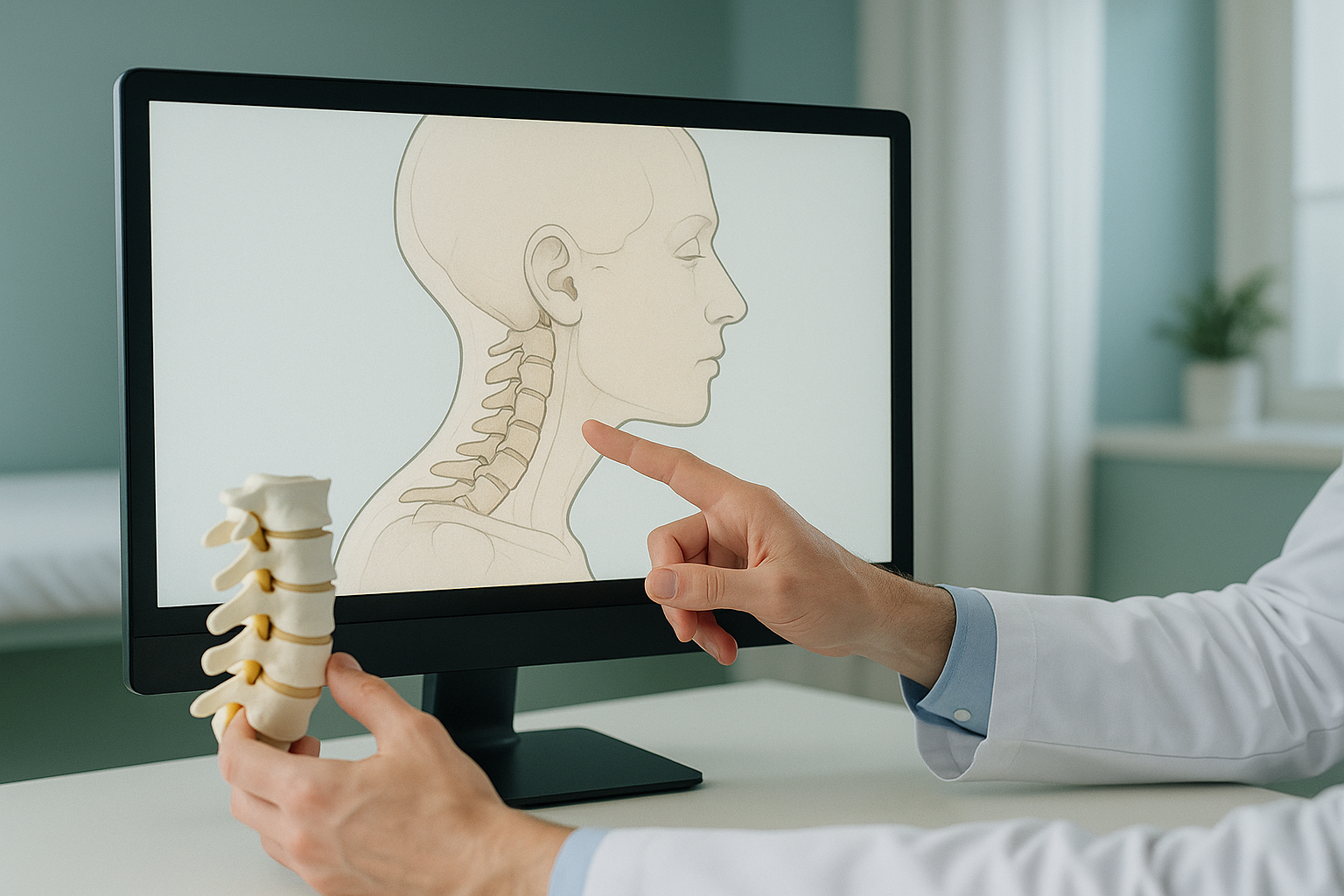
What are the signs of loss of cervical lordosis?
The most common sign is persistent neck stiffness or aching that does not settle with rest. Because the head is carried further forward, other areas start to feel the strain too.
A deep ache at the back of the neck, often worse after sitting at a desk or looking at a screen.
Tension headaches that start at the base of the skull and spread over the top of the head.
Tight, knotted muscles between the shoulder blades as they compensate for the forward head position.
Difficulty turning your head fully, especially when checking blind spots while driving.
Seek urgent help. If you experience numbness or weakness in your arms or hands, difficulty with balance, or any loss of bladder or bowel control alongside neck symptoms, contact your GP, call 111, or go to A&E straight away. These may indicate a more serious nerve problem that needs immediate assessment.
What causes straightening of cervical lordosis?
Loss of the neck curve can develop gradually from the way you hold yourself day to day, or it can follow an injury or degenerative change. Often several factors combine.
Hours spent looking down at phones or laptops push the head forward over time.
Slouching at a desk rounds the upper back, which flattens the neck to compensate.
A car accident or fall can alter the neck's curve suddenly and permanently if untreated.
Age-related changes to the discs or facet joints can gradually alter the shape of the spine.
How does a flat neck affect the rest of your body?
Your spine works as a connected chain from your skull down to your pelvis and feet. When one curve changes, the others have to adjust to keep you balanced.
If the cervical curve flattens, the upper back often rounds more to compensate. That rounding can increase the curve in the lower back or tilt the pelvis. The result is that pain may appear in your mid-back, lower back or even your hips, far from the real source of the problem.
This is exactly why imaging a single area in isolation can give an incomplete picture. A scan that captures only the neck will show the loss of curve, but it will not reveal how the rest of the spine has adapted. Understanding the full chain of compensation is the key to guiding effective treatment.
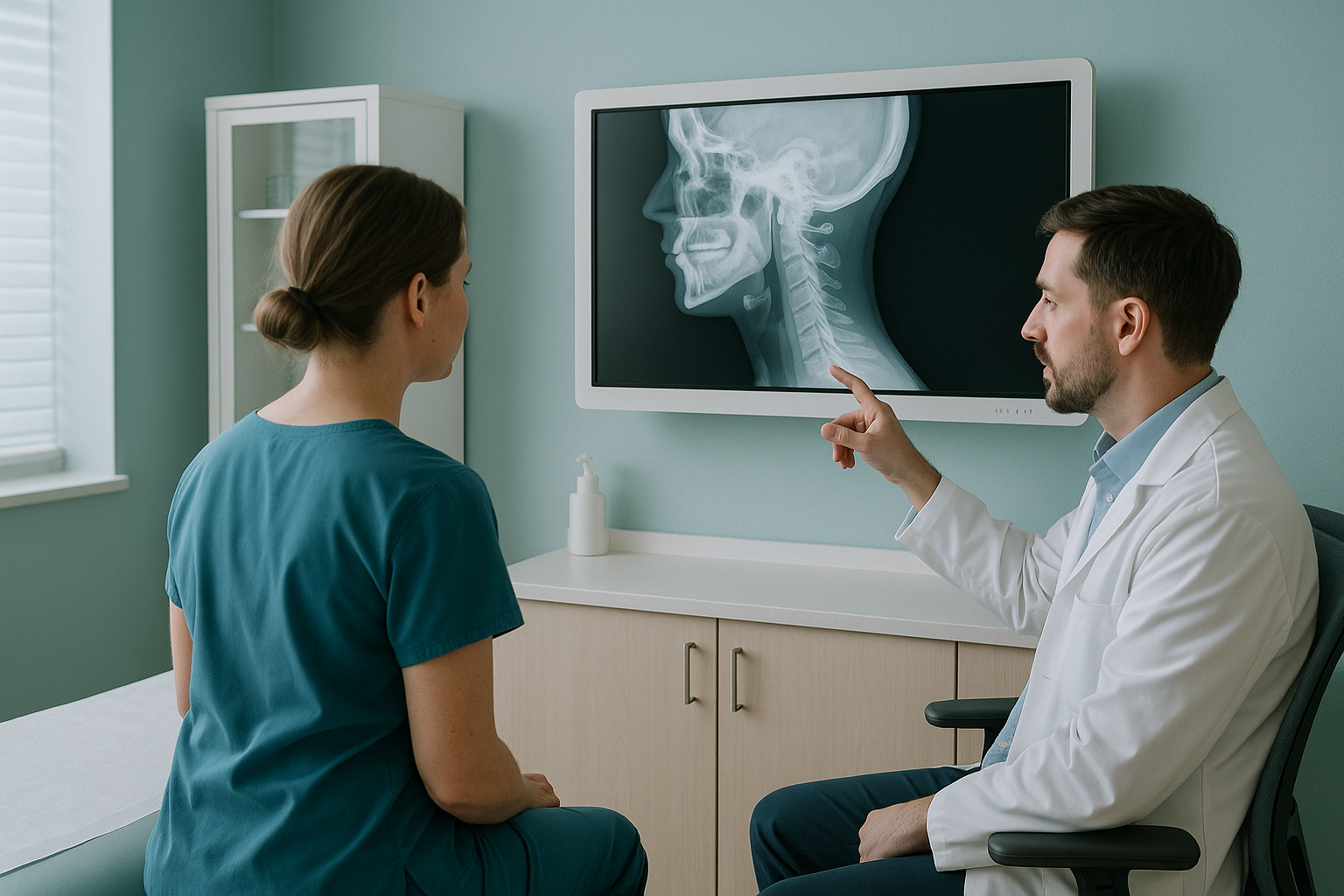
How is loss of cervical lordosis assessed when standing up?
A standing, weight-bearing scan captures your spine exactly as it works in real life, upright and under gravity. This is the position where any loss of curve, forward head shift and compensatory changes throughout the chain become visible.
Standard imaging typically has you lying down. In that position, gravity is removed and muscles relax. The head falls back, discs decompress slightly, and the neck can look better aligned than it really is. A standing EOS scan avoids that by imaging your entire skeleton from head to foot in a single upright exposure, using about 90% less radiation than a standard X-ray, around ten times less.
The result is a full-length picture showing how your neck, upper back, lower back, pelvis and legs all relate to one another. Your clinician can then see whether the flat neck is isolated or part of a wider pattern, and plan treatment accordingly.
Want to find out whether a standing alignment scan could help with your neck problem?
Book a free video consultationWhen MRI is the better choice. EOS shows bones, joints and alignment clearly. If your clinician suspects a disc bulge, nerve compression or soft-tissue damage in your neck, MRI is usually the more appropriate tool. In many cases, both types of imaging complement each other to build a complete picture.
What can help with a straightened cervical lordosis?
Management depends on the cause and severity. The first step is always accurate imaging so that any treatment is based on a clear understanding of your alignment, not guesswork.
Common approaches recommended by clinicians include posture retraining and ergonomic adjustments, targeted strengthening exercises for the deep neck flexor muscles, manual therapy from a physiotherapist or osteopath, and in rare cases, surgical consideration for structural causes.
ScanAlign does not provide treatment. We provide the diagnostic imaging that helps your clinician decide on the right next step. You do not need a referral. You can visit our FAQs page for details on cost, safety and what to expect.
If you are interested in how alignment issues relate to the broader spine, our spine alignment page explains more about how standing imaging captures the whole spinal chain.
Frequently asked questions
It means the natural inward curve of your neck has flattened or straightened. Instead of a gentle C-shape, the cervical spine becomes more upright, sometimes referred to as a military neck. This shifts the head forward and increases strain on the neck muscles, discs and joints.
It varies. A mildly straightened neck may cause occasional stiffness and nothing more. A significant loss of curve can lead to chronic pain, headaches and compensatory problems further down the spine. Accurate imaging helps determine the extent and guide the right approach.
Targeted exercises, particularly for the deep neck flexor muscles, can help improve posture and may encourage some restoration of the curve over time. Results depend on the underlying cause. A physiotherapist or specialist can design a programme based on your imaging findings.
Military neck is a casual term for loss of cervical lordosis. It describes a neck that looks unnaturally straight, like a soldier standing at attention. It is the same condition, just a different name.
When you lie down, gravity no longer pulls your head forward. The muscles relax and the spine can settle into a more neutral shape. This means the true extent of any forward head shift or curve loss may not show up. A standing scan captures the neck as it works in everyday life.
An EOS scan uses about 90% less radiation than a standard X-ray, around ten times less. This makes it a very low-dose option for full-body skeletal imaging.
No. ScanAlign is a private, self-pay clinic. You can book directly without a referral. We offer a free video consultation first so we can make sure the scan is appropriate for your concern.
Pricing details are on our FAQs page. The free video consultation will also confirm exactly what is included for your particular situation.
Yes. When the cervical curve flattens, the muscles at the base of the skull work harder to hold the head up. This extra tension often refers pain upward, producing tension-type headaches that can feel like a tight band around the head.
Cervical lordosis is the normal inward curve of the neck. Cervical kyphosis is a reversal of that curve, where the neck bows outward instead. Kyphosis is less common and usually more significant. A standing alignment scan can measure both accurately under load.
See your neck alignment as it really is
A free video consultation helps us understand your concern and confirm whether a standing EOS scan is the right next step.
Book a free video consultationWritten by Abbas Dhami (Specialist Diagnostic Radiographer)
Sources
- NHS. "Neck pain." nhs.uk. Accessed 2024.
- Gay RE. "The curve of the cervical spine: variations and significance." Journal of Manipulative and Physiological Therapeutics, 1993;16(9):591-594.
- Illés T, Somoskeöy S. "The EOS imaging system and its uses in daily orthopaedic practice." International Orthopaedics, 2012;36(7):1315-1323.
This page is general information and not a diagnosis.
ScanAlign is the trading name of CoreMed Solutions Ltd and operates under The Harley Street Hospital's CQC licence.