

Headache and Lower Back Pain: Is There a Link?
Yes, headache and lower back pain can be connected. Your spine works as a single chain from pelvis to skull. When one area is out of alignment, others compensate. A problem in your lower back can change the way your neck carries your head, leading to tension headaches or cervicogenic headaches that start at the base of the skull.
Key takeaways
- Back problems can cause headaches by forcing the neck to compensate for lower spinal misalignment.
- Cervicogenic headaches feel like they start at the back of the head and are driven by the neck and upper spine.
- Lying-down scans can miss alignment issues that only show up when you are standing and weight-bearing.
- A whole-body standing image reveals the full chain from feet to head in one low-radiation scan.
- If you have sudden severe headache with neck stiffness, fever, or loss of vision, seek urgent medical help.
Can back problems cause headaches?
Yes. Back problems can cause headaches because the spine is a connected chain. Your body is designed to keep your eyes level with the horizon. If your lower back curves too much or too little, your mid-back and neck must adjust. That adjustment puts extra strain on the muscles, joints and nerves at the top of your spine, which can trigger headaches.
This type of headache is sometimes called a cervicogenic headache. It does not start inside the brain. It starts in the structures of the neck and upper spine and refers pain upward into the back of the head, temples or behind the eyes.

Think of it like a building. If the foundation shifts, the walls lean, and the roof cracks. Your pelvis is the foundation, your lower back is the wall, and your head and neck are the roof. A tilt or shift at the bottom can show up as pain at the top.
What does headache with back pain feel like?
People who experience headache and back pain together often describe a pattern that feels different from a typical migraine or tension headache. Here are some common signs.
A dull ache that starts where the neck meets the skull and spreads forward.
Your neck feels tight and restricted, and your lower back aches at the same time.
Sitting or standing for long periods makes both headache and back pain worse.
Standard headache relief helps briefly, but the headache keeps returning.
When to seek urgent help. If you have a sudden, severe headache alongside neck stiffness and fever, or you experience numbness, weakness, loss of bladder or bowel control, or sudden vision changes, contact your GP, call 111, or go to A&E immediately. These symptoms need urgent medical attention, not a scan booking.
What causes headache and lower back pain together?
Several alignment and structural factors can produce headache and back pain at the same time. The common thread is that the body compensates for a problem in one area by overloading another.
Too much or too little curve in the lower back shifts the balance of the whole spine upward.
An uneven pelvis tilts the base of the spine, causing a knock-on effect all the way to the neck.
The head drifts forward of the shoulders, putting heavy strain on neck muscles and joints.
Even a small difference in leg length can tilt the pelvis and create a compensatory curve through the spine.
These causes are often invisible on a standard lying-down scan because gravity is not compressing the spine in the usual way. The misalignment only becomes clear when you are upright and bearing your own weight.
How does a standing scan help find the cause?
A standing whole-body EOS scan captures your entire skeleton from head to feet in one image, while you are upright and weight-bearing. This is important because lying-down imaging relaxes the muscles and can hide alignment problems that only appear when gravity is acting on your body the way it normally does.
When headache and lower back pain occur together, a clinician needs to see the full picture. A standard X-ray or MRI of just the lower back will not show how the pelvis, spine and head relate to one another under load. An EOS scan does exactly that, using about 90% less radiation than a standard X-ray, around ten times less.
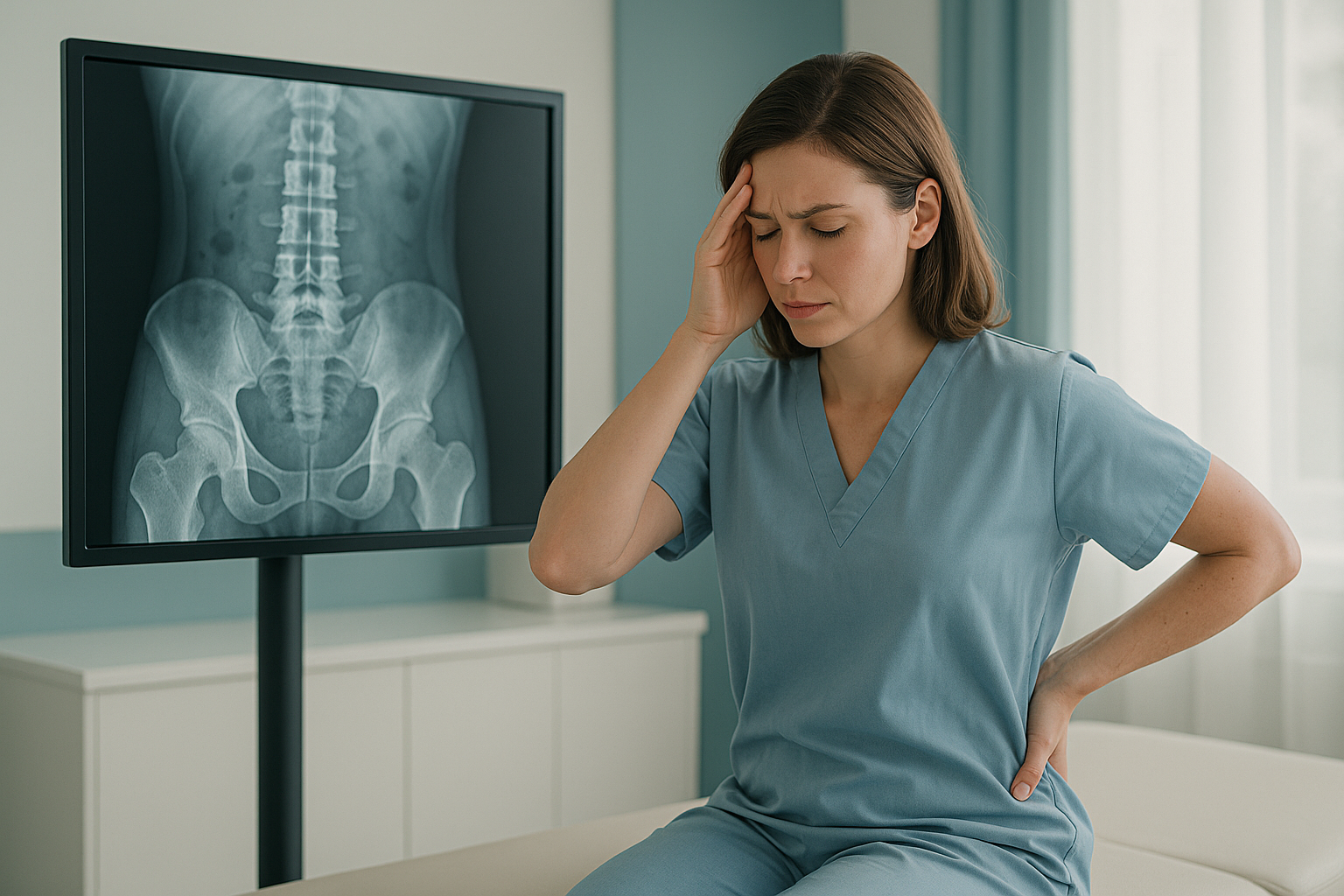
The scan takes just a few seconds and you simply stand still inside the machine. The resulting image lets your clinician trace the compensation chain from bottom to top and identify exactly where the imbalance begins.
When MRI is the better choice. EOS shows bones, joints and alignment. If your clinician suspects a disc problem, a trapped nerve, or another soft-tissue cause for your symptoms, MRI is usually the better tool. In many cases, both types of imaging work well together.
What helps when headache and back pain happen together?
The most useful first step is getting an accurate picture of your alignment. Without knowing where the imbalance starts, any approach is guesswork. A whole-body standing image gives your physiotherapist, osteopath or consultant something concrete to work from.
Once the cause is identified, a range of approaches may be recommended by your treating clinician. These might include targeted exercises, manual therapy, or postural changes. ScanAlign provides the diagnostic imaging, not the treatment itself, but detailed alignment data can make a real difference to the plan your clinician builds for you.
Not sure whether a standing alignment scan is right for your symptoms? Talk to us first, at no cost.
Book a free video consultationFrequently asked questions
Yes. When the lower back is misaligned, the upper spine and neck compensate to keep your head balanced. That extra strain on the neck muscles and joints can trigger headaches, particularly cervicogenic headaches that start at the base of the skull.
A cervicogenic headache is a headache caused by a problem in the neck, not the brain. It typically starts as a dull ache at the back of the head or behind one eye and is often linked to stiffness or restricted movement in the neck.
If you develop a sudden, severe headache alongside neck stiffness and fever, or if you experience numbness, weakness, loss of bladder or bowel control, or sudden vision changes, seek urgent medical help immediately. Contact your GP, call 111, or go to A&E.
Because the cause of your headache may not be in your head. If a pelvic tilt or lower back curve is forcing your neck to compensate, you need to see the full chain from feet to skull. A whole-body standing scan reveals exactly how each region relates to the others under gravity.
An EOS scan is a type of X-ray that captures your entire body while you are standing up. It uses about 90% less radiation than a standard X-ray, around ten times less. The result is a detailed image that shows bone alignment under real, weight-bearing conditions.
Yes. The EOS system uses about 90% less radiation than a standard X-ray. You can find more details about safety and what to expect on our FAQs page.
No. ScanAlign is a private, self-pay service and you can refer yourself. You start with a free video consultation so we can check the scan is appropriate for your symptoms.
Pricing information is available on our FAQs and cost page.
EOS shows bones, joints and alignment. For soft-tissue structures like discs and nerves, MRI is usually the better tool. Your clinician can advise which type of imaging suits your situation, or sometimes both are helpful.
ScanAlign is based at 19 Harley Street, London. The clinic operates under The Harley Street Hospital's CQC licence.
Find out where the imbalance starts
A free video consultation lets us check whether a standing alignment scan is the right next step for your headache and back pain.
Book a free video consultation Learn more about EOS scanningSources
- Bogduk N, Govind J. Cervicogenic headache: an assessment of the evidence on clinical diagnosis, invasive tests, and treatment. The Lancet Neurology. 2009;8(10):959-968.
- NHS. Headaches. nhs.uk/conditions/headaches.
- Glassman SD et al. The impact of positive sagittal balance in adult spinal deformity. Spine. 2005;30(18):2024-2029.
Written by Abbas Dhami (Specialist Diagnostic Radiographer)
Learn more about how spinal alignment is assessed on our spine conditions page.
This page is general information and not a diagnosis.
ScanAlign is the trading name of CoreMed Solutions Ltd and operates under The Harley Street Hospital's CQC licence.