
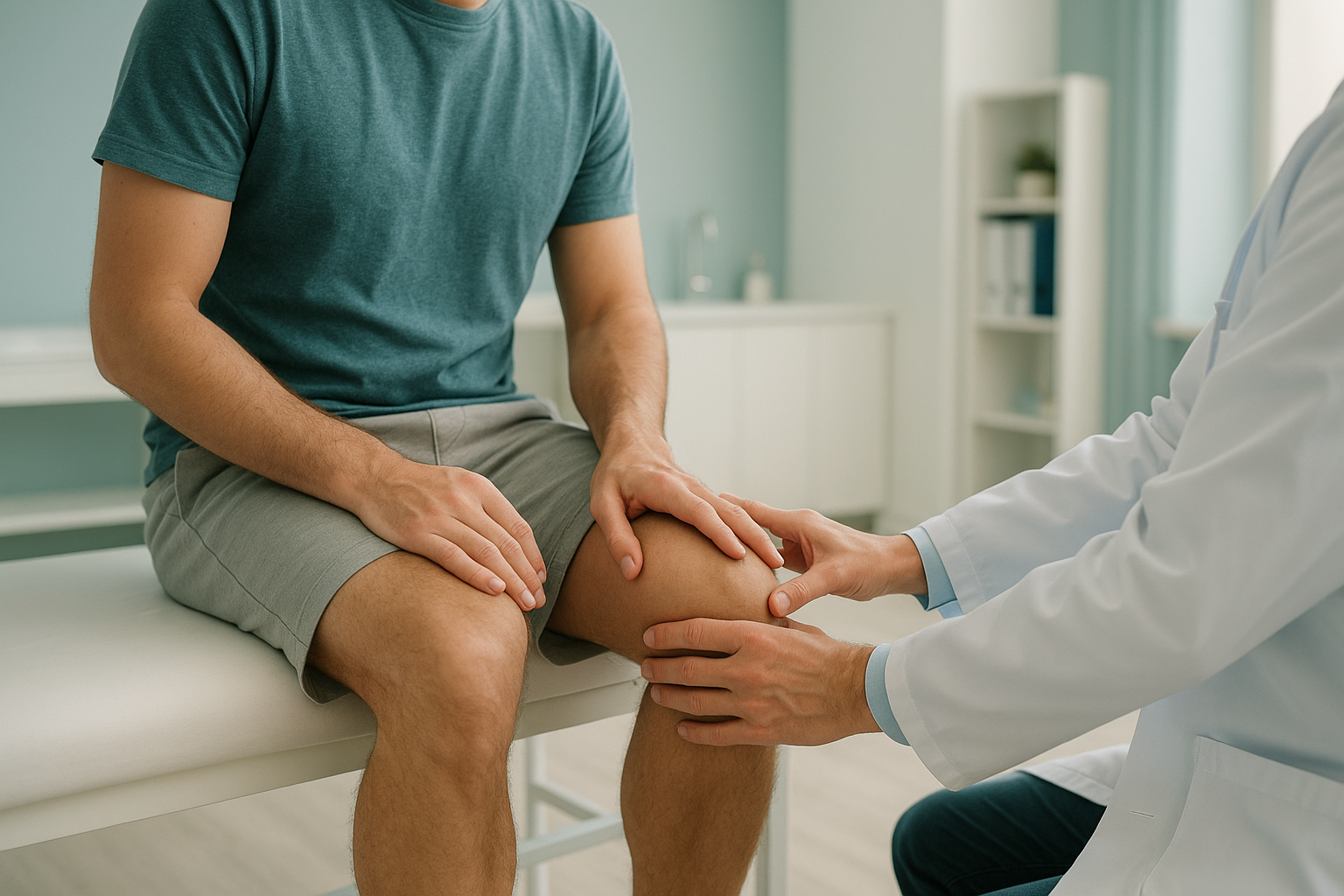
Why Does Only One Knee Hurt? Understanding Knee Pain on One Side
Pain in one knee only is rarely just about that knee. A difference in leg length, a tilted pelvis, or years of favouring one side can shift extra load onto a single joint. Standing whole-body imaging lets you compare both legs side by side and see whether an alignment issue elsewhere is making one knee work harder than the other.
Key takeaways
- Asymmetric knee pain often points to a whole-body alignment problem, not just a local injury.
- A leg length discrepancy of just a few millimetres can overload one knee over time.
- Lying-down scans relax your muscles and can hide the imbalance that appears when you stand.
- EOS standing imaging captures both legs on a single image so your clinician can compare them directly.
- If you have sudden swelling, locking, giving way, or cannot bear weight, see your GP or A&E first.
You use both knees equally, or so it feels. Yet one aches after a walk, stiffens on stairs, or swells by the end of the day while the other feels completely fine. That asymmetry is a clue worth following.
Most single-area scans look only at the painful knee. That is useful for spotting cartilage damage or arthritis in that joint. But it cannot answer a bigger question: why is this knee wearing out faster than the other one?
What does one-sided knee pain feel like?
It can show up in many ways, and the pattern often changes with activity. Here are some of the most common presentations people describe.
A dull ache that builds in one knee during or after a walk, while the other side stays comfortable.
One knee feels tight or catches going up or down stairs, especially first thing in the morning.
The affected knee puffs up by the evening or after exercise, while the other looks normal.
Pain concentrated on the inside or outside of one knee, often linked to how load travels through that leg.
Important. If your knee is hot, very swollen, locked in position, or you cannot put weight on it at all, please see your GP, call 111, or go to A&E. These signs need urgent assessment, not a scan booking.
What causes pain in one knee only?
Several factors can overload a single knee. Some are local to the joint. Others start further up or down the body and only reveal themselves when you look at the whole picture.
Even a small difference means one knee absorbs more force with every step. Over years, the wear adds up.
A lateral pelvic tilt shifts your centre of gravity sideways, sending extra load through one leg.
If one knee angles inward or outward more than the other, load concentrates on one compartment of the joint.
You naturally push off harder with your dominant leg. Over time, that joint accumulates more stress.
Previous injuries matter too. An old ankle sprain, a hip problem, or even habitual standing posture can quietly change the way force passes through one leg. You can read more about how can poor posture cause hip, knee and back pain.
How does a problem elsewhere end up in your knee?
Your body works as a connected chain from your feet up through your hips and spine. When one link shifts, the links above and below compensate. That compensation is often invisible. It does not hurt where it starts. It hurts where it finishes.
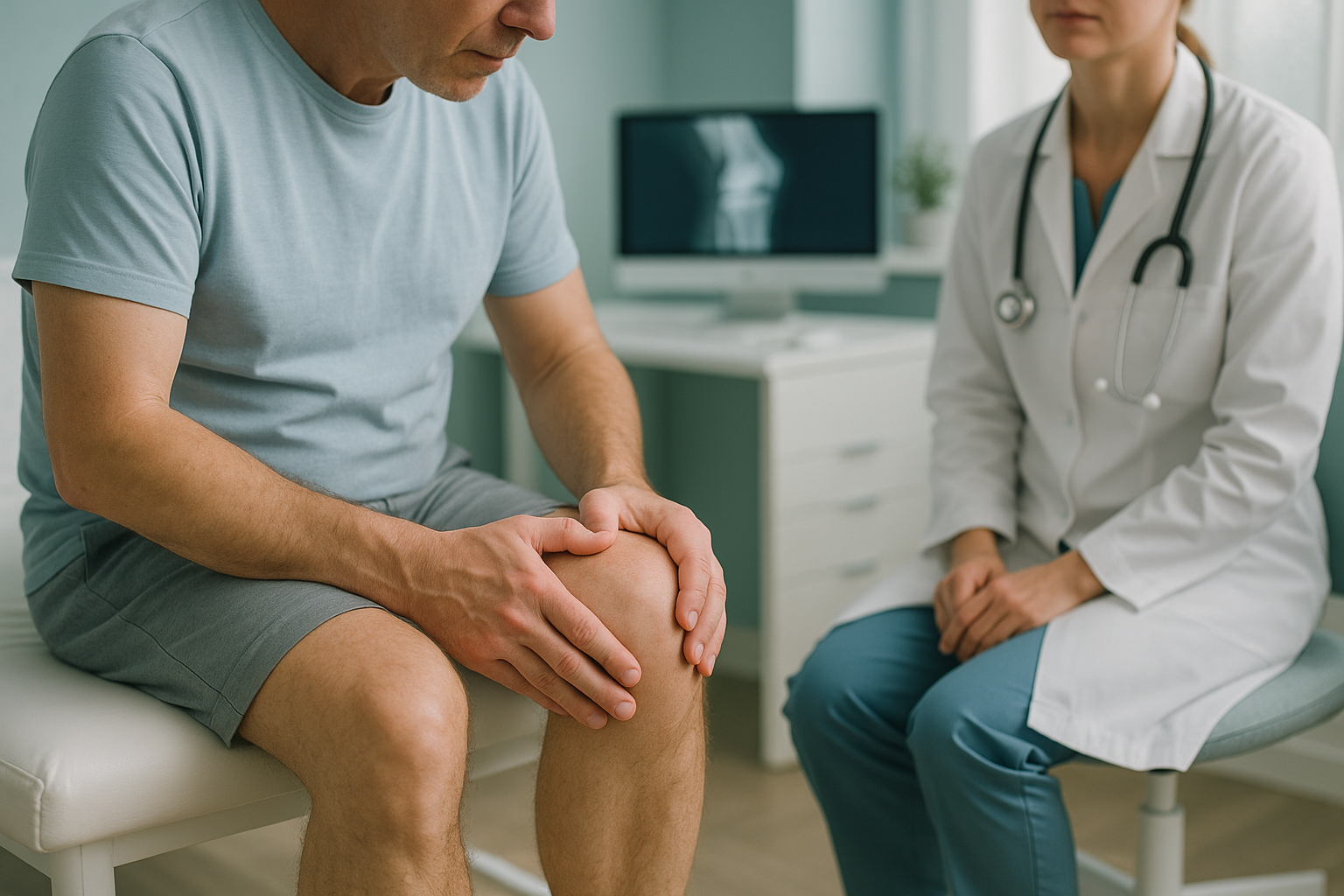
For example, a small leg length discrepancy tilts the pelvis. That tilt changes the angle at the hip. The hip angle changes how weight passes through the knee below. The knee on the longer-leg side, or the side that compensates most, ends up doing more work. Year after year, that extra load adds up.
This is why scanning only the painful knee can miss the real cause. The knee itself might look relatively normal, yet the reason it hurts lies in how the whole chain is aligned while you stand.
How does a standing scan help with knee pain on one side?
A standing scan captures your skeleton under real weight-bearing conditions, the same conditions in which your pain actually occurs. Lying-down imaging relaxes your muscles and allows your joints to settle into a neutral position. That can hide the very asymmetry causing your problem.
You stand naturally while the EOS system captures a full image from your hips to your ankles, or from head to foot, in a single pass. Both legs appear on the same image at the same scale. Your clinician can compare the alignment of the left and right sides directly and measure any asymmetry that appears only when you are weight-bearing.
EOS uses about 90% less radiation than a standard X-ray, around ten times less. A full-leg standing x-ray like this gives a clear picture of how your joints line up in real life.
A standard X-ray or MRI is taken while you lie on a table. Gravity is removed, muscles relax, and the joints settle differently than when you stand. The image only shows the area requested, often just one knee. There is no easy way to compare the two legs side by side or to see whether a tilt higher up is shifting load downward.
At ScanAlign, whole-body standing imaging, both legs are captured in a single exposure. That means one image, one moment, no stitching and no magnification errors. It is the clearest way to see whether something above or below the knee is driving the problem in that joint.
When MRI is the better choice. EOS shows bones, joints and alignment beautifully. But if your clinician suspects a torn meniscus, ligament damage, or a problem with soft tissue, discs or nerves, MRI is usually the better tool. The two scans answer different questions and often complement each other well.
What can you do about one-sided knee pain?
The most useful first step is understanding what is happening. Without knowing whether the issue is local to the knee or driven by alignment further up, it is difficult for any professional to choose the right approach. Here is what typically helps people move forward.
- Get a clear picture. A standing whole-body image lets your clinician see both legs, your pelvis and your spine in one view. That context matters.
- Share it with your team. Whether you work with a physiotherapist, osteopath, or orthopaedic surgeon, the image gives them objective information to plan around.
- Address the cause, not just the symptom. If a pelvic tilt or leg length difference is overloading one knee, targeted rehabilitation or orthotics may help reduce the load on that side over time.
Wondering whether your knee pain could be an alignment issue? A free video consultation can help you decide if a standing scan is the right next step.
Book a free video consultationFrequently asked questions about knee pain on one side
Asymmetric knee pain usually means one knee is under more mechanical stress than the other. Common reasons include a difference in leg length, a tilted pelvis, a previous injury on one side, or natural dominance in one leg. A whole-body standing image can reveal these differences.
Yes. Even a small difference shifts extra load onto one side with every step. Over months and years, that added stress can accelerate wear in the cartilage and joint surfaces of the overloaded knee.
Not in terms of what causes it. Whether the left or right knee hurts depends on which side is taking more load. The underlying mechanisms, such as alignment, leg length and pelvic position, are the same regardless of side.
Walking puts your joints under load. An alignment issue that is invisible at rest becomes apparent when gravity and ground reaction forces are involved. This is exactly why standing imaging can show problems that lying-down scans miss.
No. ScanAlign accepts self-referrals. You can book a full-body standing scan directly, starting with a free video consultation to make sure the scan is appropriate for you.
EOS uses about 90% less radiation than a standard X-ray, around ten times less. It is one of the lowest-dose skeletal imaging systems available.
Pricing details are available on the ScanAlign FAQs and cost page.
EOS is designed for bones, joints and alignment. For soft tissue structures like cartilage, ligaments and menisci, MRI is usually the better tool. Your clinician may recommend both types of imaging if needed.
You stand still inside the EOS scanner while it takes a full-length image. The scan itself takes only a few seconds. You remain clothed and there is no enclosed tunnel.
Absolutely. Your images and report are yours. Many people share them with their physiotherapist, osteopath, or orthopaedic consultant to guide the next steps in their care.
Find out why one knee is doing all the work
A free video consultation helps you understand whether a standing whole-body scan could reveal the cause of your one-sided knee pain.
Book a free video consultationSources
- Illés, T. and Somoskeöy, S. (2012). The EOS imaging system and its uses in daily orthopaedic practice. International Orthopaedics, 36(7), pp. 1405-1411.
- NHS (2023). Knee pain. nhs.uk. Available at: https://www.nhs.uk/conditions/knee-pain/
- Sabharwal, S. and Kumar, A. (2008). Methods for assessing leg length discrepancy. Clinical Orthopaedics and Related Research, 466(12), pp. 2910-2922.
Written by Abbas Dhami (Specialist Diagnostic Radiographer)
This page is general information and not a diagnosis.
ScanAlign is the trading name of CoreMed Solutions Ltd and operates under The Harley Street Hospital's CQC licence.