

Why Do I Feel Like I Am Leaning to One Side?
Feeling like your body leans to one side usually means something in your alignment is off balance. A lateral pelvic tilt, a difference in leg length, a spinal curve, or long-term muscle guarding can all shift your body's centre line sideways. Standing imaging reveals the pattern by measuring your whole skeleton under gravity.
Key takeaways
- Leaning to one side is a sign of coronal imbalance, where your body's weight is not centred evenly.
- Common causes include uneven hips, leg-length differences, scoliosis and muscle guarding after injury.
- Lying-down scans relax muscles and can hide the shift. Standing, weight-bearing imaging captures it under real conditions.
- Finding the root cause matters because pain often appears away from the real problem.
- An EOS scan uses about 90% less radiation than a standard X-ray, around ten times less.
What does leaning to one side actually mean?
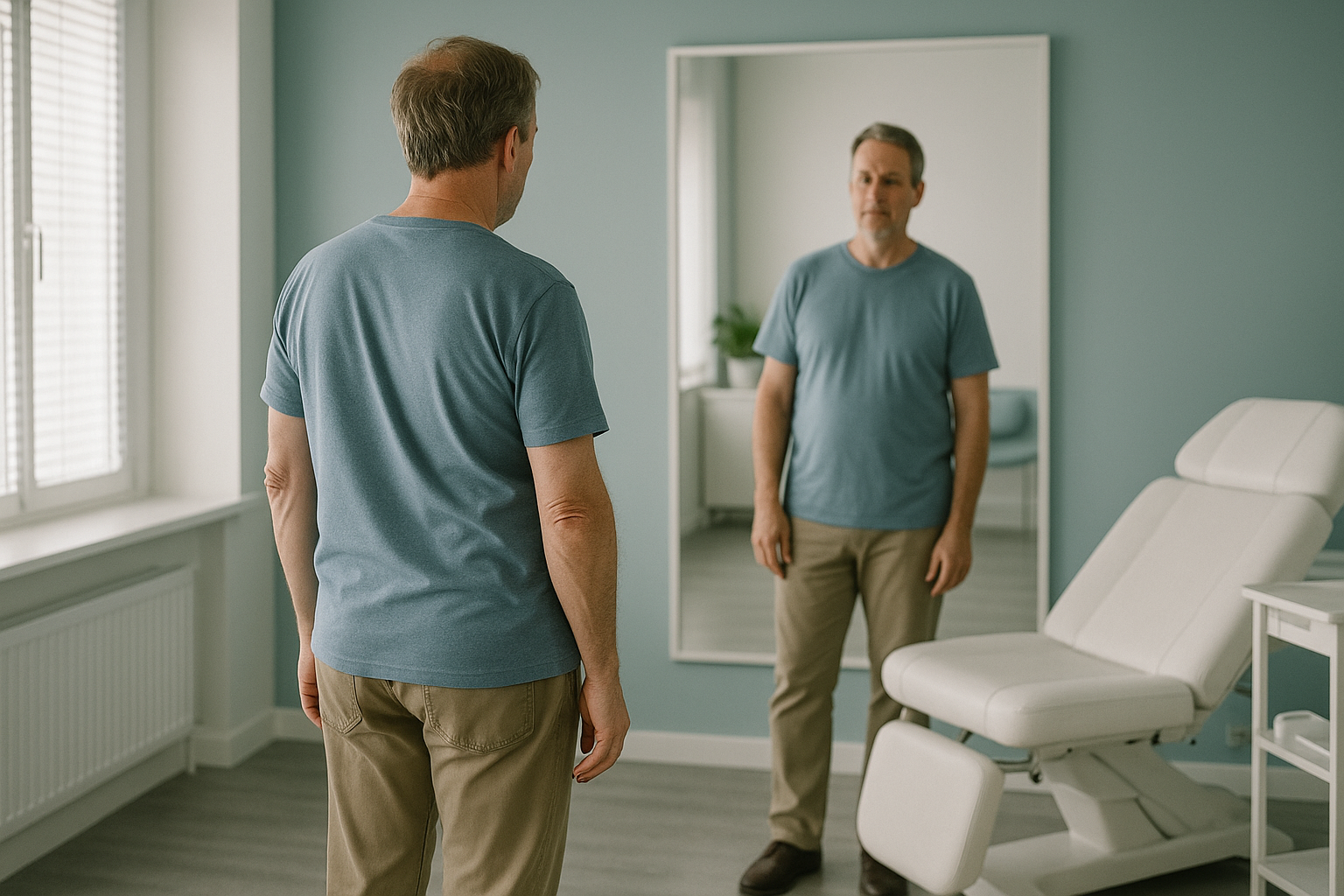
It means your trunk has shifted sideways so that your head is no longer centred above your pelvis. Clinicians call this coronal imbalance. Imagine a plumb line hanging from the middle of your skull. In balanced posture, that line falls between your feet. When you lean to one side, the line lands to the left or right, and your body has to work harder to keep you upright.
You might notice it yourself in a mirror, in photos, or simply as a nagging feeling that you are standing crooked. Other people may comment before you even realise it.
How can you tell if your body leans to one side?
Some signs are visible. Others are felt as persistent aches or odd wear patterns. Here are the most common clues.
Hemlines, belt lines or shirt collars sit higher on one side.
One side of your waist has a deeper fold than the other when you stand relaxed.
A noticeable difference in shoulder height when you look in the mirror. Learn more about uneven shoulders.
A persistent sense that your weight sits more on one leg, even when you try to stand straight.
What causes your body to lean to one side?
Several structural and muscular factors can push your centre line sideways. Often more than one is present at the same time.
When one side of the pelvis sits higher than the other, the entire spine must shift to keep your head level.
Even a small true or apparent difference in leg length tilts the pelvis and produces a side lean.
A sideways curve in the spine can shift your trunk noticeably to one side, particularly under gravity.
After pain or injury, muscles on one side tighten to protect the area. This pulls you sideways over time.
A rotated pelvis can also contribute. When the pelvis twists, the body compensates in three dimensions, creating both a rotation and a side shift.
Why does pain often show up in a different area?
Your body is a connected chain from feet to head. When one link is out of place, the links above and below adjust to keep you balanced. Clinicians call this compensation. A tilted pelvis, for example, may cause the spine to curve the opposite way, which loads one shoulder more than the other. You feel pain in the shoulder, but the real problem started at the pelvis.
This is why scanning just one area often misses the bigger picture. A single knee X-ray will not show that the knee is overloaded because of a hip that sits higher on the other side.
Wondering whether your symptoms connect? A free video consultation with our specialist radiographer can help you decide whether full-body standing imaging is the right next step.
Book a free video consultationHow is a side lean measured when you are standing up?
At ScanAlign, full-body standing imaging, we use an EOS scanner to capture your entire skeleton in a single upright image, from your skull down to your feet. Because you stand naturally during the scan, gravity and your muscles are doing exactly what they do in daily life. This means the image shows your true alignment, not a relaxed version of it.
Weight-bearing, full-body view. Muscles are active and gravity compresses your joints exactly as they are in real life. Pelvic obliquity, leg-length differences and trunk shift are clearly visible in one image.
The EOS system uses about 90% less radiation than a standard X-ray, around ten times less. That makes it practical for a whole-body capture.
Lying flat relaxes muscles and removes gravity. A tilt or shift that is obvious when you stand may flatten out on the table. The scan might look normal even though you feel lopsided every day.
Conventional imaging also tends to focus on one body area at a time, which means the chain of compensation is never captured in a single view.
The radiographer reviews the full scan and produces a detailed report your clinician can use to plan the next step, whether that is physiotherapy, orthotics, or further investigation.
When MRI is the better tool. EOS shows bones, joints and alignment brilliantly. If your clinician suspects a disc problem, nerve compression, or soft-tissue injury, MRI is usually the better choice. The two scans answer different questions and sometimes complement each other.
- Feel like you are standing crooked or leaning to one side
- Have one hip higher than the other
- Experience pain that moves around or seems unrelated to a single area
- Have had normal results from lying-down scans despite ongoing symptoms
- Sudden numbness or weakness in your legs
- Loss of bladder or bowel control
- Sudden severe pain after a fall or trauma
Contact your GP, call 111, or go to A&E straight away.
Frequently asked questions
It usually means your body's centre of gravity has shifted sideways. Common reasons include a pelvic tilt, a leg-length difference, a spinal curve, or muscle tightness on one side. Standing whole-body imaging can show exactly where the imbalance starts.
Yes. Even a small difference in leg length tilts the pelvis, and the spine curves to compensate. This can produce a visible or felt lean, along with pain in the back, hip or knee on the longer side.
Not always. Scoliosis is one possible cause, but a side lean can also come from a tilted pelvis, muscle guarding, or joint stiffness without a true spinal curve. A full-body standing scan helps distinguish between these.
Conventional X-rays are usually taken lying down and focused on one body part. Lying flat relaxes the muscles and removes gravity, which can hide a shift that is clearly present when you stand. A standing full-body scan captures your posture under real-life conditions.
It is the clinical term for when your trunk is shifted to one side so that your head is no longer centred above your pelvis. It is measured from the front or back of the body, in the coronal plane.
An EOS scan uses about 90% less radiation than a standard X-ray, around ten times less. This low dose makes it practical to image the entire skeleton in one go.
No. ScanAlign is a private self-pay clinic, so you can self-refer. You start with a free video consultation with our specialist radiographer, who helps decide whether a scan is appropriate for you.
You can find current pricing and what is included on our booking page where you can book a full-body standing scan.
The scan shows your skeletal alignment in detail. It can reveal asymmetries, tilts and shifts that explain your symptoms. It does not diagnose soft-tissue problems like disc bulges or nerve issues, which is where MRI comes in.
You receive a detailed alignment report. You can share this with your GP, physiotherapist, osteopath, or surgeon. It gives them the standing measurements they need to plan the right approach for you.
Find out why you are leaning to one side
A free video consultation with our specialist radiographer will help you understand whether a full-body standing scan is the right next step.
Book a free video consultationWritten by Abbas Dhami (Specialist Diagnostic Radiographer)
Sources
- Glassman SD, Bridwell K, Dimar JR, Horton W, Berven S, Schwab F. The impact of positive sagittal balance in adult spinal deformity. Spine. 2005;30(18):2024-2029.
- NHS. Scoliosis overview. nhs.uk/conditions/scoliosis.
- Ilharreborde B, Dubousset J, Le Huec JC. Use of EOS imaging for the assessment of scoliosis deformities. European Spine Journal. 2014;23(Suppl 4):397-405.
This page is general information and not a diagnosis.
ScanAlign is the trading name of CoreMed Solutions Ltd and operates under The Harley Street Hospital's CQC licence.