

What Is Osgood-Schlatter Disease, and When Will It Settle?
Osgood-Schlatter disease is a common cause of knee pain in growing children. It happens when the tendon below the kneecap pulls repeatedly on the growth plate at the top of the shinbone, causing pain, swelling and sometimes a visible bony lump. It usually settles once your child finishes their growth spurt, though it can take months or even a couple of years.
Key takeaways
- Osgood-Schlatter disease is a growth-related condition, not a serious injury.
- It is most common during growth spurts, typically between ages 10 and 15.
- Pain is felt just below the kneecap and worsens with running, jumping or kneeling.
- It almost always resolves on its own once the growth plate closes at skeletal maturity.
- Standing imaging can show how alignment through the whole leg affects the knee.
What exactly is Osgood-Schlatter disease?
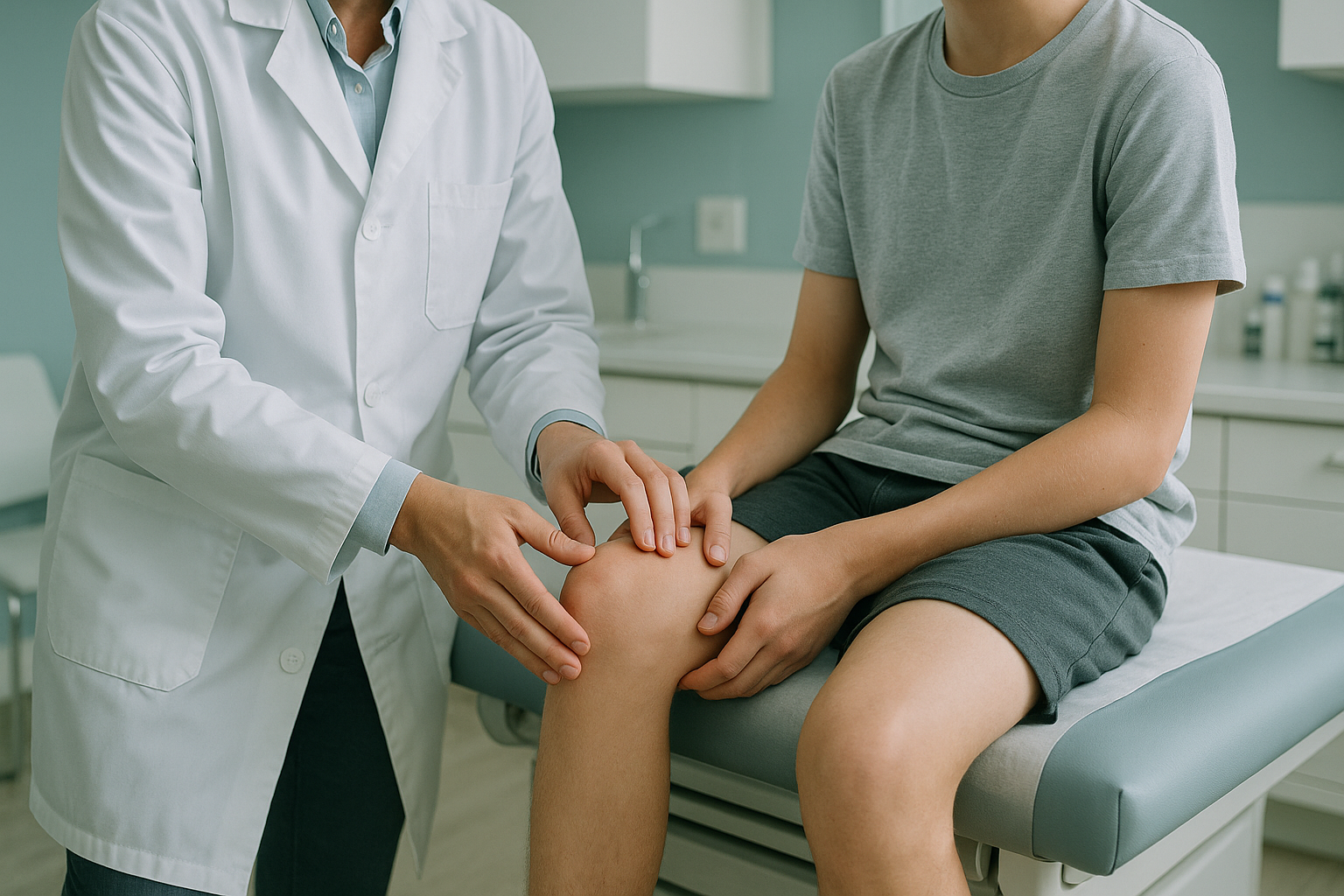
Osgood-Schlatter disease (sometimes called tibial tuberosity apophysitis) is an overuse condition affecting the bony bump just below the kneecap. In children and adolescents, this area contains a growth plate, a zone of developing cartilage that will eventually harden into solid bone. When the powerful thigh muscles (the quadriceps) pull on the tendon attached to this growth plate, the repeated traction can irritate it, causing pain, swelling and sometimes a noticeable lump.
It is not a disease in the way most people understand the word. There is no infection and no permanent damage to the joint. It is a mechanical problem driven by how quickly a child is growing relative to how much sport or physical activity they do.
What does Osgood-Schlatter feel like?
The hallmark is pain just below the kneecap that gets worse with activity and eases with rest. Your child might describe it in different ways, but the pattern is usually consistent.
Aching or sharp pain at the bony bump on the upper shin, particularly during or after sport.
The area may look puffy or develop a firm bony bump that you can feel through the skin.
Running, jumping, kneeling and climbing stairs tend to bring on the pain. Rest helps it fade.
It often affects one knee, but it can occur on both sides at the same time.
If your child also has numbness, weakness, a locked knee, or sudden severe swelling, seek urgent medical attention from your GP, 111 or A&E. These symptoms may point to something other than Osgood-Schlatter disease.
What causes Osgood-Schlatter disease?
The underlying cause is the combination of rapid bone growth and repeated mechanical stress on the growth plate. Several factors make it more likely.
Bones grow faster than muscles and tendons, increasing tension on the growth plate.
Football, basketball, gymnastics and other high-impact activities increase the load on the tendon.
Tight thigh muscles pull harder on the patellar tendon and its attachment below the knee.
Knock knees, flat feet or rotational differences can shift extra stress onto the tibial tuberosity.
It is worth knowing that the tendon connecting the kneecap to the shinbone is the same one involved in patellar tendonitis, a related condition more common in older teenagers and adults. In younger children, the growth plate is the weakest link in the chain, so it is the growth plate that takes the strain.
How long does Osgood-Schlatter disease last?
In most children, it lasts between 6 and 24 months. It tends to settle once the growth plate closes, which usually happens as your child reaches skeletal maturity, typically between ages 14 and 18 depending on how quickly they develop. Some children have symptoms that come and go in waves, flaring up during intense sporting seasons and easing during quieter periods.
A small number of young people are left with a painless bony bump below the kneecap after the condition resolves. This is cosmetic and does not usually cause any problems, although it can be tender if knocked directly.
Why does a standing scan help with Osgood-Schlatter diagnosis?
A standing, weight-bearing scan shows the knee, leg and pelvis exactly as they work when your child is on their feet. Standard lying-down imaging relaxes the muscles and can hide alignment problems that only appear under load. Because the body is a connected chain from feet to head, a slight rotational difference in the hip or a flat arch in the foot can shift extra force onto one knee, making Osgood-Schlatter worse on that side.
Your child stands naturally while the EOS scanner captures the full leg from hip to ankle in a single image. Weight is on the joints, so the image shows real-world alignment, including any knock-knee, rotation or pelvic tilt that changes how the knee is loaded.
The scan uses about 90% less radiation than a standard X-ray, around ten times less. Learn more about EOS scan safety and radiation.
Conventional X-rays taken lying down remove the effect of gravity. The joints look different when they are not bearing weight, and alignment issues in the leg can appear normal. This is why a lying-down image can miss the mechanical reason behind the knee pain.
ScanAlign standing imaging captures the whole picture so your child's clinician can see exactly where the strain is coming from, not just the sore spot.
When is MRI more suitable? EOS shows bones, joints and alignment clearly. If the concern is about soft tissue, cartilage or ligament damage inside the knee, MRI is usually the better tool. Your child's clinician can advise which is right.
What helps manage Osgood-Schlatter symptoms?
Most children do not need to stop sport entirely. Management usually centres on adjusting activity levels during flare-ups and addressing any contributing factors. Your child's GP, physiotherapist or sports medicine specialist will guide you on specifics, but common approaches include the following.
- Activity modification. Reducing the volume of jumping and running during painful episodes, then gradually building back up.
- Stretching and strengthening. Gentle stretches for the quadriceps and hamstrings, combined with exercises to build strength around the hip and knee.
- Ice after activity. Applying ice for 10 to 15 minutes after sport can help ease discomfort.
- Supportive footwear. If flat feet or poor arch support are contributing, appropriate shoes or insoles may help.
ScanAlign is a diagnostic imaging clinic. We do not provide treatment, but accurate imaging of your child's alignment gives their treating clinician a clear foundation for any management plan.
Wondering whether your child's knee pain is related to how their legs are aligned? A short video call can help you decide if imaging is the right next step.
Book a free video consultationWhat is a paediatric EOS appointment like?
Children can feel anxious about medical scans. The EOS system is open, with no tunnel or enclosed space, and the scan itself takes only seconds. Your child stands still in comfortable clothing while the scanner moves around them. You can stay in the room throughout. Read more about what makes the appointment easier for children.
For more on how we work with younger patients, see our dedicated paediatric imaging at ScanAlign page.
Frequently asked questions about Osgood-Schlatter disease
No. It is a self-limiting growth-related condition. It can be painful and frustrating, but it does not damage the joint and almost always resolves once the growth plate closes.
In most cases, yes, with some adjustments during flare-ups. Their GP or physiotherapist can help decide when to ease off and when it is safe to push on.
Surgery is very rarely needed. In a small number of cases where a bony fragment causes ongoing pain after growth has finished, a surgeon may consider removing it, but this is uncommon.
It typically appears during a growth spurt, most commonly between ages 10 and 15. It can occur slightly earlier in girls because they tend to enter puberty sooner.
No referral is needed. ScanAlign is a private self-pay clinic, and you can book a paediatric assessment directly.
The EOS system uses about 90% less radiation than a standard X-ray, around ten times less. This makes it especially suitable for children who may need imaging more than once during their growing years.
The pain goes away, but some children are left with a painless bony prominence. It is harmless and does not affect how the knee works.
Once the growth plate has fully closed, the condition does not return. However, symptoms can flare and settle several times before that point, especially during active sporting periods.
Pricing depends on the areas scanned. You can find details on our paediatric imaging page or start with a free video consultation to discuss your child's needs.
Standing imaging captures the leg under real weight-bearing conditions. Alignment problems, such as knock knees or rotational differences, only show up properly when the child is upright. This can reveal why one knee is taking more stress than the other.
Concerned about your child's knee pain?
A free video consultation lets you discuss your child's symptoms with our team and find out whether standing imaging could help their clinician understand the cause.
Book a free video consultationSources
- NHS. "Osgood-Schlatter disease." nhs.uk. Accessed 2024.
- Gholve PA, Scher DM, Khakharia S, Widmann RF, Green DW. "Osgood Schlatter syndrome." Current Opinion in Pediatrics, 2007;19(1):44-50.
- Illés T, Somoskeöy S. "The EOS imaging system and its uses in daily orthopaedic practice." International Orthopaedics, 2012;36(7):1405-1411.
Author: Abbas Dhami (Specialist Diagnostic Radiographer)
This page is general information and not a diagnosis.
ScanAlign is the trading name of CoreMed Solutions Ltd and operates under The Harley Street Hospital's CQC licence.