
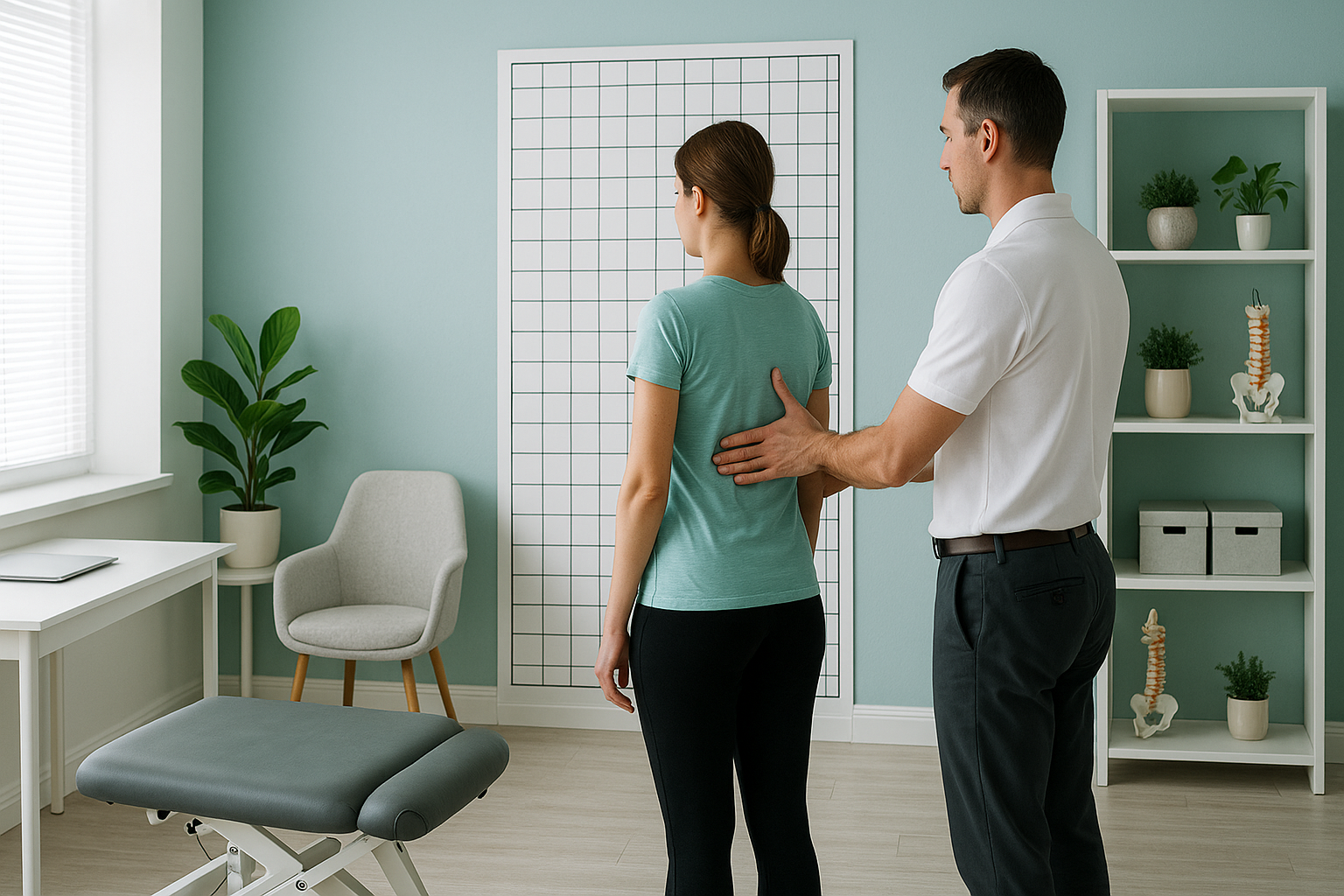
Where Can You Get a Posture Assessment in London?
ScanAlign at 19 Harley Street offers a standing whole-body posture assessment using EOS imaging. You stand naturally while the system captures your skeleton from head to feet in one image, with about 90% less radiation than a standard X-ray. No GP referral is needed.
Key takeaways
- A posture assessment in London can be done standing up with EOS imaging at ScanAlign, 19 Harley Street.
- EOS captures your full skeleton in one weight-bearing image, revealing alignment issues that lying-down scans can miss.
- You receive an objective report with clear measurements your physiotherapist, osteopath or surgeon can use.
- No GP referral is required. You can self-refer.
- The scan uses about 90% less radiation than a standard X-ray, around ten times less.
Most people looking for a posture clinic in London want a clear answer. Not just someone watching them bend forward, but an objective picture of exactly how their skeleton is aligned when standing. That is what ScanAlign standing EOS imaging provides.
Traditional posture checks rely on visual observation, photographs, or handheld tools. These approaches can be helpful, but they rarely show what is happening inside. A standing whole-body image captures every joint from your ankles to your skull in one shot, so nothing is estimated or assumed.
Why does a posture assessment need to be done standing up?
Your posture only exists when you are upright and weight-bearing. Lying down for a conventional X-ray, CT or MRI relaxes your muscles and lets gravity release the spine. That can hide the very problems you came in to investigate.
When you stand, your muscles, ligaments and joints work together to hold you up. An EOS scan captures this real-world position, showing exactly how your pelvis tilts, whether your spine curves to one side, and how your knees and hips share the load. The result is a true picture of how you carry yourself every day.
Lying on a table removes gravity from the equation. Your spine straightens, your pelvis levels out, and compensations disappear. A lying-down scan may report normal findings even when you have a noticeable imbalance on your feet. That is why many people get "normal" results yet still feel something is wrong.
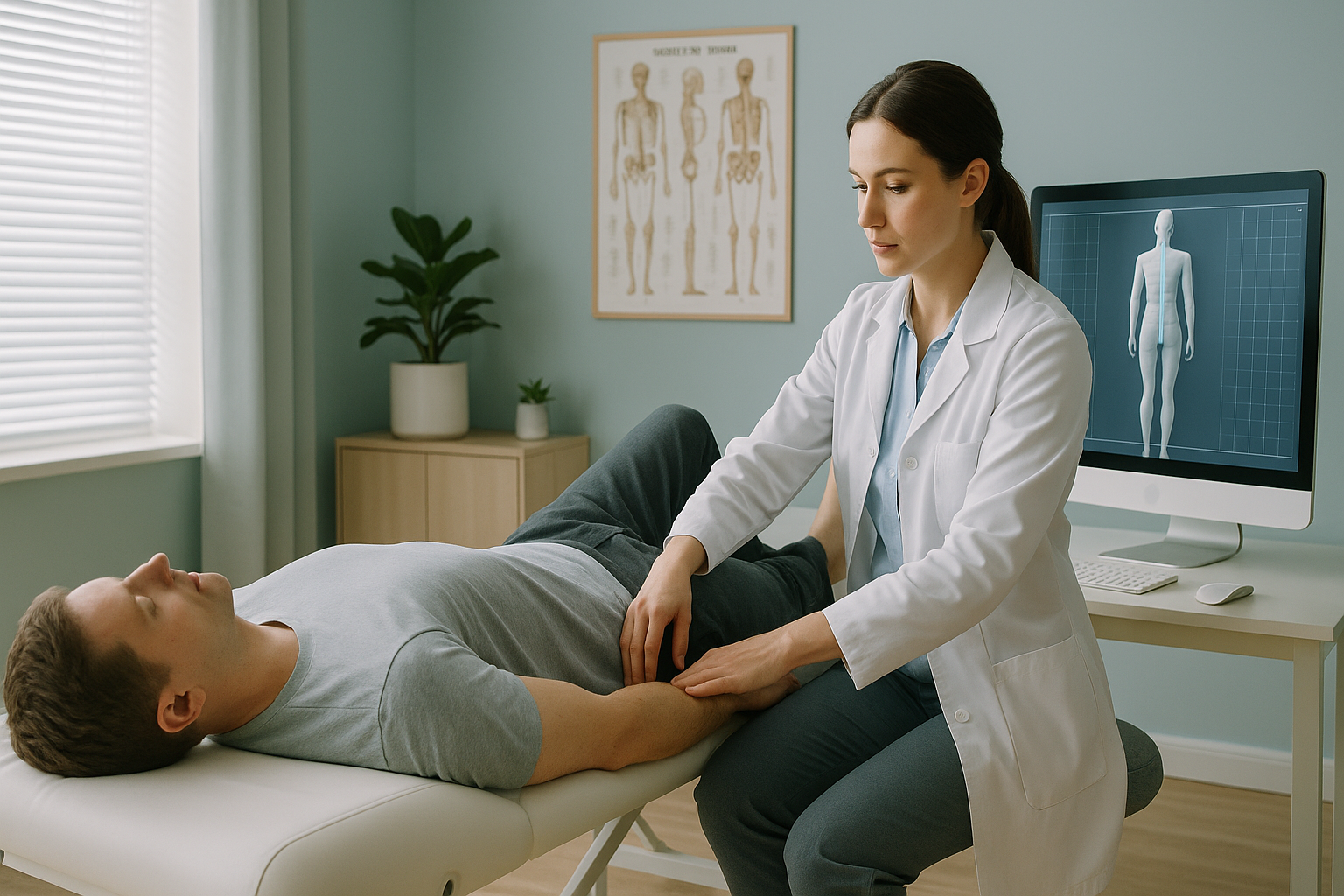
Your body is a connected chain from your feet to your head. A tilt at the pelvis can force your spine to curve the other way to keep your eyes level. Pain often shows up well away from where the real problem is. A whole-body standing image reveals those compensations in one view, which is why a posture assessment in London using EOS can be so revealing.
What does a posture assessment actually measure?
A standing EOS assessment produces an objective report covering the key landmarks your clinician needs to see. Rather than vague descriptions, you get precise, repeatable measurements.
Whether your pelvis is level, tilted or rotated, and how that affects everything above and below.
How far forward or backward your upper body sits over your pelvis when seen from the side.
Whether you lean to one side, including shoulder height difference and trunk shift.
How your hip, knee and ankle joints line up under load, and whether one leg bears more weight.
Your report includes both a front-on and side-on view. That means your treating clinician, whether a physiotherapist, osteopath or orthopaedic surgeon, gets a complete picture. Read more in our body alignment guide.
How do you know if you need a posture check-up?
You might benefit from a posture assessment if you recognise any of the following patterns. These are common reasons people visit a posture clinic in London.
Pain that keeps coming back despite treatment, especially if scans have looked "normal".
Clothes that hang unevenly, or a feeling that one side of your body works harder.
You or someone else has noticed you lean to one side or have a rounded upper back.
You need a baseline before a spinal, hip or knee procedure, or want to track recovery afterwards.
Want to find out if a standing posture assessment is right for you? You can discuss your situation in a short video call at no cost.
Book a free video consultationWhat happens when you visit a posture clinic in London?
At ScanAlign, 19 Harley Street, the process is straightforward. Here is what to expect.
Free video consultation
You speak with a specialist radiographer to discuss your concerns and confirm that a standing scan is the right next step.
Standing EOS scan
You stand naturally in the scanner. The image takes seconds and uses about 90% less radiation than a standard X-ray, around ten times less.
Objective report
Your images are analysed and you receive a detailed report with clear measurements covering sagittal balance, coronal balance, pelvic position and limb alignment.
Take it to your clinician
Share your report with your physiotherapist, osteopath or surgeon. The measurements give them objective data to guide your treatment plan.
If you would like a deeper understanding of what good alignment looks like and why it matters, see our posture correction guide.
Is a standing posture scan right for you?
A standing EOS assessment suits many people, but it is not the answer to every problem. Here is a simple guide.
A good fit
- Long-standing back, hip or knee pain with no clear diagnosis
- Visible postural imbalance or one-sided symptoms
- Pre-operative planning for spinal or joint surgery
- Post-surgery follow-up comparison
- Wanting an objective baseline for physiotherapy or rehabilitation
Not the right tool
- Suspected disc bulge, nerve compression or soft-tissue injury (MRI is better)
- Acute injury or trauma (go to A&E)
- Numbness, weakness or loss of bladder/bowel control (seek urgent medical attention via your GP, 111 or A&E)
A note on MRI. EOS excels at showing bones, joints and whole-body alignment under gravity. For soft tissue, discs or nerves, MRI is usually the better tool. The two types of imaging answer different questions, and in some cases you may benefit from both.
Where is ScanAlign located in London?
ScanAlign is at 19 Harley Street, in the heart of central London. The clinic is a short walk from Oxford Circus, Regent's Park and Great Portland Street Underground stations. You do not need a GP referral. You can book a posture assessment directly.
Frequently asked questions
No. ScanAlign accepts self-referrals. You can book directly without seeing your GP first.
Pricing details are on our frequently asked questions page. You can view them there.
Yes. EOS uses about 90% less radiation than a standard X-ray, around ten times less. It is one of the lowest-dose skeletal imaging systems available.
A traditional posture check usually involves visual observation or photographs. An EOS scan is a medical image that captures your entire skeleton standing up, giving objective, measurable data rather than estimates.
EOS is designed to show bones, joints and alignment. For soft tissue, discs or nerve problems, MRI is usually the better choice. The two types of imaging complement each other.
The scan itself takes only seconds. Your total appointment at the clinic is usually quite short, though exact times can vary.
Wear comfortable clothing without metal fastenings, zips or underwired bras if possible. You may be asked to change into a gown for the clearest image.
Absolutely. The report includes objective measurements that any clinician can use to guide treatment planning, rehabilitation or referral decisions.
Not exactly. A standard standing X-ray captures a limited area. EOS captures your entire skeleton, from head to feet, in a single standing image at a much lower dose of radiation.
Yes. Because EOS uses such a low radiation dose, it is well suited for follow-up comparison scans. Your clinician can compare measurements over time to see how your alignment has changed.
Ready to see how you really stand?
Start with a free video consultation. A specialist radiographer will discuss your concerns and help you decide if a standing posture scan is the right next step.
Book a free video consultationWritten by Abbas Dhami (Specialist Diagnostic Radiographer)
Sources
- Illés T, Somoskeöy S. The EOS imaging system and its uses in daily orthopaedic practice. International Orthopaedics (SICOT). 2012;36(7):1405-1411.
- Lazennec JY, Brusson A, Rousseau MA. Lumbar-pelvic-femoral balance on sitting and standing lateral radiographs. Orthopaedics & Traumatology: Surgery & Research. 2013;99(1 Suppl):S87-S103.
- NHS. Back pain: overview and when to get help. nhs.uk. Available at: https://www.nhs.uk/conditions/back-pain/
This page is general information and not a diagnosis.
ScanAlign is the trading name of CoreMed Solutions Ltd and operates under The Harley Street Hospital's CQC licence.