
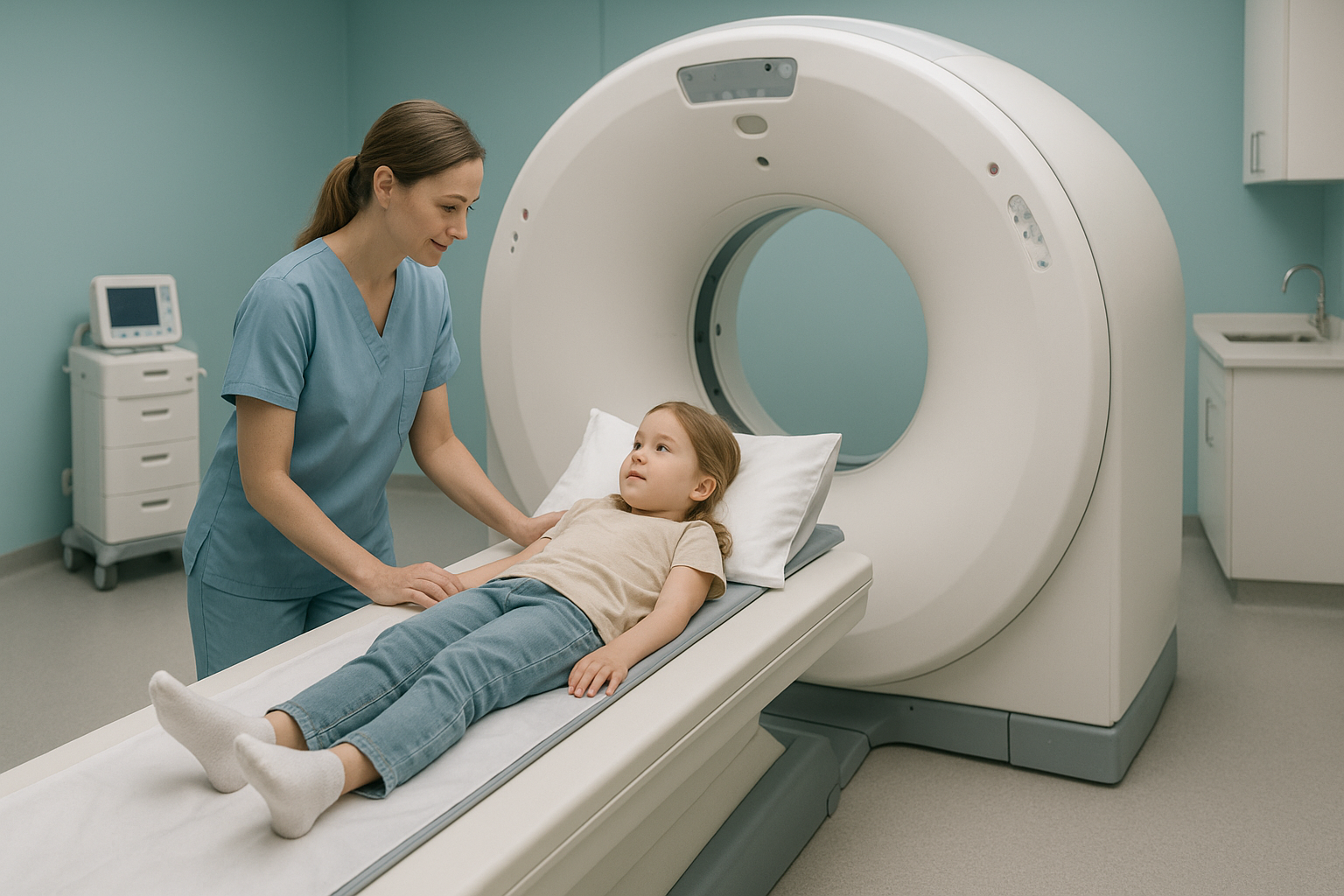
How Do You Prepare a Child for a Scan?
The best way to prepare a child for a scan is to explain in simple, honest words what will happen. An EOS scan means standing still for a few seconds in an open space. There is no tunnel, no injection, and a parent or carer stays in the room throughout. A little preparation at home goes a long way.
Key takeaways
- A standing EOS scan is open, quick, and pain-free.
- You can stay with your child for the entire appointment.
- Use simple, age-appropriate language at home beforehand.
- Dress your child in comfortable clothes with no metal fastenings.
- EOS uses about 90% less radiation than a standard X-ray, around ten times less.
Children often worry about the unknown. If your child has been referred for a scan, or you are considering paediatric imaging at ScanAlign, the tips on this page will help both of you feel calm and ready before you arrive.
What should you tell a child before an X-ray or scan?
Tell them the truth in short, simple sentences. Children cope better when they know what to expect rather than being surprised on the day.
Say something like, "A special camera will take a picture of your bones while you stand very still, like a statue."
The scan itself takes only a few seconds. The whole visit usually lasts around 20 minutes including getting settled.
No needles, no tunnel, no loud noises. These are the things children fear most. Ruling them out early makes a real difference.
Practise at home if it helps. Ask your child to stand still for a slow count of ten, feet flat on the floor, arms relaxed. Make it a game. When they do it at the clinic, it will already feel familiar.
What should a child wear to a scan?
Loose, comfortable clothing with no metal is ideal. Zips, poppers, belt buckles, and metallic prints can show up on images and may mean your child needs to change into a gown.
Good choices include a plain cotton t-shirt, joggers or leggings, and slip-on shoes. Leave jewellery and hair clips at home. If your child does need to change, a gown will be provided.

What are the steps to book a paediatric scan?
Booking is straightforward. Here is what happens from start to finish.
Free video consultation
A short call with our radiographer to understand what your child's clinician is looking for, answer your questions, and confirm the scan is appropriate.
Prepare at home
Use the tips on this page. Explain the scan, practise standing still, choose comfortable clothing. You can also read what to expect at an alignment assessment.
Attend the appointment
You and your child arrive at 19 Harley Street. You stay in the room while your child stands in the open scanner for a few seconds. No tunnel, no fuss.
Images sent to the referring clinician
The standing images show your child's bones, joints, and alignment under real weight-bearing conditions. These are shared with the requesting clinician to guide next steps.
How do you help a child with sensory needs stay still for a scan?
If your child has additional sensory needs, let us know at the consultation stage. Our team can adjust the appointment to suit them.
- Quiet environment. The EOS machine is near-silent, with no banging or buzzing.
- Familiar comfort items. Your child can bring a favourite toy or comforter to hold before and after the scan.
- Timing flexibility. We can schedule the appointment at a quieter time of day if that helps.
- Your presence throughout. You stay by their side the entire time.
Read more about what makes the appointment easier for anxious or sensory-sensitive patients.
When MRI might be needed instead. EOS shows bones, joints, and alignment clearly. For soft-tissue problems like discs, nerves, or ligaments, MRI is usually the better tool. If your child's clinician needs soft-tissue detail, they will advise you. We are always happy to discuss which type of scan is most appropriate during the free consultation.
Is an EOS scan safe for children?
Yes. EOS uses about 90% less radiation than a standard X-ray, around ten times less. That lower dose is especially important for growing children, whose tissues are more sensitive to radiation.
The scan is also standing, which means your child's alignment is captured under natural weight-bearing conditions. Lying-down scans can relax the muscles and hide alignment issues that only show up when the body is upright. You can read more about EOS scan safety and radiation.
Have questions about whether an EOS scan is right for your child? Start with a free, no-obligation video call with our radiographer.
Book a free video consultationCan a parent stay during a child's scan?
Yes, absolutely. A parent or carer stays in the room with their child for the entire scan at ScanAlign, paediatric standing imaging. You will be given a protective apron and can stand right next to your child to reassure them.
- Explaining the scan in simple, honest language
- Practising standing still at home
- Choosing comfortable, metal-free clothing
- Letting the clinic know about any additional needs
- Arriving a few minutes early so your child can settle
- Surprising them on the day with no warning
- Using scary words like "machine" or "radiation"
- Promising it will "fix" something (imaging is diagnostic only)
- Forcing them if they are very distressed, talk to us first
Common questions about preparing a child for a scan
Use simple, truthful language suited to their age. Something like, "A special camera will take a picture of your bones while you stand very still for a few seconds." Avoid medical jargon and reassure them that it does not hurt.
Yes. A parent or carer stays in the room for the entire scan. You will wear a protective apron and can stand right next to your child to keep them calm.
A referral from a clinician is usually needed for paediatric scans to make sure the imaging is appropriate. If you are unsure, our free video consultation will help you work out the best next step.
The scan itself takes only a few seconds. Including getting settled, the whole visit usually lasts around 20 minutes.
Comfortable clothing without metal fastenings. A plain cotton t-shirt and joggers or leggings are ideal. Leave jewellery, hair clips, and belts at home.
Yes. EOS uses about 90% less radiation than a standard X-ray, around ten times less. This is especially important for children, whose growing tissues are more sensitive to radiation.
Practise the "statue game" at home. On the day, you will be next to your child and our radiographer is experienced in working with children. If your child is very distressed, we will never force the scan. We can pause, try again, or reschedule.
Pricing details are available on our book a paediatric scan page. The initial video consultation is free and carries no obligation.
When a child lies down, gravity is removed and the muscles relax. This can mask alignment problems that only appear when the body is upright and bearing weight. A standing EOS scan captures the skeleton in its natural, weight-bearing position.
Absolutely. Your child can hold a favourite toy or comforter before and after the scan. During the scan, we may ask them to put it down briefly so it does not appear on the image, but it will be right beside them.
Ready to take the next step?
A free video consultation lets you ask questions, find out if an EOS scan is right for your child, and plan the visit together.
Book a free video consultationWritten by Abbas Dhami (Specialist Diagnostic Radiographer)
Sources
- NHS. "Having an X-ray." nhs.uk, 2023.
- Deschênes S, et al. "EOS low-dose imaging system." European Radiology, 2010; 20(12): 2870–2878.
- The Society and College of Radiographers. "Guidance on the role of parents and carers during imaging procedures." SCoR, 2015.
This page is general information and not a diagnosis.
ScanAlign is the trading name of CoreMed Solutions Ltd and operates under The Harley Street Hospital's CQC licence.