
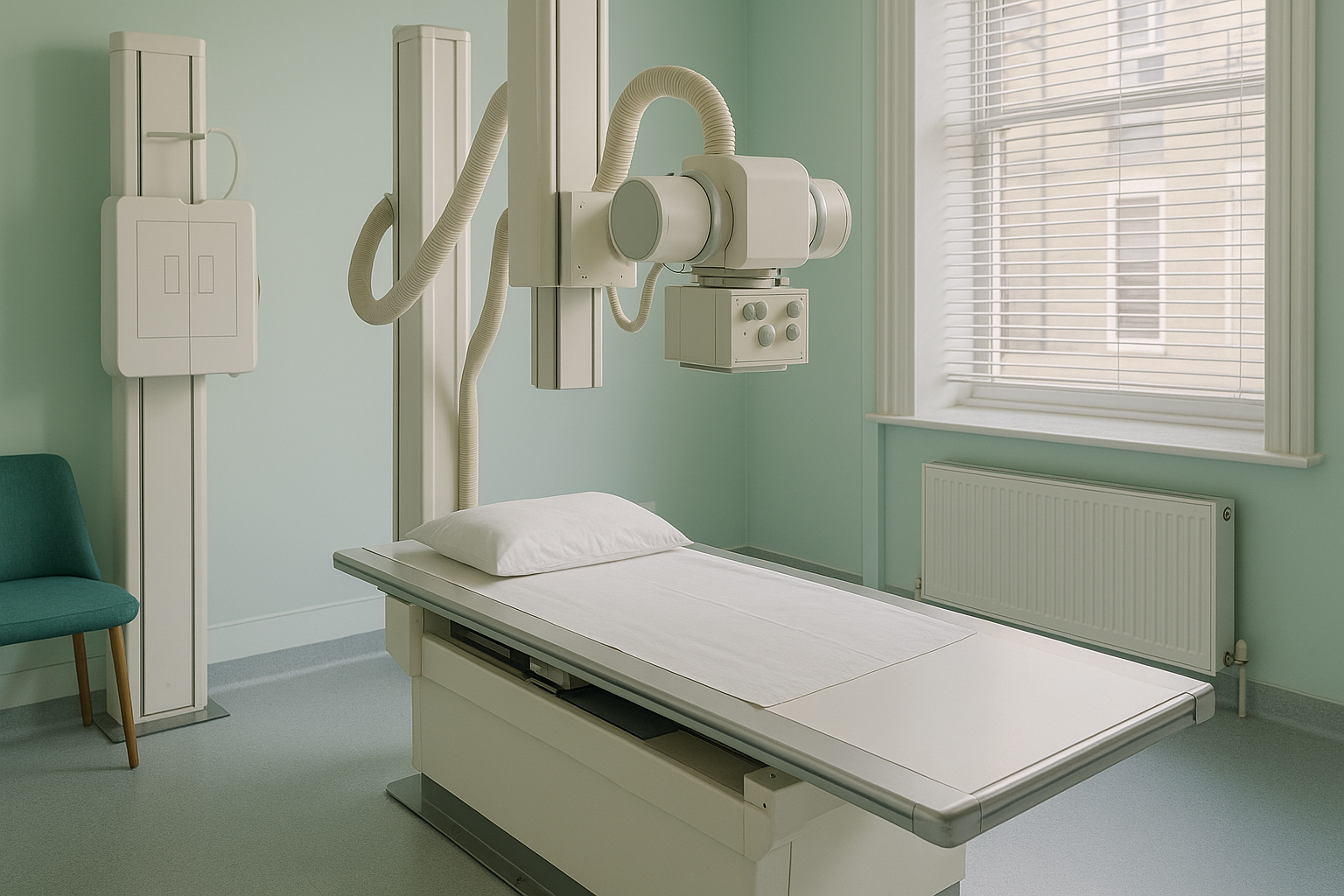
Where Can You Get a Private X-ray in London?
Several private clinics across London offer self-pay x-rays, often without needing a GP referral. Options range from standard single-area x-rays to advanced standing weight-bearing x-ray systems like EOS that image your whole body while you stand. Your choice depends on what you need to find out.
Key takeaways
- Private x-ray clinics in London let you self-refer, so you do not need a GP letter first.
- Standard x-rays show one area at a time, usually while lying down.
- Standing whole-body imaging like EOS shows how your entire skeleton lines up under your own weight.
- All private x-rays must still be clinically justified under IRMER regulations.
- EOS uses about 90% less radiation than a standard x-ray, around ten times less.
What types of private x-ray are available in London?
London has a wide range of private imaging clinics. The type of x-ray that suits you depends on your symptoms and what your clinician needs to see.
Targets one body part, such as a hand, chest or knee. Usually taken lying down or standing against a flat panel. Quick and widely available.
Captures the entire spine in one view. A full spine x-ray is useful when a clinician suspects scoliosis or wants to see overall spinal alignment.
An EOS standing x-ray captures your skeleton from head to feet while you stand. It uses about 90% less radiation than a standard x-ray and shows how every joint lines up under gravity.
Do you need a GP referral for a private x-ray in London?
Most private x-ray clinics in London accept self-referrals. You do not need a letter from your GP to book a private scan. However, every x-ray must still be clinically justified. This is a legal requirement under IRMER (Ionising Radiation Medical Exposure Regulations). It means a qualified practitioner must confirm there is a valid clinical reason before any exposure takes place.
In practice, this usually happens as part of your booking process. A radiographer or referring clinician reviews your symptoms and medical history to make sure the scan is appropriate and safe for you.

Why does it matter whether your x-ray is taken standing or lying down?
It matters because your body behaves differently under gravity. When you lie down for a standard x-ray, your muscles relax and your joints decompress. This can hide the very alignment problems causing your pain. A standing, weight-bearing image captures your skeleton as it actually works, with your full body weight pressing through each joint.
Your body is a connected chain from your feet to your head. A tilt in the pelvis can change how your spine curves. A knee that angles inward can shift the load on your hip. Pain often appears in one area but is caused by a problem somewhere else along the chain. Single-area, lying-down x-rays cannot show these connections.
Standard x-ray (lying down): Your muscles relax, your spine straightens slightly, and joints widen. The image shows anatomy, but it does not show how your body copes with gravity. A curve or tilt that causes trouble when you stand may look normal on a lying-down image.
EOS scan (standing up): Your full weight presses through your joints. Curves, tilts and rotations appear as they truly are. EOS captures your whole body in a single sweep, so your clinician can trace the chain of cause and effect from feet to skull in one image.
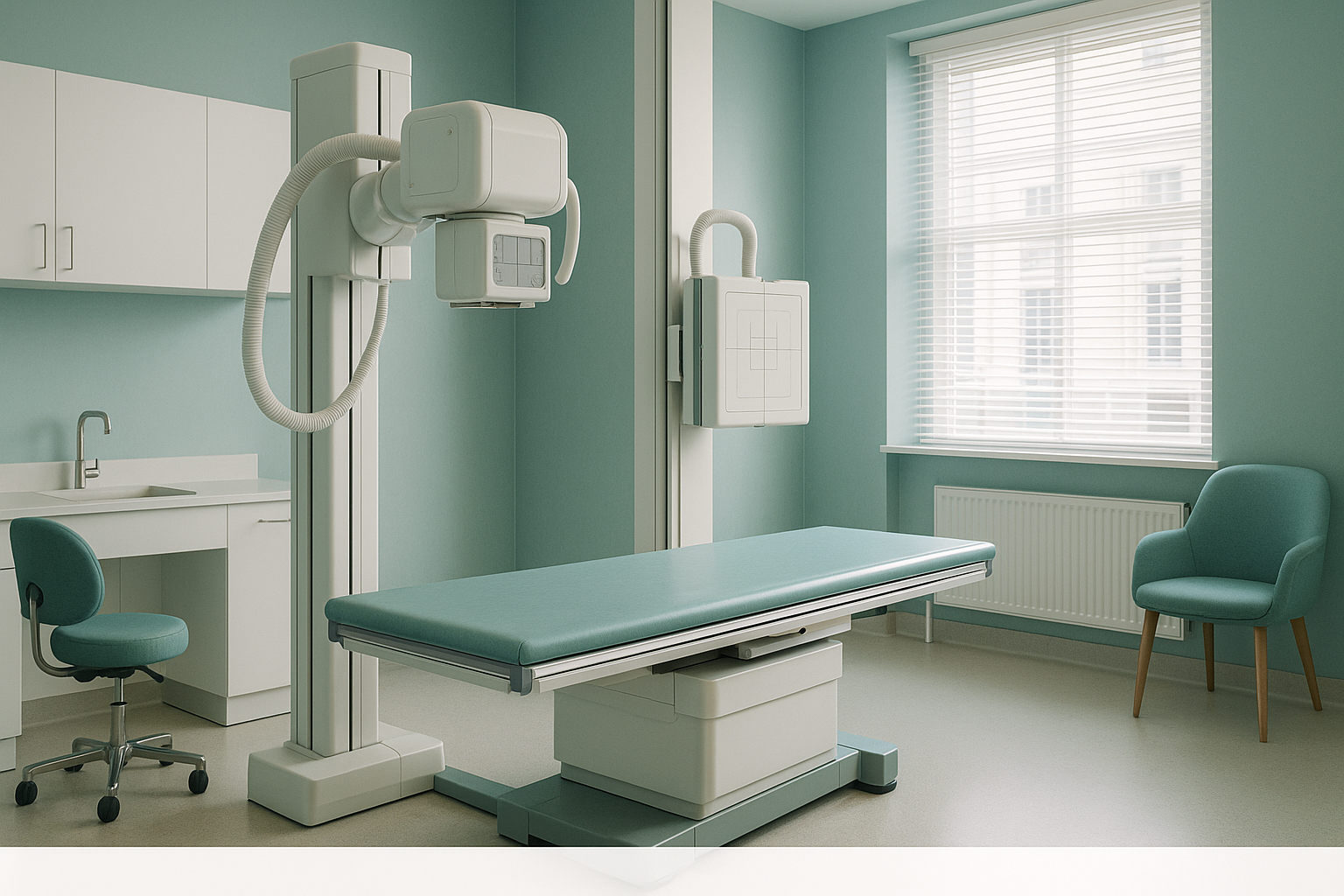
Thinking about a standing whole-body scan? ScanAlign, private standing imaging in London, offers EOS imaging at 19 Harley Street.
Book a free video consultationWhat happens when you book a private x-ray?
The process is straightforward. Most private clinics in London follow a similar path, though the details vary depending on the type of imaging.
You get in touch
Contact the clinic online or by phone. At ScanAlign, you start with a free video consultation so a specialist radiographer can understand your problem and confirm the scan is right for you.
Clinical justification
A qualified practitioner reviews your symptoms and history. Under IRMER regulations, no x-ray can go ahead without a valid clinical reason. This protects you.
The scan itself
You attend the clinic. A standard x-ray takes a few minutes. An EOS whole-body scan also takes only minutes, but captures your full skeleton in a single standing sweep.
Your results
A radiologist reviews your images and produces a report. You receive your results and can share them with any clinician involved in your care.
Is a private x-ray or a standing scan the right choice for you?
A standard private x-ray is appropriate when your clinician needs to check one specific area for a fracture, arthritis or another bony issue. A standing whole-body scan is more useful when your problem has not been explained by previous imaging, or when pain in one area may be caused by misalignment somewhere else in the chain.
- Have long-standing back, hip or knee pain without a clear diagnosis
- Have been told previous scans look "normal" but still feel something is wrong
- Want a full picture of how your whole skeleton lines up
- Are considering surgery and need detailed alignment data
- Have a recent injury and need to check for a fracture
- Need a routine chest or dental x-ray
- Have been asked for a specific image by a consultant already
What about MRI? EOS and standard x-rays are excellent for bones, joints and alignment. If your clinician suspects a problem with soft tissue, discs or nerves, MRI is usually the better tool. The two are complementary, not competing. Your clinician can advise which is appropriate for you.
Urgent symptoms? If you are experiencing sudden severe pain, numbness or weakness in your legs, or any loss of bladder or bowel control, please seek urgent medical attention. Contact your GP, call 111, or go to A&E. Do not wait for a private scan.
Frequently asked questions about private x-rays in London
Yes. Most private x-ray clinics in London accept self-referrals. You do not need a GP letter. However, every x-ray must still be clinically justified by a qualified practitioner under IRMER regulations before it goes ahead.
Costs vary between clinics and depend on the type of scan. For ScanAlign pricing, please visit the booking page or start with a free video consultation to discuss what you need.
A standard x-ray usually captures one body part while you lie down. An EOS standing x-ray captures your entire skeleton in a single standing image using about 90% less radiation than a standard x-ray, around ten times less. It shows how your body truly lines up under gravity.
Yes. All private x-ray clinics in England are regulated and must follow strict safety standards. The radiation dose from a standard x-ray is low. EOS uses about 90% less radiation than a standard x-ray, around ten times less.
ScanAlign is at 19 Harley Street, central London. It is easily reached from the West End, Oxford Circus and Regent's Park tube stations.
IRMER stands for the Ionising Radiation (Medical Exposure) Regulations. It is a legal framework that ensures every x-ray exposure is clinically justified. This means a qualified professional must agree there is a valid reason for the scan before it happens. It is there to protect you from unnecessary radiation.
A standard x-ray can show bony changes such as arthritis, fractures or narrowing of disc spaces. A standing whole-body scan goes further by showing how your entire skeleton aligns, which can reveal whether a tilt or imbalance is contributing to your pain.
A standard x-ray usually takes only a few minutes. An EOS whole-body scan also takes just minutes. Your total time in the clinic will be slightly longer to allow for registration and positioning.
It depends on what your clinician is looking for. X-rays and EOS scans are best for bones, joints and alignment. MRI is better for soft tissue, discs and nerves. They complement each other. If you are unsure which you need, a free video consultation can help clarify.
Yes. Your images and report belong to you. You can share them with any clinician, whether NHS or private. Digital images can usually be provided on disc or via a secure download link.
Not sure which type of scan you need?
Start with a free video consultation. A specialist radiographer will listen to your problem, explain your options and help you decide whether a standing whole-body scan is the right next step.
Book a free video consultationSources
- The Ionising Radiation (Medical Exposure) Regulations 2017, UK Statutory Instruments 2017 No. 1322. legislation.gov.uk
- Deschênes S, Charron G, Beaudoin G, et al. Diagnostic imaging of spinal deformities: reducing patients' radiation dose with a new slot-scanning x-ray imager. Spine. 2010;35(9):989-994.
- NHS. X-ray overview. nhs.uk/conditions/x-ray (accessed 2024).
Written by Abbas Dhami (Specialist Diagnostic Radiographer)
This page is general information and not a diagnosis.
ScanAlign is the trading name of CoreMed Solutions Ltd and operates under The Harley Street Hospital's CQC licence.