
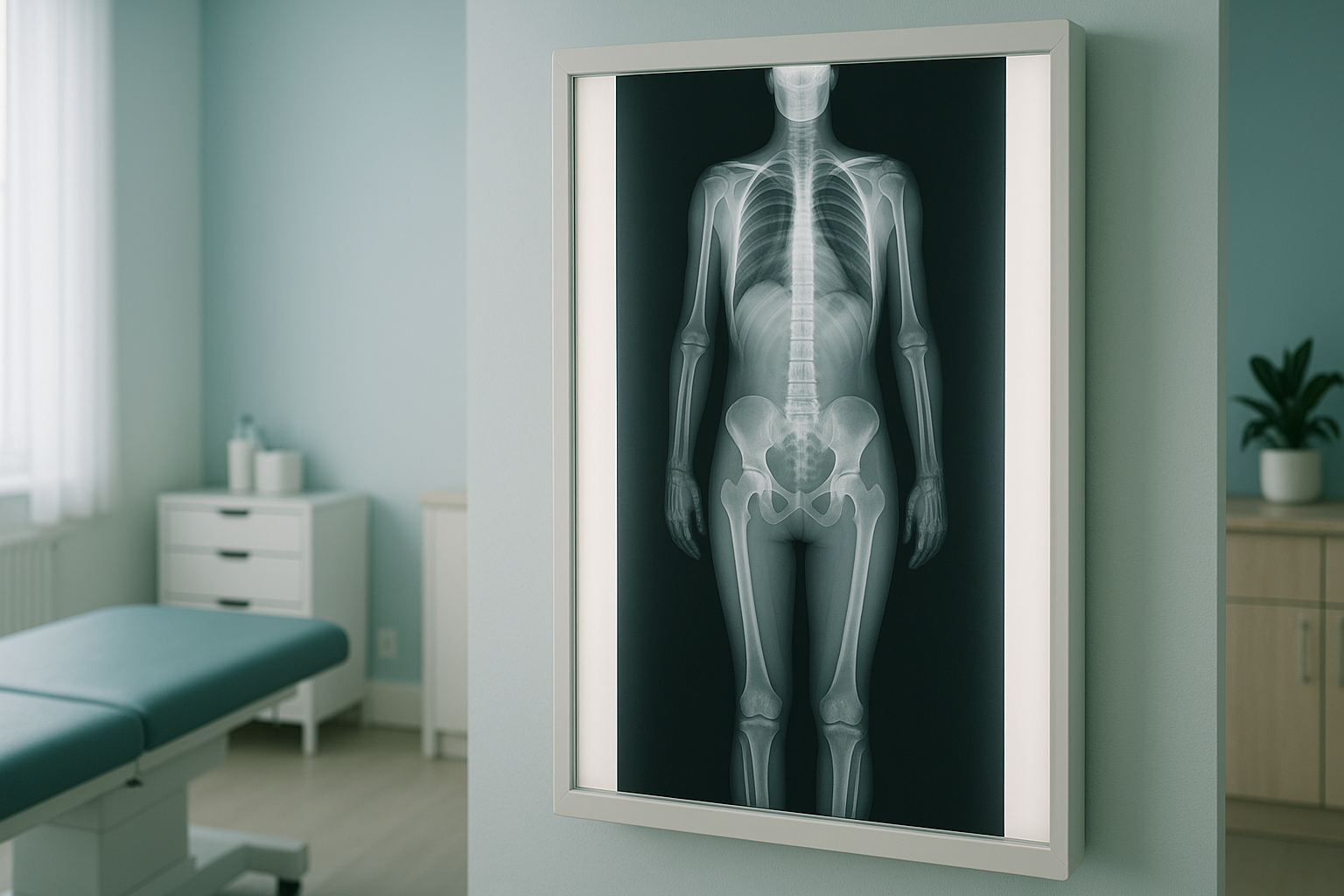
Full Spine X-ray: Can You Really See Everything in One Scan?
Yes. An EOS full spine x-ray captures your entire skeleton, from skull to feet, in a single standing image. Because you are weight-bearing, the scan shows your real alignment under gravity. It uses about 90% less radiation than a standard x-ray, around ten times less, making it a practical option for whole-body assessment.
Key takeaways
- A full spine x-ray can cover your entire skeleton in one scan when taken on an EOS system.
- Standing imaging reveals alignment problems that lying-down scans can miss.
- EOS uses about 90% less radiation than a standard x-ray, around ten times less.
- No GP referral is needed. You can self-refer for a private scan.
- EOS shows bones, joints and alignment. For soft tissue, discs or nerves, MRI is usually the better tool.
What is a full spine x-ray and what does it show?
A full spine x-ray is an image that captures every vertebra from the top of your neck to the base of your sacrum. Traditionally, this required several separate x-rays stitched together, often taken lying down. Each film covered only a portion of your spine, so the overall picture was incomplete.
With EOS technology, the scan captures your full spine, and optionally your entire skeleton, in one continuous pass while you stand naturally. The result is a single, undistorted image that shows your spine's curves, your pelvis, hips, knees and ankles, all in their true weight-bearing position.
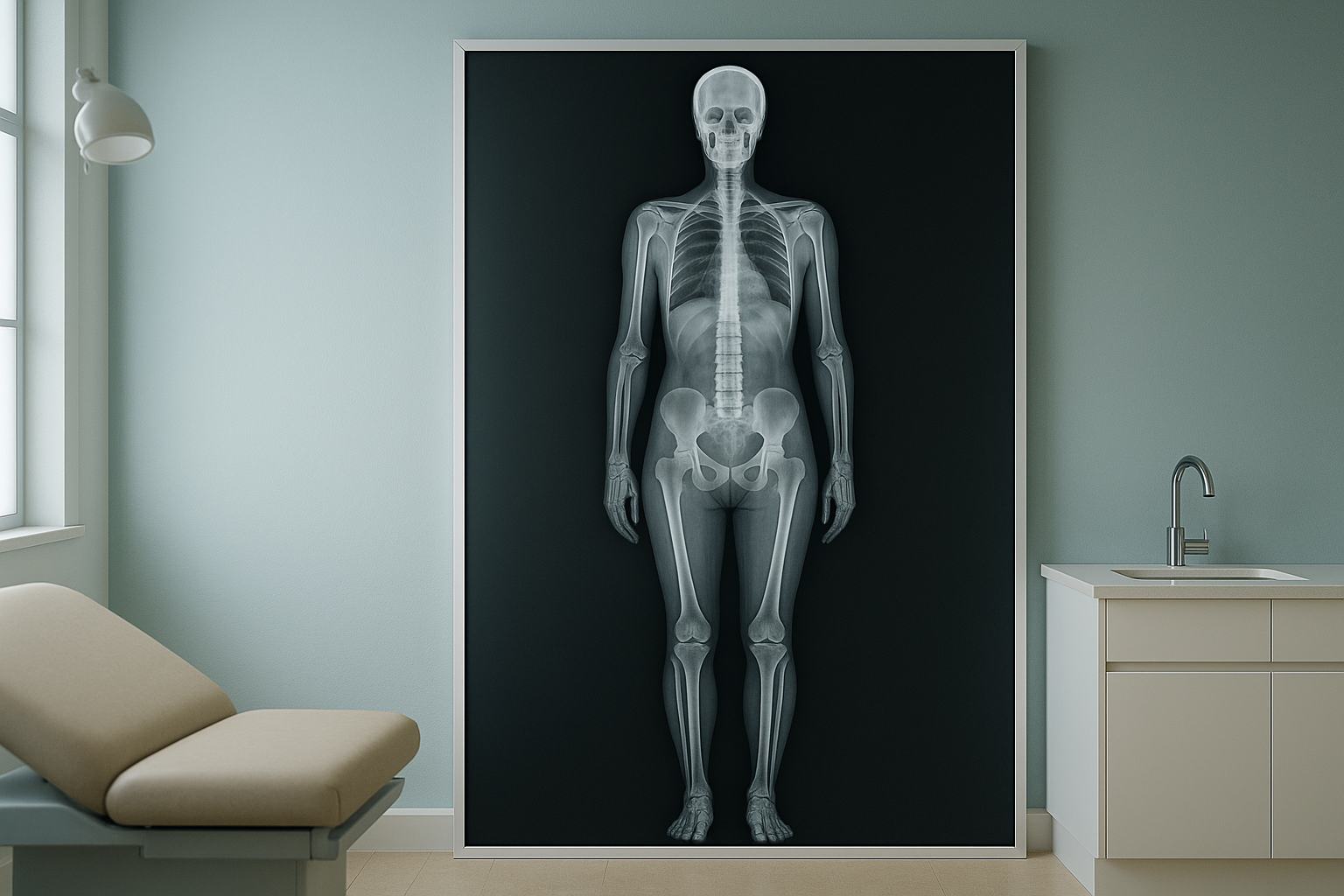
Why does a standing x-ray show more than lying down?
When you lie on a table for a conventional x-ray, CT or MRI, gravity is no longer acting on your spine the same way. Your muscles relax, your curves flatten and your joints decompress. The image may look normal even though you have a significant alignment problem when you are upright.
A standing full spine x-ray captures the forces your body actually deals with every day. A pelvic tilt that disappears when you lie flat will be clearly visible. A scoliosis curve may measure differently standing versus lying. Knee or hip joint angles that only show under load become obvious.
Your body works as a connected chain from your feet to your head. If one link is off, others compensate. You might feel pain in your lower back, but the root cause could be a leg-length difference or a rotated pelvis. A full-body standing image reveals the whole chain at once, so nothing is guessed at.
Who should consider a full spine or full body x-ray?
A full spine x-ray is useful for anyone who has a structural or alignment question that single-area imaging has not answered. You do not need to have a diagnosis already.
Pain that persists despite treatment, without a clear cause on standard imaging.
Uneven shoulders, a visible curve, or a previous scoliosis diagnosis requiring monitoring.
Surgeons often need whole-spine or whole-leg alignment data before hip or knee replacement.
You feel you lean forward, stand unevenly, or notice your posture affecting your daily life.
How does an EOS scan work for a full spine x-ray?
An EOS scan takes a full spine x-ray, or a full body x-ray from head to feet, while you stand inside an open cabin. There is no tunnel and no need to lie down. The system moves two low-dose x-ray beams vertically around you, producing both a front-to-back and a side-on image simultaneously.
The scan takes under a minute and uses about 90% less radiation than a standard x-ray, around ten times less. Because of this low dose, repeat scans for monitoring conditions like scoliosis carry far less cumulative exposure over time.
The result is a calibrated, full-length image that your clinician can use to measure alignment precisely. Software can also generate a 3D model of your spine and lower limbs from the two views, giving an even richer picture for surgical planning or complex alignment questions.
ScanAlign offers EOS full spine and full body scans at 19 Harley Street, London. No GP referral needed.
Book a free video consultationWhen MRI is the better choice: EOS excels at showing bones, joints and overall alignment. If your clinician suspects a disc bulge, nerve compression or soft-tissue injury, MRI is usually the more appropriate scan. The two tests complement each other well.
What happens after a full spine x-ray?
Your images are reviewed by a reporting radiologist who produces a detailed report. This report describes your spinal curves, pelvic position, leg alignment and any findings across the skeleton. It is written in clear terms so both you and your treating clinician can understand it.
ScanAlign is a diagnostic imaging clinic, not a treatment provider. Once you have your report, you can share it with your GP, physiotherapist, osteopath or surgeon. Many patients find that having a whole-body picture finally explains a problem that fragmented imaging missed, and it gives their clinician the data to plan the right course of action.
You can read more about spinal imaging and alignment on our dedicated page, or visit our FAQs for details on safety, preparation and cost.
Frequently asked questions about full spine x-rays
Yes. An EOS system can capture your entire skeleton, head to feet, in a single standing scan. This is sometimes called a full body x-ray or whole-body alignment scan.
An EOS full spine x-ray uses about 90% less radiation than a standard x-ray, around ten times less. This makes it one of the lowest-dose options available for skeletal imaging.
No. ScanAlign accepts self-referrals. You can book directly without a letter from your GP, though you are welcome to bring any existing reports or images with you.
For current pricing, please visit our FAQs page, which includes cost information and what is included in your scan.
Yes. A standing full spine x-ray is the standard way to assess and monitor scoliosis. Because EOS captures the whole spine in one image under load, it provides accurate curve measurement without stitching separate films together.
A full spine x-ray shows bones, joints and alignment, ideally taken standing. MRI shows soft tissue such as discs, nerves and ligaments, but is taken lying down. They answer different questions and often work best together.
The EOS scan itself takes under a minute. Your overall appointment will include positioning and a brief explanation, but the actual imaging is very quick.
It can reveal alignment issues that do not show on lying-down scans. Problems like a pelvic tilt, leg-length difference, or compensatory curvature elsewhere in the chain may explain why treatment directed at one area has not worked.
No. The EOS system is an open cabin. You simply stand inside it during the scan, so it is comfortable for anyone who finds enclosed spaces difficult.
EOS scanners are uncommon in the UK, though several private clinics offer them. ScanAlign is based at 19 Harley Street, London, and you can learn more on our homepage.
See your whole alignment in one scan
Start with a free video consultation. We will explain what a full spine or full body EOS scan can show for your situation, with no obligation.
Book a free video consultationWritten by Abbas Dhami (Specialist Diagnostic Radiographer)
Sources
- Deschênes S, Charron G, Beaudoin G, et al. "Diagnostic imaging of spinal deformities: reducing patients' radiation dose with a new slot-scanning X-ray imager." Spine, 2010;35(9):989-994.
- NHS. "Scoliosis: Diagnosis." NHS website, 2022. nhs.uk/conditions/scoliosis/diagnosis
- Melhem E, Assi A, El Rachkidi R, Ghanem I. "EOS biplanar X-ray imaging: concept, developments, benefits, and limitations." Journal of Children's Orthopaedics, 2016;10(1):1-14.
This page is general information and not a diagnosis.
ScanAlign is the trading name of CoreMed Solutions Ltd and operates under The Harley Street Hospital's CQC licence.