
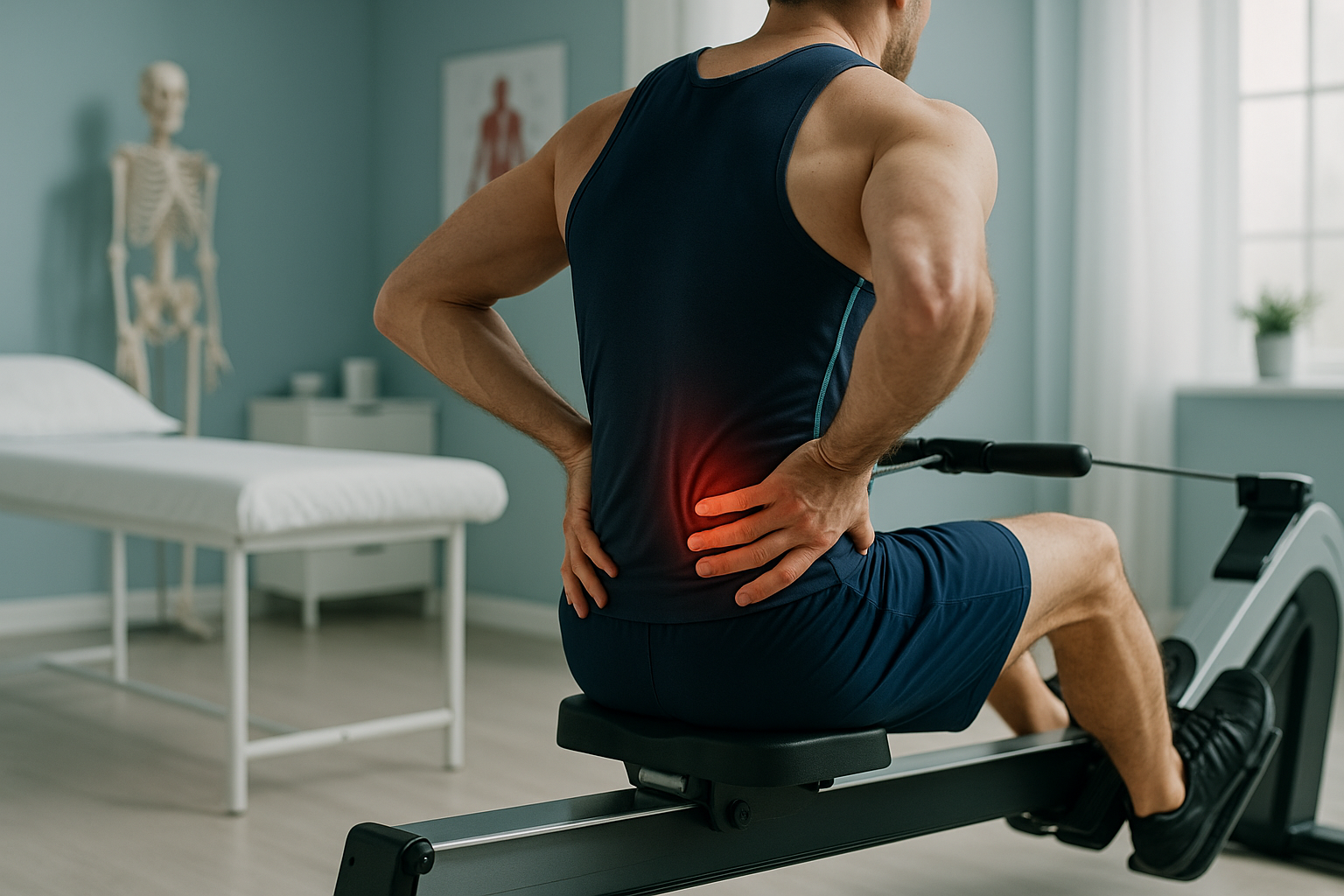
Why Do Rowers Get Lower Back Pain?
Rowing back pain usually comes from repeated lumbar flexion at the catch, especially when tight hamstrings or limited hip mobility force the lower spine to round under load. High training volumes on the ergometer multiply the stress. A standing whole-body scan can reveal pelvic and spinal alignment problems that lying-down imaging often misses.
Key takeaways
- Rowing loads the lower back hundreds of times per session, making technique and mobility critical.
- Tight hamstrings reduce pelvic rotation at the catch, forcing the lumbar spine to flex under load.
- Lying-down scans relax the muscles and can hide alignment problems that only appear when standing.
- EOS standing imaging captures the full spine and pelvis in a weight-bearing position, using about 90% less radiation than a standard X-ray.
- ScanAlign provides diagnostic imaging only, not treatment. Your scan report goes to your coach, physio or consultant.
Why is rowing so hard on the lower back?
Rowing demands more from the lower back than almost any other endurance sport. Each stroke cycles through a full range of spinal flexion and extension, under significant force, at a rate of 20 to 35 strokes per minute. Over a single session on the ergometer, that can mean well over a thousand loaded bending movements.
The catch position is where the risk is highest. At the front of the stroke you need your pelvis to rotate forwards over the hips so your spine can stay relatively neutral. If your hamstrings are tight or your hip mobility is limited, your pelvis cannot rotate far enough. The lower spine rounds instead. This repeated lumbar flexion under load is the main mechanical driver of lower back pain in rowers.
University squads and club rowers are especially vulnerable because training volume on the erg can be very high during the winter months. More strokes means more repetitions of the same movement pattern, giving the lumbar spine less time to recover.
What does rowing back pain feel like?
Most rowers describe a dull ache across the lower back that builds during longer pieces or steady-state sessions. It may also present in sharper ways depending on what structures are involved.
A deep ache in the lower back that worsens as you compress at the front of the stroke.
Difficulty straightening up after a long ergometer session, especially during winter training blocks.
Pain more on one side, which may point to a pelvic alignment issue or asymmetric technique.
If pain radiates below the knee or you feel numbness or weakness, seek urgent medical advice from your GP, 111 or A&E.
What causes rowing injury in the lower back?
Rowing injury to the lower back usually results from a combination of factors rather than one single cause. These are the most common contributors.
The spine bends forward hundreds of times per session, stressing discs and ligaments.
Short hamstrings limit pelvic rotation at the catch, forcing the spine to round instead.
High ergometer volume, especially during winter blocks, multiplies cumulative load on the spine.
A posterior pelvic tilt or asymmetry changes how load passes through the lumbar spine.
Over time, repeated flexion under load can contribute to disc problems. If you have been told you may have disc wear, our page on degenerative disc disease explains how alignment imaging fits in.
How does a standing scan help diagnose rowing back pain?
A standing scan shows your spine and pelvis exactly as they work when you are upright and weight-bearing. This matters because lying-down imaging, such as a standard X-ray, CT or MRI, relaxes the muscles and lets gravity flatten your curves. Alignment problems that are obvious when you stand can disappear when you lie down.
EOS standing scan captures your full spine, pelvis and legs in one upright image. It shows how your pelvis tilts, whether your spine is balanced over your hips, and whether one side carries more load than the other. For a rower, this reveals the biomechanical picture behind the pain.
The scan uses about 90% less radiation than a standard X-ray, around ten times less. It takes just a few seconds while you stand still.
Lying-down imaging is excellent for many things, but it cannot show how gravity and your muscles interact with your skeleton. A pelvic tilt or spinal imbalance that causes your back pain during rowing may simply not appear on a scan taken while you are flat on a table.
ScanAlign standing EOS imaging gives your physio, coach or consultant the weight-bearing data they need to understand your alignment. Because the body is a connected chain from feet to head, a problem in one area often makes another area compensate. Standing imaging captures that whole picture in a single exposure.
When is MRI the better choice? EOS shows bones, joints and alignment. For soft tissue, discs or nerves, MRI is usually the better tool. If your clinician suspects a disc bulge pressing on a nerve, they may recommend MRI alongside or instead of alignment imaging.
What helps rowers with lower back pain?
ScanAlign is a diagnostic imaging clinic and does not provide treatment. What we can say is that understanding the cause is the first step, and evidence-based approaches typically focus on the areas below.
A qualified coach can assess your catch position and help you maintain a more neutral lumbar spine under load.
Improving hamstring length and hip mobility allows greater pelvic rotation at the catch, reducing the demand on your spine.
Building endurance in the trunk muscles helps maintain spinal position through long training sessions.
Adjusting ergometer volume and intensity can reduce cumulative stress on the lower back during high-volume phases.
If your back pain is not improving with coaching and physiotherapy, a standing alignment scan can show whether a structural or pelvic issue is contributing.
Book a free video consultationFrequently asked questions about rowing back pain
Rowing requires your lower back to flex and extend under load with every stroke. If your hamstrings are tight or your hip mobility is limited, your lumbar spine rounds more than it should at the catch. Over hundreds of strokes, this repeated flexion fatigues the muscles and stresses the discs and ligaments.
The mechanism is similar, but ergometer training is often higher volume and removes the natural variation of balance and blade work. The fixed seat position on an erg can also limit how you move through the stroke, which may increase lumbar load.
Repeated lumbar flexion under load is a known risk factor for disc injury. This does not mean rowing will definitely cause disc damage, but it does mean that technique, mobility and training volume all matter. If you have persistent or worsening pain, getting a proper assessment is important.
Your pelvis needs to rotate forwards at the catch so your spine can stay relatively neutral. A posterior pelvic tilt reduces this rotation, forcing the lumbar spine to flex more. A standing alignment scan can show whether your pelvis sits in a tilted position under load.
No. ScanAlign accepts self-referrals. You begin with a free video consultation where a specialist radiographer reviews your history and confirms whether a standing scan is appropriate for you.
Yes. EOS uses about 90% less radiation than a standard X-ray, around ten times less. It is a very low-dose imaging system.
Pricing details are on our FAQs and cost page. The initial video consultation is free and there is no obligation to proceed.
Yes. A full-length standing image can reveal pelvic asymmetry, leg length differences or a spinal imbalance that loads one side more than the other. These are common findings in rowers with one-sided back pain.
They answer different questions. EOS shows alignment, pelvic tilt and how your skeleton is balanced when standing. MRI shows soft tissue, discs and nerves. Your clinician may recommend one or both depending on your symptoms.
Yes. Start with a free video consultation through our website. A specialist radiographer will review your history and confirm the most appropriate scan protocol for your situation. No GP referral is needed.
Find out what is really behind your rowing back pain
A free video consultation with a specialist radiographer. No referral needed, no obligation.
Book a free video consultationSources
- Thornton JS, Vinther A, Wilson F, et al. "Rowing injuries: an updated review." Sports Medicine. 2017;47(4):641-661.
- Buckeridge E, Bull AMJ, McGregor AH. "Biomechanical determinants of elite rowing technique and performance." Scandinavian Journal of Medicine & Science in Sports. 2015;25(2):e176-e183.
- Wilson F, Gissane C, Gormley J, Simms C. "A 12-month prospective cohort study of injury in international rowers." British Journal of Sports Medicine. 2010;44(3):207-214.
Written by Abbas Dhami (Specialist Diagnostic Radiographer)
This page is general information and not a diagnosis.
ScanAlign is the trading name of CoreMed Solutions Ltd and operates under The Harley Street Hospital's CQC licence.