

What Causes Pain Over the Sacrum and Tailbone Area?
Sacrum pain and tailbone pain, sometimes called coccydynia, usually come from prolonged sitting, a fall, childbirth or pelvic alignment issues. Because the sacrum connects the spine to the pelvis, problems above or below it often refer pain to this spot. A standing whole-body scan can reveal alignment factors that lying-down imaging misses.
Key takeaways
- The sacrum and coccyx sit at the base of the spine, where your spine meets your pelvis.
- Common causes include falls, sitting posture, childbirth and sacroiliac joint problems.
- Pain here can be referred from lower back pain or a rotated pelvis.
- Standing imaging shows how weight-bearing posture loads the sacrum, something lying-down scans cannot capture.
- EOS imaging uses about 90% less radiation than a standard X-ray, around ten times less.
What are the sacrum and tailbone, and why do they hurt?
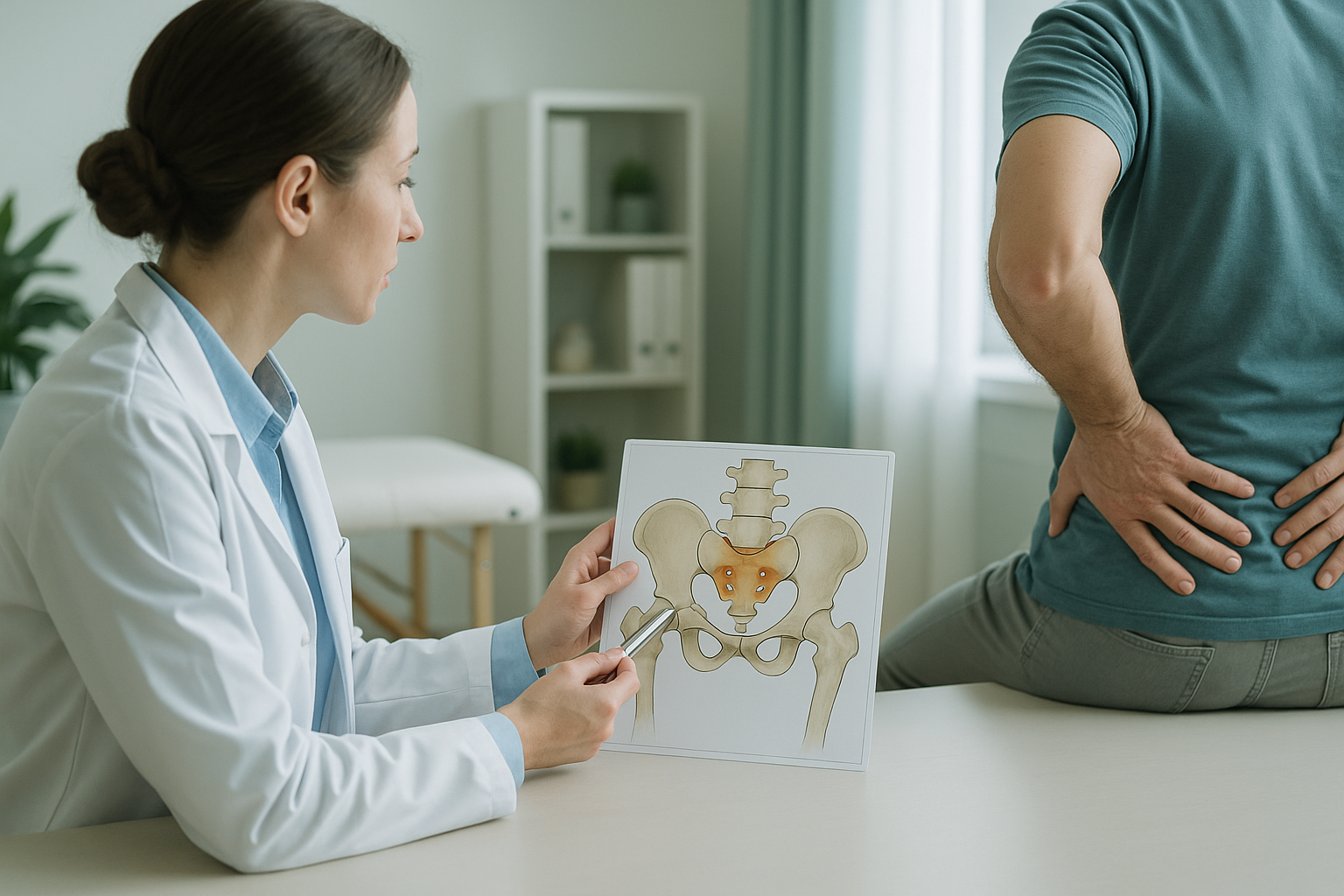
The sacrum is a wide, triangular bone at the base of your spine, formed from five fused vertebrae. Below it sits the coccyx, a small set of fused bones commonly called the tailbone. Together they anchor your pelvis and transfer the weight of your upper body into your hips and legs.
Because the sacrum connects to the pelvis on each side through the sacroiliac (SI) joints, it is affected by how you stand, sit and move. When pelvic alignment shifts, the sacrum follows, and the tailbone can bear pressure it was never designed to handle alone.
How does sacrum and tailbone pain feel?
The pain is usually a dull ache or sharp tenderness right at the base of the spine. It often gets worse when you sit, especially on hard surfaces, and may ease when you stand or walk. Some people feel it only on one side, which can point to an SI joint dysfunction.
When to consider MRI. EOS imaging shows bones, joints and alignment clearly. If your clinician suspects soft-tissue, disc or nerve involvement, MRI is usually the better tool. The two scans complement each other well.
Important. If you experience numbness around the saddle area, loss of bladder or bowel control, or sudden weakness in your legs, seek urgent medical attention. Contact your GP, call 111, or attend A&E immediately.
What causes sacrum pain and coccydynia?
Several things can trigger pain at the base of the spine. Some are obvious, like a fall. Others develop slowly over months or years as sitting habits, pelvic alignment or body mechanics shift.
In many cases, the body is compensating. The chain from your feet through your knees, hips and pelvis all affects how the sacrum is loaded. A problem in one area can make another compensate, so the source of pain and the cause of pain are not always in the same place.
How does a standing scan help with sacrum and tailbone pain?
A standing scan captures your skeleton under load, exactly as it works in real life. This is important because lying down for a conventional X-ray or MRI lets your muscles relax and your pelvis flatten. Alignment issues that only appear when gravity is involved can simply vanish on a lying-down image.
Weight is on. The scan captures your full spine, pelvis and legs in one image while you stand naturally. Pelvic rotation, leg-length differences and sacral tilt all show up because gravity is doing its job.
EOS technology uses about 90% less radiation than a standard X-ray, around ten times less. That makes it practical for whole-body assessment.
Weight is off. When you lie flat, your pelvis is unloaded. A mild tilt or rotation can correct itself, so the image looks normal even though your symptoms are very real when you are upright.
Lying-down imaging still has clear value for soft tissue and disc problems. But for alignment, it can miss the bigger picture.
ScanAlign standing EOS imaging captures your full alignment from head to feet in a single scan. This lets a specialist see whether a pelvic tilt, SI joint asymmetry or lumbar curve is putting extra pressure on your sacrum.
What helps with sacrum and tailbone pain?
The right approach depends on the cause. ScanAlign is a diagnostic imaging clinic, so we do not provide treatment. However, having a clear standing-alignment picture gives you and your clinician the information needed to choose the most effective path forward.
- Your sacrum or tailbone pain has lasted weeks or months
- Previous lying-down imaging showed nothing abnormal
- You suspect a pelvic tilt or leg-length difference
- You sit for long hours and the pain is worsening
- You want a full alignment picture before seeing a specialist
- You have numbness, weakness or loss of bladder/bowel control (seek urgent care)
- Your pain started with a recent high-impact injury (A&E may be appropriate)
- You need soft-tissue or disc assessment (MRI is usually better)
- You are under 18
Not sure whether a standing scan is the right next step? Our free video consultation lets you discuss your symptoms with our team before committing to anything.
Book a free video consultationFrequently asked questions about sacrum and tailbone pain
Sitting puts direct pressure on the coccyx, especially on hard or flat surfaces. If the coccyx is bruised, slightly misaligned or if the surrounding ligaments are strained, that pressure causes pain. Slumped posture makes it worse because more weight shifts to the base of the spine.
They are closely related but not identical. Coccydynia refers specifically to pain in the coccyx (tailbone). Sacrum pain sits slightly higher, in the broader triangular bone. Because the two bones are connected, the terms are often used together and the pain can overlap.
Yes. When the pelvis tilts or rotates, the sacroiliac joints on each side are loaded unevenly. This imbalance can strain the ligaments around the sacrum and cause pain on one or both sides. A standing whole-body scan can reveal whether a rotated pelvis is contributing.
Absolutely. The lumbar spine sits directly above the sacrum. Disc issues, joint stiffness or muscle tightness in the lower back can refer pain downward into the sacral area. This is one reason why a whole-body alignment view is helpful.
It varies widely. A mild bruise may settle in a few weeks. Coccydynia from a fall or childbirth can sometimes last months. If your pain has not improved after several weeks, it is worth investigating whether an alignment issue is keeping it going.
No. ScanAlign is a self-referral clinic, so you can book a standing spine and pelvis scan without a GP letter. You start with a free video consultation to make sure it is the right option for you.
EOS uses about 90% less radiation than a standard X-ray, around ten times less. It captures the full body in a single pass while you stand still for a few seconds.
Pricing details are on our FAQs page. ScanAlign is a private, self-pay clinic with no hidden fees.
Yes. The sacroiliac joints are where the sacrum meets the pelvis. Inflammation or dysfunction in these joints is one of the most common causes of sacral pain. You can read more about SI joint dysfunction and how alignment imaging can help.
When you lie flat, gravity no longer acts on your skeleton. Your pelvis settles into a neutral position, muscles relax and mild tilts or rotations can disappear from the image. A standing scan captures your body under real-life load, so alignment issues that cause sacrum pain are visible.
Find out what is behind your sacrum or tailbone pain
A free video consultation lets you discuss your symptoms with our team. No referral needed, no obligation.
Book a free video consultationWritten by Abbas Dhami (Specialist Diagnostic Radiographer)
Sources
- NHS. "Coccydynia (tailbone pain)." nhs.uk, 2023.
- Maigne JY, Doursounian L, Chatellier G. "Causes and mechanisms of common coccydynia." Spine, 2000;25(23):3072-3079.
- Illés T, Somoskeöy S. "The EOS imaging system and its uses in daily orthopaedic practice." International Orthopaedics, 2012;36(7):1405-1411.
This page is general information and not a diagnosis.
ScanAlign is the trading name of CoreMed Solutions Ltd and operates under The Harley Street Hospital's CQC licence.