
What Causes Sciatica, and What Actually Helps It?
Sciatica is pain that travels along the sciatic nerve, from your lower back through your buttock and down your leg. It is usually caused by a disc pressing on a nerve root in the lower spine. Most cases settle within weeks, but persistent sciatica often needs proper imaging to find the real source of the problem.
Key takeaways
- Sciatica is a symptom, not a diagnosis. Something is irritating or compressing a nerve.
- The most common causes are disc bulges, spinal narrowing and bony shifts such as spondylolisthesis.
- Lying-down scans can miss alignment problems that only appear when you are upright and weight-bearing.
- Most sciatica improves with movement and time, but sudden weakness, numbness or bladder changes need urgent medical attention.
- A standing whole-body scan shows how your spine, pelvis and legs line up under gravity, revealing causes that other scans can hide.
What does sciatica feel like?
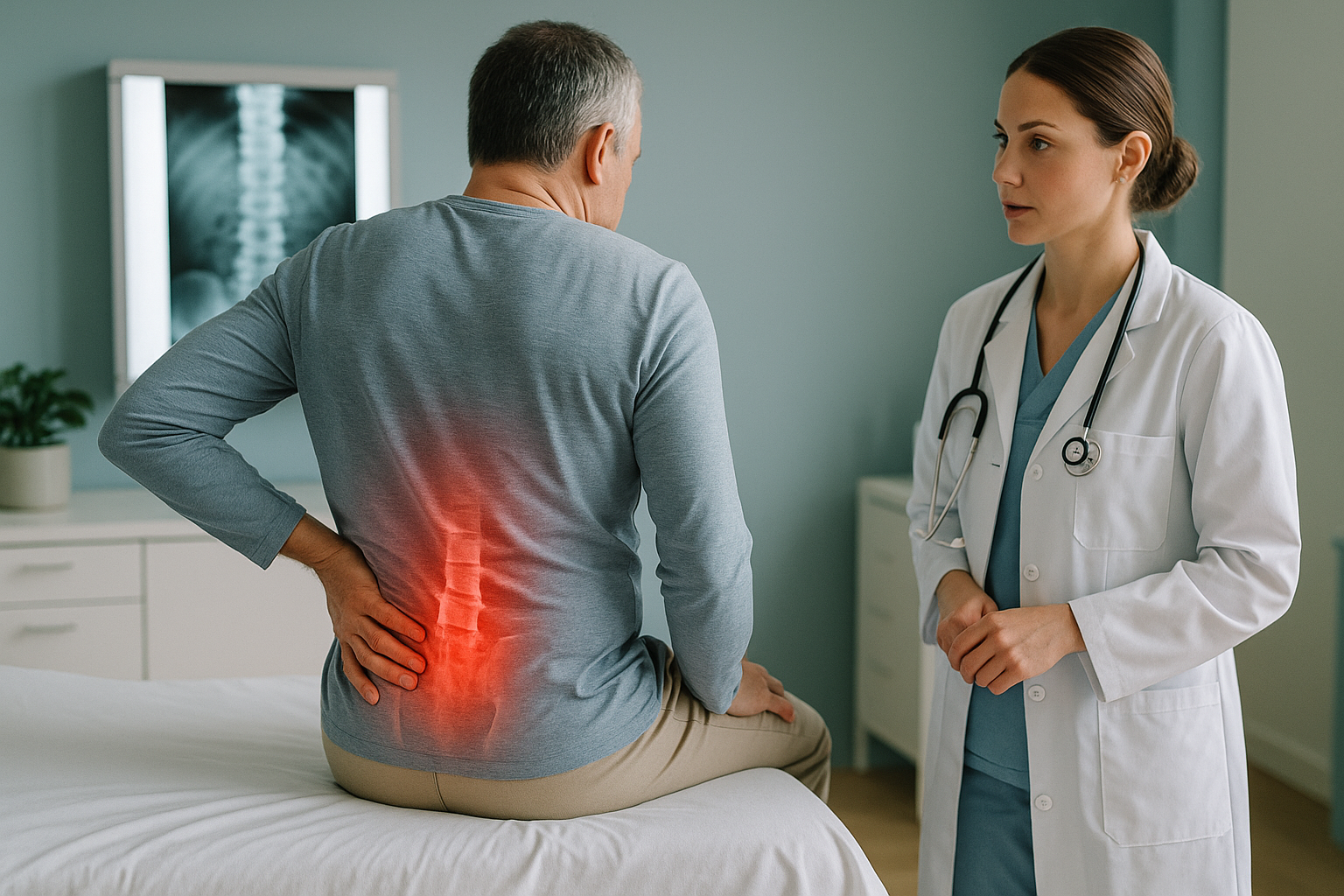
Sciatica typically causes pain that starts in the lower back or buttock and travels down one leg, often below the knee. It can feel like a sharp, burning ache or an electric-shock sensation. Some people also get pins and needles, numbness or muscle weakness in the affected leg.
The pattern of symptoms depends on which nerve root is affected. When the problem sits at the L5 level, for instance, you might notice weakness lifting the foot or pain down the outer shin. You can read more about L5 radiculopathy for detail on that specific pattern.
What causes sciatica?
Sciatica happens when something presses on or irritates a nerve root in the lower spine. The sciatic nerve is formed from nerve roots at the L4, L5 and S1 levels. Any structure that narrows the space around those roots can trigger symptoms.
Less common causes include bony growths (osteophytes), infections, or tumours. In many cases more than one factor is at work. A pelvic tilt or leg-length difference can shift your weight unevenly and overload one side of the spine, making a disc or joint problem worse over time.
Why does a standing scan matter for sciatica?
A standing, weight-bearing scan matters because gravity is part of the problem. When you lie down for a standard MRI or CT, your muscles relax and the spine unloads. A disc bulge can shrink, a vertebral slip can reduce, and a narrowed nerve exit can temporarily open up. The image may look reassuringly normal, yet you are still in pain when you stand or walk.
If you have had imaging that looks normal but the pain persists, you are not imagining it. It may be a case of when an MRI shows nothing but the pain remains. A standing scan captures your spine, pelvis and legs in one full-length image while you bear weight. This reveals disc compression, vertebral slips and pelvic tilts as they actually behave in real life.
Your body is a connected chain from your feet to your head. A tilted pelvis or a shorter leg shifts load unevenly through the spine. The nerve compression that causes your sciatica might be the result of an alignment issue further away. Single-area imaging cannot see that bigger picture.
At ScanAlign, whole-body standing imaging, we use EOS low-dose technology. It delivers about 90% less radiation than a standard X-ray, around ten times less, while capturing your full alignment in one upright exposure.
A note on MRI. EOS excels at showing bony alignment, joint positions and the overall mechanical chain. For soft-tissue detail, such as the disc itself, inflamed nerves or spinal cord structures, MRI is usually the better tool. Many people with sciatica benefit from both: an MRI to see the disc and an EOS scan to see why the disc is under abnormal load.
What actually helps sciatica?
Most sciatica improves within four to twelve weeks. Staying gently active is one of the most helpful things you can do. Prolonged bed rest usually makes things worse.
Movement and exercise
Walking, gentle stretching and specific nerve glides (movements that help the sciatic nerve slide freely through surrounding tissue) are commonly recommended. Strengthening the core and gluteal muscles can reduce the load on the lower spine over time. Some people find that certain yoga poses for sciatica offer relief, though it is worth checking with a physiotherapist first to make sure the poses suit your specific problem.
Pain relief
Over-the-counter pain relief such as paracetamol or ibuprofen can take the edge off while you stay mobile. Your GP or pharmacist can advise on what is appropriate for you.
Professional guidance
Physiotherapy, osteopathy and clinical pilates are all widely used for sciatica rehabilitation. In persistent cases, a specialist may consider steroid injections near the affected nerve root, or surgery to relieve the compression. The right approach depends entirely on what is causing the nerve irritation, which is why accurate imaging matters.
If your sciatica keeps coming back or has not improved after several weeks, a standing spine and pelvis scan can show whether alignment is part of the problem.
Book a free video consultationWhen should you get urgent help for sciatica?
You should seek urgent medical attention if you develop any of the following alongside sciatica. These are red-flag signs that may indicate a serious nerve compression called cauda equina syndrome.
- Loss of bladder or bowel control, or inability to sense when you need to go.
- Numbness around your genitals, inner thighs or back passage (saddle area).
- Sudden severe weakness in both legs.
- Rapidly worsening symptoms in both legs.
Do not wait for a scan or a consultation. Contact your GP, call 111, or go to A&E immediately. Cauda equina syndrome needs emergency assessment and, often, surgery within hours to prevent permanent damage.
Frequently asked questions about sciatica
Most episodes of sciatica improve within four to twelve weeks. If your pain has lasted longer than that, it is worth getting proper imaging to understand why it is not settling.
Yes. Many cases resolve with gentle movement, time and simple pain relief. However, if the underlying cause (such as a disc bulge or spinal narrowing) remains, sciatica can return.
Staying gently active is generally better than bed rest. Walking, light stretching and nerve glides are commonly recommended. Avoid heavy lifting or movements that significantly worsen the pain.
Sciatica is a specific type of pinched nerve. It refers to compression or irritation of the sciatic nerve or its roots in the lower spine. A pinched nerve is a broader term that can apply to any nerve in the body.
Yes. A tilted pelvis or unequal leg length shifts your weight unevenly, placing extra load on one side of the lower spine. Over time this can accelerate disc wear or narrow the space where the nerve exits, contributing to sciatica symptoms.
MRI scans are taken lying down, which unloads the spine and can temporarily relieve compression. A disc bulge or vertebral slip may reduce in that position. A standing scan captures the spine under real-world loading, showing problems that disappear when you lie flat.
No. ScanAlign is a self-referral clinic. You can book a standing spine and pelvis scan directly without a GP letter.
EOS uses about 90% less radiation than a standard X-ray, around ten times less. It is one of the lowest-dose imaging options available for full-body skeletal assessment.
Pricing details are available on our FAQs and cost page. The free video consultation is a good place to discuss what scan you may need before committing.
Heavy deadlifts, deep forward bends and high-impact activities can aggravate a compressed nerve. It is best to get a professional assessment before starting any exercise programme, so the movements match your specific cause.
Still wondering what is causing your sciatica?
A free video consultation lets you talk through your symptoms with a specialist radiographer and find out whether a standing alignment scan is the right next step.
Book a free video consultationSources
- NHS. "Sciatica." nhs.uk, reviewed 2024.
- Valat J-P et al. "Sciatica." Best Practice & Research Clinical Rheumatology, 24(2):241-252, 2010.
- Dubousset J et al. "EOS stereo-radiography system: whole-body simultaneous frontal and lateral radiographs with very low radiation dose." Revue de Chirurgie Orthopédique, 91(5 Suppl):13-25, 2005.
Written by Abbas Dhami (Specialist Diagnostic Radiographer)
This page is general information and not a diagnosis.
ScanAlign is the trading name of CoreMed Solutions Ltd and operates under The Harley Street Hospital's CQC licence.