
What Is a Slipped Disc, and Does Anything Actually Slip?
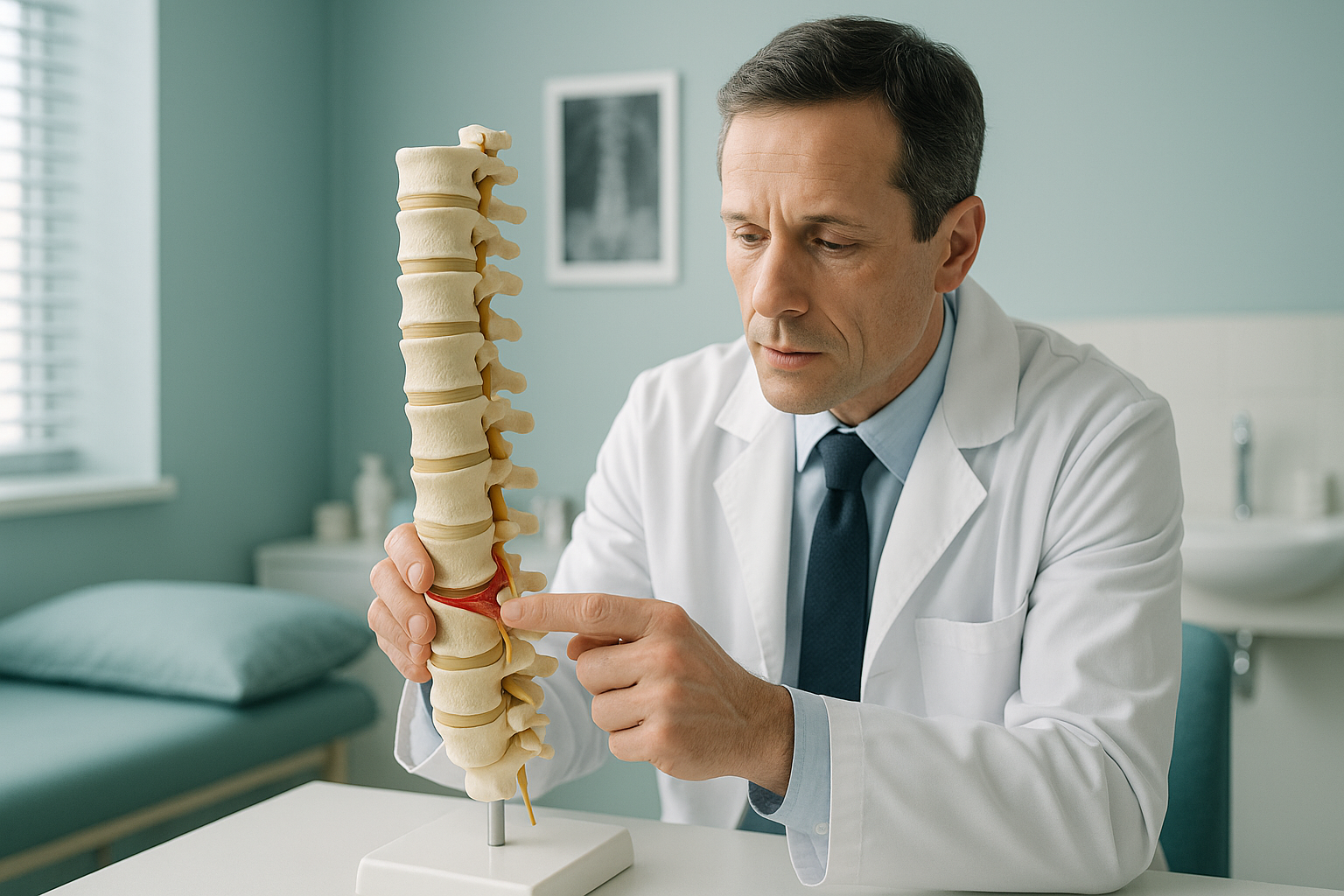
Nothing actually slips. A "slipped disc" means the soft centre of a spinal disc has pushed outward through a weak spot in its tough outer layer. The disc stays attached to the spine. When the bulging material presses on a nearby nerve, it can cause pain, tingling or weakness, most often in the lower back and leg.
Key takeaways
- The disc does not slip out of place. It bulges or ruptures while staying attached to the vertebra.
- Most slipped discs happen in the lower back (lumbar spine) and improve without surgery.
- Pain often appears away from the disc itself, travelling down the leg as sciatica.
- Standing imaging shows how spinal load and alignment change under your body weight, something lying-down scans can miss.
- Prolonged bed rest is usually unhelpful. Gentle, guided movement supports recovery.
What actually happens inside a slipped disc?
Each spinal disc sits between two vertebrae and acts as a shock absorber. It has a tough outer ring (the annulus) and a soft, gel-like centre (the nucleus). A slipped disc, also called a prolapsed disc or disc herniation, happens when that soft centre pushes through a tear in the outer ring.
The disc itself does not move out of position. It stays fixed between the bones. But the bulging material can press against the spinal nerves that run nearby. That nerve irritation is what causes pain, and it can radiate far from the disc itself, sometimes all the way down the leg.
Slipped discs are most common in the lumbar spine, the five vertebrae in your lower back. This area carries the most load when you stand, bend and lift.
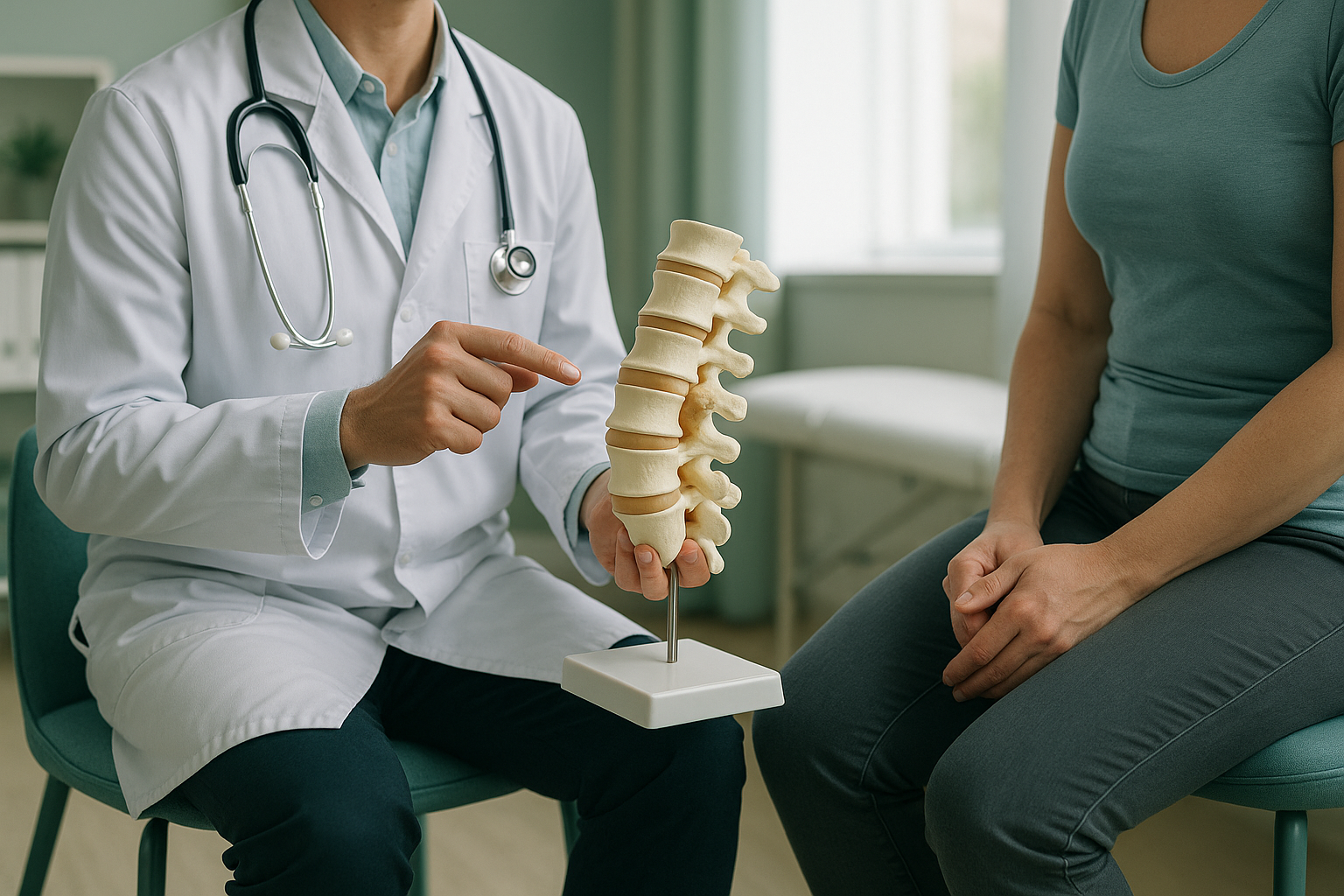
Over time, discs can also lose water content and become less flexible, a process called degenerative disc disease. This natural wear makes herniation more likely, but it does not mean damage is inevitable.
What are the symptoms of a slipped disc?
Symptoms depend on where the disc is and whether it presses on a nerve. Many disc bulges cause no symptoms at all. When they do, the most common signs include the following.
A deep ache or sharp pain across the lower back pain area, often worse when sitting or bending forward.
Shooting or burning pain from the buttock down the back of the leg, sometimes reaching the foot. This is a form of lumbar radiculopathy.
Pins and needles in the leg, foot, or toes on one side. This happens when the nerve signal is disrupted.
Difficulty lifting the foot, standing on tiptoe, or a feeling that the leg gives way when walking.
When to seek urgent help. If you develop sudden loss of bladder or bowel control, numbness around your groin or inner thighs, or rapidly worsening weakness in both legs, contact your GP, call 111 or go to A&E immediately. These are rare but serious signs that need same-day assessment.
What causes a slipped disc?
A slipped disc usually results from gradual wear rather than a single event. The outer ring weakens over years, and then a relatively small movement pushes the centre through. Common contributing factors include the following.
Discs lose water content and flexibility over time, making them more prone to tearing.
Frequent bending, twisting or heavy lifting puts repeated strain on the lower discs.
Sitting compresses lumbar discs more than standing. Long hours at a desk add sustained load.
Uneven posture or a pelvic tilt shifts extra load onto certain discs, accelerating wear on one side.
How long does a slipped disc take to recover?
Most people with a slipped disc see significant improvement within six to twelve weeks. The body gradually reabsorbs the protruding disc material, and the inflammation around the nerve settles. Timelines vary depending on the size and position of the herniation, overall health, and activity levels.
A common misconception is that bed rest speeds recovery. Current NHS guidance advises staying as active as pain allows. Prolonged rest can actually weaken the muscles that support the spine and slow healing.
Surgery is only considered when symptoms are severe, progressive, or have not responded to conservative care over several months. The vast majority of people recover without an operation.
How does standing imaging help with a slipped disc?
Standard imaging such as MRI or CT is done while you lie down. Lying flat relaxes the muscles and removes your body weight from the spine. This can make alignment problems and loading patterns invisible on the scan, even though they are present when you stand and move.
When you lie in an MRI or CT scanner, gravity no longer compresses your spine. Muscles relax. Disc bulges may reduce slightly. The scan shows anatomy but not how your spine behaves under real-world load. Alignment shifts, pelvic tilts, and uneven weight distribution are hidden.
A standing EOS scan captures your entire spine and pelvis while you bear weight, exactly as you do in daily life. It reveals how spinal curves change under load, where alignment is uneven, and whether the spine is compensating for a problem elsewhere. This full picture helps clinicians understand why a particular disc may be under extra stress.
ScanAlign standing EOS imaging uses about 90% less radiation than a standard X-ray, around ten times less. It captures the whole skeleton from head to feet in one standing image, so your clinician can see how the spine, pelvis and lower limbs relate to each other as a connected chain.
A note on MRI. EOS excels at showing bone alignment, joint positioning and spinal balance under load. For soft-tissue detail, such as the disc material itself, nerve compression or inflammation, MRI is usually the better tool. The two often complement each other well.
Wondering whether your back pain could be linked to how your whole spine is loaded? A standing alignment assessment can provide the bigger picture.
Book a free video consultationWhat helps a slipped disc get better?
Recovery focuses on reducing nerve irritation and restoring normal movement. ScanAlign is a diagnostic imaging clinic, so we do not provide treatment. However, the following approaches are widely recommended by clinicians.
- Staying active. Walking and gentle movement keep the supporting muscles engaged and promote blood flow to the area.
- Physiotherapy. A structured exercise programme can strengthen the core, improve flexibility and reduce the chance of recurrence.
- Pain management. Your GP or specialist may recommend medication to ease inflammation and nerve pain during recovery.
- Understanding the bigger picture. If the disc herniation is linked to broader alignment issues, such as a pelvic tilt or uneven spinal curves, addressing those factors can help reduce the load on the affected disc. A standing scan helps identify whether these contributing factors are present.
If you would like to book a standing spine scan, our team can talk you through what to expect during a free video consultation first.
Frequently asked questions about slipped discs
No. The disc stays attached to the vertebrae above and below it. The soft centre pushes through a tear in the outer ring, which is why the medical terms "prolapsed disc" or "disc herniation" are more accurate.
Yes, in most cases. The body gradually reabsorbs the protruding material and inflammation settles over weeks to months. Staying active and following physiotherapy guidance supports this natural process.
A slipped disc often causes pain that travels down one leg, along with numbness, tingling or weakness. However, many conditions cause back pain. Imaging and a clinical assessment are needed to confirm the diagnosis.
Prolonged bed rest is not recommended. It can weaken the muscles that support the spine and slow recovery. Current guidance advises staying as active as your pain allows.
Gentle walking, certain stretches and core stability exercises are often helpful. A physiotherapist can design a programme tailored to the location and severity of your disc problem. Avoid exercises that increase your pain.
A standard X-ray shows bones but not the disc tissue itself. MRI is the best tool for seeing the disc, the nerve and any soft-tissue involvement. A standing EOS scan adds alignment and loading information that standard X-rays and MRI do not capture.
Spinal alignment affects how load is distributed across each disc. If your pelvis is tilted or your curves are uneven, certain discs carry more stress. A standing whole-body image shows these patterns, which may help explain why a particular disc has been affected.
No. ScanAlign accepts self-referrals. You can book directly with a free video consultation to discuss your situation first.
Yes. EOS uses about 90% less radiation than a standard X-ray, around ten times less. It is one of the lowest-dose X-ray technologies available.
Pricing details are available on our FAQs and cost page. You can also discuss costs during your free video consultation before committing.
Want the bigger picture?
A standing whole-body scan shows how your spine is loaded under gravity. See whether alignment could be contributing to your disc problem.
Book a free video consultationWritten by Abbas Dhami (Specialist Diagnostic Radiographer)
Sources
- NHS. Slipped disc. nhs.uk. Available at: https://www.nhs.uk/conditions/slipped-disc/
- Brinjikji W, et al. Systematic literature review of imaging features of spinal degeneration in asymptomatic populations. AJNR Am J Neuroradiol. 2015;36(4):811-816.
- NICE. Low back pain and sciatica in over 16s: assessment and management (NG59). National Institute for Health and Care Excellence, 2016 (updated 2020).
This page is general information and not a diagnosis.
ScanAlign is the trading name of CoreMed Solutions Ltd and operates under The Harley Street Hospital's CQC licence.