
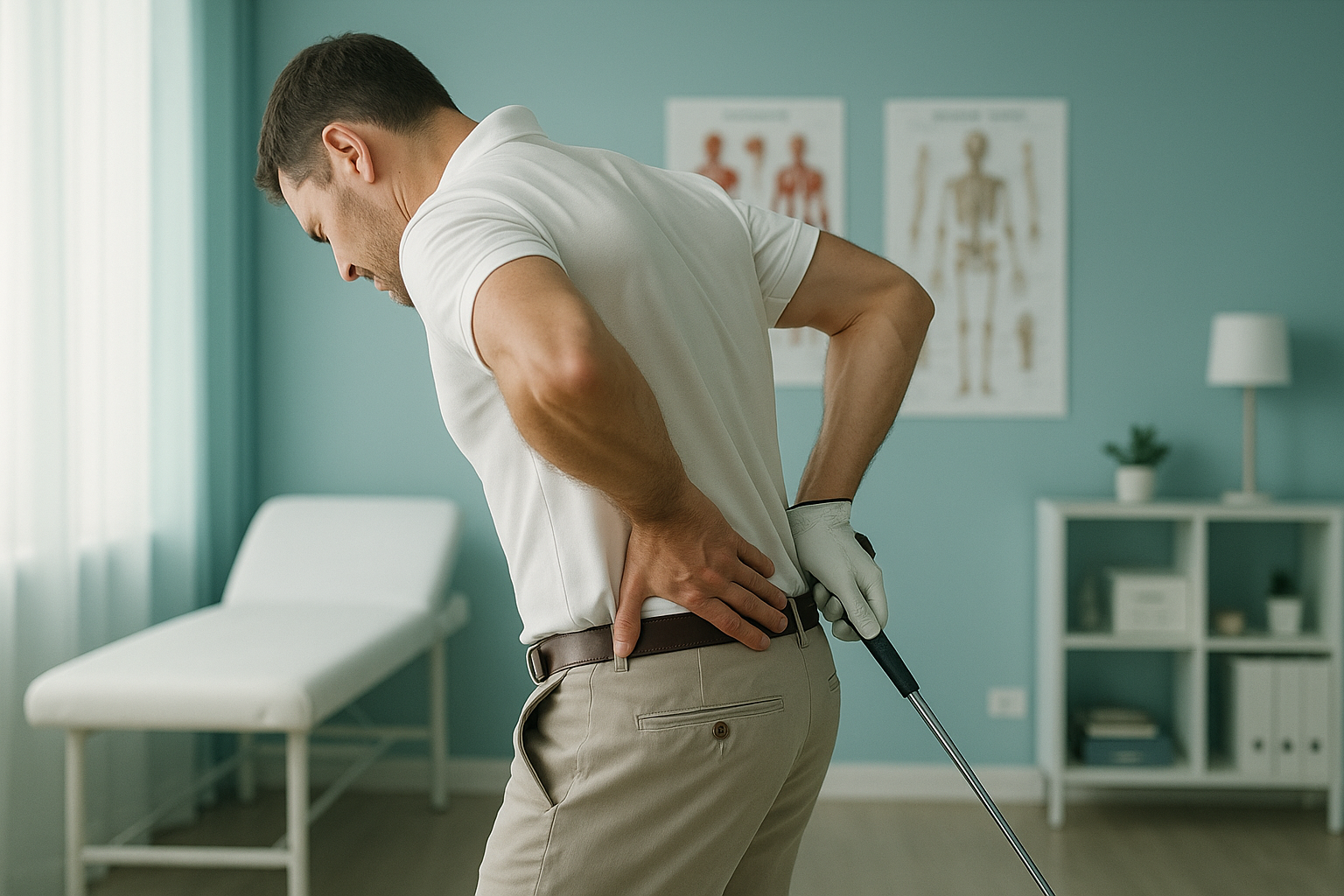
Why Do Golfers Get Lower Back Pain?
Golf back pain usually comes from the repeated twisting force of the swing. Your lower back absorbs most of the rotational load, especially if your hips or thoracic spine are stiff. Over time, this can overload the joints, discs and muscles on one side. A standing whole-body scan can reveal the alignment issues that lie-down imaging often misses.
Key takeaways
- The golf swing places a large asymmetric rotational force on the lumbar spine.
- Limited hip rotation or thoracic stiffness forces your lower back to compensate.
- Pain often appears away from the real cause because the body works as a connected chain.
- Standard lying-down imaging relaxes your muscles and can hide alignment problems that only show when you stand.
- A standing EOS scan captures your full skeleton under load, helping identify the root cause.
Why does the golf swing cause back pain?
The golf swing generates powerful rotational force that travels through your body in a fraction of a second. Your lower back sits at the junction between two large rotating masses, your pelvis below and your torso above. During the downswing, your pelvis rotates toward the target while your shoulders are still turned away. This separation, sometimes called X-factor stretch, creates intense compression and shear through the lumbar joints.

If your hips rotate freely, much of this force is absorbed before it reaches the lumbar spine. But if one or both hips are stiff, or your mid-back (thoracic spine) does not rotate well, your lower back has to make up the difference. That extra work, repeated over hundreds of swings per round and thousands per season, is where most golf back pain starts.
This is a chain problem. Your body is connected from your feet to your head, and restriction at one level forces another level to compensate. Pain often shows up in the lower back even when the real limitation is at the hip or mid-back.
What does golf-related back pain feel like?
Golf-related lower back pain can present in several ways, depending on which structures are being overloaded. These are the most common patterns.
Aching or tightness on one side of the lower back that comes on during or after play and eases with rest.
A sudden stabbing pain at the end of the swing, often on the trail side (right side for a right-handed golfer).
A feeling of being locked or stuck in a slightly bent position, especially after hitting a large bucket of balls.
Low-grade aching the morning after playing, worse when getting out of bed or bending to tie shoes.
Important. If you develop numbness, weakness in your legs, or any loss of bladder or bowel control, seek urgent medical attention. Contact your GP, call 111, or go to A&E. These symptoms need same-day assessment, not a scan booking.
What causes golf back pain beyond the swing itself?
The swing is the trigger, but underlying alignment and mobility issues decide who gets hurt and who does not. Several structural factors make golf back pain more likely.
Stiffness in one or both hips, especially the lead hip's internal rotation, forces the lumbar spine to twist further. Hip impingement (FAI) is a common contributor.
A rotated pelvis changes the starting position for every swing, overloading one side of the lower back consistently.
A stiff mid-back reduces the amount of rotation available above the lower back, so the lumbar spine compensates by twisting more.
Repeated extension and rotation compresses the small joints at the back of each vertebra, a pattern that can lead to facet joint arthropathy over time.
Volume matters too. A recreational golfer who plays three times a week and practises at the range may produce thousands of swings per month. Each swing loads the spine asymmetrically in the same direction. Without adequate mobility, conditioning and rest, the cumulative stress can exceed what the tissues can handle.
How does a standing scan help find the cause of golf back pain?
A standing whole-body EOS scan captures your full skeleton while you are upright and weight-bearing, exactly the position your body is in when you swing a club. This matters because lying-down imaging relaxes your muscles and removes the effects of gravity. A tilted pelvis, a subtle leg-length difference, or a stiff hip joint that shifts your alignment may look completely normal on a standard MRI or CT taken while you are flat on your back.
Weight-bearing, full-body view. The EOS system images you from head to foot in one low-dose capture. It shows exactly how your pelvis, spine, hips and legs align under real-world load. This means compensation patterns, tilts and rotations are visible on the image rather than hidden by a relaxed position.
The radiation dose is about 90% less than a standard X-ray, around ten times less.
Muscles relaxed, gravity removed. When you lie flat for a conventional X-ray, CT or MRI, your body can settle into a position that masks the very misalignment causing your symptoms. A disc bulge or nerve issue may still be visible, but alignment context is lost.
ScanAlign standing EOS imaging gives your clinician a full map of your alignment, so any treatment or rehabilitation can target the real source of the problem rather than just where the pain is.
When MRI is the better tool. EOS shows bones, joints and alignment. If your clinician suspects a disc herniation, nerve compression, or other soft-tissue injury, MRI is usually more appropriate. The two scans answer different questions and can work together.
What can golfers do about persistent back pain?
Improving hip and thoracic mobility is widely considered one of the most effective strategies for reducing the rotational demand on the lower back. Many golf-specific physiotherapy programmes focus on exactly this. A coach can also assess your swing mechanics for positions that increase lumbar load.
However, any exercise or swing adjustment works best when you know what you are starting with. If your pelvis is tilted, one leg is functionally longer than the other, or a hip joint does not rotate fully, a generic programme may not address the real issue. That is why accurate alignment data is valuable before starting or changing a rehab plan.
Not sure if an alignment scan is relevant to your case? A free video consultation lets you discuss your symptoms and history with our team before you commit to anything.
Book a free video consultationFrequently asked questions about golf and back pain
Mild muscle fatigue can happen after any sport, but ongoing or worsening pain is not something to dismiss as normal. It usually means something in the chain, your hips, pelvis or mid-back, is not moving as it should, and your lower back is picking up the extra load.
The golf swing combines rotation, side-bending and extension at high speed, all in one direction. Most other sports distribute load more symmetrically. This one-sided repetitive pattern is what makes the lumbar spine vulnerable in golfers.
Yes. If your lead hip cannot rotate inward enough during the downswing, the rotational force has to go somewhere. It is redirected into the lumbar spine. Hip impingement, arthritis, or simply long-standing tightness can all reduce hip rotation.
A pelvic tilt or rotation changes your starting alignment at address. It can mean one hip has less room to rotate, making the swing asymmetric from the outset and increasing load on one side of the lower back.
An EOS scan is a standing, weight-bearing X-ray that captures your full skeleton from head to foot in one image. For golfers, it reveals alignment issues, pelvic asymmetry, hip rotation limits and spinal curvatures that only show up when you are upright and loaded. The dose is about 90% less radiation than a standard X-ray, around ten times less.
No. ScanAlign is a private self-pay clinic. You can refer yourself directly. The process starts with a free video consultation.
You can find current pricing and what is included on the book an alignment scan page or during your free video consultation.
Yes. The EOS system uses about 90% less radiation than a standard X-ray, around ten times less. It is one of the lowest-dose skeletal imaging options available.
That depends on the severity and cause of your pain. ScanAlign is a diagnostic imaging clinic, not a treatment provider, so we cannot advise on activity modification. Your physiotherapist, osteopath or consultant can give you that guidance once they have accurate alignment data.
Understanding your body's alignment can inform mobility work and swing adjustments. ScanAlign provides the diagnostic imaging. Any performance benefits come from how you and your coaching or clinical team use the information.
Find out what your alignment is really doing
A free video consultation lets you discuss your symptoms and see whether a standing alignment scan could help. No obligation, no referral needed.
Book a free video consultationWritten by Abbas Dhami (Specialist Diagnostic Radiographer)
Sources
- McHardy, A., Pollard, H. and Luo, K. (2006). Golf injuries: a review of the literature. Sports Medicine, 36(2), 171-187.
- Lindsay, D. and Horton, J. (2002). Comparison of spine motion in elite golfers with and without low back pain. Journal of Sports Sciences, 20(8), 599-605.
- NHS. Low back pain. NHS.uk. Available at: https://www.nhs.uk/conditions/back-pain/ (Accessed 2024).
This page is general information and not a diagnosis.
ScanAlign is the trading name of CoreMed Solutions Ltd and operates under The Harley Street Hospital's CQC licence.