

How Does Manual Work Wear Down the Spine Over Time?
Years of heavy lifting, repetitive bending and vibrating tools place cumulative load on your spinal discs and joints. Over time this accelerates normal wear, leading to stiffness, disc narrowing and pain that often appears decades into a career. A standing whole-body scan can reveal alignment changes that lying-down imaging may miss.
Key takeaways
- Manual work back pain is usually the result of years of cumulative stress, not a single injury.
- Repetitive lifting, kneeling, crouching and vibrating tools all accelerate spinal wear.
- Pain often shows up in a different area from the real structural problem.
- A standing EOS scan shows how your spine bears load under gravity, something lying-down imaging cannot capture.
- Early imaging can help you plan ahead and stay in work longer.
What happens to the spine after years of manual work?
Your spine is designed to absorb load, but it has limits. Every time you lift a heavy object, bend at an awkward angle or absorb vibration from power tools, the discs between your vertebrae compress. In a desk job these forces are modest. In construction, plumbing, bricklaying or roofing they can be many times higher, repeated hundreds of times a day, year after year.
Over time the discs lose fluid and height. The small facet joints at the back of the spine take on more load than they were built for, and the cartilage wears thin. This is normal ageing, but manual trades speed it up. Research shows that construction workers develop spinal degeneration earlier and more severely than sedentary workers of the same age.
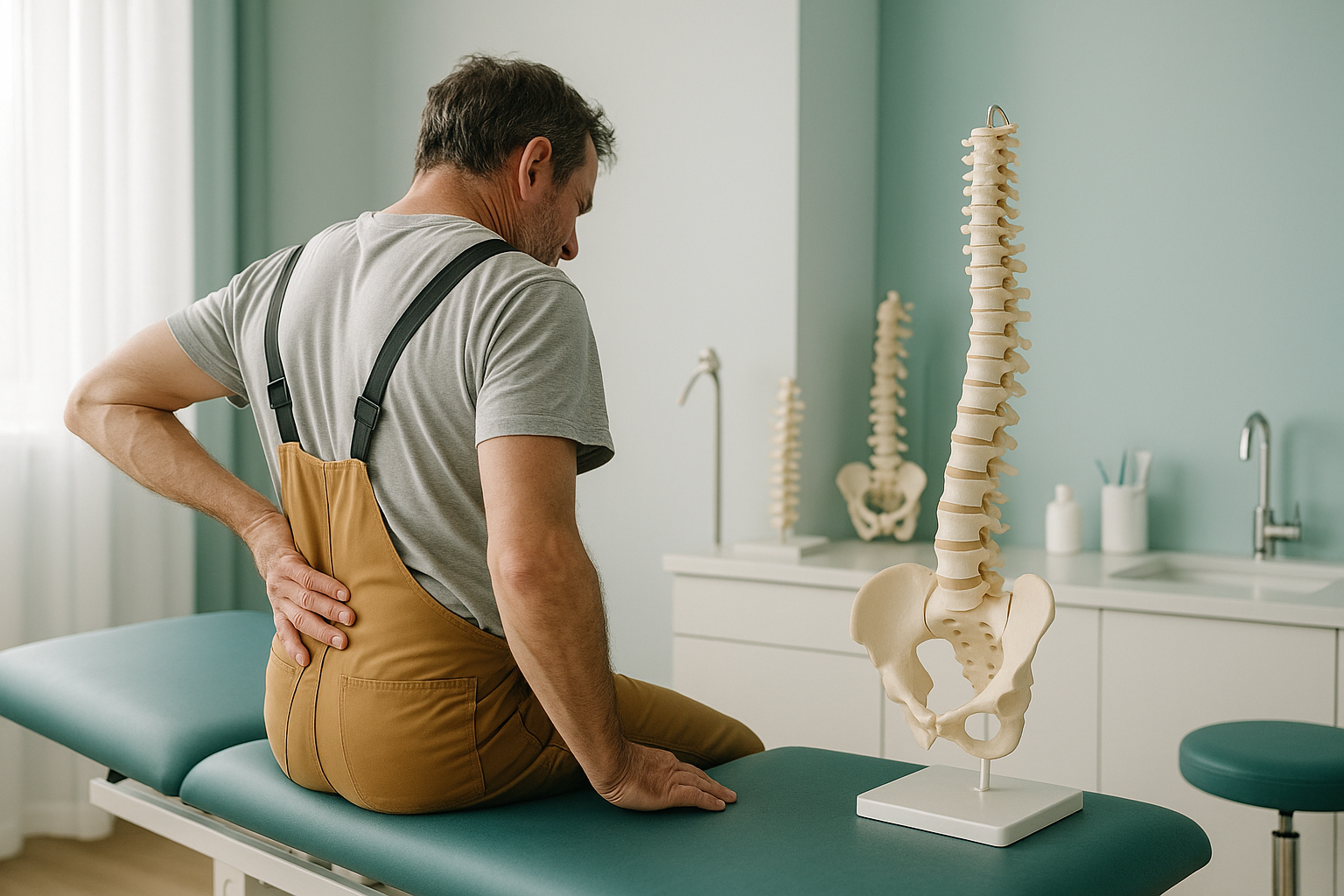
The medical terms for this wear include degenerative disc disease, spondylosis and facet joint arthropathy. They are not separate diseases. They are stages and patterns of the same gradual breakdown.
What are the warning signs of spinal wear from manual work?
The earliest sign is usually morning stiffness in the lower back that eases once you start moving. As wear progresses, you may notice pain that gets worse through the working day, especially after lifting or working overhead.
Your back feels locked up first thing and takes time to loosen.
Lifting, carrying or bending triggers or increases lower back pain.
You cannot twist, bend or reach as far as you used to.
Worn discs or narrowed joints can irritate nearby nerves, sending pain further down.
Seek urgent help if you develop sudden weakness in your legs, numbness in your groin or saddle area, or loss of bladder or bowel control. Contact your GP, call 111, or go to A&E straight away.
Why does heavy lifting cause back injury over time?
Heavy lifting is only one piece of the puzzle. Manual work back pain comes from a combination of forces that act on the spine day after day. Here are the main culprits.
Each lift compresses the discs. Repeated hundreds of times a day, the cumulative load outpaces the body's ability to recover overnight.
Kneeling, crouching under floorboards or working overhead shift load to parts of the spine not designed for sustained force.
Jackhammers, breakers and plate compactors transmit vibration through the arms and into the spine, accelerating disc and joint wear.
A 20 or 30-year career multiplies every risk factor. The spine simply runs out of reserve capacity.
Your body tries to compensate for the wear. A worn disc on one side may cause you to lean slightly, shifting load to your hips or knees without you realising. This is why many tradespeople develop pain in areas away from the original damage.
How is spinal wear assessed with a standing scan?
A standing whole-body EOS scan captures your skeleton from head to feet while you are upright, bearing your own weight. This is the position your spine works in every day on site. Standard X-rays, CT and MRI are taken lying down, which relaxes the muscles and allows the spine to settle into a position it never actually holds during work.
You stand naturally inside the EOS machine. The scan takes about 20 seconds and uses about 90% less radiation than a standard X-ray, around ten times less. The image shows how gravity, muscle tension and wear combine to affect your alignment in real life.
This is particularly useful for manual workers because your spine's compensations only show up under load. A disc that looks mildly narrowed lying down may cause noticeable tilting or shifting when you are upright.
Lying-down scans remove the effect of gravity. The spine decompresses slightly, gaps widen and tilts flatten out. The scan can still show structural damage, but it may understate how that damage actually affects you during a working day.
If you have had an MRI or X-ray that looked "mostly normal" yet you are still in significant pain, the missing piece may be what happens when you stand up.
ScanAlign standing EOS imaging captures this full picture in a single low-dose scan at 19 Harley Street, London. No GP referral is needed.
When MRI is the better choice: EOS shows bones, joints and alignment under load. For soft-tissue problems like disc bulges pressing on nerves, torn ligaments or inflammation, MRI is usually the better tool. Both types of imaging serve different purposes, and sometimes you benefit from both.
What can help if manual work has worn down your spine?
The first step is understanding exactly where and how far the wear has progressed. Without clear imaging, any plan is based on guesswork. Once you have an accurate picture of your spinal alignment and joint condition, you and your clinician can make informed decisions.
Common approaches recommended by specialists may include physiotherapy to strengthen the muscles that support the spine, adjustments to lifting technique, workplace modifications, or a referral for further treatment. ScanAlign does not provide treatment. It provides the detailed diagnostic imaging that helps other clinicians plan yours.
If you work in the trades and your back is getting worse, a standing scan can show what is really going on.
Book a free video consultationFrequently asked questions
Spinal wear happens to everyone, but manual work accelerates it significantly. Studies show construction workers develop degenerative changes earlier and more severely than people in sedentary jobs. So while some wear is normal, the rate and degree are not.
Yes. Whole-body vibration from equipment like jackhammers, plate compactors and even driving heavy vehicles over rough ground has been linked to faster disc degeneration and increased lower back pain. This is well documented in occupational health research.
During the day, your discs gradually lose fluid under sustained load and become thinner. This reduces their ability to cushion the vertebrae. By the end of a long shift the joints are closer together and the muscles are fatigued, which is why pain peaks late in the day.
No. ScanAlign is a private self-pay clinic. You can refer yourself. The process starts with a free video consultation so we can make sure the scan is appropriate for you.
An EOS scan uses about 90% less radiation than a standard X-ray, around ten times less. This makes it one of the lowest-dose skeletal imaging options available.
A standing EOS scan shows how your skeleton aligns under the force of gravity. Tilts, shifts and compensations that disappear when you lie down become visible. MRI is better for soft tissue. The two scans answer different questions.
A standard lying-down X-ray may not capture alignment problems that only appear under load. Your spine decompresses when you lie flat, which can mask narrowed discs and shifted vertebrae. A standing scan may reveal what the earlier image missed.
Pricing information is available on our book a standing spine scan page and through the free video consultation.
A detailed alignment assessment can identify problems before they become severe. This gives you and your clinician the chance to act early, whether that means targeted physiotherapy, ergonomic changes or monitoring over time, rather than waiting until the damage forces you to stop working.
Kneeling, crouching and working in confined spaces force the spine into sustained awkward positions. While the peak load may be lower than a heavy lift, the duration and repetition place significant cumulative stress on the discs and facet joints, particularly in the lower back.
Find out what is really going on with your spine
If years of manual work have taken their toll, a standing whole-body scan can show the full picture. Start with a free video consultation.
Book a free video consultationWritten by Abbas Dhami (Specialist Diagnostic Radiographer)
Sources
- Health and Safety Executive (HSE). Manual handling at work: A brief guide (INDG143). hse.gov.uk.
- Bovenzi M, Hulshof CTJ. An updated review of epidemiologic studies on the relationship between exposure to whole-body vibration and low back pain. International Archives of Occupational and Environmental Health. 1999;72(6):351-365.
- NHS. Back pain: Causes, treatment and prevention. nhs.uk.
This page is general information and not a diagnosis.
ScanAlign is the trading name of CoreMed Solutions Ltd and operates under The Harley Street Hospital's CQC licence.