
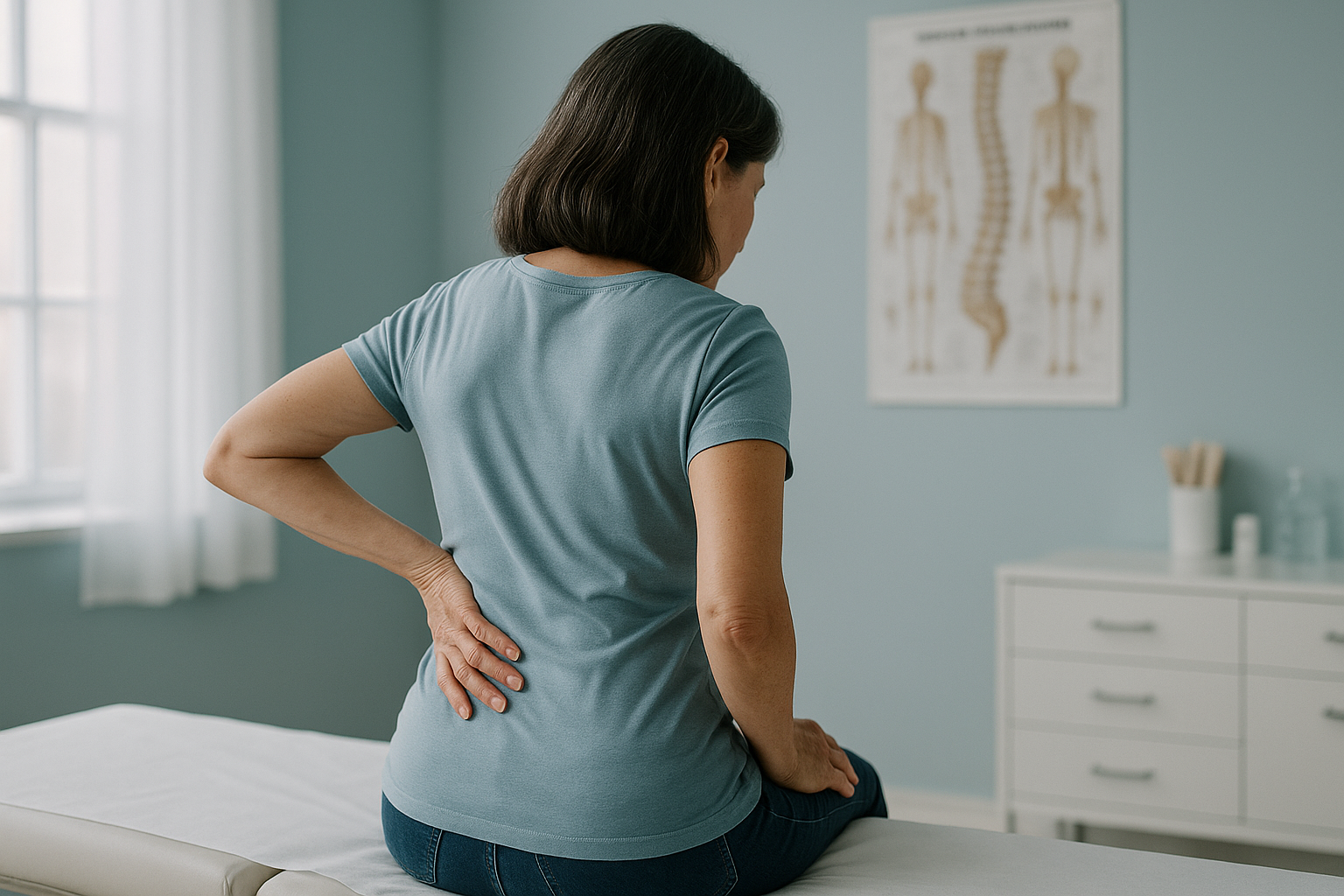
What Causes a Sore Middle Back, and How Do You Find Out?
A sore middle back usually comes from muscle strain, poor posture or stiffness in the thoracic vertebrae. Less commonly it is linked to joint wear, a wedge fracture or referred pain from the rib cage. Because the thoracic spine connects the neck above and the lower back below, a problem here often affects other areas too.
Key takeaways
- Middle back pain sits between the base of the neck and the bottom of the rib cage, covering the 12 thoracic vertebrae.
- Posture, desk work and muscle imbalance are among the most common triggers.
- Lying-down scans can miss alignment problems that only appear when you are upright and weight-bearing.
- An EOS standing scan captures the full spine in one low-dose image so clinicians can see how the thoracic curve relates to the rest of your body.
- If you have sudden numbness, weakness or loss of bladder or bowel control, seek urgent medical help (GP, 111 or A&E).
Your middle back, known clinically as the thoracic spine, runs from roughly the base of your neck down to the bottom of your rib cage. It is made up of 12 vertebrae, each connected to a pair of ribs. That rib-cage attachment makes this region more stable than the neck or lower back, but it also means stiffness here can radiate into the chest, shoulders and abdomen.
Middle back pain is common, yet it is often overlooked because most attention goes to the lower back or neck. Understanding what sits behind the ache is the first step toward sorting it out.
What are the most common mid back pain causes?
The most common mid back pain causes are muscular strain, prolonged poor posture and age-related joint stiffness. Beyond those everyday triggers, several structural and medical factors can also play a part.
Hours of sitting hunched over a screen shortens the front of the chest and overloads the mid-spine muscles.
Lifting, twisting or sudden movement can strain the muscles and soft tissues between the ribs and spine.
Spondylosis, or degenerative joint changes, gradually stiffens the thoracic vertebrae and can cause persistent aching.
An excessive forward rounding of the upper back. In younger adults this may be Scheuermann's kyphosis, where vertebrae develop a wedge shape during growth.
Osteoporosis can weaken thoracic vertebrae enough for a wedge fracture to occur, sometimes without obvious trauma.
Pain from the rib cage, the oesophagus or even the gallbladder can sometimes be felt in the mid back, especially on the right side.
Nerve irritation in the thoracic spine is less frequent than in the neck or lower back, but it does happen. If a nerve root is compressed you may feel a band of pain wrapping around the rib cage. You can read more about how nerve compression is assessed in our guide to radiculopathy explained.
What does middle back pain feel like?
Middle back pain usually presents as a dull, persistent ache between the shoulder blades or slightly lower. It can also feel sharp with certain movements. The pattern varies depending on the cause.
A broad, dull ache that builds throughout the working day and eases when you move around.
Middle back pain when breathing often points to rib joint irritation or muscle tightness around the thoracic cage.
Middle back pain on the right side (or left) can indicate a stiff rib joint or localised muscle tension on that side.
A band-like sensation around the chest wall, which may suggest a thoracic nerve is being irritated.
When to seek urgent help
If your mid back pain comes with numbness or weakness in the legs, loss of bladder or bowel control, or sudden severe symptoms, contact your GP, call 111 or go to A&E straight away. These are rare but need immediate attention.
How is thoracic spine pain assessed when you are standing up?
Thoracic spine pain is best assessed upright because standing loads the spine the way it is loaded in daily life. Lying down for a standard X-ray or MRI relaxes the muscles and can mask the postural problems that actually drive your pain.

Your body works as a connected chain. If the thoracic curve increases or stiffens, the neck and lower back must compensate. That means the source of your mid back pain may actually lie above or below, and a single-area image would miss the bigger picture.
An EOS scan at ScanAlign captures the full spine, from the base of the skull to the pelvis, in one standing image. It uses about 90% less radiation than a standard X-ray, around ten times less. Because you are upright, the image shows your natural spinal alignment under real-world conditions.
When MRI is the better choice: EOS shows bones, joints and overall alignment clearly. If your clinician suspects a disc problem, soft-tissue injury or nerve compression, MRI is usually the better tool for those details. The two scans complement each other well.
What helps with a sore middle back?
The right approach depends entirely on the cause. A clear diagnosis is the starting point, because treatment for muscle tightness is very different from treatment for a wedge fracture or kyphosis.
General guidance from physiotherapists and medical bodies commonly includes staying active, improving workstation setup, and strengthening the muscles that support the thoracic spine. A structured exercise programme can address the kind of muscle imbalance that often drives mid back stiffness.
If your pain has lasted more than a few weeks, keeps coming back, or does not respond to simple measures, getting a clear picture of your spinal alignment can help your clinician plan the next step. That is what a standing full-spine image is designed to provide.
Want to understand what is behind your middle back pain? A standing EOS scan shows your full spinal alignment in one low-dose image.
Book a free video consultationFrequently asked questions about middle back pain
Prolonged sitting, especially with a rounded posture, puts extra load on the thoracic spine and the muscles between the shoulder blades. Over time this leads to stiffness, fatigue and aching. Regular movement breaks and an upright sitting position can help.
One-sided mid back pain often comes from a stiff rib joint, localised muscle strain or a postural imbalance. In some cases, referred pain from organs such as the gallbladder can be felt in the right middle back. If this is new, persistent or worsening, see your GP.
The ribs attach to every thoracic vertebra, so inflammation or stiffness at a rib joint can cause pain with each breath. Muscle strain between the ribs is another common cause. If the pain is sudden, severe or accompanied by chest tightness, seek medical attention promptly.
Most middle back pain is caused by muscle tension or joint stiffness and resolves with time, movement and posture changes. Rarely, it can signal a vertebral fracture, infection or another condition that needs medical attention. Persistent or worsening pain should always be assessed by a healthcare professional.
Yes. A sustained slumped posture increases the thoracic curve, overstretches the back muscles and compresses the front of the vertebrae. Over months or years, this postural load can cause genuine structural changes and persistent pain.
Middle back pain sits in the thoracic region, roughly behind the rib cage. Lower back pain sits below the ribs in the lumbar spine. The two regions behave differently because the rib cage stabilises the thoracic area. However, stiffness in one region often affects the other, which is why full-spine assessment can be valuable.
No. ScanAlign accepts self-referrals. You can book a full spine assessment directly, starting with a free video consultation to check the scan is right for you.
The EOS system uses about 90% less radiation than a standard X-ray, around ten times less. That low dose makes it particularly suitable for full-body standing images.
EOS is designed to show bones, joints and overall alignment. For soft-tissue detail such as discs, ligaments or nerves, MRI is usually the better tool. Your clinician may recommend both if a full picture is needed.
ScanAlign is a private self-pay clinic. For current pricing details, please visit our FAQs and cost page.
Find out what is behind your middle back pain
A free video consultation lets us check whether a standing EOS scan is the right next step for you. No referral needed, no obligation.
Book a free video consultationWritten by Abbas Dhami (Specialist Diagnostic Radiographer)
Sources
- NHS. "Back pain." nhs.uk, 2023. Available at: nhs.uk/conditions/back-pain
- Briggs AM, Smith AJ, Straker LM, Bragge P. "Thoracic spine pain in the general population: prevalence, incidence and associated factors." BMC Musculoskeletal Disorders, 2009;10:77.
- Illés T, Somoskeöy S. "The EOS imaging system and its uses in daily orthopaedic practice." International Orthopaedics (SICOT), 2012;36(7):1405-1411.
This page is general information and not a diagnosis.
ScanAlign is the trading name of CoreMed Solutions Ltd and operates under The Harley Street Hospital's CQC licence.