
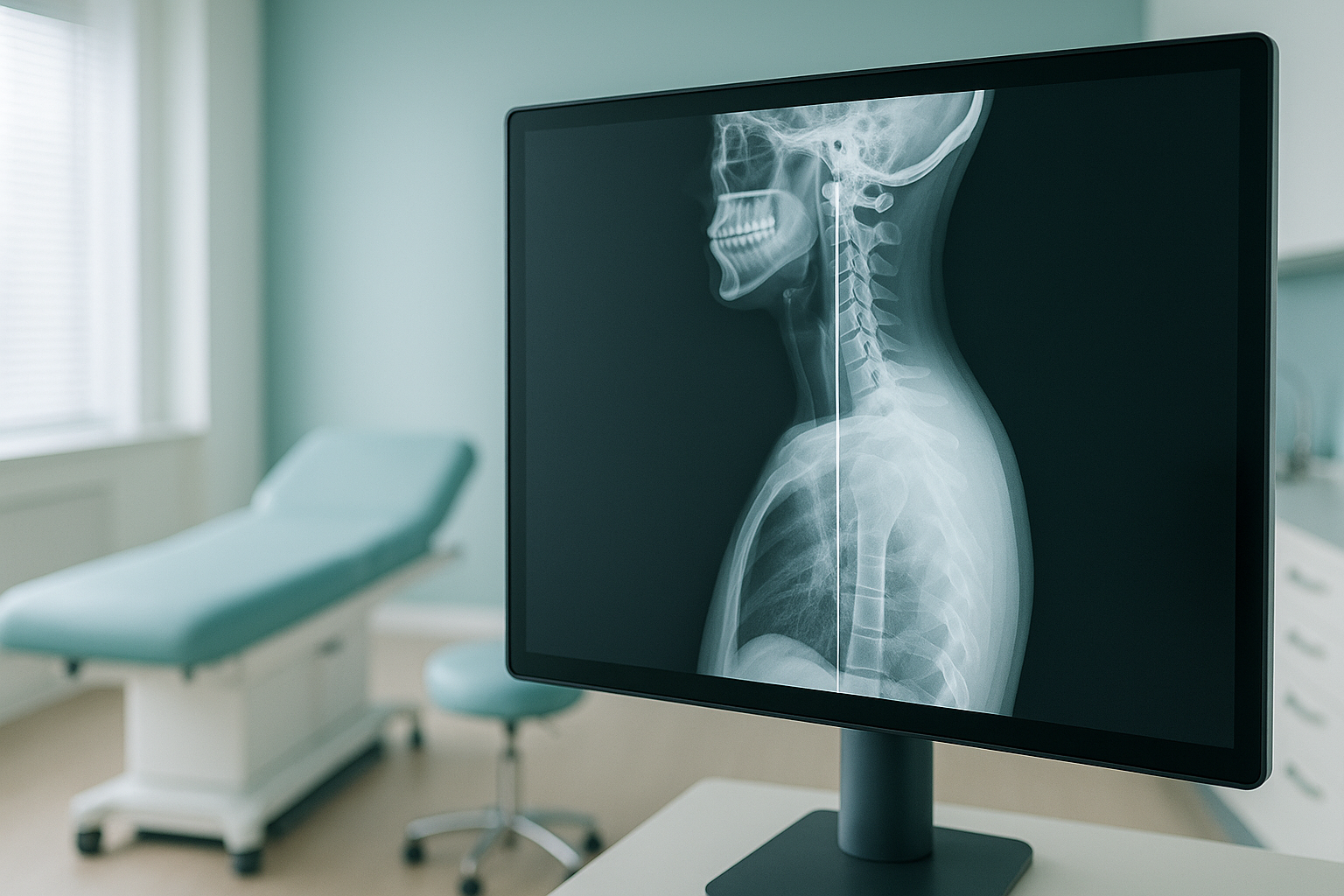
Sagittal Balance: How Your Spine Aligns Front-to-Back and Why It Matters
Sagittal balance describes how your spine lines up when viewed from the side while you are standing. A well-balanced spine keeps your head centred over your pelvis with minimal effort. When this balance shifts, your muscles work harder to hold you upright, often causing pain in places you would not expect.
Key Takeaways
- Sagittal balance is the front-to-back alignment of your spine, only truly visible when you are standing upright.
- When balance is lost, your body compensates by tilting the pelvis, bending the knees or rounding the shoulders.
- Lying-down scans relax gravity and can hide the very imbalance causing your symptoms.
- An EOS standing scan captures your full spine and pelvis in one image under natural weight-bearing.
- Understanding your sagittal balance helps your clinician plan the right approach to treatment.
What is sagittal balance of the spine?
Sagittal balance is the side-on relationship between your head, spine and pelvis when you stand. Your spine is not a straight pole. It has natural curves: a gentle inward curve in your neck (cervical lordosis), an outward curve in your upper back (thoracic kyphosis), and another inward curve in your lower back (lumbar lordosis). Together these curves stack your head neatly over your hips so your muscles can hold you upright without overworking.
Clinicians assess sagittal balance by looking at where a vertical line from the centre of your skull falls relative to the top of your sacrum (the triangular bone at the base of your spine). When that line drifts forward, you are in sagittal imbalance, and your body has to find ways to cope.

What does sagittal imbalance feel like?
Sagittal imbalance makes your body work harder to stay upright, and the symptoms often appear far from the actual cause. You might feel it as constant fatigue in your back, difficulty standing straight, or pain that worsens as the day goes on.
Feeling like you are falling forward when standing, especially later in the day.
Aching across your lower back that eases when you sit or lean on something.
Unconsciously bending your knees to bring your weight back over your feet.
Muscles in your hips or thighs aching from constantly compensating.
A note on urgent symptoms. If you experience sudden numbness, weakness in your legs, or any loss of bladder or bowel control, these may be signs of a serious condition. Please seek urgent medical attention through your GP, 111, or A&E rather than booking a scan.
What causes sagittal imbalance?
Sagittal imbalance happens when your spine's natural curves change enough that your head can no longer sit comfortably over your pelvis. Several things can trigger this shift.
Worn discs lose height, flattening the lumbar curve and tipping you forward.
Vertebral fractures, often linked to osteoporosis, can wedge the spine forward.
Over time, ligaments stiffen and muscles weaken, gradually shifting balance.
Spinal fusion can alter curves above or below the operated area.
Because the body is a connected chain from your feet to your head, a change at one level forces other areas to compensate. Your pelvis may tilt, your knees may bend, or your upper back may round further. This is why pain so often appears away from the root cause.
How is sagittal balance measured properly?
Sagittal balance can only be measured accurately when you are standing upright and bearing your own weight. This is the fundamental limitation of conventional lying-down imaging.
When you lie in a scanner for a standard X-ray, CT or MRI, gravity is removed. Your muscles relax, your curves flatten or shift, and your pelvis settles into a different position. The image may look relatively normal, even when standing balance is significantly impaired. This is one reason many people with persistent back, hip or knee problems are told their scans look "fine."
An EOS scan takes a full-length, weight-bearing image of your entire skeleton from head to feet in a single pass. You stand naturally inside the machine, and it captures your spine, pelvis, hips and legs exactly as they function in real life. Specialist software can then map the relationship between your curves and your pelvis, giving your clinician a clear picture of your overall sagittal balance.
EOS also uses about 90% less radiation than a standard X-ray, around ten times less. That makes it a practical option for follow-up imaging if your alignment needs to be tracked over time.
Want to understand your standing alignment? A full-body EOS scan at ScanAlign captures everything in one visit.
Book a free video consultationWhen MRI is the better choice. EOS shows bones, joints and alignment in excellent detail. For soft tissue, discs or nerves, MRI is usually the better tool. Your clinician can advise which scan, or combination, you need.
What can be done about sagittal imbalance?
The right approach depends entirely on how much imbalance there is and what is causing it. ScanAlign is a diagnostic imaging clinic, so we do not provide treatment. What we do is give you and your clinician the detailed standing alignment data needed to make informed decisions.
Broadly, management of sagittal imbalance may include physiotherapy to strengthen the muscles supporting your spine, adjustments to posture habits, or, in more advanced cases, surgical planning that takes your full alignment into account. Without an accurate picture of your standing balance, any plan is based on incomplete information.
If you have had previous spine imaging that did not explain your symptoms, a standing assessment can sometimes reveal the missing piece. This is especially true for people who feel worse when upright but whose lying-down scans appear normal.
Frequently asked questions about sagittal balance
Sagittal balance is how well your spine lines up from front to back when you are standing. Good balance means your head sits naturally above your pelvis. Poor balance means your body has to work harder to keep you upright.
Common symptoms include a feeling of leaning forward, lower back fatigue that worsens through the day, bent knees when standing, and aching in the hips or thighs. Some people also notice difficulty looking straight ahead without tipping their chin up.
Yes. When your spine tips forward, your pelvis, hips and knees all adjust to compensate. This extra strain can cause pain in those joints, even though the root problem is in your spinal alignment. A full standing scan can show whether this chain of compensation is at play.
A standard X-ray typically images only one area of your body, not the full chain. It also may be taken lying down or only partially weight-bearing. A full-length standing image is needed to measure how your head, spine and pelvis relate to each other under gravity.
An EOS scan is a standing, full-body X-ray that captures your entire skeleton in one pass. It uses about 90% less radiation than a standard X-ray, around ten times less. Because you stand naturally, it shows your true alignment and lets clinicians assess your sagittal balance accurately. Learn more on the EOS scan overview page.
No. ScanAlign is a private, self-pay clinic. You can book directly without a GP referral. We offer a free video consultation first so a specialist radiographer can check an EOS scan is right for you.
Yes. EOS uses about 90% less radiation than a standard X-ray. The scan takes only a few seconds to complete and you remain fully clothed. You can read more about safety and what to expect.
Pricing details are available on our FAQs and cost page. You will also discuss costs during your free video consultation before committing to anything.
In many cases, targeted physiotherapy and postural strategies can help manage mild to moderate imbalance. The key is accurate diagnosis first. ScanAlign provides the imaging; your treating clinician then recommends the most appropriate path.
Sagittal balance is about front-to-back alignment. Scoliosis is a side-to-side curve. You can have one without the other, or both together. An EOS scan captures your full alignment in every plane, so both can be assessed at the same time.
See your alignment as it really is
A free video consultation with a specialist radiographer will help you understand whether a standing EOS scan is the right next step.
Book a free video consultationSources
- Glassman SD, Bridwell K, Dimar JR, Horton W, Berven S, Schwab F. The impact of positive sagittal balance in adult spinal deformity. Spine. 2005;30(18):2024-2029.
- Schwab F, Patel A, Ungar B, Farcy JP, Lafage V. Adult spinal deformity – postoperative standing imbalance: how much can you tolerate? An overview of key parameters in assessing alignment and planning corrective surgery. Spine. 2010;35(25):2224-2231.
- NHS. Back pain – causes, treatment and prevention. nhs.uk/conditions/back-pain.
Written by Abbas Dhami (Specialist Diagnostic Radiographer)
This page is general information and not a diagnosis.
ScanAlign is the trading name of CoreMed Solutions Ltd and operates under The Harley Street Hospital's CQC licence.