
Spinal Fusion: What Happens During Surgery, and What Is Recovery Really Like?
Spinal fusion permanently joins two or more vertebrae so they heal into a single solid bone. The surgeon uses screws, rods and sometimes a bone graft or cage to hold the vertebrae while they fuse. Recovery typically takes several months, with gradual return to daily activities. You will lose some range of movement at the fused levels.
Key takeaways
- Spinal fusion locks vertebrae together to stop painful movement at a damaged segment.
- The procedure carries real risks, including infection, nerve injury and adjacent segment disease.
- Recovery can take three to twelve months before you feel the full benefit.
- Standing, weight-bearing imaging before and after surgery helps your surgeon assess your overall spinal alignment, not just the fused area.
- EOS imaging uses about 90% less radiation than a standard X-ray, around ten times less.
What is spinal fusion and why is it done?
Spinal fusion is an operation that permanently joins two or more vertebrae in your spine. The goal is to stop movement at a painful or unstable segment. Your surgeon may recommend it when non-surgical treatments, such as physiotherapy, injections or medication, have not provided enough relief.
Common reasons for lumbar fusion surgery include severe disc degeneration, a vertebra that has slipped forward or backward (spondylolisthesis or retrolisthesis), spinal fractures, or instability after a laminectomy.
The fused vertebrae eventually grow together into one piece of bone. This eliminates movement, and therefore friction and pain, at that level. However, it also removes some flexibility from your spine, which is why the decision to proceed is always weighed carefully.
What actually happens during spinal fusion surgery?
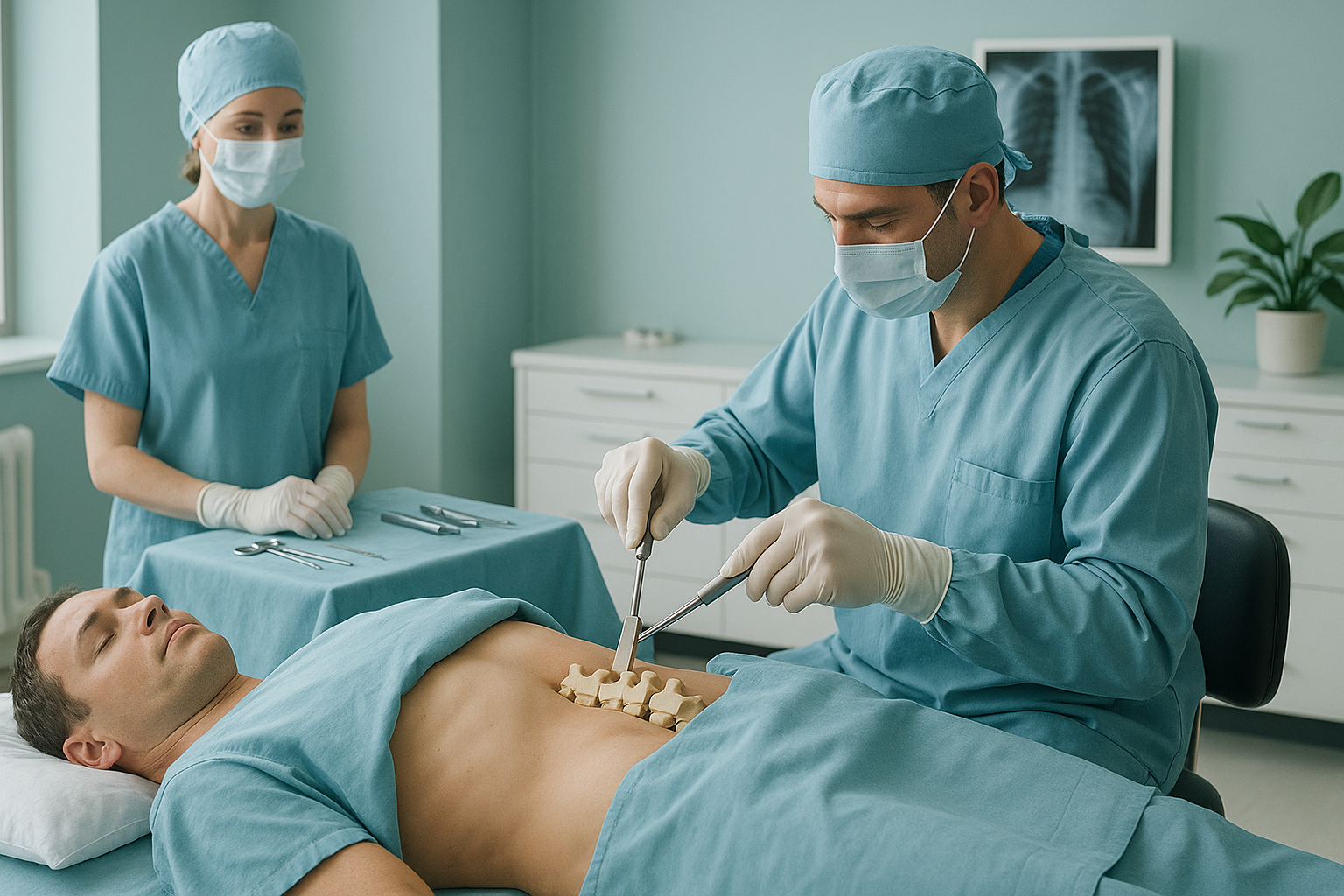
The surgeon accesses the spine from the back (posterior), the front (anterior) or sometimes both, depending on which levels need fusing and the specific problem being treated. The damaged disc material is usually removed. Then an interbody cage, a small spacer filled with bone graft material, is placed in the disc space. Pedicle screws are inserted into the vertebrae above and below, and rods connect the screws to hold everything rigid.
The bone graft can come from your own body, a donor, or a synthetic substitute. Over several months, new bone grows through and around the graft until the vertebrae fuse into one piece.
A single-level fusion typically takes two to four hours under general anaesthetic. Multi-level fusions take longer and carry higher risk, which is why surgeons try to fuse only the levels that truly need it.
What are the risks of spinal fusion?
All surgery carries risk. Spinal fusion has specific risks you should understand before consenting. These include infection, blood clots, nerve damage, and the possibility that the bones do not fuse properly (non-union). Your surgeon will discuss your individual risk profile.
Because the fused levels no longer move, the discs and joints above and below must work harder. Over time this extra stress can cause new problems at neighbouring segments.
Every fused level removes flexibility. With a single-level fusion this is often barely noticeable. Multi-level fusions can reduce bending and twisting more significantly.
If the fusion does not preserve the spine's natural curves, you can end up leaning forward when standing. This is known as flatback syndrome and may require further surgery.
Screws can loosen, rods can shift, and cages can migrate. This sometimes needs revision surgery. Good bone quality and correct alignment reduce this risk.
Important. If you develop sudden leg weakness, numbness spreading to both legs, or loss of bladder or bowel control after spinal surgery, seek urgent medical attention. Contact your surgical team, call 111, or go to A&E.
What is spinal fusion recovery really like?
Spinal fusion recovery is gradual. Most people spend one to four days in hospital, then recover at home for several weeks before returning to light activities. Full recovery, meaning the bone has solidly fused, typically takes anywhere from three to twelve months.
The typical recovery timeline
You will be resting at home, managing pain with prescribed medication. Walking short distances is encouraged. Bending, lifting and twisting are restricted.
Gentle walking increases. You may begin guided physiotherapy. Most people can manage light daily tasks but are not yet ready to drive or work.
Many people return to desk-based work. Physiotherapy focuses on core strengthening. Your surgeon will check imaging to see how the fusion is progressing.
Bone continues to fuse and strengthen. More active work and exercise can gradually resume. Some stiffness or discomfort may persist but should improve steadily.
Life after spinal fusion varies. Some people feel dramatically better once the pain source is stabilised. Others find the loss of flexibility takes adjustment. Realistic expectations, guided rehabilitation and thorough pre-operative planning all improve outcomes.
Considering surgery or already had it? A standing spine scan can show your surgeon how your whole spinal alignment looks under your own body weight, which matters for planning and follow-up.
Book a free video consultationWhy does standing imaging matter before and after spinal fusion?
Standing imaging matters because your spine behaves differently when you are upright and weight-bearing compared to lying down. A conventional X-ray, CT or MRI is taken while you are lying flat. In that position, your muscles relax, your curves change, and gravity is no longer loading your joints. The image can look reassuringly normal, even when you have significant alignment problems when standing.
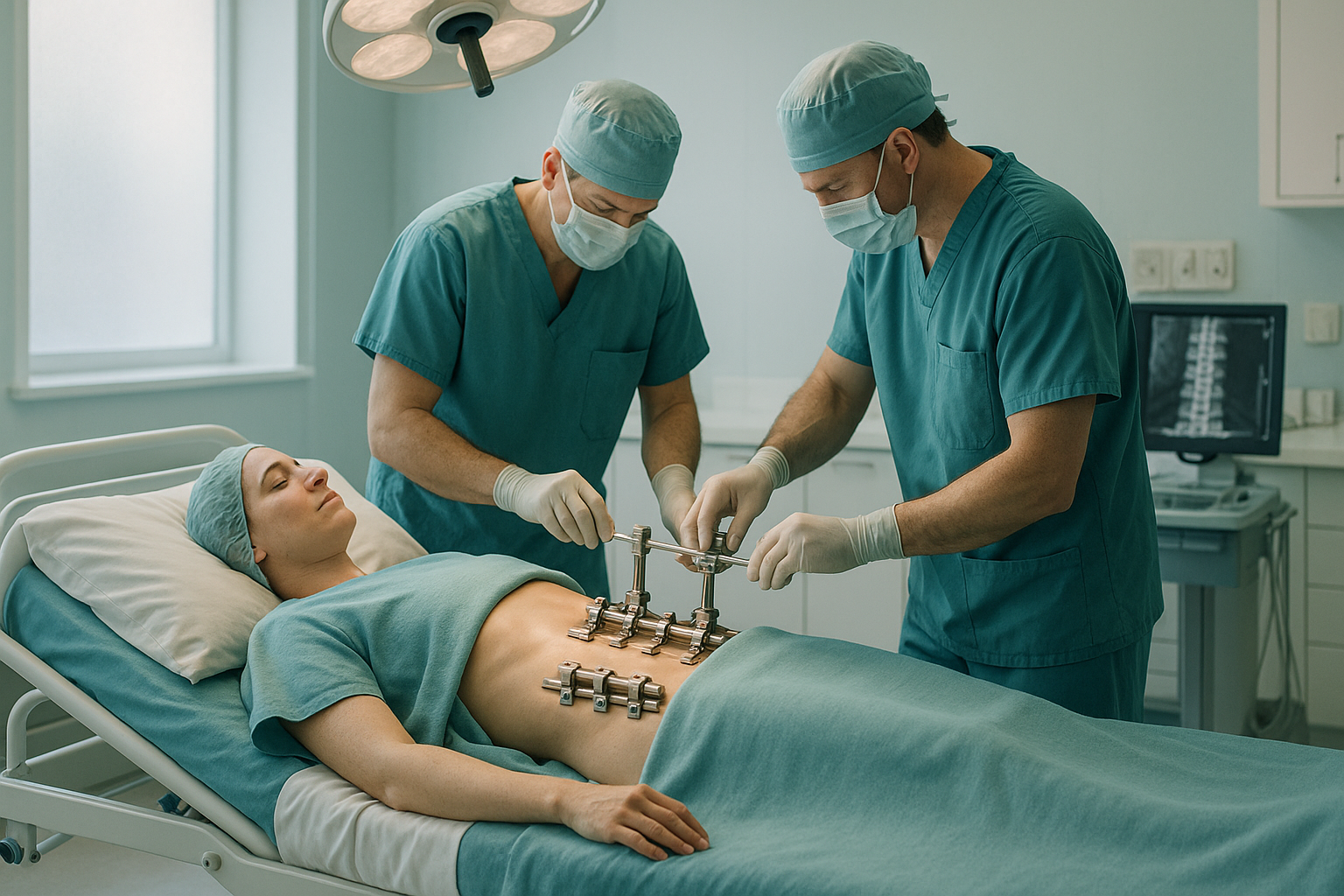
This is especially important for spinal fusion. Your surgeon needs to understand your sagittal balance, the front-to-back alignment of your entire spine when upright. If the fusion is planned at the wrong angle or without accounting for your overall balance, you could end up leaning forward, developing flatback syndrome, or putting excessive stress on the segments above and below the fusion.
ScanAlign standing imaging uses EOS technology to capture your full spine and lower limbs in a single standing image, with about 90% less radiation than a standard X-ray, around ten times less. This gives your surgical team a complete picture of how your body is aligned under real-world conditions.
When MRI is the better choice. EOS excels at showing bones, joints and whole-body alignment. For soft tissue detail, such as disc bulges, nerve compression or spinal cord problems, MRI is usually the better tool. Many people benefit from both.
Who benefits from standing imaging around spinal fusion?
A standing whole-body scan is most useful at two key moments: before surgery, when your surgeon is planning the fusion levels and angles, and after surgery, when checking that the fusion is holding proper alignment under gravity.
- Are being considered for spinal fusion and want a clear alignment baseline
- Have had fusion surgery and still feel off-balance or in pain
- Need follow-up imaging with lower radiation exposure
- Want your surgeon to see your full sagittal profile standing up
- You need soft-tissue detail (MRI is usually better for this)
- You need an emergency scan for trauma or sudden severe symptoms
- You cannot stand still for the short scanning time
Frequently asked questions about spinal fusion
A single-level fusion typically takes two to four hours. Multi-level or more complex fusions may take longer. Your surgeon will give you a more accurate estimate based on your specific case.
There is post-operative pain, which is managed with medication in hospital and at home. This surgical pain typically improves over the first few weeks. The original back or leg pain that led to surgery often starts to ease once the fusion stabilises.
This depends on your job. People with desk-based roles may return around six to twelve weeks. Physically demanding jobs may need three to six months or more. Your surgeon and physiotherapist will guide you.
When vertebrae are fused, the segments above and below take on extra movement and stress. Over time this can cause new disc degeneration or instability at those neighbouring levels. It is one of the most discussed long-term risks of fusion.
You will lose some range of movement at the fused levels. With a single-level fusion, most people barely notice the difference. Multi-level fusions reduce flexibility more noticeably. Your remaining spinal segments and hips compensate for much of the lost movement.
Standing images show your spine under gravity, revealing your true alignment. Your surgeon needs to see this to plan the correct angle and position for the fusion. Without it, there is a greater risk of problems like flatback syndrome or poor sagittal balance after surgery.
EOS uses about 90% less radiation than a standard X-ray, around ten times less. This is especially helpful if you need multiple follow-up scans after surgery to check how the fusion is progressing.
No. You can self-refer. The process starts with a free video consultation where a specialist radiographer reviews your situation and confirms whether a standing scan is appropriate for you.
You can find current pricing information on the book a standing spine scan page or by starting a free video consultation.
They serve different purposes. EOS shows your overall bony alignment standing up. MRI shows soft tissue detail like discs and nerves. Most fusion patients benefit from both types of imaging, each answering a different clinical question.
Understand your alignment before or after fusion
A standing whole-body scan shows your surgeon exactly how your spine is aligned under gravity. No referral needed.
Book a free video consultationSources
- NHS. "Lumbar decompression surgery." nhs.uk. Accessed 2024.
- Glassman SD, et al. "The impact of positive sagittal balance in adult spinal deformity." Spine, 2005;30(18):2024-2029.
- Illés T, Somoskeöy S. "The EOS imaging system and its uses in daily orthopaedic practice." International Orthopaedics, 2012;36(7):1405-1411.
Written by Abbas Dhami (Specialist Diagnostic Radiographer)
This page is general information and not a diagnosis.
ScanAlign is the trading name of CoreMed Solutions Ltd and operates under The Harley Street Hospital's CQC licence.