
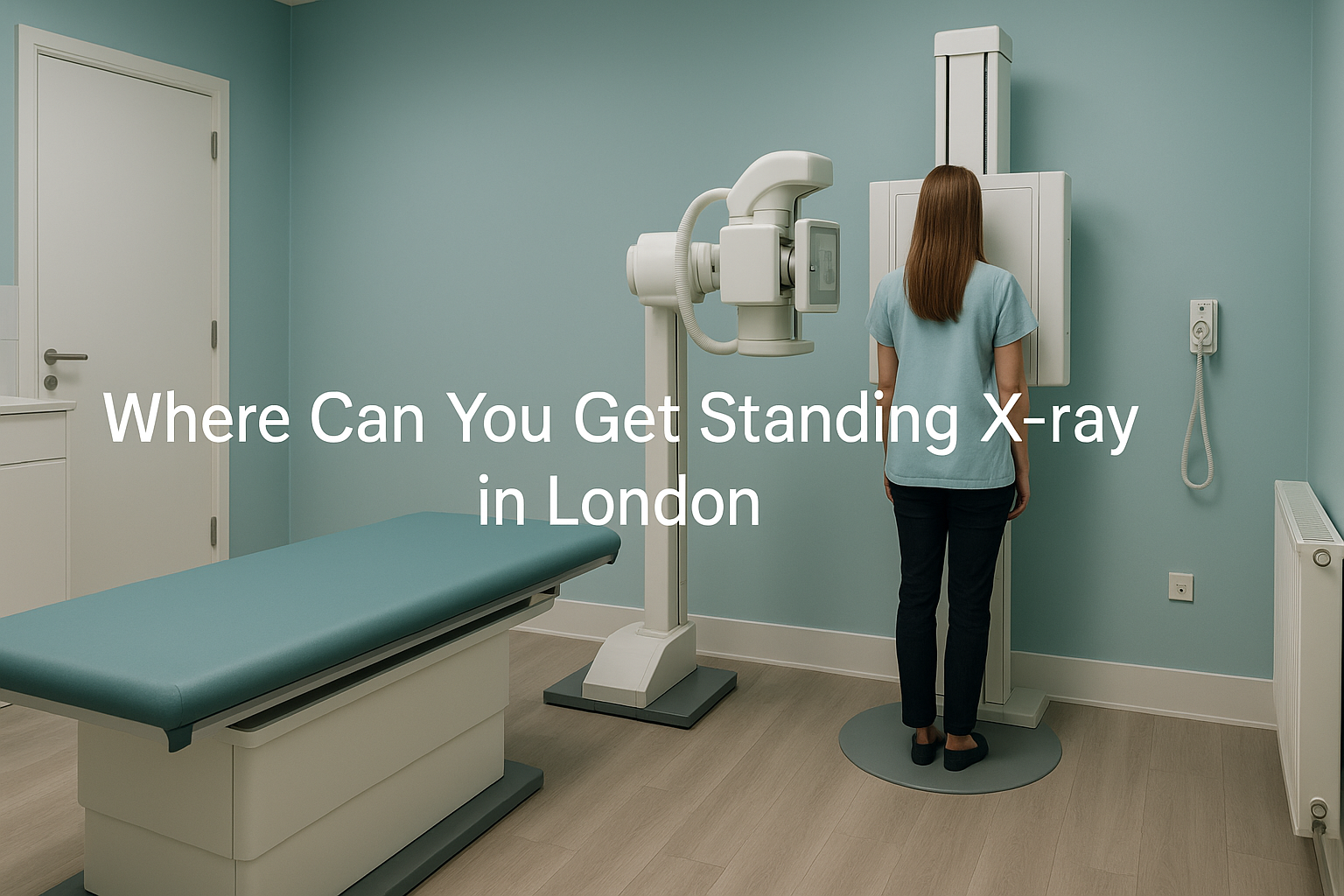
Where Can You Get a Standing X-ray in London?
You can get a standing x-ray in London at ScanAlign, standing EOS imaging in Harley Street. Based at 19 Harley Street, ScanAlign uses EOS technology to capture your full skeleton in a single upright pass. No referral is needed, and the scan shows how your bones and joints truly align under your own body weight.
Key takeaways
- ScanAlign offers standing whole-body EOS imaging at 19 Harley Street, London W1G 9QJ.
- Standing scans show your skeleton under gravity, revealing alignment issues that lying-down imaging can miss.
- EOS uses about 90% less radiation than a standard x-ray, around ten times less.
- You can self-refer. No GP letter is needed.
- A free video consultation helps decide whether a standing scan is right for you.
What is a standing x-ray and how does it work?
A standing weight-bearing x-ray is an image taken while you are upright, with your full body weight pressing through your joints. Unlike a conventional x-ray where you lie flat on a table, a standing scan captures your skeleton in the position it actually works in every day.
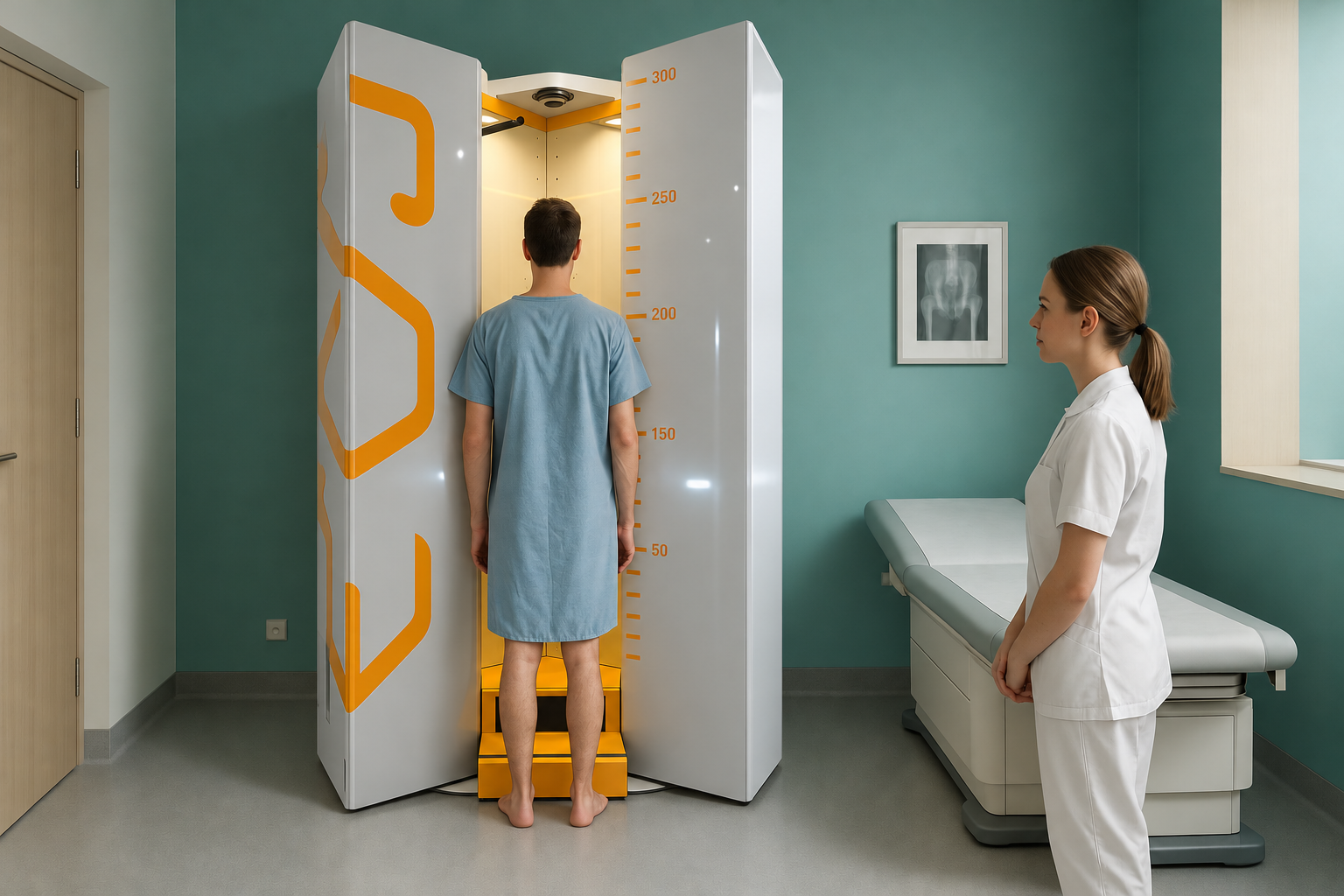
At ScanAlign, the technology used is called EOS. The EOS standing x-ray system scans your body from head to toe in a single pass, producing a full-length, non-magnified image. There is no stitching of separate images together, which means measurements are more reliable.
Because EOS uses about 90% less radiation than a standard x-ray, around ten times less, it is a particularly low-dose option. That matters when you need images of large areas like the full spine or both legs in one go.
Why does a standing x-ray show more than lying down?
When you lie flat for a conventional x-ray, CT or MRI, gravity is no longer pulling on your skeleton in the usual way. Your muscles relax, your spine decompresses, and joints settle into positions they rarely occupy in real life. The result is an image that can look normal even when there is a genuine alignment problem.
A standing scan changes this. Gravity acts on your body exactly as it does when you walk, stand and sit. A curve that flattens out on the table reappears. A leg-length difference that seems minor on a bed becomes obvious when you are bearing weight through it. Understanding the difference between weight-bearing versus lying imaging is key to understanding why your symptoms persist despite "normal" scan results.
What you see: True postural load through every joint. The spine curves as it normally does, the pelvis tilts under gravity, and the legs bear your full weight. Any asymmetry, shift or compensation is visible because the body cannot hide it.
Best for: Alignment assessment, surgical planning, tracking scoliosis or joint wear over time, and understanding why pain occurs in a different place from the structural problem.
What you see: A relaxed skeleton. Muscles switch off, discs expand slightly, and minor tilts or rotations may disappear. The image can look reassuringly normal.
Limitation: It may not reflect what happens when you stand up and move. That is why many people are told "everything looks fine" despite ongoing symptoms.
Your body works as a connected chain from your feet to your head. A subtle imbalance at the ankle can cause the knee to rotate, the hip to shift, and the lower back to compensate. Pain often appears far from its real cause. A full-body standing image captures the entire chain in one shot, so your clinician can trace the problem to its source.
Who should consider a standing x-ray in London?
A standing scan is most useful when you have a problem that has not been explained by conventional imaging, or when your clinician needs to see your skeleton under real-world loading. It is not the right tool for every situation.
- Long-standing back, hip or knee pain with "normal" scans
- Suspected leg-length difference or pelvic tilt
- Scoliosis monitoring in adults
- Pre-operative planning for spine, hip or knee surgery
- Assessing full-leg standing x-ray alignment before or after joint replacement
- Posture concerns that affect daily life
- Suspected disc bulge, nerve compression or soft-tissue injury (MRI is usually better)
- Acute fracture or trauma (go to A&E)
- Numbness, weakness or loss of bladder or bowel control (seek urgent medical help via your GP, 111 or A&E)
A note on MRI. EOS excels at showing bones, joints and alignment. For soft tissue, discs or nerves, MRI is usually the better tool. During your free video consultation, the clinical team will let you know if MRI might be more appropriate for your situation.
Not sure if a standing scan is right for you? The consultation is free, with no obligation. A specialist will review your history and advise honestly.
Book a free video consultationWhat happens when you visit ScanAlign at 19 Harley Street?
The process is straightforward. You do not need a GP referral or a letter from a consultant. You can book a standing scan directly.
A specialist reviews your history, symptoms and any previous imaging. You will know whether a standing scan is likely to help before committing to anything.
The clinic is in central London, a short walk from Oxford Circus and Regent's Park tube stations. There is no special preparation needed.
You stand inside the EOS booth. The scanner moves around you in one smooth pass. It takes only a few seconds. There is no tunnel and no loud noise.
A specialist radiographer analyses your images. The report covers alignment from head to toe, highlighting anything that may be contributing to your symptoms. You can share it with your own clinician, surgeon or physiotherapist.
Frequently asked questions about standing x-rays in London
ScanAlign offers standing EOS imaging at 19 Harley Street, London W1G 9QJ. Other London clinics also provide EOS or weight-bearing x-ray. ScanAlign specialises in full-body standing alignment assessment.
No. ScanAlign accepts self-referrals. You can book a free video consultation directly. If your GP or consultant has requested the scan, you are welcome to bring their referral letter, but it is not required.
ScanAlign is a self-pay clinic. For current pricing and what is included, please visit the FAQs and cost page.
Yes. The EOS system uses about 90% less radiation than a standard x-ray, around ten times less. This makes it one of the lowest-dose x-ray options available, especially for large-area imaging.
A standard x-ray is usually taken lying down or focused on one small area. A standing x-ray captures your skeleton under gravity and full body weight, showing real-world alignment. This reveals tilts, shifts and compensations that a lying-down image can miss.
They show different things. A standing x-ray is better at revealing alignment and loading patterns. MRI is better at showing soft tissue, discs and nerves. The two are complementary, not replacements for each other.
The EOS scan itself takes only a few seconds. Your overall appointment will be longer as it includes positioning and a brief review, but the radiation exposure is very short.
The clinic is in central London, between Oxford Circus (Central, Victoria, Bakerloo lines) and Regent's Park (Bakerloo line) tube stations. Both are a short walk away. Metered parking is available on surrounding streets.
Wear comfortable clothing without metal fastenings, zips or heavy buttons in the area being scanned. You may be asked to change into a gown for the best image quality.
Absolutely. Your report and images belong to you. Many patients share them with their surgeon, physiotherapist, osteopath or GP to guide treatment decisions.
Ready to see how your body really aligns?
Start with a free, no-obligation video consultation. A specialist will review your situation and let you know whether a standing scan can help.
Book a free video consultationSources
- Deschênes S et al. Diagnostic imaging of spinal deformities: reducing patients' radiation dose with a new slot-scanning X-ray imager. Spine, 2010;35(9):989-994.
- NHS. Back pain: causes, treatment and when to see a GP. nhs.uk, 2023.
- The Royal College of Radiologists. iRefer: Making the best use of clinical radiology. RCR guidelines on appropriate imaging referrals.
Written by Abbas Dhami (Specialist Diagnostic Radiographer).
This page is general information and not a diagnosis.
ScanAlign is the trading name of CoreMed Solutions Ltd and operates under The Harley Street Hospital's CQC licence.