
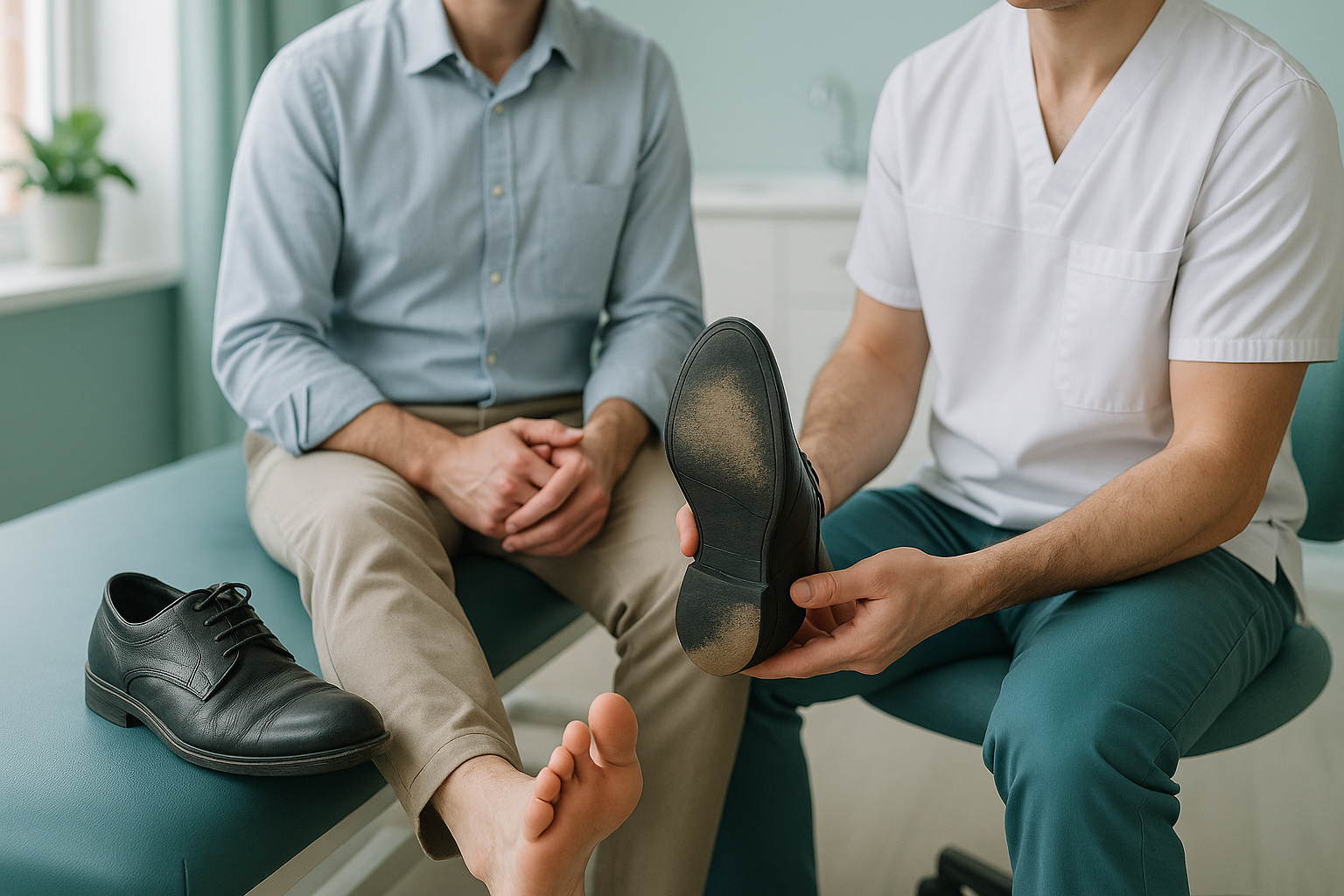
Why Do My Shoes Wear Down Unevenly on One Side?
Uneven shoe wear happens when your weight is not distributed evenly as you walk. The outsole wears faster wherever pressure is greatest. This is often caused by differences in how your feet, legs, hips or pelvis are aligned, rather than just the way you happen to walk. A standing whole-body scan can reveal the alignment issue behind the pattern.
Key takeaways
- Your shoe wear pattern is a map of how you load each foot during walking.
- Wear on the outside, inside, or just one shoe often points to a structural alignment issue higher up the body.
- Lying-down scans relax your muscles and can miss the alignment problems that cause uneven wear.
- An EOS standing scan captures your whole skeleton under real weight, from feet to head, in one image.
- No referral is needed to book a full-body standing scan at ScanAlign.
What do different shoe wear patterns mean?
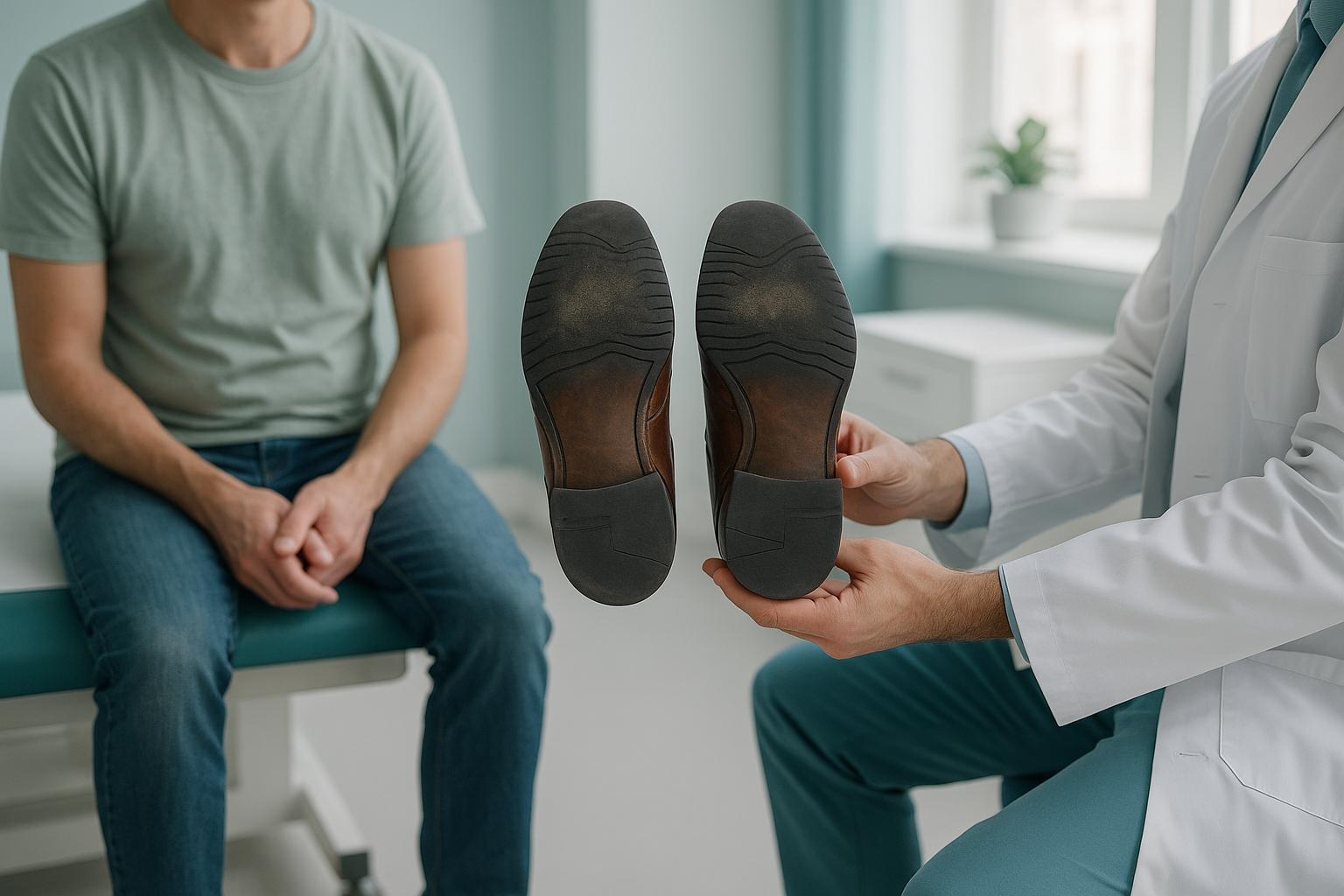
The area of your outsole that wears fastest tells you where the most pressure falls during your stride. There are three common patterns, and each points to a different loading issue.
The heel and outer sole wear faster. Your foot rolls outward as you walk, often linked to high arches or outward-turning lower legs.
The inner sole wears down first. Your foot rolls too far inward, sometimes connected to flat arches or inward knee rotation.
Asymmetric wear often signals a real structural difference between your two sides, such as a leg length discrepancy or a lateral pelvic tilt.
What causes uneven shoe wear?
The most common cause is a structural or postural imbalance somewhere along your body's weight-bearing chain. Your shoes simply reveal the end result of how forces travel from your pelvis, through your legs and into the ground.
When one side of the pelvis sits higher, your legs carry different loads, wearing your shoes unevenly.
Even a small true or functional difference in leg length shifts your gait and wears one shoe faster.
High arches tend to push weight outward. Flat arches tend to roll it inward. Both create distinct wear marks.
Rotational differences at the knee or hip alter your heel strike angle and outsole contact pattern.
Other contributing factors include muscle imbalances, old injuries, and habits like always carrying a bag on one shoulder. But the common thread is asymmetry: your two sides are not sharing the load equally.
Why does a problem in my hip or pelvis show up in my shoes?
Your body is a connected chain from your head to your feet. When one link is out of position, the links above and below it compensate. A tilted pelvis, for example, changes how much weight goes through each leg. Your knee may rotate slightly to absorb the difference, and your ankle adjusts its roll angle at heel strike. Over hundreds of thousands of steps, those tiny adjustments grind the outsole unevenly.
This is why looking at the foot alone rarely gives you the full story. Your shoe wear pattern is a clue, but the cause may sit much higher up. Understanding this chain is central to gait analysis and to making sense of postural sway, the subtle shifts your body makes to stay balanced.
Your outsoles tell a story. A standing whole-body image can reveal where that story starts.
Book a free video consultationWhen should I be concerned about my shoe wear pattern?
Some degree of wear is normal. Most people are not perfectly symmetrical. But certain patterns suggest it is worth investigating further.
- One shoe wears much faster than the other, and you replace that side noticeably sooner.
- You also have pain in your feet, knees, hips or lower back that has not responded to standard treatment.
- The wear is getting worse with each new pair of shoes.
- You notice your walking feels uneven, or others have pointed out that you lean or limp slightly.
- You have had a previous injury or surgery and your gait has never felt right since.
If you also experience sudden weakness, numbness, or loss of bladder or bowel control, please seek urgent medical attention from your GP, 111 or A&E. These symptoms need immediate assessment, not a scan appointment.
How can a standing scan show what causes uneven shoe wear?
Standard imaging, such as an X-ray, CT or MRI, is usually done lying down. When you lie flat, gravity no longer loads your joints. Your muscles relax, your pelvis levels out, and many alignment differences simply disappear. The result can look normal even when your standing posture is clearly not.
ScanAlign standing EOS imaging captures your entire skeleton from head to feet while you stand naturally. Because your full body weight is going through your joints, the image shows the real alignment your shoes are reacting to. Leg length differences, pelvic tilts, knee rotation, ankle angles: all of them become visible in a single exposure, with about 90% less radiation than a standard X-ray, around ten times less.
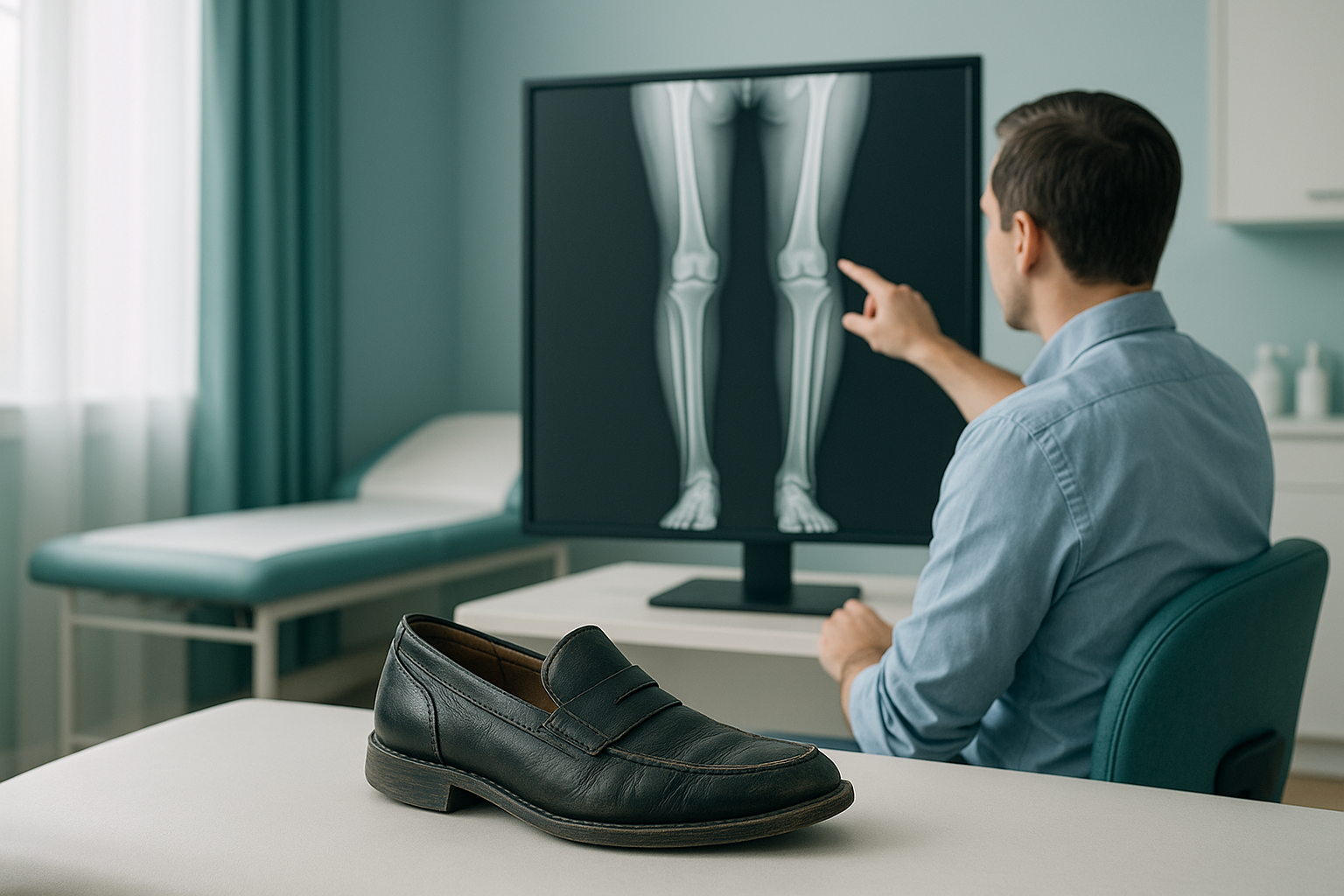
When is MRI the better choice? EOS excels at showing bones, joints and whole-body alignment. If your clinician suspects a soft-tissue injury, disc problem or nerve compression, MRI is usually the more useful tool. The two scans answer different questions and often work well together.
What can I do about uneven shoe wear?
The first step is understanding what is causing it. Without that, solutions like insoles or different trainers are educated guesses. Here is a practical approach.
- Check your shoes. Compare the heel and outsole of a well-worn pair. Note which areas are most worn, and whether it is the same on both sides.
- Consider a standing alignment assessment. A full-body standing image shows how your skeleton is aligned under load, from your pelvis through your knees and ankles. This turns a hunch into a clear picture.
- Share the findings with your clinician. Whether that is your GP, physiotherapist, podiatrist or orthopaedic consultant, precise alignment data helps them plan the right intervention, whether that is targeted exercise, orthotics, or further investigation.
ScanAlign is a diagnostic imaging clinic. We do not provide treatment, but we give you and your clinician the detailed alignment information that makes treatment more targeted.
Frequently asked questions
Outer-edge shoe wear, sometimes called a supination pattern, means your weight is rolling toward the outside of your foot during each step. This is commonly linked to high arches, outward rotation of the lower leg, or a structural difference higher up the chain such as a pelvic tilt.
A small difference is common. Nobody is perfectly symmetrical. But if one shoe wears down noticeably faster, especially over several pairs, it often points to a real structural asymmetry such as a leg length difference or a pelvic shift.
Uneven shoe wear is usually a symptom, not a cause. The same alignment issue that wears your shoes unevenly can also overload your knees, hips or lower back. The wear pattern and the pain share a common root.
Insoles can help redistribute pressure, but they work best when they are prescribed based on a clear understanding of your alignment. Without knowing the underlying cause, insoles may compensate in the wrong place.
An EOS scan captures your whole skeleton from head to feet in a single standing image. Because you are upright and weight-bearing, the scan shows how your joints actually line up under real-world conditions, with about 90% less radiation than a standard X-ray, around ten times less.
Lying-down imaging relaxes your muscles and removes gravity from the equation. Alignment differences that affect your gait can flatten out and look normal. A standing scan captures the posture and loading pattern your shoes actually respond to.
No. ScanAlign is a private self-pay clinic. You can self-refer without a GP letter. You start with a free video consultation, where a specialist radiographer reviews your concerns and confirms whether the scan is appropriate for you.
Pricing details are available on our FAQs and cost page.
Yes. The EOS system uses about 90% less radiation than a standard X-ray, around ten times less. It is one of the lowest-dose skeletal imaging methods available. More details on safety are on our FAQs page.
Yes. Your outsole is a record of how your foot contacts the ground with every step. The pattern of wear reflects your heel strike, roll-through and push-off, all of which are shaped by your overall alignment and gait mechanics.
See what your shoe wear pattern is really telling you
A free video consultation with a specialist radiographer will help you understand whether a standing alignment scan is right for you.
Book a free video consultationSources
- Illés, T. & Somoskeöy, S. (2012). The EOS imaging system and its uses in daily orthopaedic practice. International Orthopaedics, 36(7), 1405–1411.
- NHS. Foot problems and the podiatrist. nhs.uk. Available at: https://www.nhs.uk/live-well/healthy-body/foot-problems-and-the-podiatrist/
- Duval, K. et al. (2010). The effect of trunk inclination on lower limb mechanics during gait. Gait & Posture, 31(3), 370–375.
Written by Abbas Dhami (Specialist Diagnostic Radiographer)
This page is general information and not a diagnosis.
ScanAlign is the trading name of CoreMed Solutions Ltd and operates under The Harley Street Hospital's CQC licence.