
Total vs Partial Knee Replacement: Which Is Right for You?
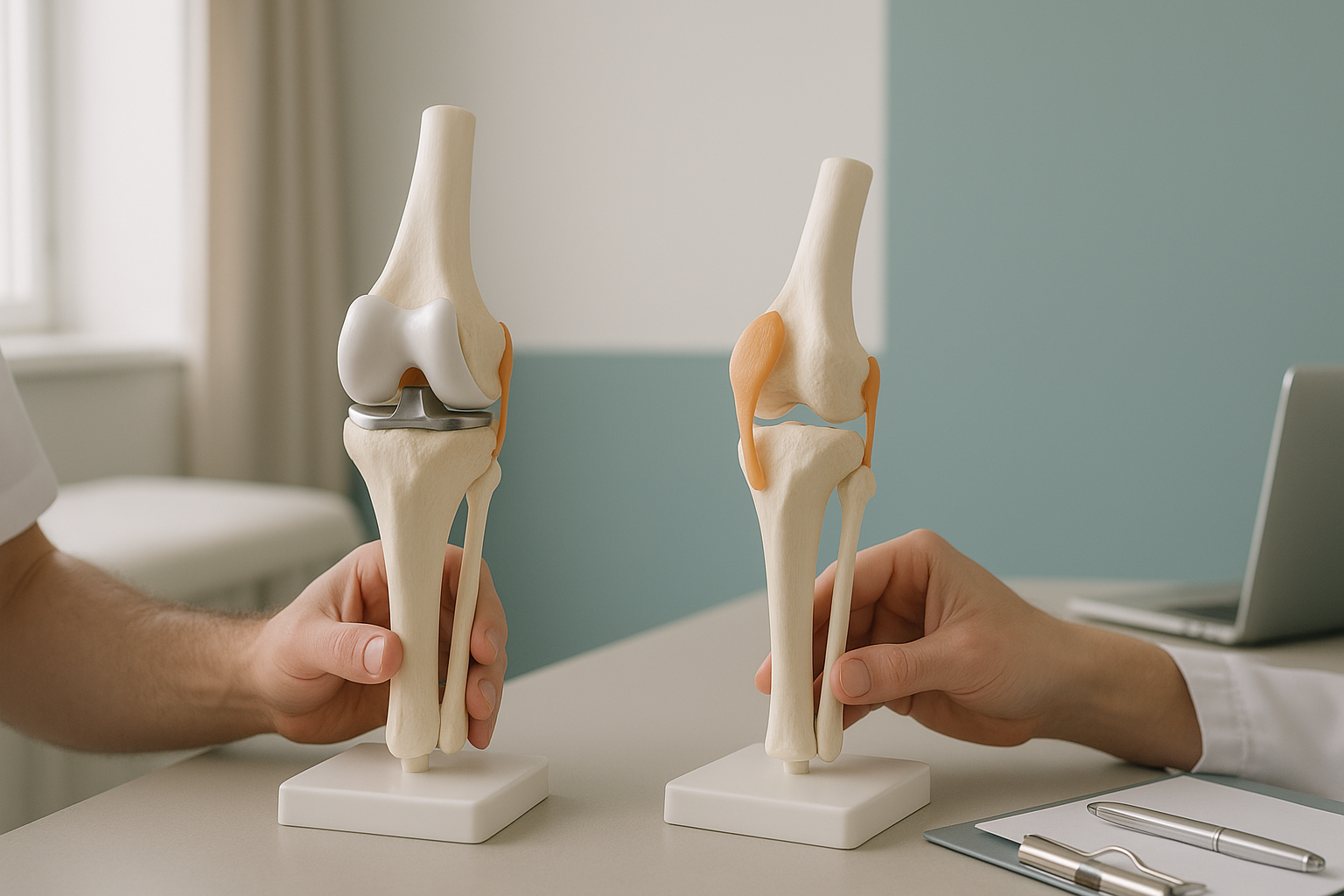
Total knee replacement surgery replaces all three compartments of the knee joint, while a partial (unicompartmental) replacement resurfaces only the damaged section. The right choice depends on where the wear is, how your leg is aligned under load, and your overall knee stability. Standing whole-body imaging helps your surgeon see the full picture before deciding.
Key takeaways
- A total replacement suits widespread wear across the knee. A partial replacement may be enough when damage is limited to one compartment.
- Leg alignment, ligament health and activity level all influence which procedure your surgeon recommends.
- Lying-down scans can miss alignment problems that only appear when you stand and bear weight.
- EOS standing imaging shows your full leg alignment from hip to ankle, giving your surgeon the measurements needed to plan accurately.
- ScanAlign is a diagnostic imaging clinic. It does not perform surgery or promise treatment outcomes.
What is the difference between a total and partial knee replacement?
A total knee replacement removes the worn surfaces from all three compartments of the knee and caps them with metal and plastic components. A partial knee replacement, sometimes called a unicompartmental knee replacement, resurfaces only the single compartment that is damaged, leaving the healthy bone, cartilage and cruciate ligaments untouched.
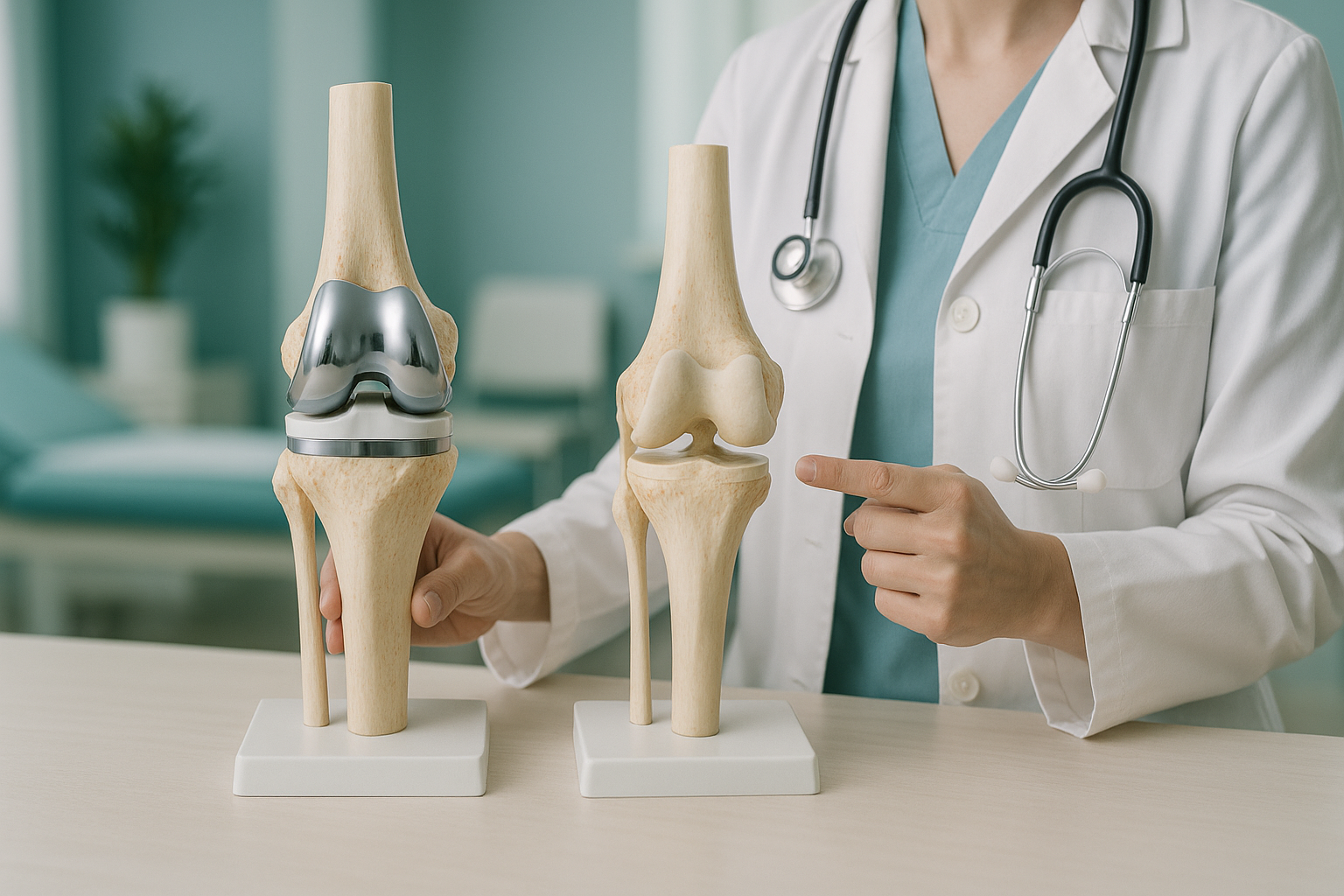
Because a partial replacement is a smaller operation, it usually means a shorter hospital stay and faster early recovery. However, not everyone is a candidate. If wear has spread across the joint, or if the knee is unstable, a total replacement is generally the safer long-term option.
How do you know if you need a total knee replacement?
You might need total knee replacement surgery when arthritis or damage affects more than one compartment and simpler treatments are no longer controlling your pain. Common signs include the following.
Aching on both the inner and outer sides of the knee, not just one area.
Your leg alignment has changed noticeably when you stand.
Difficulty walking, climbing stairs, or getting out of a chair despite medication and physiotherapy.
The knee feels loose or buckles, suggesting ligament or structural compromise.
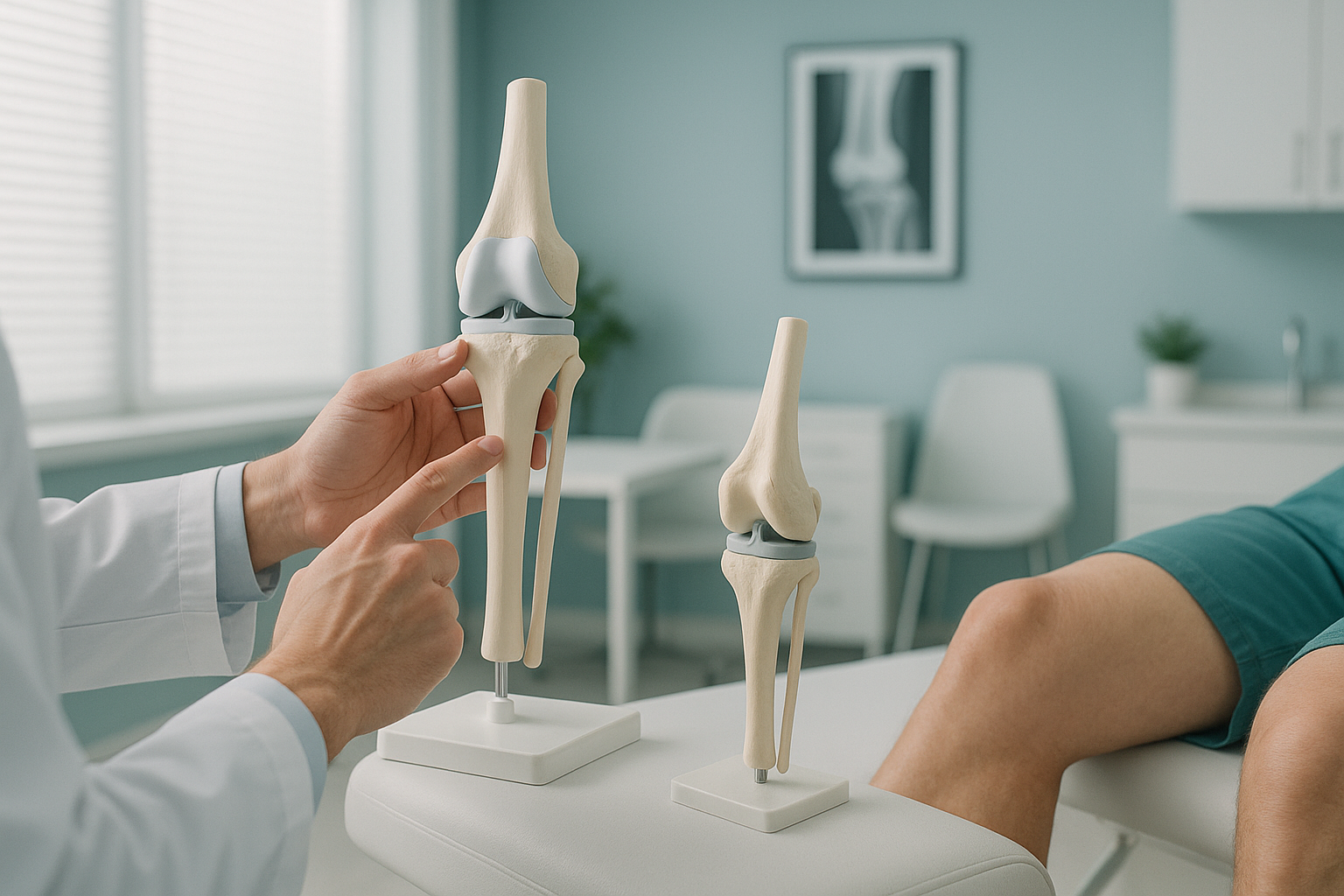
A partial replacement may suit you better if the damage is limited to just the inner (medial) compartment, your ligaments are intact, and your overall alignment is reasonably good. Your surgeon needs precise imaging to make that call.
Why does leg alignment matter when comparing knee replacement options?
Leg alignment is one of the most important factors in choosing between a total and a partial knee replacement. If your leg bows inward or outward under your body weight, the load through the knee is uneven. A partial replacement in a badly misaligned leg can wear out quickly because the new surface takes more force than it was designed for.
Your body works as a connected chain. The angle of your hip, the rotation of your thighbone, the tilt of your shinbone and the position of your ankle all influence how force travels through the knee. A problem higher up, such as a slight pelvic tilt, can shift load onto one side of the knee. If the surgeon only sees the knee in isolation, this bigger picture is missed.
That is why whole-leg, weight-bearing imaging matters before any knee replacement decision. It shows how your joints line up from hip to ankle while you stand, which is exactly how they behave when you walk.
How does standing imaging help plan knee replacement surgery?
Standing imaging captures your skeleton under its natural load. When you lie down for a conventional X-ray, CT or MRI, gravity no longer compresses your joints, and your muscles relax. The alignment your surgeon would see on a lying-down scan may not match the alignment you actually walk on.
An EOS scan takes a full-length image of both legs while you stand. It captures the mechanical axis from the centre of your hip to the centre of your ankle in a single exposure, with about 90% less radiation than a standard X-ray, around ten times less. Your surgeon can then measure exactly how much the knee is angled, whether the wear pattern matches a partial or total replacement, and what component positioning would restore balanced loading.
Considering a knee replacement? A standing alignment scan gives your surgeon the measurements they need to recommend the right procedure.
Book a free video consultationWhen MRI is the better tool. EOS shows bones, joints and alignment clearly. If your surgeon needs to assess soft tissue, such as cartilage thickness, meniscal tears or ligament damage inside the knee, MRI is usually the better choice. The two scans complement each other. EOS maps the mechanical picture; MRI maps the soft-tissue detail.
What helps you decide between a partial and total knee replacement?
The decision is made by your orthopaedic surgeon, not by a single scan. However, accurate imaging is the foundation of that decision. Here is what your surgical team typically considers.
- Where the wear is. If arthritis affects just the medial compartment and the rest of the knee is healthy, a partial replacement may be appropriate.
- Ligament integrity. A partial replacement relies on intact cruciate ligaments for stability. If those ligaments are damaged, a total replacement is usually recommended.
- Overall leg alignment. Significant bowing or knock-knee may make a partial replacement unsuitable because the load imbalance would remain after surgery.
- Activity level and expectations. Partial replacements can feel more natural and allow a wider range of movement, but they are not suited to every knee.
- Age and body weight. These factors influence how long any replacement is likely to last.
What standing alignment imaging adds is the ability to measure your mechanical axis precisely under load. This helps your surgeon match the procedure to the way your body actually functions when upright.
Frequently asked questions
Neither is inherently better. A partial knee replacement preserves more of your natural knee and can feel more natural, but it only works when damage is limited to one compartment and your ligaments are intact. A total replacement is more reliable when wear is widespread.
Most people return to light daily activities within a few weeks, but full recovery can take several months. A partial replacement generally has a shorter early recovery period. Your surgical team will give you a personalised timeline.
Yes. If a partial replacement wears out or arthritis progresses to other compartments, it can usually be revised to a total replacement. This is one reason surgeons sometimes prefer a partial option in younger, active patients.
When you lie down, gravity no longer loads your joints, and your alignment can look different. A standing scan shows the true mechanical axis of your leg under body weight, which is exactly how the replacement will function after surgery.
An EOS scan takes a full-length standing image of your skeleton in a single pass, using about 90% less radiation than a standard X-ray, around ten times less. It captures both legs from hip to ankle so your surgeon can measure alignment precisely. You can learn more on the ScanAlign overview page.
Yes. The EOS system uses about 90% less radiation than a standard X-ray, around ten times less. Full safety and preparation details are on the FAQs page.
No. ScanAlign is a private self-pay clinic and you can refer yourself. You start with a free video consultation to check that the scan is appropriate for you.
Current pricing is listed on the FAQs and cost page.
An EOS scan shows the alignment and joint spacing of your knee under load. It does not diagnose whether you need surgery. Your surgeon uses the scan alongside clinical examination and other tests to make that recommendation.
ScanAlign is based at 19 Harley Street, London, within The Harley Street Hospital.
See how your knee aligns under your own body weight
A free video consultation lets you talk through your situation and find out whether a standing alignment scan could help your surgical team plan the right procedure.
Book a free video consultationSources
- National Joint Registry (NJR). Annual reports on knee replacement outcomes in England, Wales, Northern Ireland and the Isle of Man. njrcentre.org.uk
- NHS. "Knee replacement." NHS website, reviewed regularly. nhs.uk/conditions/knee-replacement
- Paley D. Principles of Deformity Correction. Springer, 2002. Widely cited reference on mechanical axis planning and limb alignment.
Written by Abbas Dhami (Specialist Diagnostic Radiographer)
This page is general information and not a diagnosis.
ScanAlign is the trading name of CoreMed Solutions Ltd and operates under The Harley Street Hospital's CQC licence.