
Robotic Knee Replacement: How Does It Work and Is It Right for You?
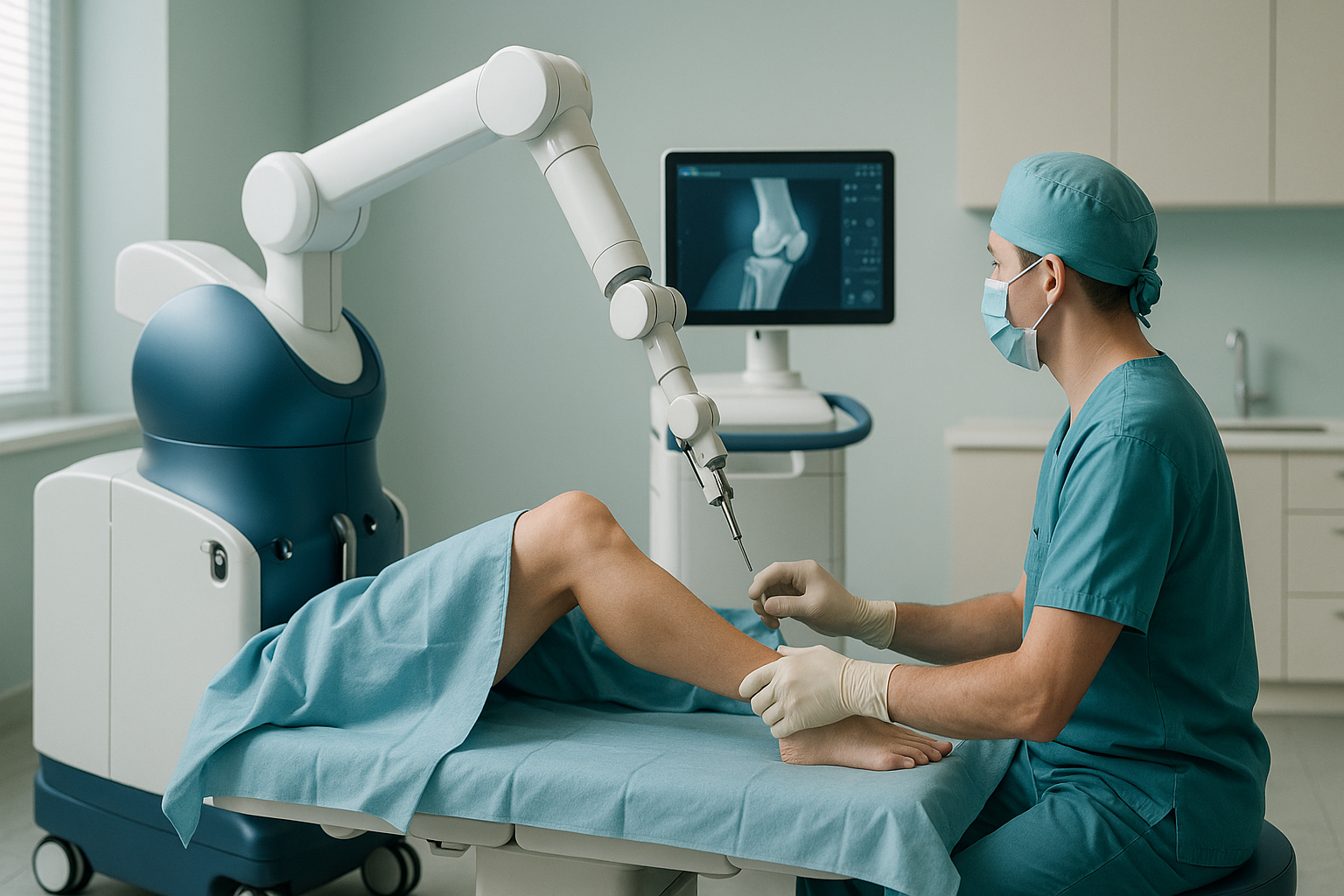
Robotic knee replacement uses a computer-guided robotic arm to help the surgeon position the knee implant with greater precision. The surgeon stays in full control throughout. Better implant positioning can mean improved comfort, a more natural-feeling knee and a smoother recovery compared with traditional surgery.
Key takeaways
- The surgeon controls the robotic arm at all times. The robot does not operate independently.
- Precise implant placement may reduce pain and improve how the knee feels after surgery.
- Pre-operative imaging is essential. Standing, weight-bearing scans show alignment that lying-down scans can miss.
- Robotic-assisted surgery is not suitable for everyone. Your surgeon will advise based on your specific situation.
- ScanAlign provides diagnostic imaging only, not surgery or treatment.
What is robotic knee replacement and how does it work?
Robotic knee replacement is a type of joint surgery where the surgeon uses a robotic arm, guided by a 3D computer model of your knee, to remove damaged bone and cartilage and position the implant. The robot does not make decisions or move on its own. Your surgeon guides every cut.
Before the operation, your knee is scanned to build a detailed digital plan. During surgery, the robotic arm follows that plan and provides real-time feedback. If the surgeon needs to adjust, they can do so at any point. The system acts as a highly precise tool, much like power steering helps a driver without taking the wheel.
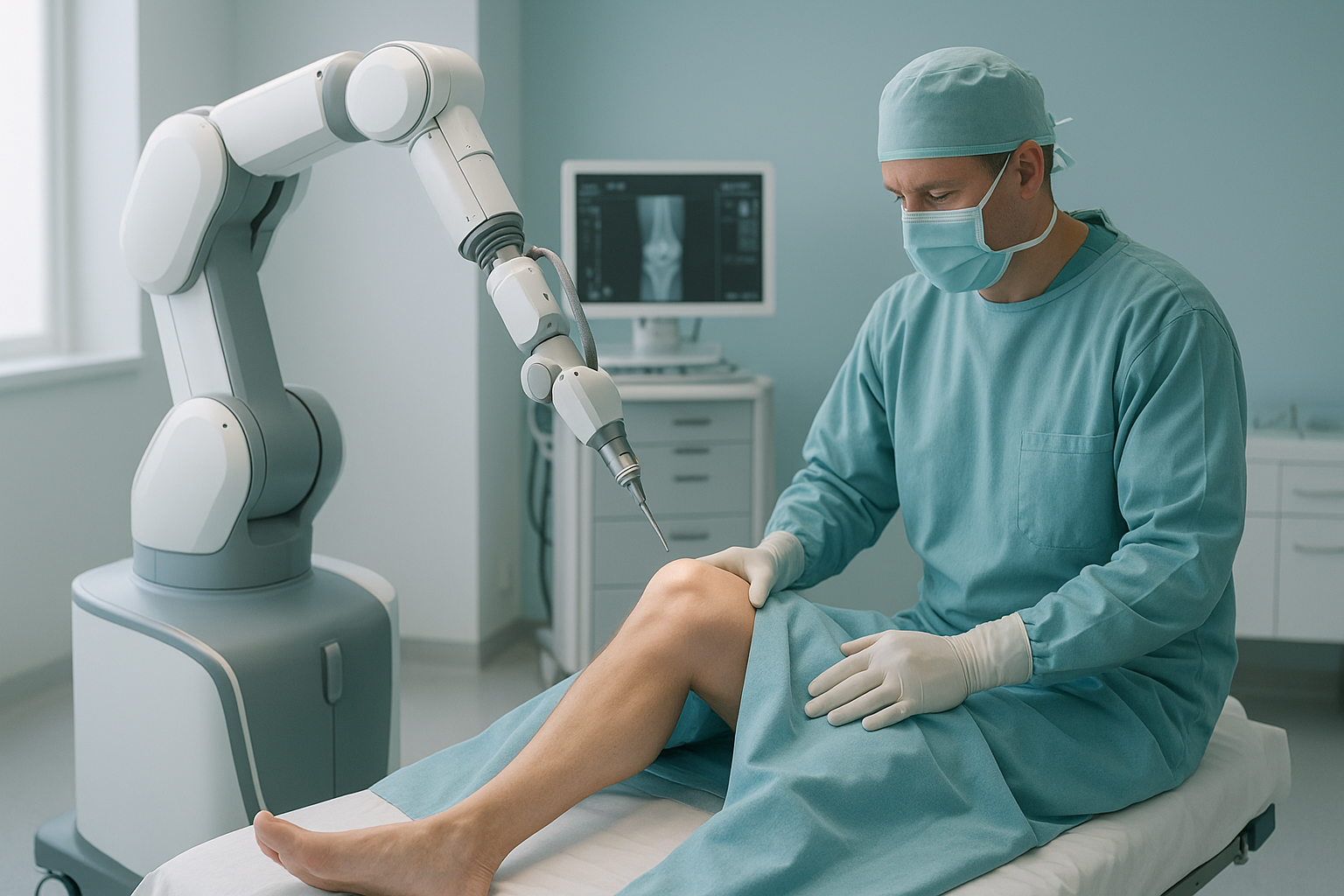
There are several robotic systems used in the UK, including Mako, ROSA and NAVIO. Each works slightly differently, but the principle is the same: the surgeon leads, the robot assists.
Is robotic knee replacement better than traditional surgery?
Research suggests robotic-assisted knee replacement can offer advantages over traditional (manual) surgery, though outcomes depend on many factors including the surgeon's experience and the quality of the pre-operative plan.
The robotic arm helps place the implant within tighter tolerances than manual cutting alone.
Better alignment may mean the knee bends and moves more naturally after recovery.
Precise bone preparation may reduce unnecessary tissue damage during the procedure.
Some patients report getting back to daily activities sooner, though this varies from person to person.
It is worth noting that robotic knee replacement is still surgery. There are the same general risks as any knee replacement, including infection, blood clots and stiffness. Your orthopaedic surgeon is the right person to discuss whether a robotic-assisted approach suits your specific case.
Why does pre-operative imaging matter for robotic knee surgery?
The accuracy of robotic knee replacement depends entirely on the quality of the pre-operative plan, and that plan starts with imaging. The better the images, the better the digital model, and the more precisely the surgeon can position the implant.
Most pre-operative imaging is done lying down on a CT or MRI table. This relaxes your muscles and removes the forces of gravity and body weight from your joints. The result is a snapshot of your knee in a position you never actually use. When you stand, your alignment changes. Weight shifts, joints compress and any tilt in the hip or ankle can alter how the knee sits.
Standing, weight-bearing EOS imaging captures your entire skeleton from head to foot in a natural, upright position. This means your surgeon can see exactly how your knee aligns with your hip, ankle and spine under real load. It reveals compensations and asymmetries that disappear when you lie flat.
EOS also uses about 90% less radiation than a standard X-ray, around ten times less. So you get a detailed, full-body picture at a very low dose.
Lying-down scans (CT and standard X-ray) show excellent bone detail, but they miss the effect of gravity and weight on alignment. A knee that looks straight when you are lying flat may tilt inward or outward when you stand. If the surgical plan is based only on lying-down images, the implant position may not match your real-world alignment.
Your body works as a connected chain. A tilt in the pelvis can shift load through the hip and into the knee. A flat foot can rotate the shin bone. These knock-on effects are only visible when you are standing. That is why surgeons planning robotic knee replacement increasingly value standing, whole-body alignment data.
At ScanAlign, we provide standing EOS imaging that shows your full alignment from head to foot. This data can form part of the pre-operative planning for robotic-assisted knee surgery.
Book a free video consultationWhen is MRI the better choice? EOS excels at showing bones, joints and mechanical alignment. For soft tissue, cartilage damage, ligament tears or nerve problems, MRI is usually the better tool. Many patients benefit from both types of imaging before knee surgery.
Who is a good candidate for robotic knee replacement?
Robotic-assisted knee replacement may be suitable if you have significant knee arthritis that has not responded to other management, and your surgeon recommends joint replacement. It is not limited to one type of patient, but it is not right for everyone either.
- You have end-stage arthritis in one or both knees
- Non-surgical treatments have not given enough relief
- You want the most precise implant placement available
- You have alignment issues in the hip, knee or ankle chain
- Your knee pain has a soft-tissue cause (ligament or meniscus) that does not need a replacement
- You have an active infection in or around the knee
- Your surgeon advises a different approach for clinical reasons
- You have certain complex deformities that fall outside the robotic system's range
Only your orthopaedic surgeon can determine whether robotic-assisted surgery is appropriate for you. ScanAlign does not provide surgical opinions. We provide the diagnostic imaging that helps your surgical team make the best plan.
If you are experiencing sudden weakness, numbness, loss of bladder or bowel control, or severe swelling with fever, please seek urgent medical attention through your GP, 111 or A&E rather than booking a scan.
Frequently asked questions about robotic knee replacement
No. The surgeon is in complete control at all times. The robotic arm acts as a precision tool that follows the surgeon's pre-operative plan. The surgeon can override or adjust the system at any point during the procedure.
Robotic-assisted surgery carries the same general risks as traditional knee replacement, including infection and blood clots. The potential advantage is greater precision in implant positioning, which may improve long-term outcomes. Your surgeon can discuss the specific risks and benefits for your case.
Recovery varies from person to person. Some patients report returning to light daily activities within a few weeks, with a fuller recovery taking several months. Your surgical team will give you a timeline based on your health and the specifics of your operation.
When you lie down for a CT or standard X-ray, gravity is removed and your muscles relax. This can hide alignment issues that only appear when you stand and bear weight. Standing EOS imaging shows your true weight-bearing alignment from head to foot, giving the surgical team a more accurate picture for planning.
An EOS scan takes a full-body image while you stand upright. It captures your entire skeleton in one pass, showing how your joints align under real load. It uses about 90% less radiation than a standard X-ray, around ten times less. You can learn more on our EOS scan overview page.
No. You can self-refer. We offer a free video consultation to discuss whether a standing EOS scan is appropriate for your situation before you book.
Pricing details are available on our FAQs and cost page.
Yes. The EOS system uses about 90% less radiation than a standard X-ray, around ten times less. It is a very low-dose imaging method. More information about safety is on our FAQs page.
EOS provides different information from CT. It excels at showing full-body weight-bearing alignment, which CT cannot capture. Many robotic systems use CT for their 3D bone model, so your surgeon may recommend both. EOS adds a layer of alignment data that CT alone does not provide.
No. ScanAlign is a diagnostic imaging clinic. We provide the scans and alignment assessment that can help your orthopaedic surgeon plan your procedure. We do not perform surgery or provide treatment.
Considering robotic knee replacement?
Find out whether standing whole-body imaging could improve your surgical plan. Our free video consultation takes a few minutes and carries no obligation.
Book a free video consultationWant to understand more about knee alignment? Visit our knee imaging page.
Sources
- Kayani B, Konan S, Tahmassebi J, Pietrzak JRT, Haddad FS. "Robotic-arm assisted total knee arthroplasty is associated with improved early functional recovery and reduced time to hospital discharge compared with conventional jig-based total knee arthroplasty." The Bone & Joint Journal, 2018;100-B(7):930-937.
- National Joint Registry (NJR). Annual reports on knee replacement outcomes in England, Wales, Northern Ireland and the Isle of Man. njrcentre.org.uk
- NHS. "Knee replacement: overview." nhs.uk/conditions/knee-replacement
Written by Abbas Dhami (Specialist Diagnostic Radiographer)
This page is general information and not a diagnosis.
ScanAlign is the trading name of CoreMed Solutions Ltd and operates under The Harley Street Hospital's CQC licence.